A Meeting Place for Evangelicals, Reformed, and Orthodox Christians

Category: Discipleship (Page 3 of 9)

“Orthodox Mama”


Folks,

Wishing you all a happy and blessed Mother’s Day!

Profile-Picture-FinalI recently discovered “TheOrthodoxMama.com — Faith, Family, and Frugal Living” administered by Sarah Wright. She’s been happily married 7 years and mother of three. She grew up in the Reformed tradition then later converted to Orthodoxy.

Her website is about more than theology.  It touches on practical life issues like: Marriage, Family Fun, Children’s Activities, Frugal Living.  Articles Archive include:


Below is an excerpt from her article: “How I Became Orthodox: My Story of Faith.”


How-I-Became-Orthodox-FinalI have not always been Eastern Orthodox. In fact, I grew up about as evangelical  as they come.  My father was a pastor in the Reformed Church in America.  I was our church pianist from the time I was thirteen.  Sunday School teacher. Vacation Bible school teacher. Bible camp counselor. Then,  I went to college at an evangelical school. While there, I served with missionaries in Equatorial Guinea (in West Africa) for ten weeks one summer. I was basically the poster child for evangelicalism.

And, I am grateful for my background.  I gained a very solid understanding of the Bible.  I also was given firm moral principles that helped me through the temptations that beset high school and college students.  I found a community of friends who supported, loved, and prayed for one another through good and bad times.

But, God led me down another path.  He whispered to me along the way.

Looking back, I can see . . . .   To Read More > Click Here

Then, I decided to go to a large, prominent evangelical seminary to study missiology in the hopes of entering the mission field.  In one of my classes I sat near two Orthodox seminarians–one from the United States and one from Africa.

. . . .

While at seminary, I also met the man who would become my husband. He was studying theology and was taking a class on the Trinity. Many of his readings came from the early Church Fathers and introduced him to Orthodoxy.

It is significant that Sarah and her husband were deeply committed Christians.  They were not mad or disgruntled with the Reformed tradition prior to becoming Orthodox. She closes noting: 

My story is a fairly simple one, I know. There was no dramatic conversion. No blinding light on the road to Damascus. No huge disillusionment with my life and faith that brought me to my knees.

Just small whispers from a faithful God who was drawing me closer and closer to Himself.

To Read More > Click Here


Holy Saturday and the Harrowing of Hell


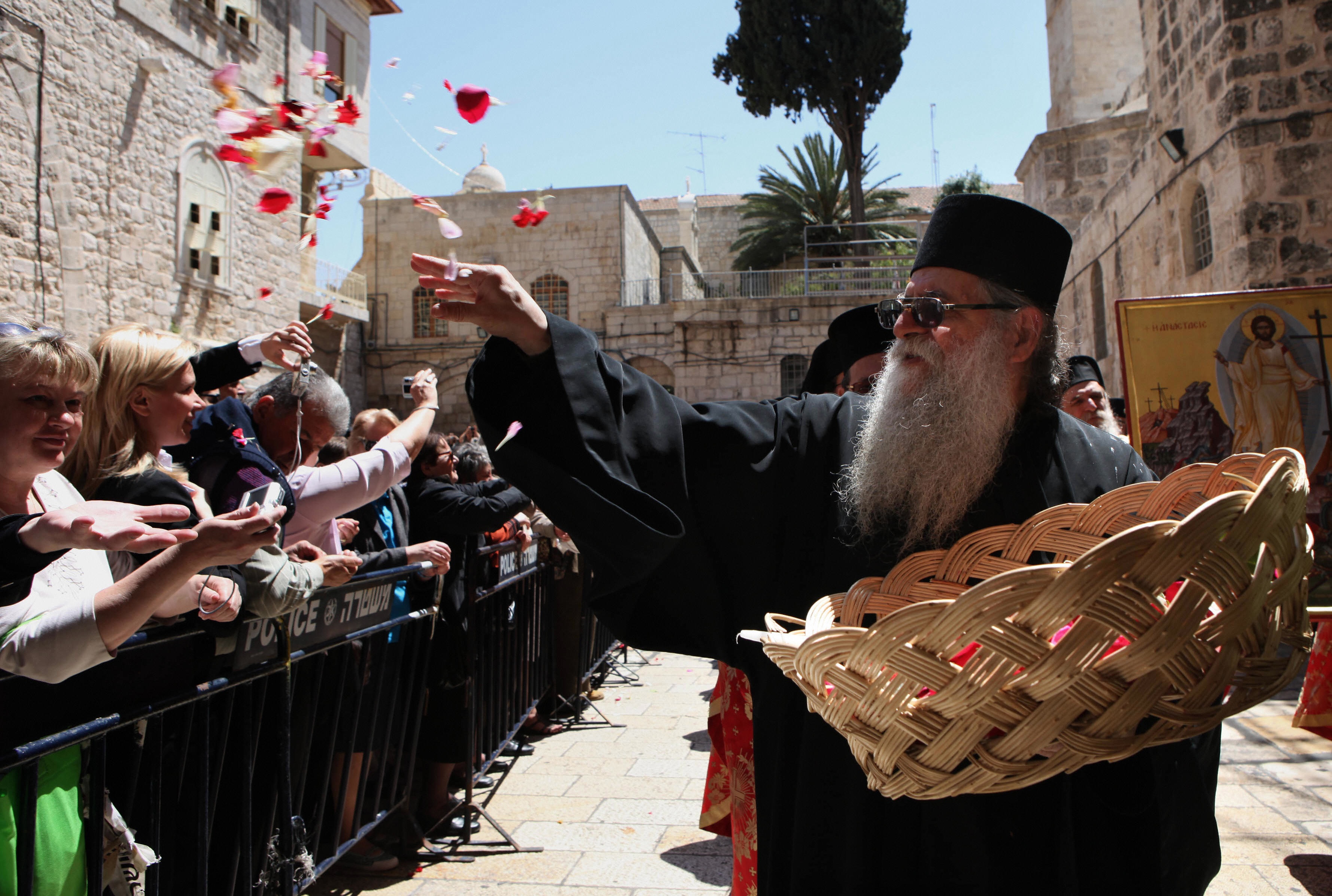
Holy Saturday service - priest scattering flowers.

Holy Saturday – Priest scattering rose petals.  Article – The Baltimore Sun.  2013

During Holy Week each day has a particular theme, a spiritual lesson for the faithful who attend the services.  As an Orthodox Christian I get much of my theological education not from reading books but from attending the services.  In addition to the Scripture readings, the hymns and prayers of the Church teach me about how God saved us in Christ.  They form as it were a running commentary on the Bible, and for those diligent and attentive they offer a form of liturgical education and dicipleship training. Standing attentively with an open heart gives one a good spiritual workout!

Each day of Holy Week has a particular theme: Thursday – Christ’s death, Friday – his burial, Saturday morning – his descent into Hell, and Saturday midnight – his resurrection.  In my early days as an Orthodox Christian my focus was on the Pascha/Easter service that celebrates Christ’s third day resurrection.  Then I began to make it a point to attend the other services and found to my happy surprise that these services have their own special take on Jesus Christ and how Christ saves us.

Recently, I began attending the Holy Saturday morning Liturgy.  At first I thought to myself: “Why is there a morning Liturgy on the day of Christ’s resurrection when we are going to celebrate the Resurrection later that night?”  I soon learned that the theme of the Holy Saturday service is Christ’s time in Hell.  The Apostles’ Creed confesses: “And he descended into Hell” (descendit ad infernos). During my time as a Protestant Evangelical I thought that one line in the Apostles Creed was a curious aberration with little relevance for salvation.  This “curious aberration” turned out to be a hidden gem of the early Church.


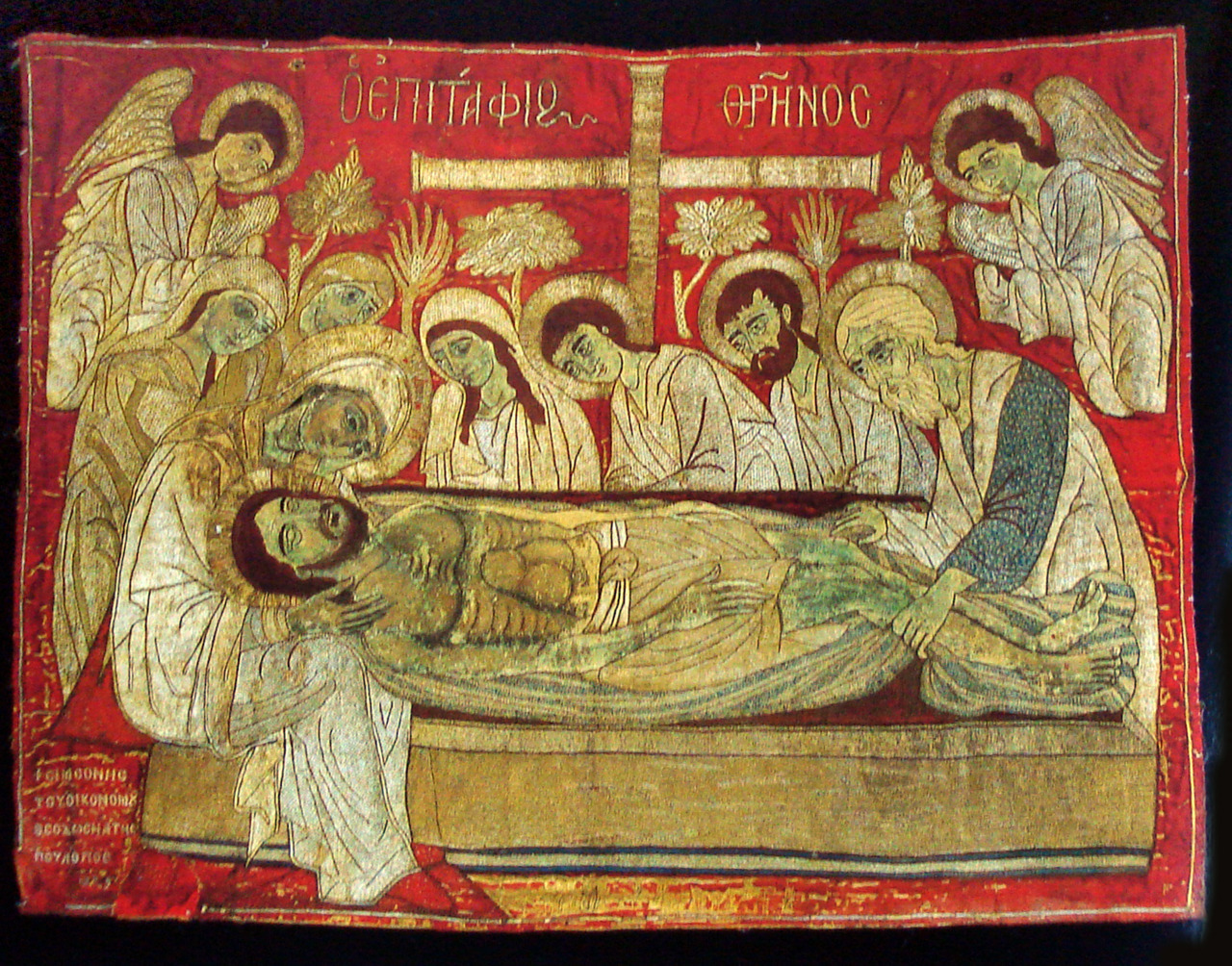
Epitaphios - tapestry depicting Christ's burial

Epitaphios – tapestry depicting Christ’s burial

Did you ever wonder what happened to Christ after he was buried?  His body was lying in the tomb but what about his soul?  It is interesting that while the Nicene Creed used in the Orthodox Church does not say anything about Christ’s descent into Hell, the Church has a lot to say about that theme in the Holy Saturday Liturgy.

The Holy Week prayer book (p. 415) used in Greek Orthodox churches contains the following hymn:


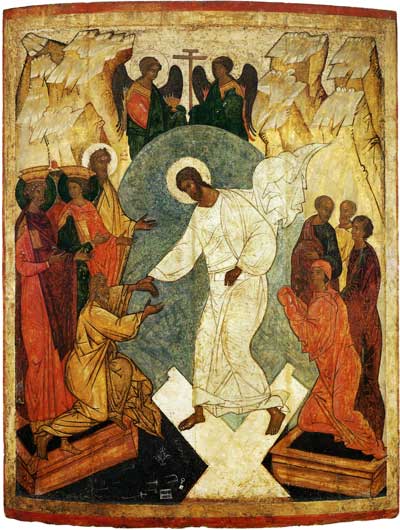
Icon of the Resurrection - Descent into Hell  Source

Icon of the Resurrection – Descent into Hell Source

Today Hades cried out groaning: “Would that I had not received the One born of Mary; for He came upon me and loosed my power.  He shattered the gates of brass; the souls, which I held captive of old, as God He raised up.”  Glory O Lord to Your Cross and Your Resurrection.

Today Hades cried out groaning: “My authority is dissolved; I received a mortal, as one of the mortals; but this One, I am powerless to contain; with Him I lose all those, over which, I had ruled.  For ages I had held the Dead, but behold, He raises up all.  Glory O Lord, to Your Cross and Your Resurrection.

Today Hades cried out groaning: “My power had been trampled on; the Shepherd has been crucified, and Adam He raised up.  I have been deprived of those, over whom I ruled; and all those, I had the power to swallow, I have disgorged.  He, Who was crucified has cleared the tombs.  The dominion of Death is no more.”  Glory O Lord, to our Cross and Your Resurrection.

For Orthodox Christians Hell is not a fearful place of torment and punishment, but rather a battlefield where a great battle was fought and our Hero Christ triumphed over the enemy Death (1 Corinthians 15:20-26).


Greek Orthodox priest scatters rose petals.  Source

Greek Orthodox priest scatters rose petals. Source

In the Greek Orthodox tradition there is the custom of the priest walking up the aisle of the church on Holy Saturday morning scattering rose petals or flowers left and right as a sign of Christ’s triumph over Death and our release from Hell.  It is quite a surprise then to walk into an Orthodox church for the Pascha/Easter service and instead of finding everything tidy and neat, one sees a joyous mess — the floor all covered with flowers.  In a little while the walls of the church will reverberate with shouts of: “Christ is Risen!” and the response: “Truly He is Risen!”

Robert Arakaki

Articles and Resources

Dan Rodricks.  “Orthodox Easter arrives, with bells, chants and rose petals.”  The Baltimore Sun, 4 May 2013.

Wesley J. Smith.  “The Joy of Orthodox Pascha.”  First Things, 18 April 2014.

Saint John Chrysostom’s 5th century Pascha homily on Christ’s resurrection.  Also in the Holy Week service book, pp. 481-482.


April Fools’ Day


Reformed seminary turned upside-down.  Theologians unable to explain mystery.

Reformed seminary turned upside-down! Theologians unable to explain mystery.

On April 1, 2015, Tony Arsenal, Gordon-Conwell Theological Seminary graduate “announced” his conversion to Eastern Orthodoxy.  See “From Geneva to Constantinople — The Eastern Orthodox Arsenal.”  He writes:

As many of you know, I have a deep love for the early Church. My theological passions circle around the related doctrines of Triadology and Christology, and I have recently become disillusioned with the insufficiency of the modern Reformed bodies in these areas. . . . .  Read more.


Orthodox Fools for Christ

There is in Orthodoxy’s spirituality the tradition of “fools for Christ.”  What may seem at first glance to be bizarre has biblical roots.  Apostle Paul writes:

We are fools for Christ’s sake, but you are wise in Christ!  We are weak, but you are strong!  You are distinguished, but we are dishonored!  (1 Corinthians 4:10; OSB)

The tradition of holy fools points to the radical message of the Cross and reminds us of the radical difference between the kingdom of God and the kingdom of the present age.

For the wisdom of this world is foolishness with God.  For it is written, “He catches the wise in their own craftiness.” (1 Corinthians 3:19; OSB)

There is the temptation in today’s society to be cool, to be respectable, to go with the flow but the Lenten journey to Christ’s humiliation, crucifixion, and his resurrection all remind us of a divine wisdom that challenges the wisdom of the world.

But the natural man does not receive the things of the Spirit of God, for they are foolishness to him; nor can he know them, because they are spiritually discerned. (1 Corinthians 2:14; OSB)

Thus “becoming fools” is part of Christian discipleship.

Let no one deceive himself.  If anyone among you seems to be wise in this age, let him become a fool that he may become wise. (1 Corinthians 3:18; emphasis added; OSB)

Some Christians have taken these verses literally and used them to express a particular type of Christian discipleship.  Keep in mind that this is not a form of mental illness but an intentional form of Christian discipleship.  In the blog CityDesert article “Fools for Christ” is a concise explanation of this seemingly outrageous form of spirituality.

One form of the ascetic Christian life is called foolishness for the sake of Christ. The fool-for-Christ set for himself the task of battling within himself the root of all sin, pride. In order to accomplish this he took on an unusual style of life, appearing as someone bereft of his mental faculties, thus bringing upon himself the ridicule of others. In addition he exposed the evil in the world through metaphorical and symbolic words and actions. He took this ascetic endeavor upon himself in order to humble himself and to also more effectively influence others, since most people respond to the usual ordinary sermon with indifference.


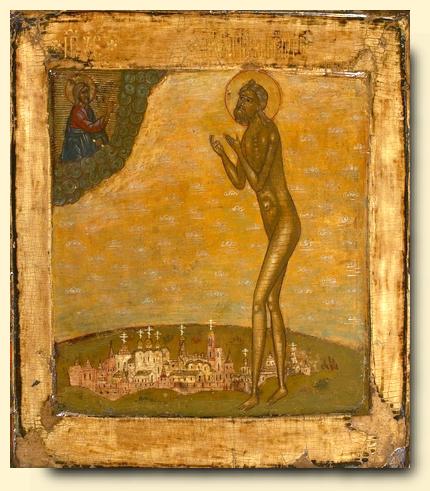
 Basil the Fool

Basil the Fool for Christ.  Source

Basil the Fool for Christ. Source

One of Russia’s important saints is Basil the Fool.  He lived in the days of Ivan the Terrible and one occasion rebuked the Czar for not paying attention to the sermon during  the Divine Liturgy.  On other occasions Basil rebuked the Czar for his violence against innocent people.  When Basil died the Czar acted as pallbearer and carried his coffin to the cemetery.  The icon depicts Basil’s nakedness which demonstrated his utter destitution and the severity of his asceticism.  Basil is credited with a number of miracles.  It is believed that by his prayers the city of Moscow was spared from invasion by the Crieman Khan, Mukhamed-Girey.

St. Basil's Cathedral - Moscow

St. Basil’s Cathedral – Moscow

Today, many people who visit Basil’s Cathedral in Moscow are unaware that this famous church building was named after a Fool for Christ.

Wishing you all a blessed April Fools Day!

Robert Arakaki

« Older posts Newer posts »