Many Reformed Christians like Orthodox Christians hold the Virgin Mary in high regard. That many Reformed Christians are even willing to call her “Theotokos” is not surprising in light of the fact that the Reformed tradition accepts the first four Ecumenical Councils: Nicea (325), Constantinople (381), Ephesus (431), and (Chalcedon 451) (See the Second Helvetic Confession Chapter 11). It was at the Third Ecumenical Council (431) that Mary’s title as the “Theotokos” was formally affirmed to be a dogma of the Church: “If any one refuses to confess that the Emmanuel is in truth God, and therefore that the holy Virgin is Mother of God (θεοτόκος), for she gave birth after a fleshly manner to the Word of God made flesh; let him be anathema.” (See NPNF Series 2 Vol. XIV p. 206) Recently, some Reformed groups are rediscovering the early Church and selectively including more and more early Church practices in their Sunday worship.
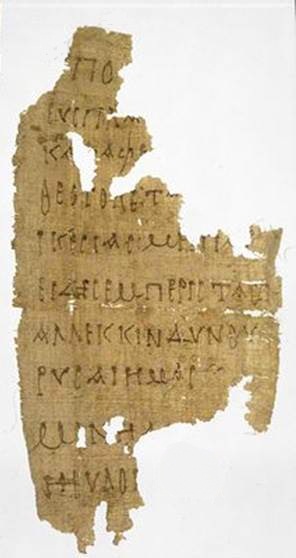
Where they differ from the Orthodox Church is over the propriety of addressing one’s prayers to Mary. Being guided by the principle of Solus Christus – that salvation is through Christ alone and that Christ is the sole mediator between man and God, Protestantism frowns on Christians praying to the Virgin Mary or the saints. They confuse Mary’s role as a chief intercessor by mistakenly thinking our Blessed Theotokos to be a deity! Sadly, many Protestants wrongly believe with little evidence and even less serious study that Christianity became corrupted and encrusted by non-biblical beliefs around the time of Emperor Constantine in the early 300s, if not earlier. However, this hypothesis has been discredited by the growing evidence that early Christians prayed to the Virgin Mary prior to Constantine. Papyrus 470 which dates back to 250 can thus be considered an example of a very early extra-biblical tradition.
In 1917, the John Rylands Library acquired a collection of papyri. Many Protestant pastors who took New Testament Greek and exegesis are likely to have heard in passing Rylands Papyrus P52 dating as early as 117 to 138 and considered to be the oldest extant record of the canonical New Testament. During this early period were other early Christian writings like the Didache, Clement’s first Epistle to the Corinthians, and Ignatius of Antioch’s letters. It is important to keep in mind that many if not most of the first generation of the Apostles’ disciples were still alive and leading the Church during the time of these early writings. These disciples of the Apostles devoted themselves to preserving and passing on the Apostles’ teachings. As we have noted several times before, the Protestant notion of the Holy Spirit “Blinking-Off” in the Church soon after the Apostles died then “Blinking On” with the Reformation is problematic both historically and theologically. Orthodoxy rejects this Protestant approach to history and upholds Pentecost as a continuous ongoing reality, that is, the Holy Spirit was present in the early Church teaching and guiding the Church into all Truth, as Christ promised (John 16:13. The Rylands collection contains P470 which contains a prayer to the Virgin Mary dating as early as 250. The date 250 is significant in light of the fact this was the time of the Decian Persecution and thus predates Constantine’s Edict of Milan issued in 313. This early prayer to Mary arose from the vibrant spirituality of the early Church.
An Ancient Christian Prayer
Papyrus 470 predates the Council of Ephesus (431) by two centuries. This is the Third Ecumenical Council that was convened for the purpose of addressing the Nestorian controversy – Nestorius’ refusal to address Mary as “Theotokos” in the Liturgy. In other words a high view of Mary was held by Christians early on and was not the result of late development of tradition as some might claim but rooted in an ancient Christian tradition. Furthermore, the term “Theotokos” was not coined at the Council of Ephesus but was already in use for some time by early Christians.
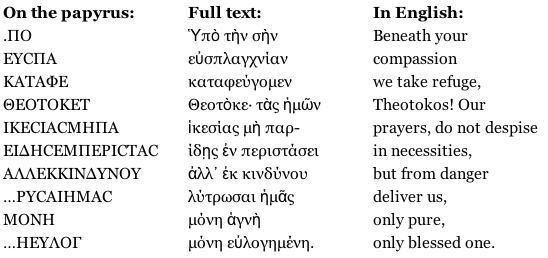
As we read the text of this short prayer – 22 words in the original Greek – we find a number of significant ideas. One aspect is the titles given to Mary:
“Theotokos” – the prayer addresses Mary not on a first name basis but by the formal title “Theotokos,”
“Only blessed” – a reference to Mary’s special election by God, and
“Only pure” – a reference to Mary’s perpetual virginity.
This was not an individual prayer but a corporate prayer – the early Christians prayed to Mary in their Sunday worship! This prayer was translated into Latin and in the Latin tradition came to be known as “Sub Tuum Praesidium.” In the Orthodox tradition this prayer is sung during the Vespers service for Great Lent and is echoed in similar prayers in the daily prayers and the Sunday Liturgy. This points to the universality of this ancient prayer. In light of the Vincentian Canon – that which is believed everywhere, always, and by all — prayer to Mary the Theotokos is a catholic or universal Christian practice.
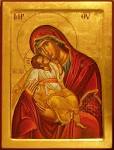
We learn from this papyrus that when early Christians gathered for worship they addressed Mary by the title “God Bearer” recognizing her role in the mystery of the Incarnation – Christ coming down from heaven and assuming human flesh for our salvation. Further, we learn that early Christians believed in praying to the saints and asking the saints to pray on their behalf. In contrast Mary is all but ignored in Protestant worship services today; she is never addressed as “Theotokos;” and she is not asked to pray for us. It is as if Mary is taken out for display during Christmas and then the rest of the year is put away in a box until next year. An early Christian visiting contemporary Protestant worship services would likely be disconcerted if not dismayed by how little attention Christ’s Mother is given by Protestants today.
Steps to Recovering Ancient Christian Worship
As archaeological evidence Rylands Papyrus 470 suggests that Protestantism, especially the Reformed tradition and Evangelicalism, may have thrown the baby out with the bathwater. Protestants can enrich their worship and devotional life by learning from the early Church by emulating their respect for Mary the Theotokos. A good first step is to refer to Mary not just as “Mary” but also as “Theotokos” or in English “Mother of God” or “God Bearer.”
The occasion of Protestantism’s High Holy Day: “Mother’s Day” (May 10 in 2015) would be a good opportunity for Protestant pastors and their parishioners to call Mary by her proper title “Theotokos.” Doing this on this upcoming Sunday morning would mark one positive step towards recovering historic Christian worship. A good follow up would be to print this ancient prayer in the church bulletin and let people be free to use this prayer to the extent they feel comfortable using it. Reformed and Evangelical Christians can ask Mary to be their prayer partner asking God’s blessing for their earthly mothers.
Another good follow-up would be to visit an Orthodox worship service to learn how they honor Mary the Theotokos in the ancient Liturgy that dates back to the early Church and how Mary sets an example of Christian discipleship through her total commitment to Jesus Christ.
Christos voskrese! Voistinu voskrese! — Christ is risen! Truly He is risen!
There is a story told about Nikolai Bukharin, a Russian Communist leader who actively propagated the message of atheism.
One of the most powerful men in the world was Nikolai Ivanovich Bukharin, a Russian Communist leader, who took part in the Bolshevik Revolution in 1917. In 1930 he addressed a massive assembly of workers in Kiev on the subject of atheism. He aimed the heavy artillery of his arguments at Christianity by hurling insults and proof against it. He went on and on for an hour effectively crucifying and killing our faith. When he was done he looked out smugly upon what he thought was the smoldering ash heap of the crowd’s faith. His speech was followed by silence and he demanded, “Are there any questions?” As deafening silence filled the auditorium, for what seemed an eternity, a man approached the platform and the lectern standing near the powerful communist leader. He surveyed the crowd scanning the silent faces from left to right. Finally, he shouted the ancient greeting known so well in the Orthodox Church: “CHRIST IS RISEN!” En masse, the crowd rose to its feet and the response came crashing forth like the sound of thunder: “INDEED, HE IS RISEN.” Source
Some question whether this event actually happened but it is a matter of record that during the Soviet era thousands of churches were destroyed and tens of thousands of priests and monks were imprisoned. It is no small miracle that the Orthodox Church in Russia has survived, outlasted Communist rule, and is currently thriving. It is a fulfillment of Christ’s promise to the Apostles: “On this rock I will build my church and the gates of hell shall not prevail against it.” (Matthew 16:18; OSB) Let us remember that the power of Christ’s third day resurrection was more than a onetime event but continues to reverberate through human history.
But I think that the idea of crossing the Bosphorus is perhaps overly dramatic and may not be an entirely helpful metaphor.
We need to remember that the Orthodox faith was at one time not confined to the East, where it has been faithfully kept, but that it was also once upon a time the faith in the West.
I coined the phrase “crossing the Bosphorus” (becoming Orthodox) in imitation of the more widely known “crossing the Tiber” (becoming Roman Catholic). I like the phrase partly because the image of Hagia Sophia (the Church of the Holy Wisdom) in Constantinople has long captured the imagination of many, drawing them to Orthodoxy.
But the underlying point of the comment contains an important truth – Orthodoxy cannot and must not be confined to a particular city, region, or ethnicity. Orthodoxy is catholic. The word “catholic” comes from the Greek καθολου for “all together” or “general.” In the early creeds the term “catholic church” was used to describe the Church’s universality as opposed to the individual local congregation. Later the term “catholic church” came to denote the true Church as opposed to the various heretical or schismatic off shoots. (See JND Kelly’s Early Christian Doctrine p. 190)
The Church’s catholicity is grounded in the Great Commission when Christ sent the Apostles into all the world to disciple nations and to baptize them in the Name of the Father, Son, and Holy Spirit (Matthew 28:19-20). The late Metropolitan Philip on the occasion of the receiving the 2,000 Evangelicals into Orthodoxy declared in his homily:
And he commissioned the disciples. He said to them: Go ye therefore and make disciples of all nations . . . . Not only Greeks. Not only Antiochians. Not only Russians. Or Serbians or Romanians. Go and make disciples of all nations. Baptizing them in the Name of the Father, of the Son, and of the Holy Spirit. (0:54-1:24)
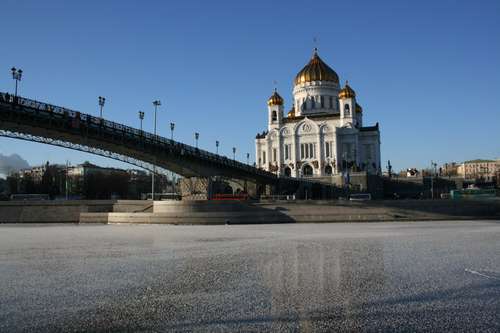
So in light of the Church’s catholicity “crossing the Bosphorus” captures only a small part of Orthodoxy’s universality. “Crossing the Bosphorus” (the Patriarchate of Constantinople) can be substituted with “crossing the Orontes” (the Antiochian Patriarchate), with “crossing the Dnieper” (Kiev, the ancient capital of Slavic Orthodoxy) or with “crossing the Moskva” (the Patriarchate of Moscow).
Protestant inquirers into Orthodoxy can easily get distracted by the variety of ethnic representations. This is especially so in the US where various ethnic branches of Orthodoxy are zealous to preserve their own particular heritage — the small “t” traditions. It is critical for Protestant inquirers to realize Orthodoxy IS the Christian faith in the best “universal” or catholic sense. Centuries before Rome broke away in 1054 there was a great unity amidst all the diversity. The faith Tradition passed down by the Apostles was believed from Britain, France, Russia, Syria, Africa, Greece and Italy. Do not let the ethnic trees cause you to miss the beauty and unity of the Forest!
Crossings
The term “crossing” can have more than one meaning. In one sense it can refer to people converting to Orthodoxy. In another sense it can refer to Orthodox missionaries going to lands where Orthodoxy is non-existent or barely known. In the 1700s Orthodox missionaries – Saints Herman, Innocent, Jacob, and Juvenaly — traversed the vast Siberian tundra then crossed the Bering Strait to bring Orthodoxy to the native peoples of Alaska.
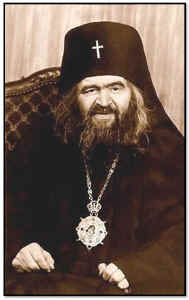
Saint John Maximovitch
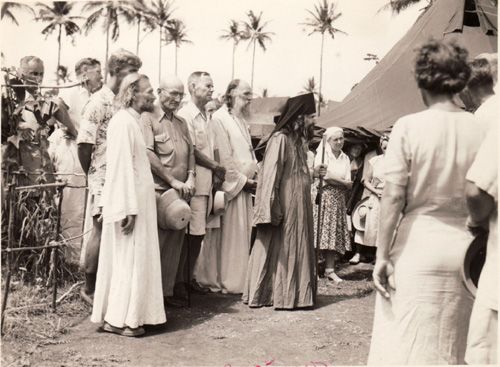
Another example of crossing is Saint John of Shanghai and San Francisco (1896-1966). In the 1930s and during World War II he served as bishop of Shanghai. Then when the Communist took over China he was forced to flee. He spent a short time in a refugee camp on the island of Tubabao in the Philippines. Eventually, he became the bishop of San Francisco. What is remarkable about Saint John Maximovitch’s ministry is how it spanned the vast Pacific Ocean, encompassing both Asia and America. Another remarkable ministry by Saint John was his collecting the lives of the saints and his desire to make known the ”western” saints. Thanks to him many of the pre-Schism Western saints became known to the Orthodox faithful.
Bishop John in Tubabao, Philippines
One Holy Catholic and Apostolic Church
A useful rule of thumb is whoever was recognized as a saint prior to the Schism of 1054 regardless whether they lived in the western half of the Roman Empire or its eastern half is an Orthodox saint. This is because they were part of the one Church. Rome’s departure in 1054 was a great loss but the Church continued to be the one Church, not two churches or two halves. We ought not let the more recent antagonisms with Roman Catholicism obscure the fact that at one time the Pope was an Orthodox patriarch and the Latin West was Orthodox. As Saint John of Shanghai and San Francisco said: “The West was Orthodox for a thousand years, and her venerable Liturgy is far older than any of her heresies.” source
In Orthodoxy a saint is recognized as a saint through a designated feast day in the Church’s liturgical calendar, a troparion (hymn) in honor of the saint, and an icon of the saint. When one is baptized or received into Orthodoxy the common practice is to take on the name a particular saint. The patron saint becomes a model of Christian discipleship and one’s prayer partner.
Latin Fathers
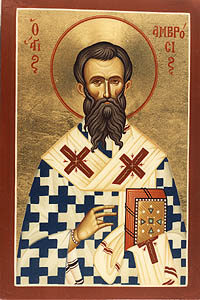
Among the Latin Fathers are Ambrose of Milan, Augustine of Hippo, Leo the Great, Gregory the Great, and Jerome.
Ambrose of Milan (c. 340-397) was the bishop who brought Augustine to Christ. Augustine in his Confessions (6.4.6) recalls how Ambrose’s powerful sermons and his exegesis of the Old Testament brought a pagan skeptic to faith in Christ. Ambrose persuaded Emperor Gratian to remove the statue of the pagan goddess Victory from the Senate halls. He excommunicated Emperor Theodosius for his role in the massacre in Thessalonica, putting the emperor under discipline until he did public penance. He also introduced antiphonal chanting into the Latin church.
It may come as a surprise to some that despite the many criticisms made of Augustine, especially in discussions about Roman Catholicism and Orthodoxy, he is recognized as a saint in the Orthodox Church. Fr. George Papademetriou wrote “Saint Augustine in the Greek Orthodox Tradition” in which he explained how Augustine is a saint of the Church despite the numerous recent criticisms of his theology. For example, while Augustine may have taught the double procession of the Holy Spirit in no way did he ever advocate changing the Nicene Creed. Saint Photius pointed out that Augustine’s understanding of the Holy Spirit’s two fold procession was a minor position and that we are obliged to follow the consensus patrum (consensus of the Fathers).
Orthodox readers who question whether Augustine is recognized as a saint need to keep in mind that his feast day falls on June 15 of the liturgical calendar. The dismissal hymn for that day goes:
O blessed Augustine, you have been proved to be a bright vessel of the divine Spirit and revealer of the city of God; you have also righteously served the Saviour as a wise hierarch who has received God. O righteous father, pray to Christ God that he may grant to us great mercy. source
Interested readers can read John Stamps’ “When Tradition Fractures” for an insightful discussion of Orthodoxy’s fraught relations with Augustine of Hippo.
There is a need for Orthodox scholars fluent in Latin. Orthodoxy needs multilingual theologians fluent in both Greek and Latin. The patristic consensus cannot be confined to any one language or region. For example, the Vincentian Canon is a Latin phrase: quod ubique, quod semper, quod ab omnibus creditum est (i.e. only “what has been believed everywhere, always, and by all”) is the catholic Faith of Christianity. Saint Vincent lived in the town of Lerins (near modern day Marseilles, France). Orthodox theology being grounded in the patristic consensus will be enriched as scholars, hierarchs, and laity read the Latin Fathers. The same can also be said of the Orthodox understanding of the patristic consensus being enriched by Syriac Fathers like Saints Ephraim the Syrian and Isaac the Syrian Bishop of Nineveh.
Celtic and British Saints
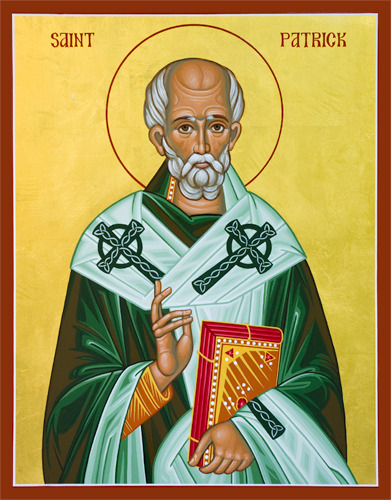
Icon – St. Patrick
In addition to Saint Patrick – Enlightener of Ireland, the Orthodox Church honors Brendan the Navigator, Venerable Bede, Saint Columba – Abbot of Iona. For those of us who live in the English speaking world one of Orthodoxy’s hidden treasures lies in the numerous Celtic and British saints. As I read through the list of names I was surprised to see so many familiar names that I never associated with Orthodoxy.
It is the practice in Orthodoxy that when one becomes Orthodox one takes on the name of a saint. Many recent converts have taken on the names of “eastern” Orthodox saints being unaware of the “western” Orthodox saints. Those presently inquiring into Orthodoxy or about to become Orthodox can reaffirm their western cultural roots by taking the name of a “western” Orthodox saint.
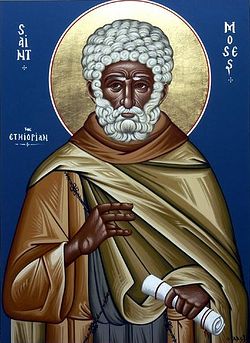
One of the more well known African saints is Moses the Black. He lived a life according to the passions of the flesh until his conversion to Christ. After his conversion he lived as a monastic and served as abbot of a monastery until his martyrdom by Berber pirates.
Also among the African saints is the pair: Irene and Sophia. Little is known about them but the Church remembers them. More well known is Mary of Egypt. One Sunday during Lent is designated the Sunday of Mary of Egypt. On that day the Orthodox Church remembers how God’ grace transformed a woman caught in the pleasures of the flesh into one of the greatest saints of all time. Other well known African saints include Athanasius the Great, Saint Katherine, and Anthony the Great.
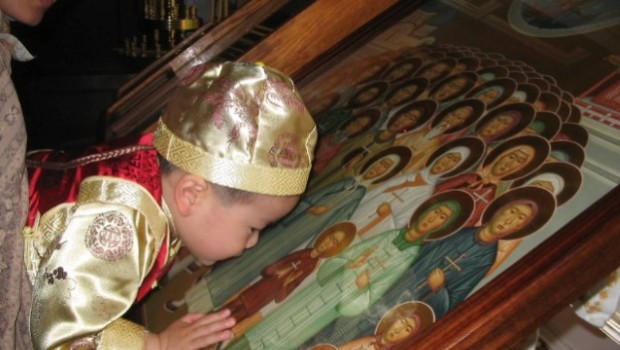
Child Honoring the Chinese Martyrs
China and Japan
China has the honor of the Martyrs of the Boxer Rebellion (1900). The icon of the Chinese Martyrs show a large group comprised of adults and children. Standing in the front is Father Mitrophan (Ji Chong or Tsi Chung) with his wife Tatiana and their three sons: Isaiah, Sergiy, and Ioann. The oldest son was 23 years old at his death and the youngest 8 years old.
Another Asian saint is Saint Nicholas of Japan, Equal to the Apostles. Born Ivan Kasatkin in 1836 in the province of Smolensk, he later studied in St. Petersburg. He received his missionary calling in the form of a request from the Russian consulate in Japan for a priest who would minister to the spiritual needs of the Russian community there, the Japanese, and other foreigners stationed in Japan. He translated the Bible and Liturgy into Japanese. After more than 50 years of missionary labor he planted 266 Christian communities before he reposed in 1912.
Crossing the Bering Straits
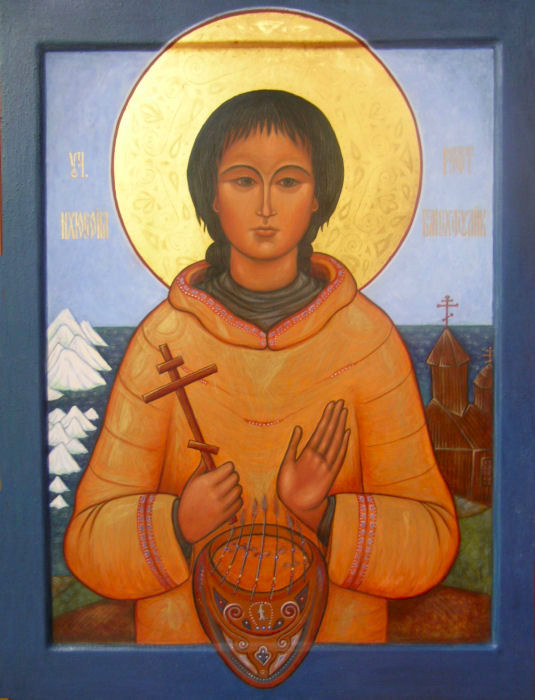
Orthodoxy first came to the American continent from the west, that is, from Russia. The early Orthodox missionaries “crossed the Bering Strait” in order to bring the Good News of Christ to the native peoples of Alaska. The Alaskan saints comprised four missionaries (Saints Herman, Innocent, Juvenaly, and Jacob) and one native born martyr (Peter the Aleut).
Martyrdom of Saint Juvenaly and his native guide.
Saint Juvenaly was born in Nerchinsk, Siberia in 1761. He worked as a mining engineer and was married. After his wife died in 1791 he entered a monastery in St. Petersburg. In 1794 Fr. Juvenaly and others had reached Kodiak. The following year Father Juvenaly baptized some 700 Chugatchi then crossed the Kenai Bay. In 1796 he and his native assistant were martyred by the Yup’ik. He was the first Orthodox Christian to receive the crown of martyrdom and is remembered as “Protomartyr.”
Another Alaskan saint is Peter the Aleut. He was born in Kodiak in the late 1700s. While in his teens he accompanied Russian fur trappers to northern California. In 1815, while hunting in his kayak south of San Francisco he was captured by Spanish soldiers. He refused to be rebaptized insisting that he was already a Christian. In their zeal to convert Peter the Roman Catholic priests cruelly dismembered his hands and feet. Today he is known as the “Martyr of San Francisco.”
It may surprise some to learn that Orthodoxy has American saints. In addition to Saint John of San Francisco, there is Saint Raphael of Brooklyn and Saint Alexis Toth of Wilkes-Barre, Pennsylvania. Saint Tikhon before he became Patriarch of Moscow served in North America striving to build up the scattered Orthodox immigrant community into a strong self-sustaining church. Saint Tikhon is known as ”Enlightener of America and Confessor of Moscow.” In his last sermon in America he said:
The Light of Orthodoxy is not lit for a small circle of people…. It is our obligation to share our spiritual treasures, our truth, our light, and our joy with those who do not have these gifts. This duty lies not only on pastors and missionaries, but also on lay people, for the Church of Christ, in the wise comparison of St. Paul, is a body, and in the life of the body, every member takes part. source
Is Orthodoxy Eastern?
In conclusion, Orthodoxy is more than eastern, it is a universal faith. To say Orthodoxy is eastern is often a shorthand reference to Orthodoxy’s deep roots in Byzantine culture and its indebtedness to the Greek Fathers. In that sense one can use the phrase “Eastern Orthodox.” But to imply that Orthodoxy is restricted to a particular region or a particular culture is misleading and can lead to a distorted understanding of Orthodoxy.
So, “No, you don’t have to ‘cross the Bosphorus’ to become Orthodox.” That’s one way. Many have entered into Orthodoxy through Greek Orthodox parishes that are under the Ecumenical Patriarchate of Constantinople. Another way is to “cross the Moskva” by converting to Orthodoxy through a ROCOR parish. Or “cross the Orontes” through the Antiochian Orthodox Archdiocese. This is what the two thousand Evangelicals did in 1987.
Unlike Roman Catholicism which has one spiritual center: Rome, Orthodoxy has many spiritual centers. What unites us is the Apostolic Faith – “what has been believed everywhere, always, and by all.” Orthodoxy in the US has an opportunity to manifest the catholicity of Orthodoxy. The challenge for many Orthodox parishes founded by immigrants is to go beyond their ethnic roots and embrace the larger Orthodox Tradition. One small step can be the inclusion of icons of American, African, or Asian saints in the sanctuary. Another small step can be children or adult class presentations on the lives of the saints. The honoring of the saints on their feast days requires the blessing of the bishop. The honoring of the North American saints is an important step towards a unified American Orthodox Church.
The Orthodox Church in America honors the North American saints on the second Sunday after Pentecost. The kontakion (hymn) for that day goes:
Today the choir of Saints who were pleasing to God in the lands of North America
Now stands before us in the Church and invisibly prays to God for us.
With them the angels glorify Him,
And all the saints of the Church of Christ keep festival with them;
And together they all pray for us to the Pre-Eternal God.
The Twelve Gates of New Jerusalem
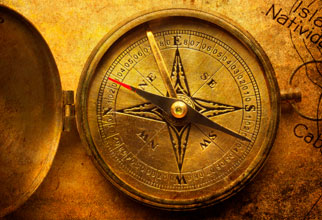
A prophetic description of Orthodoxy’s catholicity can be found in Revelation 21:13. In that passage New Jerusalem is depicted as having twelve gates: three on the east, three on the north, three on the south, and three on the west. Access to New Jerusalem from all four points of the compass points to the universality of the Gospel and Christ’s reign. They also point to the catholicity of the Church as it welcomes peoples from all over the world into the kingdom of God.
 As archaeological evidence Rylands Papyrus 470 suggests that Protestantism, especially the Reformed tradition and Evangelicalism, may have thrown the baby out with the bathwater. Protestants can enrich their worship and devotional life by learning from the early Church by emulating their respect for Mary the Theotokos. A good first step is to refer to Mary not just as “Mary” but also as “Theotokos” or in English “Mother of God” or “God Bearer.”




Recent Comments