A Meeting Place for Evangelicals, Reformed, and Orthodox Christians

Category: Church History (Page 13 of 20)

Geneva Bible for Orthodox Russia?

Part 4 of 4.  Parts 1,  2, and  3.

Cathedral of the Annunciation - Moscow

Cathedral of the Annunciation – Moscow

In 1995, the New Geneva Study Bible was published by Thomas Nelson Publishers under the editorial leadership of R.C. Sproul and J.I. Packer.

R.C. Sproul has ambitious goals for this new study bible including using it to evangelize Russia.


He writes:

Beyond the borders of America, the New Geneva Study Bible may be used to expand the light of the Reformation to lands where the original Reformation never reached, especially to Russia and Eastern Europe.  Source

What should be the attitude of an Orthodox believer in Russia towards the New Geneva Study Bible?  I would say: cautious skepticism.  Having been a Protestant Evangelical I can understand the enthusiastic Calvinist’s desire to share the Good News with everyone everywhere.  However, as a convert to Orthodoxy I am quite conscious of the limitations of Reformed theology.  In the spirit of caveat emptor (let the buyer beware), I list below some of my concerns about the New Geneva Study Bible and the original sixteenth century Geneva Bible.


The Bible and Interpretation
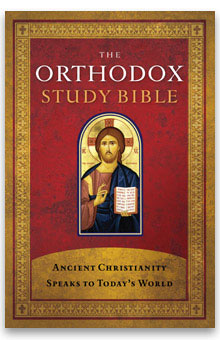
The-Orthodox-Study-BibleAs discussed in an earlier blog posting theological tradition is the foundational bedrock upon which every study bible is rooted in and upon which it rests. The New Geneva Study Bible (like ALL Protestant study bibles) is thus not pure exegesis, but grows out of the Reformed tradition.  This theological tradition is quite recent going back only to the 1500s.  On the other hand the Orthodox Study Bible commentary rests on the teachings of the early church fathers.  This interpretive tradition goes as far back as the second century and reflects a broad catholic tradition shared by Christians all across the Roman Empire and even beyond.

There’s a certain irony in the fact that BOTH the New Geneva Study Bible and the Orthodox Study Bible have in common the NKJV translation of the New Testament!  If the differences cannot be attributed to differences in translation, then what is the reason for the differences in commentary?  If one takes a step back one soon becomes aware that the  commentary arise from a certain interpretive community.  That is, we do not read the Bible alone but our understanding of the Bible is influenced by the community we are part of.

When one looks at the Reformed tradition one finds a theological tradition confined to parts of Europe.  Furthermore, the Geneva Bible represents one specific, narrow stream of Protestantism.  If one wants to study the theology of the early English Reformers, the sixteenth century variants of the Geneva Bible (not the updated version) is a good choice.  But if one wants understand how Christians have historically understood the Bible from the early days to the present the Orthodox Study Bible is the better choice.


Passing Fad or Enduring Classic?

The Geneva Study Bible’s popularity was relatively short lived in comparison to the King James Version.  Where the KJV appealed across the spectrum of Protestant denominations, the Geneva Bible appealed primarily to English Puritans.  Thus, the Geneva Bible can be considered a passing fad or a transitional translation that prepared the way for the enduring classic of English literature, the King James Bible.

The recent attempt to bring back the Geneva Bible goes against the flow of history.  It appeals principally to neo-Reformed Christians and is essentially a niche Bible.  Its popularity will likely be short lived.


An Accurate Translation?
Source

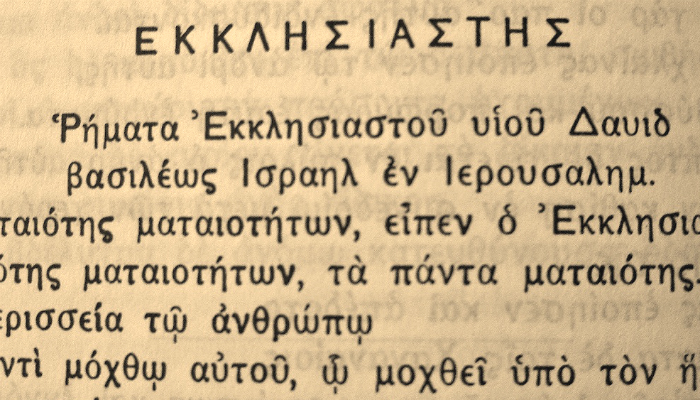
“The Greek World of the Old Testament” Source

A bible translation is only as good as its source text.  The Geneva Bible like other Protestant bibles uses the Hebrew Masoretic text as the basis for its Old Testament translation.  Historically, the shift to the Masoretic text is significant.  Protestantism’s preference for the Hebrew text stems from Renaissance humanism’s ideal ad fontes—the belief that the path to true knowledge is through reading the classical texts in their original tongues.  But this new humanist ideal marks a radical departure from the early church fathers’ desire to be discipled by the Apostles, not worldly wisdom. It was the Greek Old Testament (Septuagint) and the Greek New Testament that the Apostles and early Christians knew as their Bible.

Many of the Old Testament passages in the New Testament are either direct quotes or paraphrase from the Septuagint, not the Hebrew Masoretic text.  Textual variations between the Hebrew and Greek Old Testament quotes are for the most part minor, but from time to time they will diverge; in that case which one should one prefer?  I would suggest the older source text should be given preference.  This makes sense in light of the fact that the Septuagint was produced about two to three centuries before the birth of Christ. The Masoretic text would not be compiled by Jewish scholars until the 600s to 900s.  This makes the Greek Septuagint almost a thousand years older than the Hebrew Masoretic text!  


A Conservative or Innovative Bible?

Gen_1599_toc

The Geneva Bible was one of the first bibles to tamper with the biblical canon by excluding the deuterocanonical books (aka Apocrypha).  This is not a minor issue but centers on the question: Is this book or writing inspired by God?  It takes a certain amount of audacity to claim to have the authority to make that determination!

In my first posting on the Geneva Bible I traced the gradual evolution of the Geneva Bible.  The first printing in 1576 contained the biblical canon much like the Roman Catholic Church’s but by 1599 the Apocrypha was left out.  This action stemmed from the increased hostility between Protestants and Roman Catholics.  It can also be seen as stemming from the English Reformers’ intolerance of the in-between status of the deuterocanonical books which were considered inspired but not on the same level as other parts of the biblical canon.  Gary Michuta in an insightful article showed how the exclusion of the Aprocrypha led to changes in the marginal notes that sought to show the New Testament reliance on the Apocrypha, e.g., Matthew 27:48 and Wisdom 2:18, and Hebrews 1:3 and Wisdom 7:36.

This tampering with the biblical canon demonstrates the Reformed tradition’s innovative character. This is a radical departure from the historic Bible, not a conservative return to the early Church as some would like to think.  


The Need for a Protestant Study Bible

The attempt to bring back the Geneva Bible represents a step backwards for Protestants today.  The Geneva Bible reflects English Protestantism in the late 1500s before the emergence of King James Version in 1611.  Since then many more English translations have appeared each with their own strengths and weaknesses.  It is hard to accept the claim made by some that the Geneva Bible is to be preferred over all other English translations.

What is needed instead is a Protestant Study Bible that reflects the rich diversity of Protestant readings of the Bible.  Such a bible would help advance our understanding of Protestantism’s complex and even contradictory relations with Scripture.  The Reformed tradition is one facet of Protestantism’s complex and often conflicted hermeneutical history.  The Protestant Study Bible that I am suggesting here would be a useful resource for Protestant-Orthodox interfaith dialogue.  We share the same Scripture but we are separated by differing readings of Scripture.  These divergent readings arise from fundamentally different hermeneutical starting points.  Where Orthodoxy assumes Apostolic Tradition as the normative interpretive framework for reading Scripture, the Protestantism insisted on sola scriptura which in time took on an increasingly nuanced and qualified forms resulting in often contradictory interpretations.


A Political Agenda?

The New Geneva Study Bible seems to have become intertwined with a certain political agenda.  We find in the treatise “The Forgotten Translation” posted on genevabible.com linking the Geneva Bible to American democracy.

Thanks to the Institutes of the Christian Religion, his printed sermons, the Academy, his commentaries on nearly every book of the Bible (except the Song of Solomon and the Book of Revelation), and his pattern of Church and Civil government, Calvin shaped the thought and motivated the ideals of Protestantism in France, the Netherlands, Poland, Hungry, Scotland, and the English Puritans; many of whom settled in America. The great American historian George Bancroft stated, “He that will not honor the memory, and respect the influence of Calvin, knows but little of the origin of American liberty.” The famous German historian, Leopold von Ranke, wrote, “John Calvin was the virtual founder of America.” John Adams, the second president of the United States, wrote: “Let not Geneva be forgotten or despised. Religious liberty owes it most respect.”

As wonderful as some moderns might believe the American democracy may be, it must not be affixed to the Word of God.  The Bible belongs to the Church catholic and not just to one particular polity.  One has to wonder if the Neo-Reformed missionary project is intertwined with an attempt to civilize the world according to the “American Way.”  Rather than respect Russia’s Orthodox Christian heritage, the New Geneva Bible (Reformation Study Bible) seems to be an attempt to replace it with American Protestantism.


Conclusion

To summarize, despite the admirable motives for attempting to bring back the Geneva Bible there are significant problems with this particular bible:

(1) Its commentary notes come out of a relatively recent theological tradition, the Protestant Reformation which originated in the 1500s;

(2) It was popular for a brief period of time until superseded by the King James Version;

(3) It used the Hebrew Masoretic text instead of the Septuagint;

(4) It changed the Old Testament canon by leaving out certain books that the Christian Church had long considered Scripture;

(5) Its recent come back seems to be connected to the neo-Reformed movement within Evangelicalism; and

(6) The recent endeavor to export it Russia rests on the assumption that Reformed theology is superior to Orthodox Christianity.

So what should an Orthodox Christian in Russia say if offered a copy of the Geneva Bible?  I would suggest that even if offered a free copy of the Geneva Bible, one should reply: Thanks, but no thanks.  They might even challenge Protestant zealots to consider how the Geneva Bible is in reality a radical departure from historic Christianity.  That it might be just as much a political tract promoting modern democratic Americanism as it is a “new and improved” Protestant version of the Bible.  They could also offer to sit down with their Protestant friend and compare the Geneva Bible with the Orthodox Study Bible.

 Robert Arakaki 
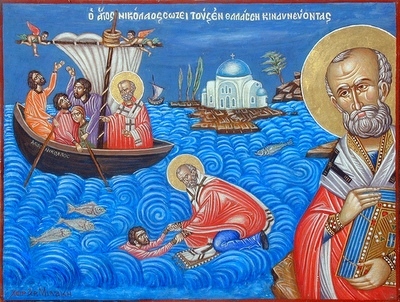
Saint Nicholas and the Meaning of Christmas


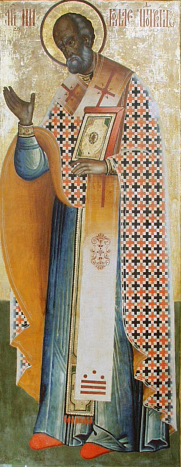
Icon - St. Nicholas of Myra

Icon – St. Nicholas of Myra

Has the meaning of Christmas changed in recent years?  Has the creeping commercialism of the past 40 years radically reshaped our understanding of Christmas?  We learn in the news about Black Friday and Green Monday, about record sales and great bargains, and sadly about customers fighting other customers so they can get the perfect gift for their loved ones.  Television shows talk about our having “the best Christmas ever!”  It is as if Christmas is a rush that brings us perfect happiness.  Perhaps this commercialization of Christmas has not corrupted the meaning of Christmas for many, but we suspect that it certainly has for millions.  How did American culture go so wrong when it comes to celebrating Christmas?

Part of the problem is the fact that many people get much of their understanding of Christmas through the mass media which is heavily dependent on advertising revenue to survive.  In many ways, this form of capitalist consumerism has come to dominate the Christmas season dangerously obscuring its traditional meaning.


If asked point blank about the meaning of Christmas, how would your 10-12 year old children answer?  Could they discuss the central meaning of Christmas?  What we really ought to  celebrate in Christmas?

Rather than react negatively to all this, we can respond positively by learning from Saint Nicholas of Myra, the original “Santa Claus.”  The name “santa” comes from the word “saint” and the name “Claus” is a shortened form of “Nicholas.”  Unlike the modern mythical chubby figure who flies around the world on Christmas Eve in a sled pulled by flying reindeer there was a real live Santa in history.  Nicholas of Myra lived in Asia Minor (modern day Turkey) in the fourth century.  He was much beloved and shortly after he died he was remembered as a great saint by Christians in both the East and West.  In recent years people have forgotten about the first Santa and were taught a “new and improved” Santa who brings lots and lots of toys to good girls and boys.  For a discussion of how modern society redefined “Santa Claus” see my 2011 posting “Remembering St. Nicholas, Recovering a Christian Heritage.”


Learning from Saint Nicholas

Lesson 1 – Standing up for the Orthodox Faith

In Christmas we celebrate the birth of the Son of God who came into the world for our salvation.  There is truth in the saying: “Christ is the reason for the season.”  The true meaning of Christmas rests on right doctrine.  A heretical understanding of Christ poses a deadly threat to the Christmas season.  If Jesus is not truly the Son of God then Christmas is a waste of time.  All the twinkling Christmas lights, Christmas caroling, and eggnog drink and cookies are all for nothing if Jesus is not the Son of God.

We do not celebrate Christ coming into our hearts spiritually at Christmas. No, the Christ of the Christmas season is the true Logos of God who comes physically into human history, taking on flesh “becoming Incarnate of the Virgin Mary” as the Nicene Creed so rightly says. God took on true humanity in Christ, becoming like us so He might redeem a fallen human race by conquering both sin and death.  In the Incarnation the Word of the God invaded human history to rescue us.  The birth of Christ is just as real as D Day (6 June 1945) when the Allied forces landed in Normandy to bring about the end of Hitler’s evil rule.  Here, moderns might rightly say the Incarnation is “massive”!

We learn from Saint Nicholas the importance of holding to a right faith in Christ.  Saint Nicholas was more than a nice guy.  He was bishop of the church.  As bishop he was responsible for guarding the Christian Faith.  When the Arian heresy surfaced denying that Jesus Christ was truly divine, Bishop Nicholas and other bishops met to uphold Christ’s divinity: “true God of true God, begotten, not made, of one essence with the Father.”  There is the story that at the Council of Nicea (AD 325) Nicholas was so upset at hearing Arius’ blasphemy that he slugged Arius in the face.  This is a saint willing to fight for the faith!  Not some jolly old man sitting in a chair with children on his lap.


Lesson 2 – Giving to the Poor

Santa’s big bag of toys and his surprise visits on Christmas Eve come from the story of a poor man who had three daughters.  Because he could not afford to pay his daughters’ dowry they were in danger of being forced into prostitution in order to survive.  Out of humility Nicholas would come in the middle of the night and throw in a bag of coin for each of the three daughters.  When the father caught Nicholas in the act he began to thank him, but Nicholas stopped him saying that it was not him who should be thanked but God alone.  In another version of the story the daughters would wash their stocking and hang them during the night to dry.  Nicholas deposited gold coins in the stocking in the middle of the night to help them.

The story of Saint Nicholas rescuing the three young daughters can be applied to the modern problem of human trafficking.  Human trafficking (sexual slavery, forced labor, or organ harvesting) is a humanitarian crisis today involving some 2.5 million people in over 120 countries (United Nations).  Because poverty is one of the major driving forces underlying human trafficking — Almsgiving can be a major means of addressing this problem.

Almsgiving is more than writing out a check to a worthy cause; Christian almsgiving is rooted in a spirituality radically different from secular charity.  I recommend the reader read Todd Madigan’s insightful “The Advent of Modern Almsgiving.”

In addition to supporting organizations that combat human trafficking, Orthodox Christians can also remember to pray for the victims and perpetrators during the Divine Liturgy.  There is one petition that can apply to the issue of human trafficking:

For those who travel, by land, sea and air, for those who are sick or suffering or in captivity, and for their safekeeping, let us pray to the Lord.


Lesson 3 – Being Open to Miracles

St. Nicholas praying for deliverance

St. Nicholas praying for deliverance

Saint Nicholas is also known as Nicholas the Wonderworker.  His life story is full of miracles and deliverances.  He once went on a pilgrimage to Jerusalem by boat.  Along the way the ship ran into a fierce storm that threatened to capsize the boat and take the life of all on board.  Saint Nicholas prayed fervently for the safety of the passengers and in answer to his prayers the sea became calm once again.  On another occasion he rescued three men who were unjustly accused by snatching the sword out of the executioner’s hand.

Nicholas’ charismatic ministry continued even after his death.  He was buried in Myra and the town became a popular pilgrimage site.  People would visit his grave site and ask for his prayers.  When the Muslims conquered Asia Minor, a group of sailors hurriedly dug up Nicholas’ bones and transported them to the town of Bari in southern Italy.  Parts of his relics were also taken to the city of Venice.  His posthumous popularity among ordinary Christians can be traced to his devotion to Christ and his reputation as an effective intercessor.


Lesson 4 – Embracing Asceticism

From childhood Nicholas strove to live a holy life dedicated to Christ.  At an early age he devoted himself to the reading of the Bible and other spiritual works.  He gave himself to prayer day and night.  He was the first to arrive at church.  When his predecessor died an elderly bishop had a vision informing him that the first person to enter the church that night was to be made the next archbishop of Myra.  When the saint arrived before anyone else he was stopped by the elder who asked him: “What is your name, child?”  God’s chosen one replied: “My name is Nicholas, Master, and I am your servant.”  Nicholas wanted to retire to the desert as a monk but he heard a voice telling him that this was not his calling.  The Lord told Nicholas: “Nicholas, this is not the vineyard where you shall ear fruit for Me.  Return to the world, and glorify My Name there.”

For modern day Orthodox Christians Saint Nicholas can serve as an example reminding us that devotion to God can be as simple as coming to the Liturgy on time.  It is a sad fact that many Orthodox Christians straggle into the Sunday worship rather than eagerly participating in the Liturgy.

The ascetic life involves the disciplines of prayer, Bible reading, fasting, and almsgiving.  All these spiritual disciplines can be found in the pre-Christmas fast observed by Orthodoxy.  This is probably one of the biggest adjustments Protestants need to make when they become Orthodox.  Many Protestants in America view the Christmas season as a joyful time of caroling, shopping, Christmas festivities, and children opening presents around the Christmas tree on Christmas morning.  The notion of Lent during Christmas seems almost a contradiction in terms.  Yet fasting and Christmas do go together.  If Christmas is about preparing the way for the Son of God who would one day die on the Cross for our then fasting, mourning, and repentance are very appropriate ways for us to anticipate Christmas.  Too many modern Christians take a pick-and-choose approach to spirituality.  They choose only the feasting; historically, however, the church fathers taught feasting rests upon prior fasting.  The cycle of fasting-feasting is an integral part of Orthodox spirituality.  The Christmas Nativity is about the Christ Child who was born to rule and born to die.  Thus, Christmas is both a time of joy and mourning (see Luke 6:20-26).


A “Countercultural” Approach to Christmas

Many Christians lament how Christmas has become commercialized and how the true meaning of Christmas has been lost.  Rather than complain, we can respond positively by following the example of Saint Nicholas of Myra and observing Christmas the Orthodox way.  The advantage of Orthodoxy’s Christmas Lent is that it is not a knee-jerk reaction to contemporary trends, but based on following Holy Tradition which has been passed down over many generations.  This gives Orthodox Christians spiritual stability even as secular understanding of Christmas morphs in bizarre ways.

What can the Orthodox do to hold on to the true meaning of Christmas?  We can make an effort honor Saint Nicholas on his feast day (December 6) at church even if it falls on the middle of the week.  In the video below we see an Orthodox parish in San Anselmo, California, gathered on a Wednesday to celebrate St. Nicholas feast day.

http://www.youtube.com/watch?v=s2gr-JJjpEg

If we attend mid-week services to celebrate Saint Nicholas’ feast day that will surely make a huge impact on our children.  We can tell them about Saint Nicholas’ devotion to prayer, fasting, and almsgiving as an example to follow during the Christmas fast.

We can support charitable organizations that help those in need.  We can support organizations that combat human trafficking while we also pray more fervently when the Divine Liturgy exhorts us to pray for those “in captivity.”  One possibility is supporting organizations like Samaritana – “Towards Prostitution-Free Societies.”

Parents can buy an icon of Saint Nicholas and teach their children about the first Santa Claus who was a real person who lived in the fourth century.  Saint Nicholas’ life story is full of interesting and inspiring stories that we can pass on to our children.  We can teach them the hymns of the church about Saint Nicholas.  We can teach children that Saint Nicholas is in heaven praying for us.

Kontakion 1

O champion wonderworker and superb servant of Christ
thou who pourest out for all the world
the most precious myrrh of mercy
and an inexhaustible sea of miracles
I praise thee with love, O Saint Nicholas;
and as thou art one having boldness toward the Lord, from all dangers do thou deliver us,
that we may cry to thee:    Rejoice, O Nicholas, Great Wonderworker!


In conclusion, celebrating Christmas in the spirit of Saint Nicholas is an act of radical discipleship.  The original Saint Nicholas was not some jolly old man but a radical Christian.  Let us learn from him and make our Christmas an Orthodox Christmas.

Robert Arakaki


A Protestant Exodus? – My Response to Peter Leithart


Maria Lago Studio "Exodus" Source

Maria Lago Studio “Exodus” Source

In Rev. Peter Leithart’s recent column for First Things: “The tragedy of conversion” (7 October 2013), he describes as tragic Protestants who acquired the taste for “catholicity and unity” and instead of remaining Protestant go so far as to convert to the Orthodox Church or to Rome.  This is a crisis affecting Protestantism in general and the Federal Vision movement in particular.  The New York Times published an article in 2009 about this trend: “More Protestants Find a Home in Orthodox Antioch Church.

The recent exodus while not large in number is significant.  Scott Hahn, a former Presbyterian seminary professor, wrote about his conversion in Rome Sweet Home.  Other notable converts include Thomas Howard and Francis Beckwith, former president of the Evangelical Theological Society.  More recently, a certain amount of controversy surrounded Jason Stellman.  Ironically, it was Pastor Stellman whom the PCA assigned to be the lead prosecutor for Leithart’s heresy trial!

On the Eastern Orthodox side the late Peter Gillquist tells the story how he and his fellow Campus Crusade for Christ co-workers became Orthodox in his book Becoming OrthodoxClark Carlton is a former Baptist seminarian and Matthew Gallatin a former Calvary Chapel pastor.  Frank Schaeffer, son of the famous Evangelical thinker, Francis Schaeffer, converted to Orthodoxy.  One prominent convert is the late Jaroslav Pelikan, world renowned Yale University professor who authored the five volume The Christian Tradition.  Michael Hyatt, former CEO of Thomas Nelson Publications and a former ruling elder in the PCA, is now a deacon serving the Orthodox Church.

When one looks at the kind of people exiting Protestantism, we see some of the most seasoned, serious, and brightest people of the Evangelical world: seminarians, seminary professors, pastors, authors, publishers, leaders of leading Evangelical organizations.  One has to ask: What is going on here!?!

My assessment is that Protestantism having lost its theological center has become a fractured and confusing, if not volatile and unstable.  Troubled by this state of confusion many are seeking refuge in the historic early Church.  This is the backdrop to Leithart’s recent column.


Protestantism’s Meltdown

In the first half of the twentieth century American Protestantism was divided principally between liberals and conservatives.  Then in the 1950s and 1960s there was an influx of Pentecostalism into historic mainline Protestant churches.  The 1970s marked the beginning of the shift to post-denominational Protestantism.  More recently, American Protestantism saw the rise of mega churches whose seeker friendly services downplayed doctrine.   Church shopping became the new normal as people began to evaluate churches in terms of the services they had to offer instead of their teachings.

An ironic reaction to all this has been a growing ancient-future movement that sought to rediscover their roots in ancient Christianity.  Soon Evangelicals began having processions with acolytes carrying crosses, clergy wearing vestments, reciting the Nicene Creed, quoting early church fathers, and holding weekly Eucharist.  This return to the roots movement took several forms.  One was the Emergent Movement which attempted to be post-modern and eclectic in worship and doctrine.  Another was the Canterbury trail movement where people joined one of the various Anglican off-shoots from Episcopalianism.

Peter Leithart is part of the Federal Vision (FV) movement, a high church expression of Reformed theology that seeks to give greater emphasis to covenant theology, Trinitarian thinking, and the sacraments of baptism and Holy Communion – as did many if not most of the early Reformers.

Leithart and his FV colleagues believe themselves to be on the cutting edge of “the-future-church” and much closer to getting it right than say the Presbyterian Church in America (PCA) or the Orthodox Presbyterian Church (OPC).  In actuality, they are just another “new-and-improved” Reformed splinter group.  For them, a Christian moving from an older Protestant denomination–Methodist, Baptist, Anglican, or mainline Reformed—to the Federal Vision would be making a wise move in the right direction.

Given the peculiar way the FV folks understand “catholicity and unity,” it is no surprise that they think a Protestant converting to Orthodoxy is going in the wrong direction.  An even bigger problem for them is knowledgeable Reformed Christians from the Federal Vision jumping ship!  There is a quiet exodus from the FV to Orthodoxy under way right now. This is the growing crisis that the Rev. Peter Leithart is trying to head off.


800px-Border_Collie_sheepdog_trial

Keeping the sheep in line

A former PCA elder, currently an Orthodox catechumen, explained to me the implicit insult in his move towards Orthodoxy: “What!  You actually believe the Apostles and their disciples got the Faith right centuries ago . . . before our FV insights . . . . Grrrrr!!”  What adds to their grief and distress is that Pastor Leithart and his mentor Pastor James B. Jordan were two of the prominent CREC & PCA leaders who cracked open the door for their bright and zealous disciples to inquire into historic Orthodoxy with the unexpected results of some converting to Orthodoxy!  Now, they are writing articles like this one in an effort at damage control.  It seems to me that what Rev. Leithart is trying to do is keep people from straying off the Protestant reservation.


Leithart’s Theology of Time

hour20glass

Leithart’s opposition to Protestants converting to Orthodoxy stems from his understanding church history.

He writes:

Apart from all the detailed historical arguments, this quest makes an assumption about the nature of time, an assumption that I have labeled “tragic.”

It’s the assumption that the old is always purer and better, and that if we want to regain life and health we need to go back to the beginning (Emphasis added).

Leithart sees church history as progressive and dialectical.  For him, early Christianity was just the beginning of a long evolutionary journey and that the mature church of Protestantism is to be preferred over the infancy of early Christianity.  To dissuade Protestants from converting to Orthodoxy Leithart argues that the true Church is not to be found among the Protestants, Catholics, or Orthodox but ahead of us in the future.  He writes:

History is patterned in the same way.  Eden is not the golden time to which we return; it is the infancy from which we begin and grow up.  The golden age is ahead, in the Edenic Jerusalem.

This evolutionary approach to church history is congruent with postmillennialism favored by Reformed theologians.  It reminds me of Mercersburg Theology’s Philip Schaff who posited that church history is the outworking of a Hegelian dialect, that over time division will be resolved into deeper unity, and that over time heresy and error will be resolved into deeper truth.  This is radically at odds with how Orthodoxy understands truth and what the Bible teaches.

Leithart’s portrayal of time is based on a false characterization of the Orthodox understanding of time.  Time is not the issue here.  The issue here is the promise of the Holy Spirit Christ made to His Apostles in the Upper Room discourse (John 13-16).  Was the coming of the Holy Spirit at Pentecost to be a brief flash of inspiration for the Apostles and their disciples?  Or did the Holy Spirit come to inhabit the Church permanently, “abide with you forever” (John 14:16)?  For the Orthodox these are not difficult questions.  Christ’s promises were proven true not only in the book of Acts but in subsequent church history.  For Orthodox Christians the Holy Spirit guided the early Church through the Ecumenical Councils and continues to guide the Church.  This is very different from the Blinked-Out/Blinked-On theory of church history prevalent among Protestants.  This theory assumes that the light went out in the early Church and did not come back on until the Protestant Reformation.  The Orthodox understanding of Holy Tradition and the Bible arising out of Holy Tradition means that the Apostles got their teachings directly from Christ and the Holy Spirit.  Neither Scripture nor Tradition are dependent on Rev. Leithart’s notion that time is the crucial factor or his implicit evolutionary assumption “new is always better.”


The Faith Once and for All Delivered to the Saints

The Bible rules out an evolutionary understanding of theology.  We find in Jude 3:

Beloved, while I was very diligent to write to you concerning our common salvation, I found it necessary to write to you exhorting you to contend earnestly for the faith which was once for all delivered to the saints. (Emphasis added; OSB)

There are three important points made in this short verse.  One, the word πιστει (pistei, faith) has the definite article which indicates that the writer has in mind a body of truth or a set of doctrines.  This points to one true Faith, not multiple versions as would be assumed by Leithart’s theory of history.  Two, the word παραδοθειση (paradotheise, aorist passive participle, delivered) points to a traditioning process.  Reinecker’s Linguistic Key to the Greek New Testament has this to say about παραδοθειση:

The word is used for handing down authorized tradition in Israel (s. 1 Cor. 15:1-3; 2 Thess. 3:6), and Jude is therefore saying that the Christian apostolic tradition is normative for the people of God (Green).  (p. 803)

The Christian Faith is not something discovered through rational study of the Bible or the result of creative engagement with culture, but received from the Apostles.  Protestant theology with its sola scriptura assumes that Christian doctrine arises from the study of Scripture independent of Tradition.  This is a novel theological method alien to that of the early Church Fathers.  Three, the word ‘απαξ (hapax) points to a unique one-time revelation.  The same word used in Hebrews 9:28 to describe Christ’s unique one-time sacrifice on the Cross.   That one time revelation was the Incarnation of the Word of God in Jesus Christ.  Jesus taught his Apostles the Faith they were to teach the nations.  As recipients of the Apostolic Tradition we are obligated to safeguard it from change until the Lord returns at the Second Coming.  Thus, if we take Jude 3 at face value we have no choice but to reject Rev. Leithart’s evolutionary approach to Christian doctrine.

Another telling and related bible verse few Protestants seem to notice is 2 Thessalonians 2:15: “Therefore, stand fast and hold the traditions which you were taught, whether by words or our epistle.” (Emphasis added; OSB)  Note that the verb used here is “stand fast” (στηκεν), not to move ahead.  This sense of standing one’s ground can be found in Paul’s use of the same Greek word in 1 Corinthians 16:13 and Galatians 5:1.

If one holds to the traditioning model of theology then antiquity becomes a very important criterion for theological orthodoxy.  Antiquity is important, not because older is better but because antiquity is one of the distinguishing markers of apostolicity. Apostolicity without antiquity is sheer nonsense.  That is why unbroken apostolic succession is so important.  This leaves Protestants seeking the early Church with only two choices: acceptance of Orthodoxy’s Holy Tradition or submission to the Roman Pontiff.  Anglicanism, despite its having bishops, because it originated from a schismatic break with Rome, cannot claim unbroken continuity.


Coming to Zion

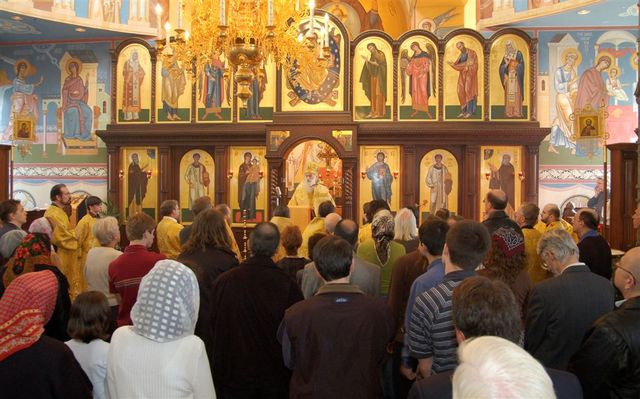
St. Seraphim Cathedral - Dallas, Texas

St. Seraphim Cathedral – Dallas, Texas


The fundamental problem with Rev. Leithart’s approach to church history is his understanding of time as χρονος (chronos).   It omits the understanding of history as καιρος (kairos).  Because of the Incarnation of the divine Word, human history is no longer trapped by chronological time.  Because the Kingdom of God has broken into human history the golden age Leithart longs for is present in the Liturgy.  Orthodox worship involves the shift from chronos to kairos.  Frederica Mathewes-Green describes in At the Corner of East and Now a typical Orthodox Sunday service:

This first service of the day is called the “Kairon,” from the Greek word for time.  Not chronos, orderly measured time, but kairos, the right time, the moment-in-time, the time of fulfillment.  Worship lifts us out of ordinary time into the eternal now.  At the beginning of the Divine Liturgy, the deacon says to the priest, “It is time for the Lord to act.” (p. 15)

For Orthodoxy the golden era of Christianity is now.  We are not moving towards Mount Zion, we are already at Mount Zion.  We read in Hebrews 12:22-24:

But you have come to Mount Zion and to the city of the living God, the heavenly Jerusalem, to an innumerable company of angels, to the general assembly and church of the firstborn who are registered in heaven, to God the Judge of all to the spirits of just men made perfect, to Jesus the Mediator of the new covenant, and to the blood of sprinkling that speaks better things than that of Abel. (Emphasis added; OSB)

The first thing to note is the opening phrase “you have come.”  The Greek for “have come” is προσεληλυθατε (proseleluthate) which is the perfect active indicative form of “come to” or “draw near.”  The perfect means: you have already come to Mount Zion, not you will come one day in the future come to Mount Zion.  This passage in Hebrews 12 describes what happens every time we celebrate the Divine Liturgy.


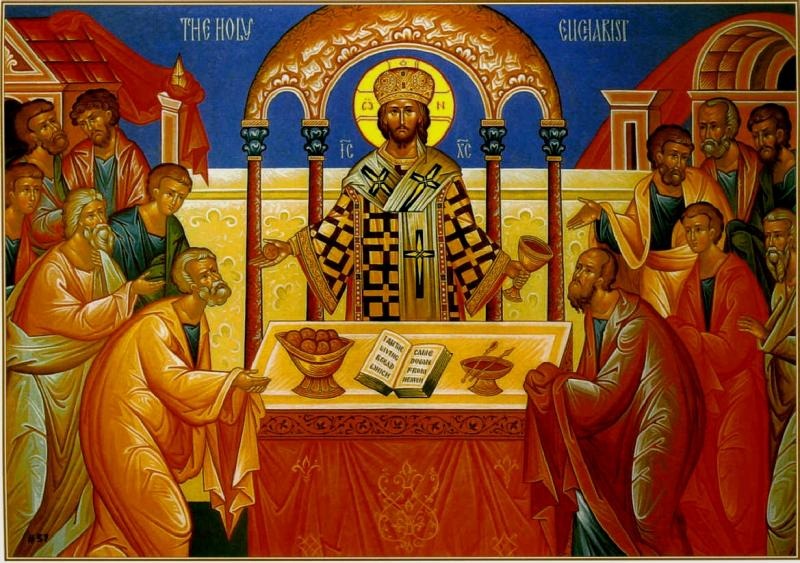
"The Lamb of God is broken and shared, broken but divided; forever eaten yet never consumed, but sanctifying those who partake of Him."

“The Lamb of God is broken and shared, broken but not divided; forever eaten yet never consumed, . . .”


The Church is the city of the living God, not in the process of becoming the city of God.  In the Eucharist the local congregation gathers as the people of God to join in the eternal worship of heaven.  As we transition into the second half of the Liturgy the Trisagion hymn reminds us that in the Eucharist we are surrounded by an innumerable number of angels.  When I look around the church I see icons of the saints, “the spirits of just men made perfect.”  As we go up for Holy Communion we see the communion chalice which contains the blood of Christ which speaks more powerfully than that of Abel’s.  Thus, Hebrews 12:22-24 describes the Orthodox Liturgy.  Gabe Martini notes in his response to Rev. Leithart:

In the Eucharistic fellowship of the Church, we are ever-united with all the Saints of history, both past and present. Our orientation is eschatological, and eschatology is not merely “the future,” in a strictly linear sense. This is nowhere more pronounced than in our celebration of the Eucharist, which is an event that points the faithful towards the east—not merely towards Eden or the beginnings of a nostalgic faith, but towards the great wedding feast of the Lamb. This is played out not only in our written tradition and services, but also in our iconography of the Mystical Supper, which shows both Jesus and the apostles not in a dingy upper room of first-century Palestine but at the table of the wedding feast in eternity.


Scene+from+the+film+TitanicThus, if Rev. Leithart’s theological argument is flawed, then Protestants should give serious consideration to converting to Orthodoxy.  Crossing the Bosphorus presents a way out of a current situation in Protestantism that Leithart described as “agonizing.”  It involves leaving a sinking ship for a more structurally sound vessel.  If Protestantism is a sinking ship, the real tragedy would be for one to go down with the ship and not help others cross over to a better, more stable and historic boat.  I would urge Rev. Leithart and other Protestants to reconsider their position.


The Blessings of Crossing Over

The Bosphorus Strait

The Bosphorus Strait

People convert for various reasons.  Part of what prompted my converting to Orthodoxy was Protestantism’s theological incoherence.  Despite the initial appeal of sola scriptura I found Protestantism’s lack of Tradition has resulted in hermeneutical havoc.  My research led me to the unexpected conclusion that Protestantism’s hermeneutical chaos was intrinsic to sola Scriptura!  When I discovered the Ecumenical Councils and the notion of Holy Tradition I found a stable framework for reading Scripture.  One unanticipated blessing was Orthodoxy’s rich tradition of spirituality which taught me about the need for denying the passions the flesh and the cultivation of humility for spiritual growth in Christ.  Another benefit in converting to Orthodoxy is that I found myself receiving the Eucharist in the same church as that of the ancient fathers like John Chrysostom, Basil the Great, Athanasius the Great, Cyril of Jerusalem etc.  I find great comfort knowing that I am now in the one holy catholic and apostolic Church confessed in the Nicene Creed.  I no longer find myself yearning to be part of that Church because I am now at home.  I pray other yearning Protestants will find a home in the Orthodox Church.

Robert Arakaki

See Also

Rev. Peter Leithart:  “Too catholic to be Catholic.”

Robert Arakaki: “Unintentional Schism? A Response to Peter Leithart’s ‘Too catholic to be Catholic.”

Robert Arakaki:  “Crossing the Bosphorus.”

« Older posts Newer posts »