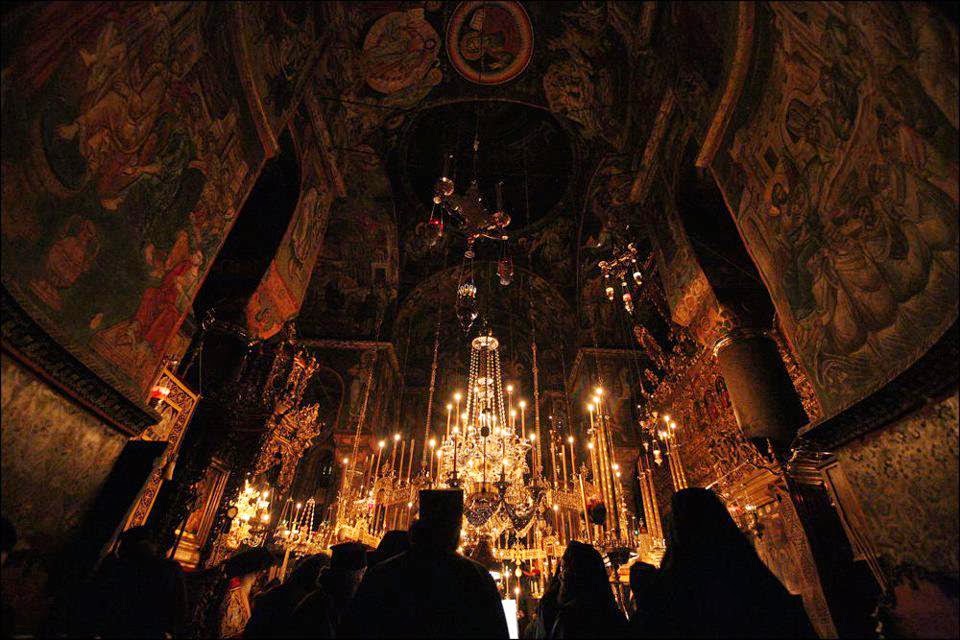
A Meeting Place for Evangelicals, Reformed, and Orthodox Christians

Category: Church History (Page 12 of 20)

Which Path to Church Unity? Recognition vs Reception


Beauty so ancient and so new

Beauty so ancient and so new


From time to time my friends and I get into a discussion about Christian unity.  Anglicans and Roman Catholics seem to be especially eager to reunite with the Orthodox and I have to explain why such efforts are difficult, if not improbable.  This position is often met with frustration and perplexity: Why can’t we just be one?  What’s the hang up?  I began to notice that we seem to be speaking past each other.  As I reflected on this impasse I realized that we were operating from different paradigms.  One is what I call the recognition paradigm and the other, the reception paradigm.

The recognition paradigm involves the mutual recognition of the validity of the other church’s baptism, their clergy’s ordination, their doctrines, and allowing for inter-communion among their members.  The reception paradigm involves one church body accepting the other church’s doctrines and practices as normative, and being received or incorporated into the other church body.  Understanding the difference in paradigms can go a long way in helping Christians understand each other.


Invisible or Visible Church?

The question of church unity depends on how we understand the Church.  When I was a Protestant Evangelical I was taught that there was the visible local congregation and the invisible universal capital “C” church which consists of all true “born again” Christians.  Thus, the ideal Church existed in heaven above all the scandalous divisions among Christians here below.

But when I reflected on the Apostle Paul’s teachings in I Corinthians 12 about the body of Christ I began to see a contradiction between what Paul taught and what modern Evangelicals believed.  An invisible body is essentially a ghost, not a genuine body.  This notion of an invisible body of Christ also ran contrary to I John 1:1-3 which taught that Jesus’ tangible and visible body was the core of the Gospel.  This led me to question whether Evangelicalism’s invisible capital “C” church was theologically sound.

I began to move towards the idea of a visible Church as I started reading about the early Church. I was haunted by Irenaeus of Lyons’ description of the early Church:

Having received this preaching and this faith, as I have said, the Church, although scattered in the whole world, carefully preserves it, as if living in one house.  She believes these things [everywhere] alike, as if she had but one heart and one soul, and preaches them harmoniously, teaches them, and hands them down, as if she had but one mouth.  (Against Heresies 1.10.2; emphasis added)

The early Church shared the same faith and worship all across the Roman Empire.  This was so different from Protestantism’s many denominations.  The early Church was remarkably free of denominationalism, why wasn’t the same true of Protestantism?

I was also struck by the early Christians’ emphasis on the importance of belonging to the visible Church.  Cyprian of Carthage wrote:

He can no longer have God for his Father, who has not the Church for his mother.  (On the Unity of the Church §6)

My view changed further as I reflected on the Nicene Creed’s line: “I believe in one, holy, catholic and apostolic Church.”  The word “one” means that there is only one Church, not two churches, nor two halves.  Nor does it mean the branch theory Anglicanism proposes or the multitude of denominations as is the case with Protestantism.  The problem with the Anglican branch theory is that it substitutes the church catholic with the church comprehensive.  Anglican comprehensiveness superimposes liturgical uniformity on doctrinal pluralism.  Because there is no precedent for this in the early Church, this approach is highly suspect.  Likewise, I began to see that if one took the idea of the visible Church seriously then Protestant denominationalism is like Humpty Dumpty all broken up in pieces waiting for someone to make him whole again.

In Orthodoxy I encountered a different paradigm: the Orthodox Church IS the one holy, catholic, and apostolic Church confessed in the Nicene Creed.  Kallistos Ware in The Orthodox Church wrote:

The Orthodox Church in all humility believes itself to be the ‘one, holy, Catholic and Apostolic Church’, of which the Creed speaks: such is the fundamental conviction which guides Orthodox in their relations with other Christians.  There are divisions among Christians, but the Church itself is not divided nor can it ever be. (p. 307)

For Orthodoxy there has always been one Church.  There may have been people and groups that fell into heresy and schism: they have left the Church but the Church always retained her unity.  A leaf may fall from a tree or a branch may break off, but there still remains one tree.  Theologically speaking, it is heretical to believe that where there was one Church there is now two or more churches, or that the one Church is now broken into several fragments, or that one Church is now invisible.  For Orthodoxy the one Church has never been lost.  It has never gone away because it is here in the Orthodox Church.

Many Western Christians are offended by the Orthodox position.  They interpret this to mean that Orthodoxy is superior to other religious traditions, or that God’s grace is found only in Orthodoxy and absent outside.  The irony of the Orthodox understanding of visible church unity is that it has been regarded as schismatic, especially by Protestants!  This can be seen for example in Gordon-Conwell adjunct professor Preston Graham Jr.’s paper on ecumenicism.  Of the Orthodox understanding he noted:

This option seeks to express visible unit by limiting the church to what is in reality only one denomination or “tradition” based on one interpretation of the meaning of apostolic order/succession such as to exclude all dissenting views of apostolic order/succession. The sum effect of this option is to seek after visible unity by means of schism! (p. 26)


Protestant Egalitarianism

Prof. Graham’s rejection of Orthodox ecclesiology is rooted in Protestantism’s almost dogmatic insistence upon egalitarianism.  There is a certain appeal to Protestantism’s ecclesial egalitarianism; all churches are equal therefore Orthodoxy is just one denomination among many.  This insistence on the equality of all church bodies likely stems from the Reformers’ rejection of the Roman papacy.  It also conforms to the modern mindset which favors individual liberty and equality for all.  If all men have an inherent right to an equal liberty, who’s to say that one Church structure and Tradition should be favored over any other?

Protestant ecclesial egalitarianism can also be found in the Anglican branch theory.  An interesting take on the branch theory is the stance that no one branch is the true Church therefore we all need each other.  There is a certain humility in this stance but it also opens the door to theological relativism.  It is a sad fact that Anglicanism today is theologically incoherent and increasingly fractured.

In addition to Protestant ecclesial egalitarianism, there is corollary epistemological egalitarianism.  This takes the form of all Christians being equal with respect to the interpretation of Scripture.  This is a consequence of the Reformers’ rejection of the papacy.  In light of the supremacy of Scripture (sola scriptura), they feel free to reject or disregard what they call “manmade doctrine.”  More recently, Protestant egalitarianism took a postmodern turn with the Emerging Church movement criticizing the traditional church’s “captivity to Enlightenment rationalism.” (see O’Brien 2009)  The Protestant disbelief in a supernatural capital “T” Tradition makes discussion of reunion highly problematic.  Here we see two disparate paradigms for the source of doctrine.  For Protestants it is Scripture Alone; the church plays an auxiliary role but not a determinative role in the making of doctrine.  The belief that there is no capital “T” Tradition, only manmade traditions, implies a disbelief in Christ’s promise that he would send the Holy Spirit to guide the Church (John 16:13).

But for Orthodoxy, the Church is the recipient and guardian of Apostolic Tradition.  Under the guidance of the Holy Spirit she preserves and expounds Scripture for the generations to come (John 14:26, Ephesians 4:11).  Theological controversy is best settled through the conciliar method.  The Jerusalem Council in Acts 15 provided the precedent for the Ecumenical Councils.  Just as the Jerusalem Council was guided by the Holy Spirit, so also the Ecumenical Councils.

Some of my Anglican friends are appreciative of small “t” tradition, but they view certain Orthodox positions, e.g., Mary as the Theotokos or the veneration of icons, as too extreme.  They see themselves as a moderating center between Orthodoxy and low church Evangelicalism.  But I noticed that like their low church brethren, Anglican Evangelicals reject all supernatural notion of Apostolic Tradition.  The presupposition of sola scriptura held by Protestants, whether low church or high church, constitutes a major obstacle to church reunion.  If Anglicans desire reunion with Orthodoxy they need to be willing to renounce sola scriptura and embrace the very same Holy Tradition passed on by the Apostles.

Scripture Alone does not exclude other sources like ancient church councils and church fathers.  Evangelicals seeking to engage Orthodoxy are often enthusiastic practitioners of ressourcement.  They appropriate from the early Church while blithely ignoring its authority.  This cherry picking approach is fundamentally flawed.  Augustine of Hippo summed up the matter aptly when he wrote:

If you believe what you like in the Gospels, and reject what you don’t like, it is not the Gospel you believe but yourself.

Some Evangelical pastors love to pepper their sermons with quotations from early church fathers but they do this selectively.  Few Protestants have come to grips with the fact that while they embrace certain church fathers as individuals, they ignore the fathers’ Church.  For example, Augustine wrote:

For my part, I should not believe the gospel except as moved by the authority of the Catholic Church.  (Against the Fundamental Epistle of the Manichees, Chapter 5)

Here Augustine was warning against an individualistic Christianity divorced from the visible Church.  This is something that Ancient-Future Evangelicals are reluctant to grapple with.  So my question to Protestants seeking church unity is: Are you willing to put sola scriptura on the table?  In a Facebook thread I described what this approach would entail:

If you really want to put sola scriptura on the table consider whether you would be willing to accept the Council of Nicea’s Creed as authoritative, binding on all Christians, and an infallible guide for understanding what Scripture teaches. For me this conciliar hermeneutics provides the basis for theological unity. A departure from conciliar hermeneutics will result in doctrinal pluralism and relativism. Accepting this position wouldn’t necessarily make you Orthodox but it would provide for a common basis for discussion with Orthodox Christians.

It is good to see Evangelicals develop an interest in the church fathers and the early liturgies.  I would also encourage them to learn from the way the early church fathers read Scripture and to see how the conciliar hermeneutics differ from later Protestant hermeneutics.  A patristically informed biblical hermeneutics can help build bridges between Evangelicals and Orthodox.  (See Scot McKnight’s posting “Patristics and the Bible.”)


Horizontal and Vertical Unity

There are two critical dimensions to church unity.  Horizontal church unity consists of unity among churches across space; vertical church unity consists of unity across time – being united with the ancient churches founded by the Apostles.  Key to vertical unity is apostolic succession through the office of the bishop.  It is through the local bishop that the local Orthodox parish is linked to the early Church.  Reading the writings of the early church fathers or using early liturgical texts do not suffice for vertical unity.  The office of the bishop is one key difference between Protestant and Orthodox approaches to unity.

For Orthodoxy horizontal and vertical unity are both critically important.  They are found in the Eucharist and in the bishop who presides over the Eucharist.  Receiving Communion in Orthodoxy means sharing the same faith as other Orthodox Christians around the world today.  And through its bishop the local Orthodox parish can trace a direct historical link to the “breaking of bread” mentioned in Acts 2:46!

Christians interested in church unity need to understand Orthodoxy’s distinctive understanding of Tradition.  Apostolic Tradition is key to understanding Orthodox ecclesiology.   Bishop Kallistos Ware recounted Father Lev Gillet’s definition of Orthodoxy:

An Orthodox is one who accepts the Apostolic Tradition and who lives in communion with the bishops who are the appointed teachers of this Tradition.  (The Inner Kingdom p. 14; italics in original)

The key here is the crucial role played by the bishop in Apostolic Tradition.  At the time an Anglican, Ware found this to be an eye opener.  He recounted:

Orthodoxy, so I recognized in a sudden flash of insight, is not merely a matter of personal belief; it also presupposes outward and visible communion in the sacraments with the bishops who are the divinely-commissioned witnesses to the truth (The Inner Kingdom p. 15; emphasis added).

So with respect to Orthodoxy’s claim to be the true Church, the question is not superiority versus inferiority, but rather fidelity to and continuity with Apostolic Tradition.

In the early Church the bishop was more than an administrator, as the successor to the Apostles he presided over the Eucharist and guarded the doctrinal purity of the Church. This understanding of the crucial role of the episcopacy to the integrity and unity of the Church is an ancient one.  Irenaeus of Lyons wrote:

This is true Gnosis: the teaching of the apostles, and the ancient institution of the church, spread throughout the entire world, and the distinctive mark of the body of Christ in accordance with the succession of bishops, to whom the apostles entrusted each local church, and the unfeigned preservation, coming down to us, of the scriptures, with a complete collection allowing for neither addition nor subtraction, a reading without falsification and, in conformity with the scriptures, so interpretation that is legitimate, careful, without danger of blasphemy. (Against Heresies 4.33.8; emphasis added)

Augustine had a similar high view of the episcopacy.  He wrote:

The consent of peoples and nations keeps me in the Church; so does her authority, inaugurated by miracles, nourished by hope, enlarged by love, established by age. The succession of priests keeps me, beginning from the very seat of the Apostle Peter, to whom the Lord, after His resurrection, gave it in charge to feed His sheep, down to the present episcopate.  (Against the Fundamental Epistle of the Manichees, Chapter 5; emphasis added)

Many Protestant churches do not have bishops or if they do have bishops are unable to trace an unbroken lineage back to the Apostles.  The concept of apostolic succession is alien to Protestant theology.  Much of the efforts at church unity by Protestants have been focused on horizontal unity with little attention given to vertical unity.  This is the greatest flaw in the mutual recognition approach to church unity.  In its pursuit of horizontal unity it has sacrificed vertical unity.

A local Orthodox parish cannot modify its liturgy or doctrine unilaterally.  If a local Orthodox parish were to do so in order to have unity with their Protestant neighbors they will have severed their connections with the Orthodox Church worldwide not to mention their ties with the early Church.  Moreover, no Orthodox bishop would permit a local parish to stray from Apostolic Tradition.  The bishop’s job is to preserve the unity and integrity of the Church.

There are two types of church bodies: those whose episcopacy can claim linkage to the original Apostles (Orthodoxy, Roman Catholicism, and the Non-Chalcedonian churches) and those whose leadership cannot make that claim (Protestantism).  Recognition to one degree or another is possible with these church bodies that can claim historic ties to the early Church (see Ware The Orthodox Church pp. 311-316).  But in the case of Protestants who have broken off from the papacy recognition is ruled out as an option.  This means that union with the Orthodox Church is through reception.


Western Ecumenicism

It seems that for Western Christianity church unity is a problem that needs to be solved, that church unity has been lost and needs to be restored.  There seems to be a certain eagerness and anxiety in the West’s endeavors to achieve unity with Orthodoxy.  When it comes to unity among Christians two important issues need to be addressed: (1) the nature of the unity we seek and (2) and the path we are to take to get there.

For example, my Anglican friends insist that they are part of the “catholic church” confessed in the Apostles Creed and the Nicene Creed.  They note that they use the “same” Nicene Creed as the Orthodox and that they too can claim apostolic succession.  In the course of numerous discussions I began to realize that while my Anglican friends don’t hold to Orthodox doctrine or follow Orthodox practices, what they want is for Orthodoxy to recognize the validity of their Anglican doctrines, rites, and clergy.  In other words, they are seeking mutual recognition between Anglicans and Orthodox even with the disparity in doctrine, worship, and polity.

Mutual recognition is also the strategy that Roman Catholics are using with Orthodoxy.  Pope John Paul II adopted the branch theory when he spoke of Roman Catholicism and Orthodoxy as two lungs breathing together.  They are not asking any changes in Orthodox doctrine and practice; “all” they are asking for is for Orthodoxy to come under the authority of the Bishop of Rome which for Orthodoxy is a deal breaker.

Related to the mutual recognition paradigm is interfaith dialogue.  Many in the ecumenical movement approach interfaith dialogue much in the spirit of labor versus management negotiations: We will give a little on this, if you give a little on that. They believe that doctrine, worship, and polity are all “on the table.”  Another ecumenical tactic is to redefine or reframe theological issues so that both sides, once at odds with each other, can now sign a joint statement.  Orthodox priest Georges Florovsky called this “doctrinal minimalism.” This approach to ecumenicism is based on an ecclesial pragmatism and theological relativism, or a theological reductionism that seeks to frame doctrine in broadest possible terms.

But for Orthodoxy Holy Tradition is the fullness of the Faith and therefore not negotiable.  The Church is not a social construct but a divine creation founded by Christ himself (Matthew 16:18).  Thus, one of the major impediments to ecumenical dialogue is that we differ significantly on the goal (the kind of unity we seek) and the means (the path to unity).


Christian Collaboration in a Pluralistic Society

There are two kinds of goals for Christian unity.  One goal is Christian unity in the form of one family.  The family model of Christian unity is based on the assumption that we are all related to one another and that we live under the same roof.  Given the Orthodox understanding of church unity, union with Protestants through the recognition paradigm is unfeasible.  The only viable path to unity is through reception.

But what if Protestants are not ready to give up their core Protestant beliefs, what then?  I suggest that there is an alternative approach to Christian unity available to Orthodox and non-Orthodox.  That is Christian unity in the form of being friendly neighbors.  We live next door to each other but we live under separate roofs.  We coexist peacefully and work cooperatively on important projects in the name of Christ.


We need to encourage and support friendly cooperative relations across the Christian traditions.  We can respect each others’ different traditions as we seek to work together for a Christian witness in a pluralistic, post-Christian American society.  The annual March for Life in which Protestants, Roman Catholics, and Orthodox come together is a good example interfaith cooperation.


In Hawaii I am happy to be part of a monthly get together of “mere Christians” comprised of Protestants, Anglicans, Roman Catholics, and Orthodox Christians.  We come together in Christ’s love from our different church traditions for a common meal and a talk on faith and culture.


Unity through Coming Home
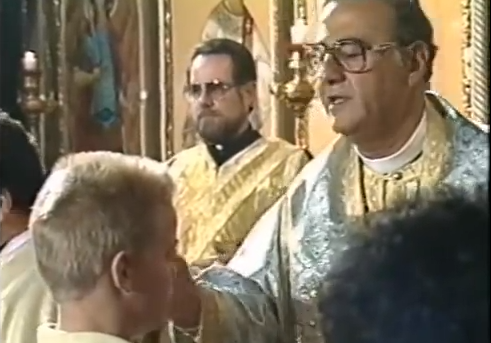
What is the reception method like?  In the 1970s a group of Evangelicals became interested in the early Church.  They discovered to their great surprise that early Christian worship was liturgical and sacramental so they became liturgical and sacramental in their worship.  They found out that the early Church was creedal so they adopted the Nicene Creed.  Along the way they found out the early Church had priests and bishops, so they ordained each other as priests and appointed their own bishops!  They even went so far as to make altars and put up tiny postcard size icons behind their altars.  They thought of themselves as “orthodox” until they came face to face with Eastern Orthodoxy.  Peter Gillquist tells the story how this group of Evangelicals was received into the Antiochian Orthodox Church in his book Becoming Orthodox.  But in terms of numbers this paled in comparison with the reception of some twenty thousand Uniates into Orthodoxy in the late 1800s.

There is a great hunger among Protestants today for the early Church and for church unity.  This has led to many rediscovering the early church fathers and seeking to bring back liturgical worship.  This hunger for ancient Christianity manifested itself in the 1800s in the Mercersburg Theology in the US and in the Oxford movement in England, and more recently in the Federal Vision movement and the Ancient-Future worship movement.  This recent enthusiasm for church unity and the ancient faith is very commendable but carries a high price tag.  If one wishes to enter into Eucharistic unity with the ancient Church one must be prepared to give up aspects of Protestantism that are at odds with the ancient Christian Faith.  Reception should not be viewed as an obstacle but an open door.  Thousands of Protestants have already taken this bold step and hopefully many more in the days to come will unite themselves with the one Church confessed in the Nicene Creed.

Robert Arakaki

Other articles:

Former Church of England priest Michael Harper‘s conversion story

A Calvinist Anglican Converts to Orthodoxy” Interview: Joseph Gleason with Mark Bradshaw — Journey to Orthodoxy (24 October 2013)

Episcopal congregation embracing Orthodox faith” by Carla Hinton NewsOK (7 July 2007)

St. Alexis Toth – Confessor of the Orthodox Faith in America

Service Text: “Service for the Reception of Converts” (denver.goarch.org)
 

Tertullian Refutes the “Fall of the Church” Heresy


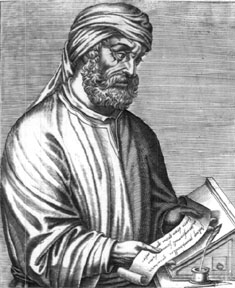
Tertullian

Tertullian

The “fall of the church” heresy is widely held among Protestants but not unique to Protestants.  The “fall of the church” was something that early Christians had to contend with as well.  Tertullian answered it in “The Prescription Against Heretics.”

The “fall of the church” refers to the belief that after the Apostles died the early Christians strayed from the original Apostles’ teachings and practices.  This has been known as the great Apostasy, or the BOBO theory – the Blink Off/Blink On of the Holy Spirit’s activity in the life of the Church.

Tertullian (c. 160 – c. 225) lived in Carthage, a North African Roman province.  He was a lawyer by training and one of the more influential Latin theologians in the early Church.  While he did fall into error towards the end of his life and is not considered by many Orthodox a “church father,” his early writings can nevertheless be helpful to understanding early Christianity. 

Prescription is one of the more important and highly regarded works of Tertullian for patristic studies.  Quasten wrote in his Patrology:

De praesciptione haereticorum is by far the most finished, the most characteristic, and the most valuable of Tertullian’s writings.  The main ideas of this treatise have won for it enduring timeliness and admiration.  Although it can be assigned no definite date, it was quite obviously written when the author was still on the best of terms with the Catholic Church, probably around the year 200 A.D.  (p. 272)


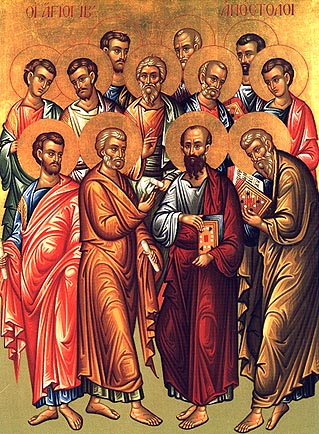
Apostles of Christ

Apostles of Christ

Defining Orthodoxy 

The “fall of the church” was one of several arguments used by early heretics to draw people away from the Church.  To understand these errors it is important to understand the way early Christians understood orthodoxy.  In the early Church orthodoxy (right doctrine) was based on apostolicity.  Apostolicity meant that a local church was able to trace its teachings back to the original Apostles via the traditioning process.

Tertullian wrote:


It remains, then, that we demonstrate whether this doctrine of ours, of which we have not given the rule, has its origin in the tradition of the apostles and whether all other doctrines do not ipso facto proceed from falsehood. (Prescription 21; italics in original; bold added).

. . . and after first bearing witness to the faith in Jesus Christ throughout Judaea, and founding churches (there), they next went forth into the world and preached the same doctrine of the same faith to the nations. They then in like manner founded churches in every city, from which all the other churches, one after another, derived the tradition of the faith, and the seeds of doctrine, and are every day deriving them, that they may become churches.  Indeed, it is on this account only that they will be able to deem themselves apostolic, as being the offspring of apostolic churches. (Prescription 20.4-6; emphasis added)

Here we see that the Great Commission is basically the transmission of Holy Tradition.  This may come as a surprise to many Evangelicals who assume that the Apostles went out to all the nations with a leather bound Bible under their arms.  But it needs to be kept in mind that all that the Apostles had were Christ’s teachings and deeds carefully memorized and stored in their hearts.  Similarly, when they planted churches the early converts had to learn by heart the Apostles’ teachings.  It would not be until decades later that the Gospels and the Epistles be written down on paper; and even then it would not be until centuries later that a formal collection known as the “New Testament” came to be recognized by the early Church.  The biblical canon came about as the early bishops individually and in councils carefully scrutinized which early writings were indeed divinely inspired and apostolic.

In Tertullian’s time there were churches planted by the Apostles and there were churches that learned the Gospel from the first churches; both could claim apostolicity in light of the fact that they shared the same Apostolic Faith.  Tertullian wrote:

Therefore the churches, although they are so many and so great, comprise but the one primitive church, (founded) by the apostles, from which they all (spring).  In this way all are primitive, and all are apostolic, whilst they are all proved to be one, in (unbroken) unity, by their peaceful communion, and title of brotherhood, and bond of hospitality, —privileges which no other rule directs than the one tradition of the selfsame mystery. (Prescription 20.7-8; emphasis added)

In Tertullian’s time Christianity did not have an elaborate set of institutions like seminaries, bookstores, bible camps, and TV stations.  Basically, early Christianity consisted of the local church under the leadership of the bishop, the successor to the Apostles.  For Tertullian one indicator of theological orthodoxy was being able to trace one’s bishop’s succession back to the original Apostles.

But if there be any (heresies) which are bold enough to plant themselves in the midst of the apostolic age, that they may thereby seem to have been handed down by the apostles, because they existed in the time of the apostles, we can say: Let them produce the original records of their churches; let them unfold the roll of their bishops, running down in due succession from the beginning in such a manner that [that first bishop of theirs ] bishop shall be able to show for his ordainer and predecessor some one of the apostles or of apostolic men,— a man, moreover, who continued steadfast with the apostles. (Prescription 32; emphasis added)

Just as significant is the importance Tertullian placed on the Eucharist as proof of orthodoxy: to be doctrinally orthodox was to be in communion with the apostolic churches. In the early church the claim was made that the teachings one heard at the weekly Eucharist were the same one as that taught by the original Twelve.

We hold communion with the apostolic churches because our doctrine is in no respect different from theirs.  This is our witness to the truth.  (Prescription 21)

In summary, Tertullian’s description of early orthodoxy consisted of: (1) the traditioning process, (2) the local bishop as successor to the Apostles, and (3) the Eucharist as the sign of doctrinal unity.


Holy Tradition or Sola Scriptura?

Tertullian advanced a number of arguments that would make a Protestant’s hair stand.  In Prescription 19.1 he opens with: “Our appeal, therefore, must not be made to the Scriptures. . . .”  Unlike Protestants who view Scriptures as a level playing field that anyone can read and anyone can interpret according to their conscience, Tertullian viewed Scripture as part of the sacred deposit entrusted to Church, recognized by the Church, and safeguarded for future generations by that same Church.

For wherever it shall be manifest that the true Christian rule and faith shall be, there will likewise be the true Scriptures and expositions thereof, and all the Christian traditions. (Prescription 19.3; italics in original)

There is no shred of evidence of Protestantism’s sola scriptura in Tertullian’s Prescription.  What we find is the oral Tradition supplemented by written Tradition, and the two complementing the other.

Now, what that was which they preached—in other words, what it was which Christ revealed to them—can, as I must here likewise prescribe, properly be proved in no other way than by those very churches which the apostles founded in person by declaring the gospel to them directly themselves, both viva voce, as the phrase is, and subsequently by their epistles (Prescription 21.3; italics in original; bold added)

The early Christians never separated the two but saw the oral and the written forms of Tradition as integral to each other.  Naturally, the oral form of the Apostolic teaching preceded the written form and continues to this day to inform the Church’s understanding of the New Testament text.  In other words, early biblical exegesis was rooted in oral Tradition and did not arise from an independent objective reading of the Scripture text.  It was a ecclesial activity, and not something carried out independently of the Church and its bishops.


Early Attacks on Orthodoxy

The early heretics used a variety of arguments designed to undermine the faith of the early Christians.  The heresies are all aimed at attacking the notion of apostolicity.  They make sense if orthodoxy is grounded in the traditioning process; but don’t make sense if early orthodoxy is based on sola scriptura.

Heresy # 1 – Christ had Other Apostles (Prescription 21)

Heresy #2 -– The Apostles Didn’t Know All There Was to Know (Prescription 22.2)

Heresy #3 – The Apostles Knew All There Was to Know But Chose to Hold Some Things Back (Prescription 22.2)

Heresy #4 – Peter’s Knowledge of the Gospel Inferior to Paul’s (Prescription 23 & 24)

Heresy #5 – Paul’s Knowledge of the Gospel Superior to Peter’s (Prescription 23 & 24)


Tertullian Refutes the “Fall of the Church” Heresy

Tertullian describes the “fall of the church” heresy:

. . .let us see whether, while the apostles proclaimed it perhaps, simply and fully, the churches, through their own fault, set it forth otherwise than the apostles had done. (Prescription 27.1)

The early heretics cited Paul’s letter to the Galatians in support of the fall of the church theory: “O foolish Galatians, who hath bewitched you?” and “Ye did run so well; who hath hindered you?”  They also pointed to Paul’s admonishment to the Corinthians about their being carnal and suited only for milk, not meat.  Tertullian points out that the heretics failed to take into account that the early churches likewise responded to Paul’s correction.  In addition, Tertullian pointed to Christ’s promise of the Holy Spirit guiding the Church “into all truth” (John 14:26) as evidence against the fall theory.

Grant, then, that all have erred; that the apostle was mistaken in giving his testimony; that the Holy Ghost had no such respect to any one (church) as to lead it into truth, although sent with this view by Christ, and for this asked of the Father that He might be the teacher of truth; grant, also, that He, the Steward of God, the Vicar of Christ, neglected His office, permitting the churches for a time to understand differently, (and) to believe differently, what He Himself was preaching by the apostles,—is it likely that so many churches, and they so great, should have gone astray into one and the same faith? (Prescription 28.1; emphasis added)

In Chapter 28, Tertullian points out the implication of the fall of the church heresy.  It means a widespread apostasy among the early Christians and that even Paul was mistaken in his witness to the Gospel.  Furthermore, it means that John 14:26 was not fulfilled even though Christ promised that He would send the Holy Spirit to guide the Church.  Furthermore, it implies that the third Person of the Trinity, the Holy Spirit, the “Vicar of Christ” failed to do his job and that Christ made a false promise!

Tertullian points out that if the “fall of the church” theory held true then the churches would have diverged significantly from the teachings of the Apostles and that in turn would have resulted in theological divergences among the churches.  But theological divergences were not to be found among the churches but with the heretics.

Error of doctrine in the churches must necessarily have produced various issues.  When, however, that which is deposited among many is found to be one and the same, it is not the result of error, but of tradition.  Can anyone, then, be reckless enough to say that they were in error who handed on the tradition? (Prescription 28.2-4)

Where diversity of doctrine is found, there, then, must the corruption both of the Scriptures and the expositions thereof be regarded as existing.  On those whose purpose it was to teach differently, lay the necessity of differently arranging the instruments of doctrine. (Prescription 38.1-2)

Tertullian notes that where error results in fragmentation, orthodoxy results in doctrinal uniformity (unity) among the early Christians.  Doctrinal unity flows from fidelity to the traditioning process used by the Apostles in transmitting the Gospel.

Tertullian sketches out what the “fall of the church” would have looked like if it did in fact happen:

During the interval the gospel was wrongly preached; men wrongly believed; so many thousands were wrongly baptized; so many works of faith were wrongly wrought; so many miraculous gifts, so many spiritual endowments, were wrongly set in operation; so many priestly functions, so many ministries, were wrongly executed; and, to sum up the whole, so many martyrs wrongly received their crowns! (Prescription 29.3)

In other words (at least in Tertullian’s mind) it is unthinkable and ludicrous to suppose that all the good things done by the early Christians were in fact bad things.  Also, Tertullian points out that if such a massive defection had occurred then one logical consequence would be doctrinal pluralism.  To put it another way, it does not make sense that so many Christians would have gone wrong all in the same direction at the same time!


Tertullian Compared With Irenaeus of Lyons

Where Tertullian’s standing as a church father is in question, the same cannot be said of Irenaeus of Lyons who is considered to be the greatest theologian of the second century.  Tertullian and Irenaeus were contemporaries having lived in the latter half of the second century.

While Tertullian’s apologetics strategy In Prescription Against Heretics may strike Protestants as somewhat odd, it bears strong resemblance to Irenaeus’ Against Heresies.  A comparison between the two shows strong similarities in the way they understood early orthodoxy: (1) both assumed doctrinal orthodoxy to rest on Apostolic Tradition (Prescription 20.4-6; Against Heresies 3.1.1), (2) both understood Apostolic Tradition to exist first in oral then in written form (Prescription 21.3; Against Heresies 3.4.2), (3) both taught that orthodox churches were those who could trace their bishop’s succession back to the original Apostles (Prescription 32.1; Against Heresies 3.3.1), and (4) both asserted that a key sign of doctrinal orthodoxy is the unity of faith among Christians (Prescription 20.7-8; Against Heresies 1.10.1).

Tertullian taken together with Irenaeus gives us valuable insight into the theological method of the early Church.  Their theological method bears a striking resemblance to the Orthodox Church but also striking disparity with the theological method(s) of Protestantism.


Conclusions

The “fall of the church” heresy was not unique to Protestants but something that the early Church had to contend with as well. Protestants have used the “fall” as a way of justifying their breaking away from the Church of Rome, and the early heretics used it as a way creating an opening so they could present their alternative gospel to their listeners.

Tertullian refuted the “fall of the church” theory on four grounds: (1) biblical – it implied the failure of the Holy Spirit to guide the Church “into all truth” which in turn implied the failure of Christ’s promise in John 14:26, (2) theological – it implied the denial of divine sovereignty, (3) sociological – if true the fall of the church would have resulted into doctrinal fragmentation which flies in the face of the doctrinal unity shared by early Christians, and (4) historical –there was no evidence of a massive defection among early Christians.

Tertullian’s refutation of the “fall of the church” heresy is instructive for Orthodox-Reformed dialogue.  It sheds light on how orthodoxy was understood in the early Church.  In early Christianity orthodoxy was premised on apostolic succession and fidelity to the traditioning process resulting from a continuing Pentecost via the Holy Spirit.  Capital “O” Orthodoxy today claims this same basis for its claim to be the true Church founded by Christ and his Apostles.

Protestants have an understanding of apostolicity different from Tertullian’s.  The Protestant principle of sola scriptura assumes that apostolicity resides in the apostolic authorship of the New Testament and that Scripture is sufficient in itself to guarantee right doctrine.  With the exception of the Anglicans, the vast majority of Protestants reject apostolic succession as a marker of orthodoxy.

One of the biggest challenges that Tertullian’s Prescription poses to Protestantism is his claim that heresy results in doctrinal diversity.  This is especially daunting in light of the multitude of Protestant denominations.  There are some Protestants who might point out differences even among some of the Apostolic Fathers, as if this disproves Tertullian’s claim to unity. What do we say to this? Was Tertullian’s sense of broad unity among the early churches wrong?  Was there, as these Protestants must establish, a doctrinal free-for-all among the early churches? No, the early Christians’ unity in the Pentecost promise of the Holy Spirit was real and Tertullian was right. What differences that existed were largely minor for the Church as a whole and did not disrupt the Eucharistic unity among the early Christians.  If there was no “fall of the church” in early Christianity then Protestants will need to reconsider their insistence on the need for the reform of the Church.  Orthodoxy claims that in light of the fact that it has faithfully kept the Apostolic Tradition Protestants need look no further for the primitive apostolic Church described by Tertullian.

Robert Arakaki 


Source

Tertullian.  1980.  “The Prescription Against the Heretics.”  In The Ante-Nicene Fathers, Vol. III, pp. 243-265.  Reprinted 1980.  Translators: Alexander Roberts and James Donaldson.  Wm. B. Eerdmans Press: Grand Rapids, Michigan.

Irenaeus of Lyons.  1985.  “Against Heresies.”  In The Ante-Nicene Fathers, Vol. I, pp. 315-567.  Reprinted 1985.  Translators: A. Cleveland Coxe.  Wm. B. Eerdmans Press: Grand Rapids, Michigan.

Quasten, Johannes.  1986.  Patrology.  Volume II.  The Ante-Nicene Literature After Irenaeus.  Christian Classics, Inc.: Westminster, Maryland.


Calvin and the “Fall of the Church”


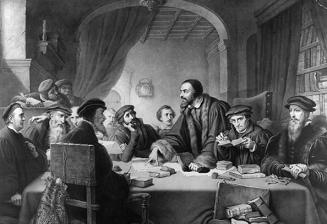
jean_calvin_counselDid John Calvin believe in the “Fall of the Church”?  That is, did he believe that the early Church apostatized from Apostolic doctrine and worship, and that true Christianity was not restored until the Protestant Reformation?  The “Fall of the Church” is widely held among Protestants but some of our readers deny that Calvin held this view calling it a “canard.”


Part I. The BOBO Theory

Fuller Seminary professor and missiologist Ralph D. Winter noticed that many Evangelicals are under the impression that Christianity “Blinked-Out” after the Apostles and then “Blinked-On” with the Protestant Reformers.

. . . “BOBO” theory—that the Christian faith somehow “Blinked Out” after the Apostles and “Blinked On” again in our time, or whenever our modern “prophets” arose, be they Luther, Calvin, Wesley, Joseph Smith, Ellen White or John Wimber. The result of this kind of BOBO approach is that you have “early” saints and “latter-day” saints, but no saints in the middle.

Winter noted that this view has resulted in Protestants having little interest in the one thousand years of church history before the Reformation because nothing spiritually important was happening between the New Testament church and the 1500s.  Winter wrote about the negative effect this had on Protestants:

But this only really means that these children do not get exposed to all the incredible things God did with that Bible between the times of the Apostles and the Reformers, a period which is staggering proof of the unique power of the Bible! To many people, it is as if there were “no saints in the middle.”

The BOBO theory is crucial to Protestantism’s self understanding.  Protestants believe that after the calamitous “Fall of the Church,” the Reformation marked a return to the early Church – the way it was meant to be.  Without this justification, the Reformation would be a schismatic deviation.  Sometimes one is presented with a more subtly nuanced version that allows for a small continuing “Remnant Church” present throughout church history that held on to the True Faith – of course assumed to be more or less Protestant.  The problem with this view, aside from the lack of historical evidence, is that this supposed historic “Remnant” existed independently of any historically recognized Church be it Orthodox or even Roman Catholic.


Did Calvin Hold to the BOBO Theory?

In “Necessity of Reforming the Church” Calvin made reference to the “primitive and purer Church” (p. 215).  In his Institutes Calvin saw icons, altars, vestments, ritual gestures, and other decorations as signs of the early Church’s decline and degeneration.

First, then, if we attach any weight to the authority of the ancient Church, let us remember, that for five hundred years, during which religion was in a more prosperous condition, and a purer doctrine flourished, Christian churches were completely free from visible representations. Hence their first admission as an ornament to churches took place after the purity of the ministry had somewhat degenerated. I will not dispute as to the rationality of the grounds on which the first introduction of them proceeded, but if you compare the two periods, you will find that the latter had greatly declined from the purity of the times when images were unknown. (Institutes 1.11.13, p. 113; emphasis added)

Calvin also traced the fall of the church to the emergence of liturgical worship, something that commenced soon after the original Apostles passed on.  Calvin wrote in the Institutes:

Under the apostles the Lord’s Supper was administered with great simplicity.  Their immediate successors added something to enhance the dignity of the mystery which was not to be condemned.  But afterward they were replaced by those foolish imitators, who, by patching pieces from time to time, contrived for us these priestly vestments that we see in the Mass, these altar ornaments, these gesticulations, and the whole apparatus of useless things. (Institutes 4.10.19, p. 1198; emphasis added)

In this passage we find a succession of: (1) “the Apostles,” (2) their second generation “immediate successors,” and (3) the subsequent generations of “foolish imitators.”  What Calvin is asserting here is that the Eucharist underwent considerable change shortly after the passing of the Apostles resulting in the “Fall of the Church.”  That all this happened within a few decades or in the first century after the Apostles’ repose raises serious questions about Calvin’s understanding of post-Apostolic Christianity.  Calvin here is implying that the Apostles’ disciples disregarded Paul’s exhortations to “preserve” and “guard” the Faith “with the help of the Holy Spirit” (see 2 Timothy 1:14).  This alleged “Fall” raises serious questions about the sincerity of the Apostles’ disciples and about the Holy Spirit’s presence in the early Church.  This is not a small claim but very serious accusations!

We have here two different versions of the “Fall of the Church”: (1) an immediate Fall right after the passing of the original Apostles (Institutes 4.10.19) and (2) a later Fall after the first five centuries (Institutes 1.11.13).  This inconsistency makes it hard for a church history major like me to ascertain when the “Fall” took place, who instigated the “Fall,” and what was the driving force behind the “Fall.”


The Blinked-Out, Blinked-On trope is especially evident in Calvin’s essay “The Necessity of Reforming the Church”:

This much certainly must be clear alike to just and unjust, that the Reformers have done no small service to the Church in stirring up the world as from the deep darkness of ignorance to read the Scriptures, in labouring diligently to make them better understood, and in happily throwing light on certain points of doctrine of the highest practical importance. (“Necessity” pp. 186-187, cf. p. 191; emphasis added)

We maintain to start with that, when God raised up Luther and others, who held forth a torch to light us into the way of salvation, and on whose ministry our churches are founded and built, those heads of doctrine in which the truth of our religion, those in which the pure and legitimate worship of God, and those in which the salvation of men are comprehended, were in a great measure obsolete. (“Necessity” pp. 185-186; emphasis added)

Therefore, from the evidences above it is clear that Calvin did in fact hold to the BOBO theory of church history.  Orthodox theologians and historians can in many ways agree with Calvin about the Roman Church’s decline.  However, where many Orthodox view Rome’s decline as having occurred after the Great Schism of 1054, Calvin viewed the “Fall of the Church” as having occurred during the time of the Ecumenical Councils when Rome was in communion with the other patriarchates.  This is something Orthodox Christians would find problematic.  Orthodoxy believes that it has faithfully kept and preserved Apostolic Tradition for the past two thousand years and because it never suffered a “Fall” is the same Church as the early Church.


Calvin’s Dispensationalism

Calvin’s understanding of church history as discontinuous marked by ruptures is not all that anomalous.  One sees a similar understanding in Calvin’s view of the relationship between the Old and New Covenants.  He wrote:

For if we are not to throw everything into confusion, we must always bear in mind the distinction between the old and new dispensations, and the fact that ceremonies, whose observance was useful under the law, are now not only superfluous but absurd and wicked.  When Christ was absent and not yet manifested, ceremonies by shadowing him forth nourished the hope of his advent in the breasts of believers; but now they only obscure his present and conspicuous glory.  We see what God himself has done.  For those ceremonies which he had commanded for a time he has now abrogated forever. (“Necessity” p. 192; emphasis added)

The problem with this statement is that it is unbiblical.  It contradicts Matthew 5:17 where Christ taught that he did not come to abolish (abrogate) the Law but to fulfill it.  With the New Covenant came a new priesthood based on Christ’s priesthood and a new form of worship based on Christ’s sacrificial death on the Cross.  Here It seems is the root cause of Calvin’s mistake – he tragically transposed the Protestants’ controversy with Roman Catholicism onto the early Church.


Part II. The Historical Evidence

Calvin’s belief that the early church fell away from the Apostles’ teachings can be tested by examining the earliest Christian writings with respect to: (1) the Eucharist, (2) the use of icons in worship, (3) the Gospel Message, and (4) church government (the episcopacy).  We will be using the following writings: (1) the Didache (c. 90-110), (2) the letters of Ignatius of Antioch (d. 98-117), (3) Justin Martyr’s Apology (d. 165), and (4) Irenaeus of Lyons’ Against Heresies (d. 202).  These comprise the earliest Christian writings outside the New Testament and thus give us valuable insights into the faith and practices of the post-Apostolic Church and allow us to ascertain the degree of continuity in faith and practice.


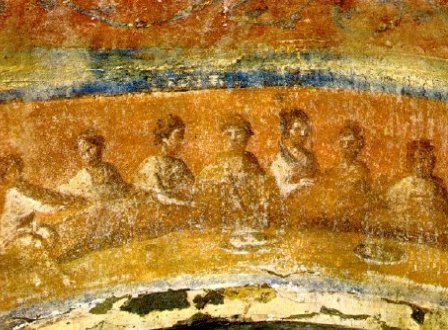
3rd century Roman catacomb painting

Eucharistic meal – 3rd century Roman catacomb


The Eucharist

One way of testing Calvin’s “Fall of the Church” theory is by examining early Christian worship.  One feature that immediately stands out is the importance of the Eucharist for the early Christians and their sacramental understanding of the Eucharist.

When I was a Protestant one thing I always heard at the monthly Holy Communion service was the pastor emphasizing that the bread and the grape juice were just symbols.  So when I read the early church fathers I was struck by the fact that none of the church fathers taught that the bread and the wine were just symbols.  As a matter of fact, they taught something quite different.  Ignatius of Antioch referred to the Eucharist as the “medicine of immortality (Letter to the Ephesians 20:2).  His belief in the real presence can be found in another letter.

I desire the “bread of God,” which is the flesh of Jesus Christ, who was “of the seed of David,” and for drink I desire his blood, which is incorruptible love. (Letter to the Romans 7.3; emphasis added)

Belief in the real presence can also be found in Justin Martyr.

For not as common bread and common drink do we receive these; but in like manner as Jesus Christ our Saviour, having been made flesh by the Word of God, had both flesh and blood for our salvation, so likewise have we been taught that the food which is blessed by the prayer of His word and from which our blood and flesh by transmutation are nourished, is the flesh and blood of that Jesus who was made flesh.  (The First Apology 66; emphasis added)

Another early witness to the real presence in the Eucharist is Irenaeus.

When, therefore, the mingled cup and the manufactured bread receives the Word of God, and the Eucharist of the blood and the body of Christ is made, from which things the substance of our flesh is increased and supported, how can they affirm that the flesh is incapable of receiving the gift of God, which is life eternal . . . . (Against Heresies 5.2.3; emphasis added)

The Eucharist was central to early Christian worship and theology.  In the early church to deny the real presence in the Eucharist was to commit heresy.  Ignatius of Antioch wrote regarding the heretics:

They abstain from Eucharist and prayer, because they do not confess that the Eucharist is the flesh of our Saviour Jesus Christ who suffered for our sins, which the Father raised by his goodness. (Letter to the Smyrneans 7.1; emphasis added)

As an Evangelical I was struck by the fact that it was the heretics who denied the real presence in the Eucharist.  Just as significant is Ignatius’ insistence that the Eucharistic celebration is integrally linked to the office of the bishop.  In other words, early church government was episcopal, not congregational!

Be careful therefore to use one Eucharist (for there is one flesh of our Lord Jesus Christ, and one cup for union with his blood, one altar, as there is one bishop with the presbytery and the deacons my fellow servants), in order that whatever you do you may do it according to God. (Letter to the Philadelphians 4.1)

As an Evangelical in a congregationalist denomination I was unsettled by the fact that modern Evangelicalism was much closer to the early heretics than they realize.  This started me thinking:  Was it the early Christians who fell away or the modern Evangelicals?  Why is Evangelicalism so different from the early Church?

Thus, the evidence shows that the Eucharist was at the center of early Christian worship – not the sermon.  By subtly displacing the Eucharist and putting the sermon at the center of Christian worship, Calvin detached the heart and focus of worship from its Eucharistic moorings. Those who came after Calvin would go even further and strip Christian worship of its sacramental character. One only need witness today’s Protestant worship to see the absence of the Eucharist most every Sunday – much less the real presence of the Body and Blood of Christ in the Eucharist! This has resulted in the recent move among Protestants to restore liturgical worship, but even then the sermon still overshadows the Eucharist.


Altar, Vestments, and Ceremonies

Calvin taught that the early church celebrated the Eucharist with “great simplicity” (Institutes 4.10.19).  But he is arguing from silence.  He seems to be assuming that because the New Testament writings had little to say about how the early Christians worshiped that their worship was devoid of liturgical rites and ceremonies.

When we read the Old Testament we find biblical support for the use of altars, vestments, and ceremonies in worship.  The Tabernacle had two altars: one for burnt offering (Exodus 27:1-8) and another for incense (Exodus 30:1-10).  The priests were dressed in ornate vestments of gold, blue, purple, and scarlet in accordance with God’s directions to Moses (Exodus 28:1-5).  Thus, Old Testament worship was an elaborate affair with processions, music, and ceremonies – nothing at all like the stark austere Reformed worship!

When we come to the New Testament we find no evidence of Old Testament worship being abolished and the instituting of minimalist worship with bare walls.  We do, however, find hints of Old Testament worship being carried over into Christianity.  In Hebrews 13:10 is a cryptic statement: “We have an altar . . . .”  This was a reference to the Eucharistic celebration.  The Christians saw themselves as the New Israel of Christ and in that light viewed the Eucharist as the continuation and fulfillment of the Old Testament sacrificial system.  So we shouldn’t be surprised by Ignatius’ references to a Christian altar.

Be careful therefore to use one Eucharist (for there is one flesh of our Lord Jesus Christ, and one cup for union with his blood, one altar . . . . (Letter to the Philadelphians 4.1; emphasis added)

And,

Hasten all to come together as to one temple of God as to one altar, to one Jesus Christ, who came forth from the one Father, and is with one, and departed to one.  (Letter to the Magnesians 7.2; emphasis added)

If the early Christians understood the Church as the Temple of the New Covenant then it is no surprise that they would view the clergy as the priests of the New Covenant (see Isaiah 66:19-21).  All this makes sense in light of the fact that the Eucharist was central to early Christian worship.  Thus, the wooden table or box (ark) where the priest celebrated the Eucharist would be considered an altar.


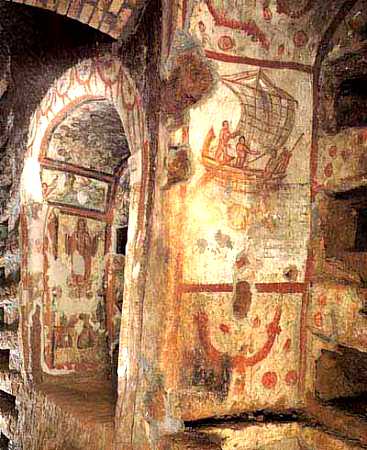
Prophet Jonah - Roman catacomb painting

Orant gesture in background, Prophet Jonah in foreground – Roman catacomb painting

Icons

Calvin believed that the early churches were “completely free from visible representations” (Institutes 1.11.13).  His assumption seems to be that because the New Testament had little to say about religious pictures in church buildings that icons were not part of early Christian worship.

But Calvin’s iconoclasm is weakened when we take into account the Old Testament passages about the images of the cherubim in the Tabernacle (Exodus 26:1, 31) and in the Temple (1 Kings 6:29-32).

Thus, the Old Testament places of worship were filled with visual representations: cherubim, palm trees, and flowers.  Images of the cherubim were depicted on the curtain for the entrance to the Holy of Holies as well on the walls of the inner and outer rooms of the Temple.  See my article: “The Biblical Basis for Icons.”  In light of an absence of any New Testament passages mandating the removal of icons or the abolition of Old Testament worship we can assume some continuity between Jewish worship and early Christian worship.

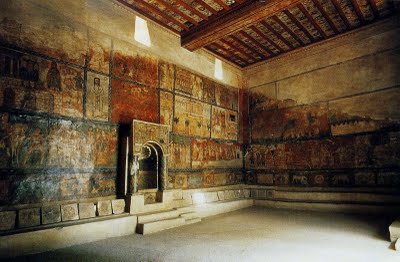
Recent archaeological research found that Jewish synagogues around the time of Christ were not bare rooms devoid of images but embellished with religious decorations.  See my article “Early Jewish Attitudes toward Images.”  Especially damaging to Calvin’s argument are the recent archaeological findings of images in the Jewish synagogue and Christian church in the town of Dura Europos which was buried circa 250. Taken together the biblical and archaeological evidences present a strong refutation of Calvin’s “Fall of the Church” theory.

Dura Europos Synagogue. Source

Dura Europos Synagogue. Source


Defending the Gospel Message

A study of early church history shows that the church faced numerous theological challenges: Ebionitism which affirmed Jesus as Messiah but not as divine, Docetism and Gnosticism which denied that Jesus was truly human, Marcionism which saw the Old and New Testaments as representing two different religions and deities, and Montanism a prophetic movement which held that Apostolic tradition was superseded by the new prophecies.  One thing that is striking is the absence of any controversy during this period over the issues mentioned by Calvin: liturgical worship, vestments, incense, or icons.  Surely if the early Church had drifted away from the Apostles’ teachings as Calvin alleged someone would have spoken up?

The Apostle Paul was not unaware that the Church would come under attack by heretics so he took steps to ensure the safeguarding of the Gospel.  At Timothy’s ordination to the office of bishop he admonished:

What you heard from me, keep as the pattern of sound teaching, with faith and love in Jesus Christ.  Guard the good deposit that was entrusted to you—guard it with the help of the Holy Spirit who lives in us.  (2 Timothy 1:13-14; NIV; emphasis added)

The phrases “pattern of sound words” and “good deposit” referred to a set of core doctrines to be held by all Christians.  This was the basis for the theological unity of the early Church, to deviate from this doctrinal core was to fall into heresy.  The early Christians were diligent in defending the orthodoxy of the Church.  Ignatius warned Polycarp against tolerating those who taught “strange doctrine.” (Ignatius to Polycarp 3)  A similar warning against “another doctrine” is found in Didache 11.1 and in Polycarp’s Letter to the Philippians (7.2).

In Against Heresies 1.22.1 Irenaeus referred to the “rule of faith (truth)” by which one could determine someone adhered to the Apostolic teachings or not.  In Against Heresies 2.9.1 Irenaeus remarked how the entire Christian Church received the Apostles’ Tradition.  Polycarp in Letter to the Philippians 7.2 made reference to the traditioning process as well.

The early church preserved the Apostles’ teachings by means of the bishop having received a body of teaching from his predecessor, the bishop as the primary teacher of the local church, and the congregation united with the bishop at the weekly Eucharistic celebration.  For Irenaeus theological orthodoxy was linked to the bishop’s role in the traditioning process.

True knowledge is [that which consists in] the doctrine of the apostles, and the ancient constitution of the Church throughout the whole world, and the distinctive manifestation of the body of Christ according to the successions of the bishops, by which they have handed down that Church which exists in every place, and has come even unto us, being guarded and preserved, without any forging of Scriptures, by a very complete system of doctrine, and neither receiving addition nor [suffering] curtailment [in the truths which she believes]; . . . . (Against Heresies 4.33.8emphasis added; see also 3.3.1)

Irenaeus described his mentor Polycarp’s efforts to remember accurately the teaching and example of his mentor the Apostle John.

And as he [Polycarp] remembered their words, and what he heard from them concerning the Lord, and concerning his miracles and his teaching, having received them from eyewitnesses of the ‘Word of life,’ Polycarp related all things in harmony with the Scriptures.  These things being told me by the mercy of God, I listened to them attentively, noting them down, not on paper, but in my heart.  And continually through God’s grace, I recall them faithfully.  (in Eusebius’ Church History 5.20.7,  NPNF p. 371; emphasis added)

In other words, the early Christians did not play fast and loose with the Apostles’ teachings as one might infer from the “Fall of the Church” theory.  Rather, they sought to preserve and transmit faithfully the Apostles’ teachings to later generations.  If anyone dared to stray from the regula fidei they would have been excluded from the Eucharist.  That is why the episcopacy and the Eucharist were so critical to the theological integrity of the early Church.


Priests and Bishops

Just as the Jewish temple had a priesthood so too did the early church have a priesthood (clergy).  Under the New Covenant the Eucharist was based on Christ’s once and for all sacrifice on the Cross.  The bishop along with the priests (presbyters) presided over the Eucharistic assembly.  Ignatius was an early witness to the three orders: bishops, priests, and deacons.

Be zealous to do all things in harmony with God, with the bishop presiding in the place of God and the presbyters in the place of the Council of the Apostles, and the deacons, who are most dear to me, entrusted with the service of Jesus Christ . . . . (Letter to the Magnesians 6.1; emphasis added)

He viewed this threefold hierarchy, not as optional, but as necessary.

Likewise let all respect the deacons as Jesus Christ, even as the bishop is also a type of the Father, and the presbyters as the council of God and the college of Apostles.  Without these the name of “Church” is not given.  (Letter to the Trallians 3.1; emphasis added)

In his Letter to the Smyrneans 8 Ignatius stressed that the sacraments of baptism and the Lord’s Supper were not valid unless done with the consent of the bishop.  Irenaeus made a similar point as well:

Wherefore it is incumbent to obey the presbyters who are in the Church, — those who, as I have shown, possess the succession from the apostles; those who, together with the succession of the episcopate, have received the certain gift of truth, according to the good pleasure of the Father. (Against Heresies 4.26.2,)

An examination of church history shows that the episcopacy was the universal form of church governance.  It was not until the Protestant Reformation that we see the emergence of novel polities: congregationalism, presbyterianism, and independent non-denominationalism.


Assessing Calvin’s “Fall of the Church” Theory

While insightful, Ralph Winter’s essay seems to have overlooked some of the startling theological implications of the BOBO theory.  One implication is that the Holy Spirit was active in the early days of the church then disappeared for the next thousand years or more then reappeared with the Protestant Reformation in the 1500s!  Also, Winter did not discuss Christ’s promise in John 14:26: “but the Counselor, the Holy Spirit, whom the Father will send in my name, will teach you all things and will remind you of everything I have said to you.”   This has profound implications for the doctrine of God’s sovereignty in history.  For Reformed Christians this gap in church history also has troubling implications for God’s ability to keep his covenant promises.  How can a Reformed Christian square his belief in the sovereignty of God and covenant theology with the “Fall of the Church” theory proposed by Calvin?

For me as a church history major the “Fall of the Church” theory stems from a foundational flaw.  The “Fall of the Church” theory makes sense if one reads church history with the assumption that the early Christians were Calvinists.  Any hints of liturgical worship among early Christians, i.e., anything unlike Reformed worship, can be attributed to their “falling away.”  But this approach is like taking a meat cleaver and hacking church history into pieces!  It utterly disregards the notion of historical continuity and development.  A more reasonable approach is to view early Christian worship of the second century described in the post-apostolic writings as flowing from the Christian worship of the first century described in the New Testament.  In light of the evidences one can then decide whether or not early Christian worship was liturgical, simple or elaborate, with or without icons.  And whether or not there was continuity or significant departures in practice or doctrine.  The second century writings are more useful for understanding first century Christian worship than those from the 1500s, the time of rhe Reformers.

Calvin’s BOBO theory of church history was influential in the Reformed tradition until Philip Schaff gave his “Principle of Protestantism” address in 1844.  In it Schaff proposed that the Protestant Reformation represented the flowering of medieval Catholicism.  Where Calvin saw discontinuity and rupture, Schaff saw continuity and evolution.  Thanks to Schaff church history became an academic discipline that stood on its own independent of theology.  This allowed for the emergence of historical theology.  Jaroslav Pelikan’s The Christian Tradition is probably one of the finest works of historical theology in the twentieth century and extremely useful for understanding commonalities and divergences in the different theological traditions.  [Note: This eminent Yale historian and long time Lutheran pastor to the surprise of many converted to Orthodoxy!]

Calvin’s theological system is complex and contains contradictions.  These contradictions offer points of contact between the Reformed tradition and Eastern Orthodoxy.  Despite his view that early Christianity had deteriorated over time, Calvin at times held some of the early church fathers in high regard.  Calvin was not averse to quoting the church fathers against his Roman Catholic opponents.  In his “Reply to Sadolet” Calvin affirmed the antiquity principle asserting “our agreement with antiquity is far closer than yours” (p. 231).  Calvin’s arguments against the medieval church may be valid but does it likewise apply to the Orthodox Church?  It has been noted that the Latin Church under the influence of medieval Scholasticism and the rise of the legal schools drifted away from its patristic roots.  This suggests Calvin may have been a victim of historical circumstances.  Calvin’s openness to the church fathers and the early Church laid the foundation of Mercersburg Theology in the 1800s and the attempt by Nevin and Schaff to bring back the catholic dimension to the Reformed tradition.

So while Calvin’s BOBO theory of church history is seriously flawed, he is to be commended for his willingness on occasion to draw on the early church fathers.  This gives Reformed Christians an advantage over their Evangelical counterparts when it comes to engaging Eastern Orthodoxy.  I found in Mercersburg Theology and the Reformed tradition a point of contact leading me to the early church and ultimately into the Orthodox Church.  I am deeply indebted to Mercersburg Theology for the intellectual tools that enabled me to critically examine Reformed theology even though it had unintended consequences like my eventually converting to Orthodoxy.

Robert Arakaki


Source

Calvin, John.  1960.  Institutes of the Christian Religion.  Ford Lewis Battles, translator.  The Library of Christian Classics. Volume XX. John T. McNeill, editor.  Philadelphia: The Westminster Press.

Calvin, John.  1964.  “The Necessity of Reforming the Church” in Calvin: Theological Treatises, pp. 184-216. Editor: J.K.S. Reid.  Philadelphia: The Westminster Press.

Calvin, John.  1964.  “Reply to Sadolet” in Calvin: Theological Treatises, pp. 221-256. Editor: J.K.S. Reid.  Philadelphia: The Westminster Press.

Eusebius.  1890.  “The Church History of Eusebius” in Eusebius.  Translator: Arthur Cushman McGiffert.  Nicene and Post-Nicene Fathers.  Second Series.  Vol. I.  Grand Rapids, Michigan: Wm. B. Eerdmans Publishing Company.

Ignatius.  1985.  The Apostolic Fathers.  Volume I.  Loeb Classical Library.  Editor: Kirsopp Lake.  Cambridge, Massachusetts: Harvard University Press.

Irenaeus.  1985.  The Apostolic Fathers.  Editors: Alexander Roberts and James Donaldson.  Ante-Nicene Fathers.  Volume I.  Grand Rapids, Michigan: Wm. B. Eerdmans Publishing Company.

Justin Martyr.  1985.  The Apostolic Fathers.  Editors: Alexander Roberts and James Donaldson.  Ante-Nicene Fathers.  Volume I.  Grand Rapids, Michigan: Wm. B. Eerdmans Publishing Company.

Polycarp.  1985.  The Apostolic Fathers.  Volume I.  Loeb Classical Library.  Editor: Kirsopp Lake.  Cambridge, Massachusetts: Harvard University Press.

Winter, Ralph D.  1992.  “The Kingdom Strikes Back: Ten Epochs of Redemptive History.”

« Older posts Newer posts »