A Meeting Place for Evangelicals, Reformed, and Orthodox Christians

Category: Church Fathers (Page 4 of 12)

Getting to Know Your Church Fathers

First Ecumenical Council - Nicea AD 325

First Ecumenical Council – Nicea AD 325


One reason why many Protestants today bought the notion that the early Church Fathers were theological infants is their ignorance of church history.  The best remedy for that is getting to know the Church Fathers by actually reading their writings.  The early Church Fathers are the heritage of all Christians, regardless of denomination.  One way Reformed Christians, Evangelicals, and Orthodox Christians can deepen fellowship with each other is by exploring their common roots in the Fathers of the early Church.  The ministry of the Church Fathers was based on the charismatic gift of teaching (Ephesians 4:11-13) and together as a collective witness they have ensured the doctrinal stability of the Church and preserved the Faith which was passed on to them as a sacred Trust (Ephesians 4:14-16, 2 Timothy 1:14).

Getting to know the early Church Fathers will not be an easy task for many Protestants.  For many reading the early Christian writings will be like stumbling into a foreign land where the customs and landmarks are either unfamiliar or entirely absent.  I remember struggling to make sense of the early Church Fathers when I was at seminary.  Looking back, one important lesson I learned was the need to hold in suspension the assumption that the early Church was Protestant and to pay attention to the issues, vocabulary, and the methods employed by the early Christians, only then could I make headway in comprehending the early Church Fathers.

13808570-Couple-of-tourists-looking-at-city-tour-map--Stock-PhotoThis article presents a quick sketch of Church Fathers with whom all Reformed Christians and Evangelicals should become acquainted with.  I also included an early handbook and an early Liturgy widely used in the early Church; these were included because they are important for understanding early Christianity.    The list of these ten sources starts with the earliest writings around the end of the first century and ends in the eighth century.  The article is intended to be like a travel guide for first-time visitors who want to be ready to take in the sights and sounds of a new culture.


1. Ignatius of Antioch – The city of Antioch was the Apostle Paul’s home church (see Acts 13-14).  As the third bishop of the church of Antioch Ignatius was heir to the same Apostolic Tradition as Apostle Paul.  It is believed that Ignatius was the child that Jesus used as an acted out parable in Matthew 18:1-4.  Ignatius was arrested by Roman authorities during the reign of Trajan (AD 98/117) and sent to Rome to be executed.  On his way to Rome he composed seven letters to the churches he visited; all seven of them are available to us today.

Present day Protestants may find surprising the importance Ignatius placed on the Eucharist and the office of the bishop.  In his Letter to the Smyrnaeans Ignatius stressed that a Sunday gathering could only be valid if it was done in unity with the Bishop (Smyrnaeans chapter 8).

Let that be deemed a proper Eucharist, which is [administered] either by the bishop, or by one to whom he has entrusted it. Wherever the bishop shall appear, there let the multitude [of the people] also be; even as, wherever Jesus Christ is, there is the Catholic Church. (Smyrnaeans chapter 8)

Another surprise for Evangelicals who hold to a memorialist understanding of the Lord’s Supper is Ignatius’ affirming that the Real Presence of Christ’s body and blood in the Eucharist (Smyrnaeans chapter 7).  He writes of the Gnostic heretics:

They abstain from the Eucharist and from prayer, because they confess not the Eucharist to be the flesh of our Saviour Jesus Christ . . . . (Smyrnaeans chapter 7)

Ignatius’ Letters


2. The Didache — In the late 1800s a church handbook with instructions about Christian living and worship was discovered in a monastery in Constantinople.  Scholars generally date the Didache to AD 100, some even date it as early as AD 70!  Christians who debate about baptism by total immersion versus baptism by sprinkling will find it informative that the early Church gave preference to baptism by immersion but allowed for baptism by pouring under certain circumstances (Didache VII).  The Didache also records one of the earliest known Eucharistic prayers (Didache IX).  Early documents like the Didache brings clarity to certain ambiguities in Scripture.  For example, the Eucharist as a normal part of Christian worship and early Christians worshiped on Sunday, not Saturday.

And concerning baptism, baptize this way: Having first said all these things, baptize into the name of the Father, and of the Son, and of the Holy Spirit, in living water. But if you have not living water, baptize into other water; and if you can not in cold, in warm. But if you have not either, pour out water thrice upon the head into the name of Father and Son and Holy Spirit.  (Didache VII)

Didache


3. Irenaeus of Lyons – Considered the leading theologian of the second century, Irenaeus was a disciple of Polycarp who was the disciple of the Apostle John.  The Apostle John in his three epistles combated the heresy of Gnosticism.  A century later Gnosticism was still a problem for the early Church leading Irenaeus to write Against Heresies (AH), a comprehensive refutation of Gnosticism.  The Gnostics did not deny the bishops’ claim to authority but insinuated: (1) that within the outward Church was a secret tradition that offered “deeper” insights into the Gospel and (2) that the bishops only gave the external meaning of the Gospel.  Irenaeus refuted Gnosticism by expounding on Scripture and the Rule of Faith (Tradition).

Against Heresies is a lengthy work comprised of five books.  The bulk of the book is a detailed description and refutation of Gnosticism but here and there like golden nuggets are passages of outstanding theological wisdom.  Protestants would be surprised to learn that Irenaeus knew about a creed much like today’s Nicene Creed (AH 1.10.1).  Irenaeus taught that in the Eucharist the bread and the wine became the body and blood of Christ (AH 4.18.4-5).  Christians troubled by Protestantism’s many denominations and church splits will be daunted by Irenaeus’ claim that across the Roman Empire Christians confessed the same Faith (AH 1.10.4).

As I have already observed, the Church, having received this preaching and this faith, although scattered throughout the whole world, yet, as if occupying but one house, carefully preserves it. She also believes these points [doctrine] just as if she had but one soul, and one and the same heart, and she proclaims them, and teaches them, and hands them down, with perfect harmony, as if she possessed only one mouth.  (AH 1.10.2)

We find Irenaeus refuting an argument that resembles today’s “church fathers = infant” argument:

But, again, when we refer them to that tradition which originates from the apostles, [and] which is preserved by means of the succession of presbyters in the Churches, they object to tradition, saying that they themselves are wiser not merely than the presbyters, but even than the apostles . . . .  (AH 3.2.2; emphasis added)

Against Heresies


4. Athanasius the Great – Many Protestants appreciate Athanasius’ staunch defense of Christ’s divinity.  His book On the Incarnation is a theological classic, in which one finds an explanation of how the uniting of Christ’s divine and human natures were needed to bring about our salvation.  Many Protestants will be surprised to find that Athanasius did not follow the forensic paradigm which saw death as punishment meted out by the divine Judge but as the consequence of our loss of union with Christ (§5).

. . .to this end He takes to Himself a body capable of death, that it, by partaking of the Word Who is above all, might be worthy to die in the stead of all, and might, because of the Word which had come to dwell in it, remain incorruptible, and that thenceforth corruption might be stayed from all by the Grace of the Resurrection. (§9)

Athanasius understood salvation as the uniting of created mortal flesh with the infinite immortality of the uncreated Word (§9).  He understood the goal of our salvation as theosis, a doctrine known to Orthodox Christians but largely unknown among Protestants.

For He was made man that we might be made God. (§5)

On the Incarnation


5. Basil the Great – Where Athanasius defended the divinity of Christ, Basil defended the divinity of the Holy Spirit.  The Arian heresy was at root anti-Trinitarian.  Consistent Arianism denied not just the divinity of Christ but also that of the Holy Spirit.  Many Protestants will find it confusing that Basil opens the book by parsing the doxologies to the Trinity used in early Christian worship.  Basil’s parsing of the doxologies reflects the fact that theology in the early Church was liturgical theology.  What the early Christians believed was found in the Sunday Liturgy, not in thick tomes of systematic theology.  Another challenge to the Protestant dogma of sola scriptura can be found in §66 where Basil affirms that unwritten tradition has equal authority to written tradition, Scripture.  Protestants will be surprised to learn how many of the unwritten traditions enumerated by Basil are still kept in the Orthodox Church today.

If we attacked the unwritten customs, claiming them to be of little importance we would fatally mutilate the Gospel, no matter what our intentions. . . . (§66)

On the Holy Spirit


6. John Chrysostom – Many Protestants know him as “Golden Mouth” — one of the greatest preachers in Christianity.  His giftedness as a preacher was such that the sermon was moved from its usual place – immediately following the Gospel reading – to the end of Liturgy so that people would stay to receive Holy Communion.  Otherwise they would leave as soon as the sermon was over!  His sermons were typically straightforward and didactic; many are still available today.  One particular sermon, the Easter or Paschal sermon, has become part of Orthodox Tradition.  This sermon is read in Orthodox churches everywhere on Easter Sunday.  In this famous Easter sermon is the Christus Victor motif – Christ’s conquering death by his death.

By descending into Hell, He made Hell captive. He embittered it when it tasted of His flesh. And Isaiah, foretelling this, did cry: Hell, said he, was embittered, when it encountered Thee in the lower regions. It was embittered, for it was abolished. It was embittered, for it was mocked. It was embittered, for it was slain.   Source

Homilies on the Gospel of John 


7. Liturgy St. John Chrysostom – On most Sundays Orthodox worship services will be the Liturgy of St. John Chrysostom.  In the prayers are eloquent affirmations of faith and devotion.  Through faithful Sunday attendance people will find their minds and hearts shaped by the prayers of the Church.  Before the Gospel reading, the priest will say this eloquent prayer:

Shine in our hearts, loving Master, the pure light of Your divine knowledge, and open the eyes of our minds that we may comprehend the message of your Gospel.

Christians who struggle with Calvin’s harsh doctrine of double predestination will find it comforting that every Liturgy closes with: . . . for He is good and He loves mankind.

Liturgy of St. John Chrysostom


8. Cyril of Jerusalem – It was the practice of the early Church to have prospective converts undergo a lengthy course of instruction (catechumenate).  It was expected that catechumens would attend the Sunday services and afterwards listen to lectures on the Christian Faith.  Cyril was the patriarch or bishop of Jerusalem in the 300s.  Many people undertook a pilgrimage to Jerusalem to visit the places mentioned in the Gospels, to learn about the Christian Faith from a bishop who could claim to be a successor to James the Lord’s brother and first patriarch of Jerusalem (Acts 15:12-21).

The Catechetical Lectures provide a valuable window into the theology of the early Church as articulated by one of its prominent leaders.  Cyril stressed the fact that the Faith they were about to learn was part of a chain of tradition.

But in learning the Faith and in professing it, acquire and keep that only, which is now delivered to thee by the Church, and now delivered to thee by the Church, and which has been built up strongly out of all the Scriptures. (Lecture 5.12.22; NPNF Vol. VII p. 32)

Cyril expected the catechumens to memorize the Nicene Creed:

This summary [creed] I wish you both to commit to memory when I recite it, and to rehearse it with all diligence among yourselves, not writing out of paper, but engraving it by the memory upon your heart, taking care while you rehearse it that no Catechumen chance to overhear the thing which have been delivered to you.  (Lecture 5.12.23; NPNF Vol. VII p. 32; emphasis added)

The Catechetical Lectures of St. Cyril of Jerusalem


9. Vincent of Lerins – Vincent lived in the 400s in Gaul (France) during a time when theological questions and opinions were proliferating.  This led to theological confusion as people began to think that the Bible could be interpreted in various ways.  In his Commonitory Vincent argued that Scripture was to be interpreted in light of the catholic tradition.  This principle was summed up in a Latin phrase known as the Vincentian Canon.

Quod ubique, quod semper, quod ab omnibus creditum est. (That Faith which has been believed everywhere, always, by all.)   (Commonitory 2.6)

Although more a short treatise than a full length book, the Commonitory gives the reader a concise and cogent explanation of how the teachings of the Church is based on Scripture interpreted in light of sacred Tradition.

Commonitory


10. John of Damascus – He was born in AD 676 under Muslim rule and is reported to have worked for the caliph of Damascus.  John is known for his eloquent defense of icons, On the Divine Images, and for one of the earliest systematic theologies, Exposition of the Orthodox Faith.  Like other Church Fathers John of Damascus affirmed human free will (See Exposition 3.14; NPNF vol. IX, p. 58).  By John’s time much of the Christological and Trinitarian controversies had been settled.  The more recent debates were about energies and free-will, issues crucial to refuting the monothelite heresy which denied that Christ had two wills, human and divine.  From these debates came a nuanced understanding of the Trinity in the form of the doctrine of perichoresis – the three Persons of the Trinity mutually indwelling or interpenetrating one another.

For the Son is in the Father and the Spirit: and the Spirit in the Father and the Son: and the Father in the Son and the Spirit, but there is no coalescence or commingling or confusion. (Exposition 1.14; NPNF vol. IX p. 17)

His eloquent defense of icons helped lay the groundwork for the repudiation of iconoclasm at the Seventh Ecumenical Council (Nicea II).

In former times God, who is without form or body, could never be depicted. But now when God is seen in the flesh conversing with men, I make an image of the God whom I see. I do not worship matter; I worship the Creator of matter who became matter for my sake. . . .  (On the Divine Images)

Exposition on the Orthodox Faith

On the Divine Images


Closing Observations

When we speak of the Church Fathers we are talking about a diverse group of great Christians, some of whom lived in the first century on the western edge of the Roman Empire, and others who lived in the eighth century in Damascus under Muslim rule.  Despite vast distances in space and time between them, they shared in a common Faith and worship.  For Protestants it is important not to assume that the Church Fathers are like them.  For me a major breakthrough came when I realized I had been assuming that the early Church Fathers were Protestants when clearly they were not.  Another breakthrough came when I began to notice strong similarities between present day Orthodoxy and the early Church.  There is no getting around the fact that early Christian worship was liturgical and its church polity episcopal.  In terms of theological method the early Church Fathers did theology using the paradigm of Scripture in Tradition, rather than the Protestant paradigm of Scripture alone (sola scriptura).  As a church history major I was struck by the fact that in contrast to Protestantism’s many denominations, the early Church maintained theological unity for a thousand years until the Great Schism of 1054 when Rome parted ways with the other four patriarchates.

For those interested in learning more about the Church Fathers, it is useful to know that there are collections of these writings easily accessible.  One of the better known collections is the one initiated by Philip Schaff and still being published today, the Ante-Nicene Fathers and the Nicene and Post-Nicene Fathers series.  See the Christian Classics Ethereal Library (CCEL).  A convenient one-volume work is James Payton’s A Patristic Treasury.  It should be noted that not all early Christian writers are regarded by the Orthodox Church to be “church fathers.”  This title or honor is given to those notable for the orthodoxy of their teachings and the sanctity of their lives.  The Orthodox Church does not have an official listing but commemorates them in its Liturgy.

Protestants, Roman Catholics, and Orthodox should get to know the Church Fathers of the first millennium.  The Church Fathers represent a shared heritage among us.  As we learn from the Fathers, we will be able to talk to each other using a shared vocabulary and theological paradigm.  To disavow the Church Fathers is to become unmoored from historic Christianity.   To embrace the Church Fathers is to be grounded in the historic Christian Faith “once for all entrusted to the saints” (Jude 3).

Robert Arakaki

The Early Church Fathers: Babies or Giants?

shutterstock_145266973

I recently received an inquiry from someone with a Reformed background.  He brought to my attention that a certain Protestant pastor is said to have claimed that the early Church Fathers were “church babies.”  I have not been able to verify whether or not this pastor actually made that remark but I felt that the question deserved a good answer.  This reader has also been in conversation with friends who are interested in Mercersburg Theology.  One of them brought up the “fallacy of infallibility” objection against Orthodoxy.  That is, “locally an Orthodox or Catholic bishop would have authority over his denomination but since the Church has been immature for the last 2000 years (being resurrected again in the 16th century) she is in no way infallible.”  What follows is an attempt to answer that particular conversation but also in a way others can benefit.


My Response

Holy Tradition as the Basis for a Bishop’s Authority

Apostolic succession is key to understanding the office of the bishop.  And, key to understanding apostolic succession is the traditioning process, i.e., the receiving, preserving, and transmitting of Apostolic Tradition.  The office of the bishop is more than an institutional rank; it is a sacred trust.  The bishop has been entrusted with what the apostle Paul referred to as the “good deposit.” (2 Timothy 1:14)  A bishop has authority so long as he is faithful to the Tradition that Christ entrusted to his apostles.  A heretical bishop loses his authority once he abandons Holy Tradition.  Orthodoxy’s approach to the episcopacy focuses on the inner content, i.e., fidelity to Holy Tradition.  In the West the focus is more on the outer form of the episcopal office, i.e., ritual succession (a matter of proper genealogy).  This explains why they consider the Roman papacy valid despite innovations like the Filioque clause, purgatory, Mary’s Immaculate Conception, etc.  It also explains why Anglicans consider themselves to have valid bishops despite their bishops’ failure to uphold the teachings of the Seven Ecumenical Councils and worse yet abandon traditional Christian morality.  What counts for them is the proper rite being carried out when consecrating their bishops.


Vertical and Horizontal Accountability

Holy Tradition provides both vertical and horizontal accountability.  Vertical accountability refers to the present day bishop being able to trace his lineage back to the original apostles.  Horizontal accountability refers to the present day bishop holding doctrines and celebrating a liturgy similar to other bishops around the world who can trace their lineage back to the apostles.


Dojo_New

Martial Arts as Tradition

In the martial arts, each school is run by a sensei or sifu (master teacher) who can trace his style to past master teachers.  The sensei is one who earned the right to bear the name of a particular style of martial arts, to open his own dojo (school), and have his own students.  The sensei is also one who has inherited from his teacher the authority to bestow belts (ranks) on his students, the highest rank being the black belt.  This means that a student can verify his sensei’s claims by visiting other dojos, watching the other students, and talking with their teachers.  Anyone can set up their own school of martial arts and give out black belts but for all of this to be meaningful one must be part of a living tradition.  The point of this analogy is that in Protestantism anyone can set up his own “church” and claim “apostolic succession” just by holding a Bible in his hand.  In Orthodoxy a congregation cannot be considered a valid church unless it is a Eucharistic community under the authority of the bishop (Ignatius’ Letter to the Smyrneans chapter 8).  The Eucharist is the constitutive act of the local Christian community and access to the Eucharist is a sign that one belongs to the one holy catholic and apostolic Church.


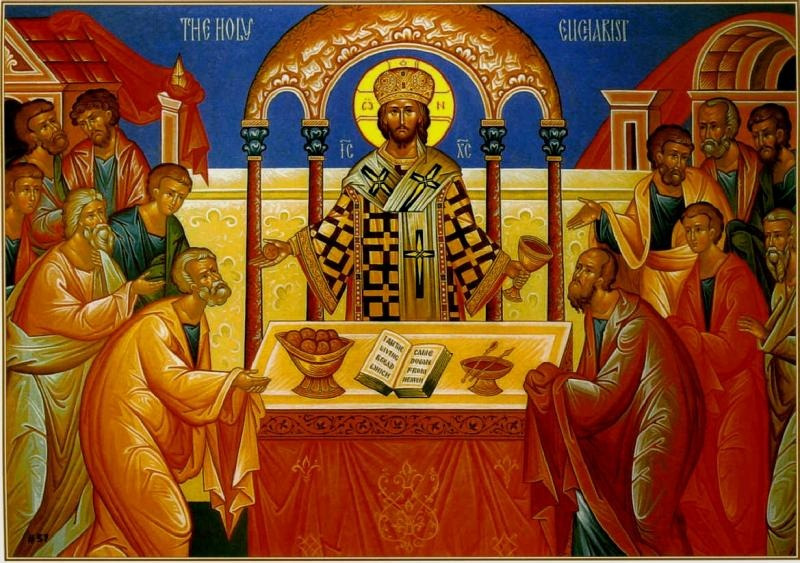
icon-of-christ-high-priest-the-holy-eucharist

Jesus Christ: The Great High Priest


The Eucharist Makes the Church

The Eucharist as a constitutive act can best be understood from the standpoint of covenant theology.  Every covenant required a sacrifice for its ratification and Christ’s one-time death on the Cross was foundational for the New Covenant.  When Jesus the Lamb of God died on the Cross the Old Covenant sacrificial system came to a close, and the New Covenant was put into effect.  The sacrificial system of Leviticus instituted by Moses was superseded by the Eucharist instituted by Jesus Christ in the upper room with the twelve disciples.  The implications of the real presence of Christ’s body and blood in the Eucharist are enormous.  It is best understood not so much as a reenactment or a repetition of Christ’s one-time death on the Cross but rather an extension of Christ’s death on the Cross across space and time via the Divine Liturgy.  The weekly Eucharist can be understood as an act of covenant renewal in which the vassal (the Christian) renews his commitment to the suzerain (Christ).  It can also be understood as a covenant meal in which the suzerain (Christ) and his vassals (the Christian believers) come together as a sign of peace and friendship between two former enemies and as a sign of their common life together.  Like the ancient Near Eastern covenant treaties the Gospels recall and re-enact the suzerain’s great deeds on behalf of the vassals.  The New Testament records the terms of the covenant by which the vassal (the Christian) remains in good standing with the suzerain (Christ).  So long as the vassal remains in a covenant relationship via the covenant meal (the Eucharist) he enjoys the benefits promised in the covenant document (the Bible).  Skipping the meal with the suzerain raises questions about one’s relationship with the suzerain.  An example of this would be David’s avoiding a meal with King Saul (1 Samuel 20:5, 24-29).

The Eucharist as a constitutive act explains why exclusion from the Eucharist is so consequential for Christian identity and one’s salvation.  The fact that Roman Catholics are not allowed to receive Communion at Orthodox churches is a sign of the break between the two traditions.  And this is why it is such a big deal for an Orthodox mission to transition from Reader Services to the Divine Liturgy; this marks the congregation becoming a proper church when the bishop assigns a priest to the mission who will be celebrating the Liturgy on a regular basis.


Source

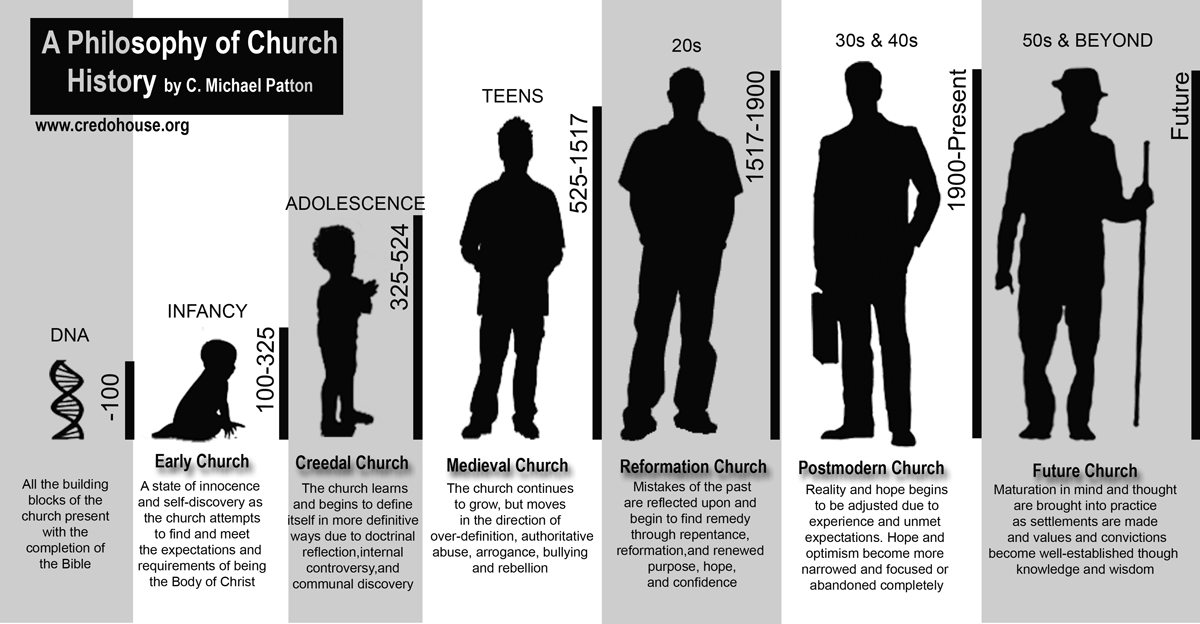
Evolutionary Paradigm of Church History    Source


Paradigms of Church History

The concept of Holy Tradition has implications for how one understands church history.  It implies the priority given to the preservation of Holy Tradition from generation to generation.  That is why Orthodoxy looks askance at innovation.  When I was a Protestant I was bewildered as to why Orthodoxy would want to hold on to a fossilized or ossified faith.  However, I came to see the Christian Faith as something shared by the community, not as an expression of individual creative thought.  Moreover, I came to appreciate that in the deepest sense Holy Tradition is living and dynamic in the way that a skillful conductor and a well-trained orchestra can infuse meaning and nuance into a music scored by Mozart or Bach.  In the hands of a lackluster orchestra a musical classic can become lifeless and dull.  What makes capital “T” Tradition a living tradition is the Church abiding in the Holy Spirit.

The Orthodox paradigm values doctrinal and liturgical stability.  The opposite approach would be an evolutionary or progressive understanding of church history.  This is the understanding that theology over time expands and improves upon what has come before, i.e., the present is superior to the past.  I can sympathize with the progressive approach to church history.  If one delights in thick tomes of systematic theologies and detailed doctrinal formulas, extensive commentaries like those produced by medieval Scholastics, the Reformers, and modern Protestants, plus modern-day seminaries with their erudite faculty members with Ph.D.s from world-renowned universities then the early Church Fathers would seem like small potatoes so to speak.  But speaking as one who has studied at Gordon-Conwell Theological Seminary in Massachusetts and the Graduate Theological Union in Berkeley, California, I can attest that there is greater wisdom to be found in the early Church Fathers and in the classic liturgies of St. John Chrysostom and St. Basil the Great.  For a humorous yet searing indictment of modern theology in comparison to the Church Fathers I recommend Thomas Oden’s After Modernity … What?  The heart of the Christian Faith is not a detailed theological understanding of God but rather a trajectory that leads to union with Christ and life in the Trinity.

maxresdefault-2

Left: Orthodox paradigm of theology; Right: Protestant paradigm of theology


Honoring Our Fathers

There are other problems with the paradigm that denigrate the Church Fathers as “babies.”  It is very disrespectful to look down one’s nose at the men who suffered martyrdom to preserve the Christian Faith against pagan Rome and who struggled to preserve the Gospel against the heretics.  Furthermore, can one call their Christology and their doctrines of the Trinity immature?  By what benchmark would your friend measure the early Church Fathers against modern day Protestants?  By sola fide? By sola scriptura? This fixation on the progressive understanding of the Christian Faith is characteristic of Western Christianity.  One sees it as the rationale for the elaborate theological systems of medieval Scholasticism.  It serves as the justifying basis for Protestantism’s novel doctrines.  Even more recently, it has been used to justify the new prophetic revelations in Pentecostal Christianity and the Liberal Christianity’s revisionist theologies and its new morality.  The result has been the unceasing fracturing of Protestantism and an ever-intensifying theological chaos, leading to a religion unrecognizable to early Christians.


New Testament Teaching on Spiritual Maturity

We learn from Scripture that the apostles were acutely aware of the need for maturity in the Faith. The apostle Paul’s description in Ephesians 4:14 of “infants, tossed back and forth by the waves, and blown here and there by every wind of doctrine” describes well the predicament of modern day Protestants. In contrast to Protestantism’s stormy seas, Orthodoxy’s historic Faith resembles an unmoving rock that offers shelter and stability.  The author of Hebrews expected spiritual maturity of his readers and rebuked those who “by now ought to be teachers, but have need someone teach them the elementary principles all over again.” (Hebrews 5:11) Paul’s exhortation to second generation Bishop Timothy to seek out “faithful men, who will be able to teach others also” shows the high value the early Church placed on maturity. (2 Timothy 2:2) There is not a hint whatsoever in Scripture that the apostles were inclined to entrust the Faith once for all delivered to the saints, to “spiritual babies.” Indeed the very opposite can be seen clear in the New Testament Scriptures along with the writings of the designated successors to the apostles (bishops) immediately afterwards.

We should consider another often neglected historic fact. Much has been made of the timing of the Incarnation and the spread of the Gospel during the era of Pax Romana. The intellectual acumen of the early Fathers is a matter greatly neglected, especially by Protestants.  This blind spot can be attributed in part to: (1) unfamiliarity with early Christianity, (2) the assumption that there is no significant difference between early Christianity and Roman Catholicism, and (3) the attitude of chronological snobbery, i.e., the thinking that Protestants are more advanced in their theologizing. But many if not most of the early bishops were brilliant intellectual giants fluent in several ancient languages and conversant in the best of Greek philosophy.  Consider for example Irenaeus of Lyons, Athanasius the Great, Basil the Great, John Chrysostom, Gregory of Nyssa, and John of Damascus. They are far more likely to be intellectual giants and scholars of exceptional maturity — marked by a ascetic piety that should shame most modern Christians and theologians of our present today.


The Question of Infallibility

Your friend’s remark about the fallacy of infallibility begs the question as to where infallibility is to be found.  Within Christianity there are three choices: infallibility resides in the Bible – the Protestant paradigm, infallibility resides in the Pope, the supreme bishop over all Christianity – the Roman Catholic paradigm, and infallibility resides in the Church, the Body of Christ – the Orthodox paradigm.  For Orthodoxy infallibility is not intrinsic to the Church but rather a grace conferred by the Holy Spirit.  Infallibility is an intrinsic property of the Spirit of Truth whom Christ sent to guide the Church (John 16:13).  Orthodoxy believes that the Holy Spirit guided the Ecumenical Councils in their deliberations about the two natures of Christ and the Trinity.  The proof of the pudding lies in the unity of the faith shared by the Orthodox throughout space and time; and in the doctrinal stability that Western Christians so often deride as static, ossified, fossilized, archaic, or more recently, “infantile.”

light-bulb

BOBO Theory: Blink Off, then Blink On

One of the greatest witnesses to Truth is the Divine Liturgy.  This is because Scripture is primarily a liturgical document.  The proper social context for Scripture is the Sunday Liturgy; private personal devotion in the home or the theologian’s study is secondary.  That is why I invite inquirers to the Divine Liturgy and I ask them to consider that the Liturgy has been essentially unchanged for over a thousand years.  This constancy in worship belies the widespread Protestant belief that the Church was in spiritual darkness until the Protestant Reformation of the 1500s.  If your friend likes Mercersburg Theology then he would know that Nevin and Schaff rejected the “Blink On/Blink Off” (BOBO) paradigm of church history.  This was the main point of Philip Schaff’s inaugural lecture which was later published in book form as The Principle of ProtestantismAs a matter of fact it was those who held to the BOBO theory of church history that initiated a heresy trial against Schaff!  What I appreciate about Mercersburg Theology is the attempt to show that Protestantism is not a novelty, but rooted in church history, and the attempt to show that Calvin’s understanding of the Real Presence in the Eucharist is rooted in the early Church Fathers.  However, as I noted in my essay “An Eastern Orthodox Critique of Mercersburg Theology” – It can’t get you there.  If your friend wants to hold to the BOBO theory, he must first show what benchmark he uses for determining doctrinal orthodoxy and give historical evidence of where and when the early Church went off the rails. If for example, he wants to use sola fide as a benchmark he has to first define the term then show that there were early Church Fathers who taught this doctrine.  Furthermore, he must be able to give specific citations, not vague allusions or broad characterizations.  And, I would note that the paradigm of early Church Fathers = spiritual babies and Protestant Reformers = spiritual adults is nothing more than a rephrasing of the BOBO theory.


Covenant Theology Leads to Holy Orthodoxy

Orthodoxy fits covenant theology much better than Protestantism.  If the Bible is a covenant document, then the Eucharist is a covenant meal.  At each Eucharist the covenant community renews its covenant commitment to the Suzerain (Christ).  Thus, the infrequent celebration of the Lord’s Supper characteristic of Protestantism belies its covenant identity.  Implicit to the covenant framework is the notion of covenant authority.  Just as the Old Testament priests were authorized to offer sacrifices and teach the Torah (Malachi 2:7), so too the New Covenant has a priesthood.  This is implied by the author of Hebrews claim: “We have an altar” (13:10) and Isaiah’s prophecy that God would take some of the Gentiles to be priests (66:20-21).  Liturgical worship with an ordained priesthood was the standard format of Christian worship until the Protestant Reformation.  The Reformed tradition’s disavowal of the episcopacy is rooted in its rejection of apostolic succession.  This means that Protestantism has no historical link to the early Church.  That link has been broken.  The Protestant Reformation is much like the Northern Kingdom’s schismatic break from the Jerusalem Temple (1 Kings 12:25-33); the religious schism was more catastrophic than the political.  Separation from the Levitical priesthood and the Temple in Jerusalem resulted in the eventual demise of the Northern Kingdom.  Israel’s identity as a covenant community was grounded in fidelity to the Torah given by Moses at Mt. Sinai and in fidelity to the order of worship given in the latter half of the book of Exodus.  One thing I admire about Protestant biblical scholarship is the great amount of effort given to textual criticism in the attempt to recover the original manuscripts.  It is unfortunate that Protestantism has neglected the search for a priestly lineage that goes back to the apostles.  Having the Bible is not enough for establishing a covenant identity.  One needs a duly authorized priesthood, as well.  Orthodoxy’s claim to a legitimate priesthood (the episcopacy) can be verified through an examination of its claim to apostolic succession.

In closing, holding a Bible in one’s hand does not make one a Christian any more than preaching from the Bible makes a gathering a church.  This is because holding in one’s hands the covenant document (the Bible) does not make one a proper member of the covenant community.  Participation in the covenant community requires covenant initiation (circumcision in the Old Covenant, baptism in the New Covenant) and participation in the covenant meal (Passover in the Old Covenant, the Eucharist in the New Covenant.  Being part of the covenant community assumes that one is living under the authority of the covenant leadership.  And just as important is fidelity to the terms of the covenant, i.e., living a life of love and justice to God and one another.  I very much appreciate the Reformed tradition’s insight into the importance of the covenant, because it has helped me to identify the Orthodox Church as the true covenant community founded by the Suzerain Jesus Christ who came to restore us to the kingdom of God.

Robert Arakaki


Recommended Readings

Robert Arakaki.  2011.  “The Biblical Basis for Holy Tradition.”  OrthodoxBridge.com

Robert Arakaki.  2012.  “An Eastern Orthodox Critique of Mercersburg Theology.” OrthodoxBridge.com

Robert Arakaki.  2014.  “John Calvin and the ‘Fall of the Church.'”  OthodoxBridge.com

Robert Arakaki.  2014. “Déjà Vu All Over Again.”  OrthodoxBridge.com

Thomas Oden.  1990.  After Modernity … What?  Zondervan Publishing House.

Jaroslav Pelikan.  1976.  The Emergence of the Catholic Tradition (100-600).  The Christian Tradition. Vol. 1.  University of Chicago Press.

Jaroslav Pelikan.  1986.  The Vindication of Tradition.  Yale University Press.

J.A. Thompson.  1964.  The Ancient Near Eastern Treaties and the Old Testament.  The Tyndale Press.

Ralph D. Winter.  2013.  “The Kingdom Strikes Back: Ten Epochs of Redemptive History.”  In Perspectives on the World Christian Movement.  Ralph D. Winter and Steven C. Hawthorne, eds.  William Carey Library Publishers.


A Growing Exodus? Words of Encouragement for Hesitant Calvinists


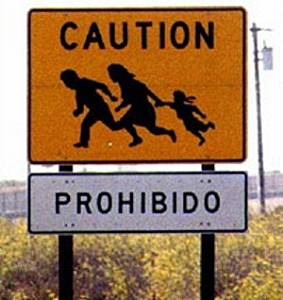
nocrossing1

No Entry? or No Leaving?

In response to some families recently leaving his Reformed (CREC) church for the Orthodox Church, Pastor Toby Sumpter recently wrote “The Levite Club.”  In the article he uses strong language to dissuade them from leaving Reformed Christianity for Orthodoxy.

His main argument is that to leave the Reformed church for Orthodoxy is an act of schism. That is, it will bring division to the body of Christ. Coming from a new Reformed denominational spin-off founded in 1998, this accusation is rich in irony. I don’t think Pastor Sumpter is advocating the invisible church model so popular among Evangelicals but something closer to the Anglican branch theory of the church. This is the doctrine that there is one Church with several branches: Roman Catholic, Reformed Protestant, and Eastern Orthodox. This is a relatively new doctrine that arose in Anglicanism several centuries after the Protestant Reformation in the mid-1800s and has no ancient precedent.

According to the branch theory while church divisions are regrettable, they are transitory in nature and will in time be overcome with church unity once again restored. I infer this from Pastor Sumpter’s subsequent blog posting which contains a lengthy excerpt from Philip Schaff’sPrinciple of Protestantism.”  In light of the branch theory of the church it is understandable that Pastor Sumpter would view with alarm parishioners leaving Reformed Protestantism for Orthodoxy.


Does Galatians 2 Apply?

Pastor Sumpter brings up Galatians 2 to bolster his argument that leaving the Reformed church is wrong. He sees parallels between the present situation and the conflict between the Apostles Peter and Paul in Antioch.

You can’t convert and act like you aren’t making a drastic statement about them. How is going from sharing the body and blood of Christ with them to being forbidden to becoming more catholic? You are going from loving Christ in the brothers and sisters right in front of you to getting cozy with strangers. This is why Paul withstood Peter to his face in Antioch. He was eating with some brothers and then when the Judaizers showed up, he withdrew. This is against the truth of the gospel.

Pastor Sumpter, following other CREC teachers, presumes Galatians 2 somehow addresses the question who has access to the Eucharist. But in fact, in Galatians 2 Paul was rebuking Peter for refusing to partake of the common meal with Gentile converts to Christ; Eucharistic fellowship was not an issue in Galatians 2. The Greek for “eat with” in Galatians 2:12 is συνεσθιω (sunesthio). It was used for ordinary meals, not special religious festivals; see Luke 15:2, Acts 11:3, and 1 Corinthians 5:11. For Pastor Sumpter to equate the common meal with the Eucharist is a serious misreading of the biblical text. So, to apply Galatians 2 to the issue of Eucharistic fellowship today represents a lapse in logical reasoning. On the other hand to apply Galatians 2 to the present day situation — Orthodox Christians welcome the opportunity to share a common meal with their Reformed friends and family members!

For a closer parallel let us imagine that the Judaizers were Christian teachers who were at one time loyal to the Apostles then repudiated them as false teachers, broke off to start a new Christian church based on the “true” Gospel of salvation. Then we would have a situation more pertinent to the issue before us. Let us imagine that these renegades came to Antioch with their new teachings and unapologetic for their break with the Apostles, would they be admitted to the Eucharist?  It is hard to imagine the Apostles Peter and Paul allowing them to partake of the Eucharist!

The problem with Pastor Sumpter’s usage of Galatians 2 goes beyond the twisting of Scripture to make it say what you want; the problem is also ignorance of church history. Trinitarian baptism never guaranteed someone Eucharistic fellowship any more than Circumcision guaranteed access to the Jewish Temple. Both the Jew of the Old Covenant and the Christian of the New Covenant could become unclean and forfeit his sacramental privileges. Historically, admission to the Eucharist was premised on being in submission to the ruling Bishop at the time, not merely Baptism. In the early Church it was the Bishop who taught new converts the Gospel. Thus, to be baptized in the early Church meant coming under the authority of the Bishop, likewise to receive the Eucharist meant that one was in unity with the Bishop who was in Eucharistic unity with other bishops around the world, that is, the Church Catholic. To be excommunicated by your Bishop meant being out of fellowship not only with the local Christian fellowship but the universal Church as well.

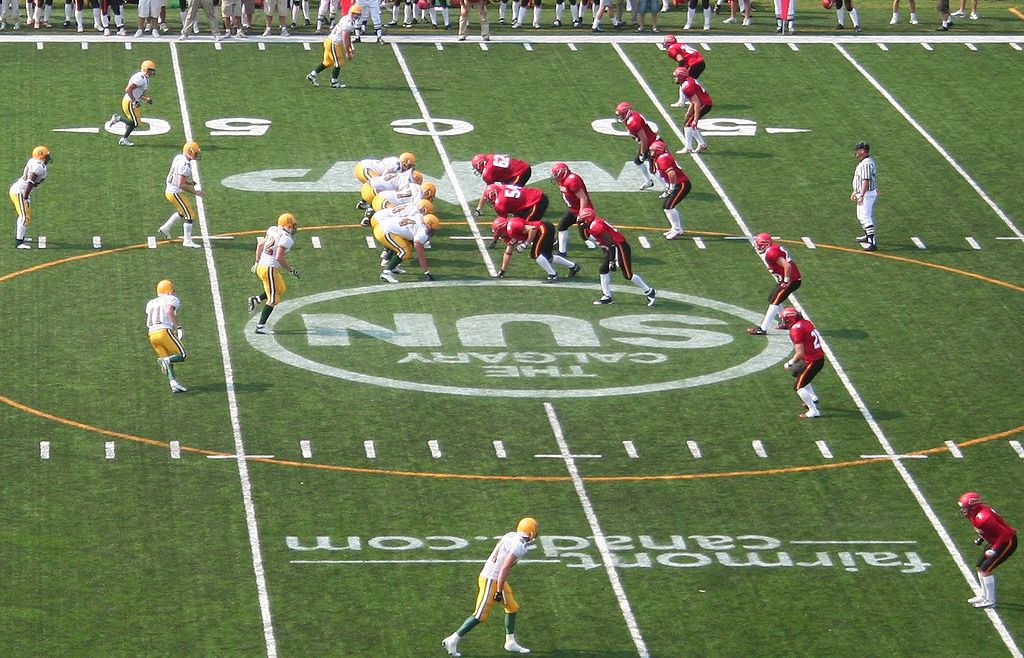
Canadian Football playing field.

Canadian Football playing field.  Source

The amazing thing is that the CREC pastors want to repudiate the historic Church, Her Bishops, and Her Sacraments, then claim the right to celebrate Her Sacraments in their own way. It is astonishing that Pastor Sumpter would call the historic Orthodox Church “divisive” and/or “schismatic” if She does not follow the CREC theology and ecclesiology!  It would make as much sense as Canadian football players demanding admission to the NFL Hall of Fame or else the NFL would be divisive or exclusionary!  Let us recognize and respect the fact that different games have different rules one must play by. Different game rules call for different playing fields, or else we will end up with multiple players on the same playing field playing according their own interpretations of the rule book with no referees to enforce the rules. If a football player wishes to play in the NFL games, he must play according NFL rules not according his own interpretation.


Where is the True Church?

Pastor Toby Sumpter’s beef with Orthodoxy lies in their refusal to recognize Protestant sacraments as equally valid as the Holy Mysteries received in the Orthodox Divine Liturgy. He wrote in a comment thread:

I may request that a person be baptized before coming to the table at Trinity, but I do not thereby insist that if any other church does it differently than me, they are therefore not a true church and their sacraments invalid. Rome and Orthodoxy are sectarian by their refusal to acknowledge the fullness of the Triune God in the sacraments and government of other historic Christian bodies. [Emphasis added.]

What he is saying here is: Hey! We’re just as much a church as the Orthodox Church is a church. This is based on the assumption that Protestantism is part of the “one holy catholic and apostolic Church” confessed in the Nicene Creed. But this raises several questions: What is the Church historically? More importantly, what has been the basis for church unity?  Is the church just any group of people who gather to hear sermons from the Bible, formulate new doctrines and confessions, create their own Bishops and Sacraments? Does church history teach or allow for modern ecclesiastical entrepreneurialism that give rise to new startup churches, new teachings, and alternative Christianities?

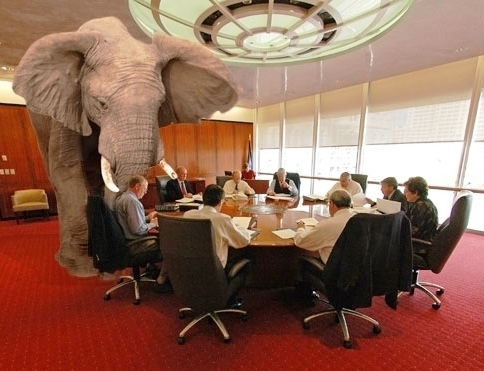
elephant-in-the-room3Historically, the Christian community gathered on Sunday to celebrate the Eucharist around the Apostles and then later their successors, the Bishops. There is simply no way the office of the Bishop can be honestly read out of the historic Church of the first fifteen centuries. It is possible that the trauma of the break from Rome created a historical amnesia in Protestant theology. Recently, there has appeared in Protestantism a desire to recover and incorporate some historic forms of worship. This has resulted in Reformed churches celebrating Holy Communion on a weekly basis. Some have gone so far as to discard the “just-a-symbol” understanding of the Lord’s Supper for the historic understanding of the Real-Presence of Christ’s body and blood in the Eucharist. These steps are all commendable. Yet there remains one important element missing — perhaps the elephant in the room – that is the episcopacy or the office of the Bishop.


Who’s Your Bishop?

The episcopacy or office of the bishop is critical to understanding the Church. Protestants have dismissed or overlooked the historic role Bishops played in Christianity because of the historic abuses of the Bishop(s) (Popes) of Rome, but sincere Christians cannot miss the fact of the episcopacy when reading Church history. For example, Ignatius, Bishop of Antioch (d. 98/117) wrote a series of letters that shed light on the early Church. It is important to keep in mind that he came from the Apostle Paul’s home church (see Acts 11:19-26, 13:1-3)! And it is worth noting the very venue of Galatians 2! [How early is Ignatius of Antioch? There is the story that Ignatius was among the children Jesus took into his arms and blessed (see Mark 10:13-16).]  And it is important to keep in mind that he was writing not as a church historian but as Bishop on his way to his impending martyrdom. In his Letter to the Smyrnaeans he wrote:

Wheresoever the bishop shall appear, there let the people be; even as where Jesus may be, there is the universal Church. It is not lawful apart from the bishop either to baptize or to hold a love-feast; but whatsoever he shall approve, this is well-pleasing also to God; that everything which ye do may be sure and valid. [Lightfoot translation; Emphasis added.]

For early Christians, the Bishop was more than a church administrator; he was viewed as the successor to the Apostles. For this reason early Christians took care to maintain lists of apostolic succession. See Eusebius’ Church History 3.22, 3.34-36 (NPNF Vol.1, pp. 149, 166-169). It was his job to safeguard and pass down the teachings of the Apostles. It was also his job to see that the churches under him were functioning in an orderly and harmonious manner, and that the Eucharist and the sacraments were administered properly.

We must also bear in mind something rarely noted in the Protestant reading of Church history — the New Testament Scriptures were incomplete for the first four decades of church history. As a matter of fact most scholars believe all the New Testament was not finished for the first 70 years!  This means there was no basis for the Protestant Sola Scriptura in the early Church!  How then was the Faith transmitted to the next generations?  Answer: by the Holy Tradition of the Apostles. The Apostle Paul made numerous references to Tradition; see 2 Thessalonians 2:15; 1 Thessalonians 2:13; 2 Timothy 1:13-14; 1 Corinthians 11:23. In other words, the early Christians depended on the Bishops to teach them the Apostles’ doctrines and practices (Tradition). The Apostle Paul expected successors like Bishops Timothy and Titus would faithfully pass on his teachings without change to future generations of Christians. And even when the New Testament canon was finalized in subsequent centuries the Bishops remained the official guardians of Apostolic Tradition. (There is not a single shred of historical evidence that once the New Testament canon was finalized that the Christians then shifted to Sola Scriptura. This is a Protestant presupposition that needs to be scrutinized in light of historical evidence.)

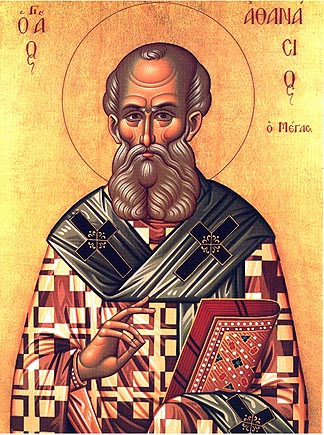
Athanasius the Great in bishop's vestments

Athanasius the Great holding the Gospel book

Historically, the Bishops were responsible for the safekeeping of the physical text of Scripture as well as its right meaning. One can have the right Scripture but abuse it through a wrong interpretation of the text (heresy). In Orthodox iconography the office of the Bishop is signified by the saint holding the Gospel book, a sign of his being the guardian and interpreter of Holy Scripture.

So if Ignatius of Antioch, the third Bishop of the Apostle Paul’s home church, were to walk into Trinity Reformed Church in Moscow, Idaho, (the church pastored by Pastor Toby Sumpter) he would ask: Who IS your Bishop. . . where does he live?  If a congregation cannot give the name of their Bishop and his line of succession back to the original Apostles, the implications are disturbing. One, the congregation would not be considered part of the “universal Church” or “Catholic Church” according Ignatius’ letter. Two, the baptisms and Eucharistic celebrations conducted at these bishop-less congregations would lack Apostolic validity!  (How would you feel if you learned your family doctor didn’t have a real M.D. degree and that the certificate on the wall was a mail order degree?  Would you entrust your family’s health into the hands of a self-taught quack?!!)  Please note: Orthodoxy does not assert dogmatically Protestant sacraments or churches are devoid of grace. Indeed, Metropolitan Kallistos Ware grants there are “measures of the grace of God” in other Christian communions. See The Orthodox Church pp. 307-311. What IS held is that, in openly rejecting the Orthodox Church of history, one rejects the fullness of historic Orthodoxy. One cannot repudiate much that is central to the historic Church (on the one hand), then turn around and claim the same status and privileges of the very Church one has just repudiated!

In other words, Saint Ignatius of Antioch effectively undercuts the basis for Pastor Toby Sumpter’s branch theory of the church!  A bishop-less church is like a general cut off from the chain of command!  Could a loyal soldier in good conscience obey the order of a renegade general?  This leaves a Reformed Christian in search of the historic church with two choices: (1) accept the logical implications of Ignatius of Antioch’s writings and look into Orthodoxy or (2) discard Ignatius of Antioch’s writings on the basis of Sola Scriptura (the Bible alone) and embrace the Protestant understanding of the church.

Thus, Orthodoxy’s unwillingness to recognize Reformed churches as part of the one holy catholic and apostolic Church is not the result of an arbitrary sectarian outlook held by hide bound church leaders. Orthodoxy’s refusal to grant mutual recognition to Reformed churches is grounded in the teachings of the early Church. In my journey to Orthodoxy one thing that has struck me is how much of early Christianity lives on in Orthodoxy. Tradition in Orthodoxy is a living Tradition. It is something lived out day by day over many centuries. Every Sunday Orthodox churches celebrate the historic Liturgy of St. John Chrysostom or St. Basil the Great. In Orthodoxy I see the Church of the early Church Fathers like Irenaeus of Lyons, Athanasius the Great, John Chrysostom, Basil the Great, John of Damascus. For a Protestant to visit an Orthodox Liturgy is like the movie Jurassic Park where paleobiologist Alan Grant sees living breathing dinosaurs walking right before his eyes.


The Unity of the Church

If Pastor Sumpter holds to the branch theory of the church, then it behooves him to demonstrate how this particular ecclesiology does in fact promote church unity. When one looks at more recent Reformed movements like the Federal Vision or the CREC (Communion of Reformed Evangelical Churches) and their embrace of the catholicity of the church one has to wonder how they would bring about unity in an already fractured Reformed tradition, not to mention the many differences in the larger Protestant tradition.

But the unity being discussed here is a horizontal unity among the various Protestant bodies today. It is a horizontal unity in the sense that it spans the world geographically in the present moment. Another dimension to church unity is the vertical unity that links the present day church to the early Church. Can Pastor Sumpter claim unity with the early Church?   Pastor Sumpter and Philip Schaff may have read the church fathers but are they in the line of historic Eucharistic Communion with a Bishop of the early church say of Saint John Chrysostom?

backtothefuture-delorean

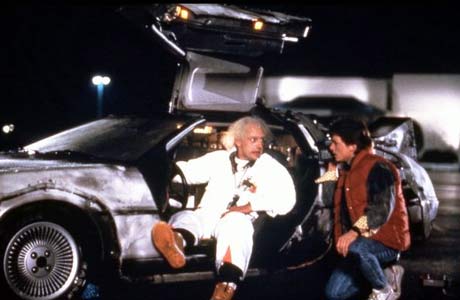
Let’s go time traveling!

Let us try this thought experiment. Let’s say Toby Sumpter and Philip Schaff travelled in a time machine back to Hagia Sophia Cathedral in Constantinople in the late fourth century when John Chrysostom was giving his famous sermons. Would they be allowed to receive Communion?  The answer is: No. This is based on the fact that the Patriarchate of Constantinople of today which has been in unbroken continuity with Saint John Chrysostom for centuries would deny Pastor Toby Sumpter Holy Communion now as it would then. Keep in mind that John Chrysostom is the 37th Bishop of Constantinople who served from 398 to 404, and the current Bishop is Bartholomew I who took office in 1991 is the 271st Bishop of Constantinople.

In terms of doctrine and worship the Greek Orthodox Church today is virtually identical with Saint John Chrysostom’s Church then. The question one must then ask is: Is there a discontinuity between the Greek Orthodox Church of today and the church of John Chrysostom’s time?  If there is a disruption (this I believe is what Pastor Sumpter would assume), then when did the break take place?  If the discontinuity is due to Protestantism’s break with Rome then the question becomes: Is the Reformed church one with Saint John Chrysostom’s church or is it a separate church?


By What Authority?

Interestingly, in addition to logic and reason, Pastor Sumpter felt the need to invoke his pastoral authority as he closes the blog article.

You are under the authority of and in communion with Jesus now through the pastors and elders who baptized you, catechized you, and serve you the Supper.

When I read this sentence I was taken aback. When I was a Protestant I never encountered such naked expression of pastoral power; not even when I was talking with my pastor about my intention to become Orthodox!  This kind of strong authority is a part of Orthodoxy but even then Orthodox priests exercise it cautiously. I heard an Orthodox Priest relate instances when parishioners wanted to adopt practices or views contrary to Orthodoxy, his response to them was: “There’s the door. And you’re welcome to come back when you’re ready.”  Meaning they were free to leave the Church if they held views at odds with the teachings of the Church but that he would welcome them back if they changed their mind. This open door approach is more respectful of human dignity than emotional blackmail and spiritual intimidation cloaked in “pastoral” concern.

But the more fundamental question here is: What is the basis for pastoral authority?  At the Last Supper Jesus said to his disciples: “This cup is the new covenant in my blood, which is poured out for you.” (Luke 22:20)  In other words with his death on the Cross Jesus inaugurated the New Covenant. This means that the Church is the New Israel. Like the Israel of the Old Covenant there was covenant order and covenant authority. Covenant authority is not something one generates by one’s self; it is conferred by a higher authority. Jesus told his disciples: “I confer on you a kingdom, just as my Father conferred one on me. . . .” (Luke 22:29)  Covenant authority is conferred by Christ to his Apostles who in turned conferred it to their successors the Bishops via ordination. Inquirers into Orthodoxy today can examine the Orthodox Church’s claim to apostolic succession through the lists of successions, e.g., that of Patriarchate of Antioch or that of Constantinople. The sad thing is that the lack of Bishops means the absence of covenant authority in Reformed churches. This leads to the question: By what authority does Pastor Sumpter warn people not to convert to Orthodoxy?  Lacking the covenant authority of the historic apostolic Church, Pastor Sumpter is on shaky grounds here.

Pastor Sumpter curiously uses his pastoral position with emotional family appeals for unity. One wonders if he offers the same counsel to couples and families coming to his church who are leaving historic Orthodox, Roman Catholic, or Baptist, Pentecostal, Anglican family backgrounds? Or does Pastor Sumpter’s idea of schism cut in only one direction? Regardless, this line of argumentation seems more than a tad manipulative – if not downright duplicitous.


Joining the Levite Club?

It is regrettable that Pastor Toby Sumpter has to engage in name calling in his defense of Reformed Christianity. This is more than a breach of good manners; it is also symptomatic of a weak theological position. I am reminded of this quote:

Observe which side resorts to the most vociferous name calling and you are likely to have identified the side with the weaker argument and they know it. (Charles R. Anderson)  Source

Equating joining Orthodoxy with joining the “Levite club” or becoming “camel gulpers” and “gnat stranglers” is colorful polemics but not reasoned argumentation. We deserve better than that!

You can’t convert and act like you aren’t making a drastic statement about them. How is going from sharing the body and blood of Christ with them to being forbidden to becoming more catholic? You are going from loving Christ in the brothers and sisters right in front of you to getting cozy with strangers. This is why Paul withstood Peter to his face in Antioch. He was eating with some brothers and then when the Judaizers showed up, he withdrew. This is against the truth of the gospel. This is high handed hypocrisy and pharisaism. You are the Levite and the Priest on the road from Jericho to Jerusalem. You have made an idol of ceremonies and traditions, and you are training to become a professional camel gulper and gnat strangler.  [Emphasis added.]

I suspect the polemic here is directed against: (1) Orthodoxy’s liturgical approach to worship and prayer and (2) Orthodoxy’s ascetic disciplines. With respect to the first target of Pastor Sumpter’s polemic (liturgical worship) all I can say he is correct in his judgment. Just as Old Testament worship and spirituality was liturgical and formal in nature so too is Orthodox worship and spirituality. I note however that Christian worship has historically been liturgical in nature and that it was not until the Protestant Reformation and especially the emergence of Puritanism that ceremonialism was stripped from Christian worship. So what’s the problem?

With respect to the second target of Pastor Sumpter’s polemic (Orthodoxy’s ascetic disciplines) I would point out that while Orthodoxy has a lot of rules about fasting and prayer, it is not legalistic. This may sound contradictory but the fact of the matter is we fast and pray for our spiritual growth, not to earn God’s favor. I learned that there are occasions when it is better for an Orthodox Christian not to fast for reasons of charity or hospitality. For example, if an Orthodox Christian visits the home of a non-Orthodox family and is offered hamburger the better thing is accept their hospitality than to rigidly keep the fast.

Please don't swallow me!

Please don’t swallow me!

In Orthodox spirituality discipline is leaven with grace and mercy. There are frequent warnings about the spirit of Pharisaism. After several years of attempting to keep the fasts I’ve had to eat a lot humble pie but I don’t think I’ve become a “camel gulper.”  😉


Away with Bishops?

In a subsequent blog article —  “Better Than Anointed Lords“– Pastor Sumpter posted a lengthy excerpt from Philip Schaff’s “Principle of Protestantism” which employs similar rhetorical techniques. It is evident that Schaff has a low opinion of Orthodoxy when he calls attention to the “dead Armenian and Greek denominations.” Philip Schaff’s ad hominem attack against Orthodoxy in the 1800s is no less ferocious than Pastor Sumpter’s.

No, we need something higher and better than anointed lords and consecrated gentlemen. Such aristocratic hierarchs and proud bearers of apostolic succession precisely, like the pharisees and highpriests of Judaism, have themselves again and again secularized the Church, rocking it into the sleep of lifeless formalism or religious indifference. [Emphasis added.]  

Schaff’s attack on the office of the Bishop is breathtaking. Throughout church history there have been good Bishops and bad Bishops, but that is no reason to dispense with the episcopacy. There have been good Pastors and bad Pastors, but that is not reason for dispensing with the office of the Pastor!  Using this same logic if there are numerous bad sermons given on Sunday morning is that reason enough to drop the sermon altogether? Is not the more reasonable solution?? More dedicated Bishops, better Pastors, and high quality sermons? We need as the Apostle Paul advised Bishop Timothy to “fan into flame the gift of God” (2 Timothy 1:6).


A Word for Hesitant Protestants

What I have tried to do in this blog article is to respond logically and calmly to Pastor Sumpter’s warnings and admonitions to Reformed Christians interested in Orthodoxy. It is understandable that someone of Pastor Sumpter’s theological convictions would express alarm over people converting to Orthodoxy. People have been crossing over for some time now from the Reformed tradition to Orthodoxy, and this tiny trickle has been growing into a noticeable stream of converts drawing the attention of concerned Reformed pastors.

In this blog article I gave reasons for becoming Orthodox, but I also recognize that some people are hesitant for relational reasons. They fear the breakup of long standing friendships and intimate family ties. These are good reasons to hesitate. Generally, the counsel by Orthodox Priests is that it is better for the husband or wife to delay their entry into the Church in order to give their spouse time to consider Orthodoxy. Orthodoxy seeks to keep marital and family ties intact. See my articles: “Family Concerns and Conversion to Orthodoxy” and “Called Together.”

For many inquirers the best approach is the “Nicodemus approach,” that is, to inquire quietly and discreetly about Orthodox Christianity. There are many excellent books and materials out there. Thanks to the Internet people can listen to Ancient Faith Radio or read the Early Church Fathers online. Another venue for quiet exploration is the Saturday evening Vespers service or visit an Orthodox Liturgy while traveling. One could even set up a one on one meeting with a local Orthodox priest. Many priests are converts to Orthodox and many of the priests who are “cradle Orthodox” have experience dealing with Protestant inquirers. And of course there’s the Contact Form on this blog and other similar blogs. 🙂

For hesitant Protestant inquirers my message to them is: “Don’t be afraid!  Trust in God’s sovereignty and his great mercy.”  We can’t control the times we live in but we can choose how we will live. In my blog article “Crossing the Bosphorus” I compared the different kinds of border crossings taking place today. With some families becoming Orthodox is like moving house, one loads up the truck, say your goodbyes, and move into your new home. For others becoming Orthodox will be like crossing hostile territory strung with barbed wires and guards on patrol. For these families becoming Orthodox will be much more difficult and costly. My aim here is to foster friendly dialogue and mutual respect on both sides. I believe there can be friendly dialogue between the Reformed and Orthodox traditions even as we disagree.


Can We Still be Friends?

In a recent blog posting “Evangelicals and Orthodox in Conversation” I pointed out the longstanding friendship between Pastor John Armstrong and Father Wilbur Ellsworth even as they diverged theologically. Ellsworth became Orthodox while Armstrong remained a convinced Reformed minister. [See video]

coffee_conversation_by_kieranriley-d4d0bfy

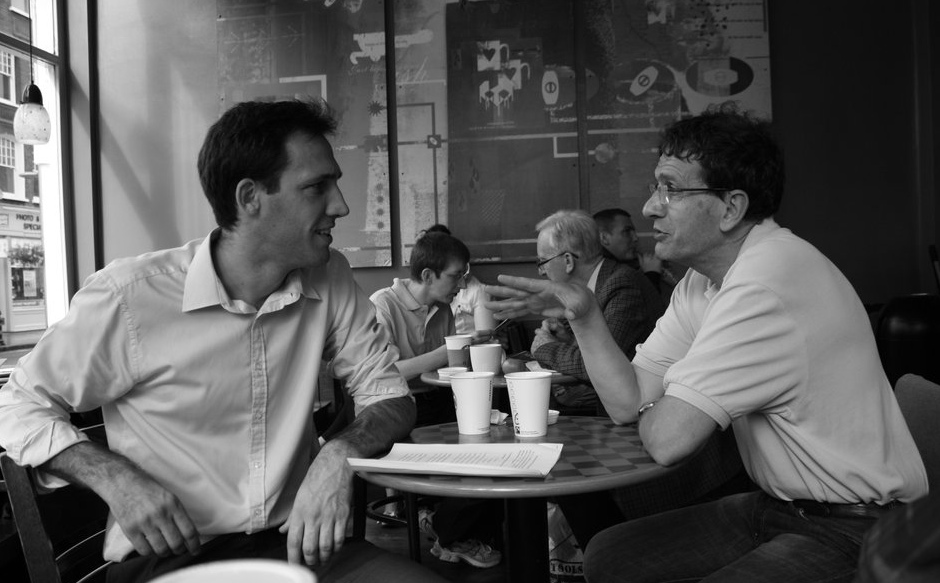
Friends talking and having a good time.

It’s more than a decade since I converted to Orthodoxy. I’m amazed that many of my friendships still carry over from my Protestant days. A few days ago I had dinner with a retired Congregationalist pastor, went to the local farmers’ market with a couple who belong to a United Methodist Church and another friend who is Roman Catholic. A few nights ago I went to a Thai food restaurant for dinner with a friend from the missions committee of my former home church and caught up with a missionary couple whom I knew from the 1980s!

Much of this camaraderie is due to the mutual respect we have for each other even as we differ theologically. Also, I emphasized the personal aspect of friendship but exercised caution when it comes to church functions. I’ve attended funerals at my former home church; and I attended their centennial anniversary but I told them I would not be attending their Sunday Services. I can’t because it would be like seeing an old girlfriend one still has feelings for. Love and commitment calls for wisdom in setting boundaries. The point I want to make is that friendships can continue even as we change church membership.

Source

Enjoying a common meal!  Source

As I wrote earlier in this blog article, Orthodox Christians welcome the opportunity to share a common meal with their Reformed friends and family members!  This is the right application of Galatians 2 to the present situation. Let us not be like the early Judaizers who disinvited themselves from the common meal with Gentile fellow believers in Christ. We may not always agree theologically but we can still be friends.

Robert Arakaki


« Older posts Newer posts »