Radiant Pascha!
And Other Weird Orthodox Stuff
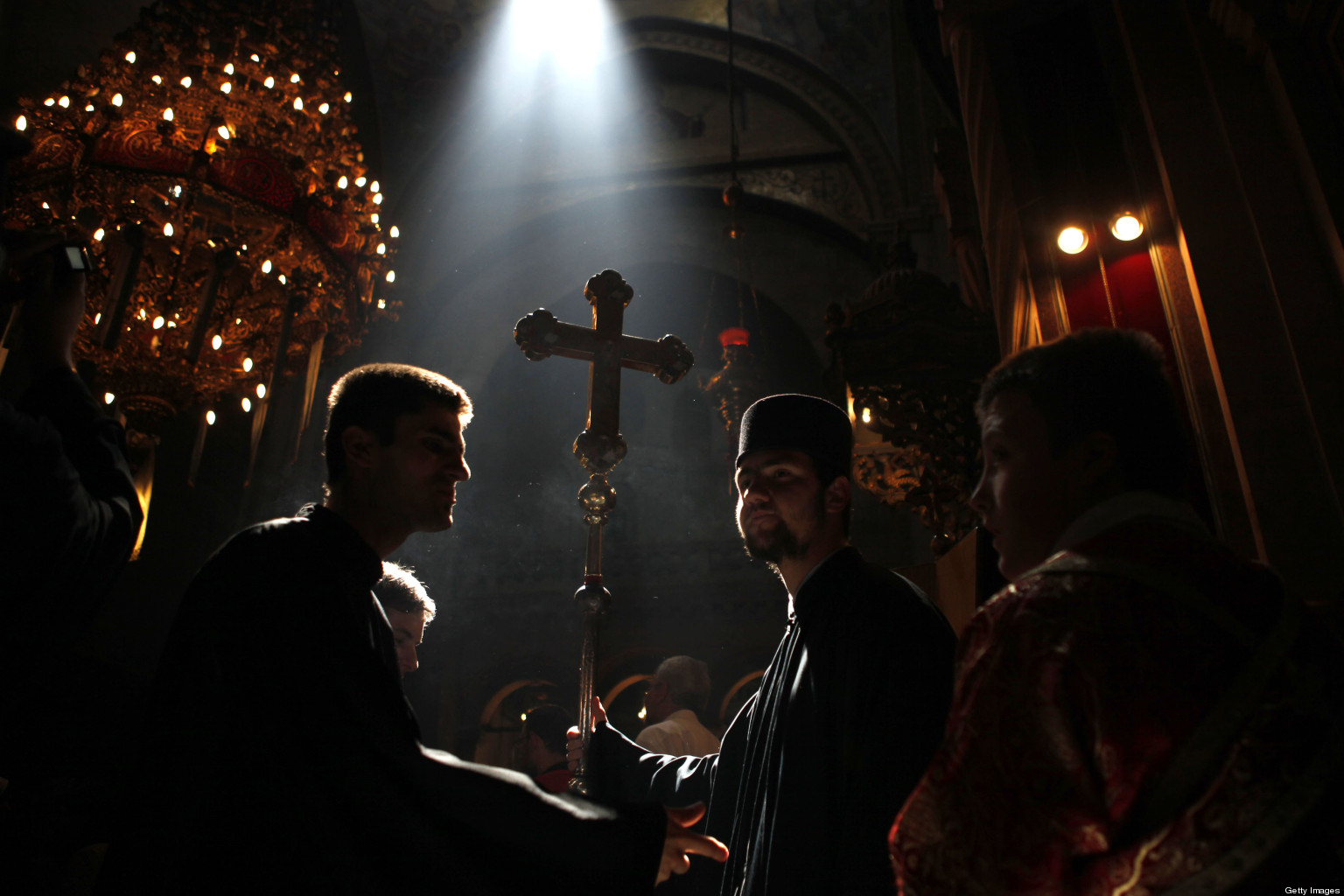
For Protestant inquirers, Orthodoxy is more beautiful, glorious, wilder, and weirder than they would imagine. They hear ancient prayers chanted in dark churches illuminated by candles while smelling the scent of incense drifting in the air. If they attend the Orthodox services on special feast days, they will see other surprising rituals: the priest and congregation processing around the church building with the symbolic funeral shroud of Christ on Holy Friday, the priest flinging flowers all around the main sanctuary on Holy Saturday, and the joyous shouts of “He is Risen!” at the Easter midnight service. They will see priests handing out bottles of holy water on the feast day of Christ’s baptism, and priests blessing baskets of fruits and jars of honey at the start of the Dormition fast in August. They will also witness strange things like miraculous icons and people kissing the relics of dead saints.
These Orthodox practices will seem strange to most Protestants. But before discussing these Orthodox practices below, let’s first look at some common Protestant or at least American practices regarding loved ones who are no longer with us. In other words, how does one of the premiere Protestant countries, the U.S.A., treat their departed loved ones?
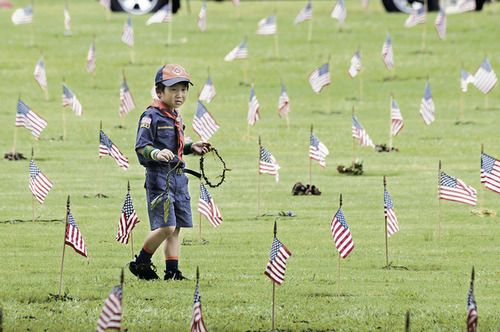
Memorial Day at the National Memorial Cemetery, Honolulu HI Source
Those who criticize Orthodoxy for the importance we give to the relics of the saints might want to take into consideration the priority the U.S. government gives to locating the remains of the fallen soldiers in far-off battle sites. In 2015, the U.S. government allocated $80 million for the Senator Daniel K. Inouye Defense POW/MIA Accounting Agency building in Hawaii. This forensic laboratory will help identify bone fragments and return them properly to loved ones. Would Protestant critics be willing to say that the $80 million could have been better used elsewhere? Similarly, there is the local custom in Hawaii of placing flower leis on the graves in the National Cemetery on Memorial Day. Would Protestant critics be willing to say that the time put into making the leis and the hours the local Boy Scouts put into placing the leis on the graves would be better used elsewhere? If they are willing to grant that it is very much worth the time and trouble to remember and honor those who gave their lives for their country, how much more would it be worth the time and trouble for Christians to honor those who gave up their lives for Christ?
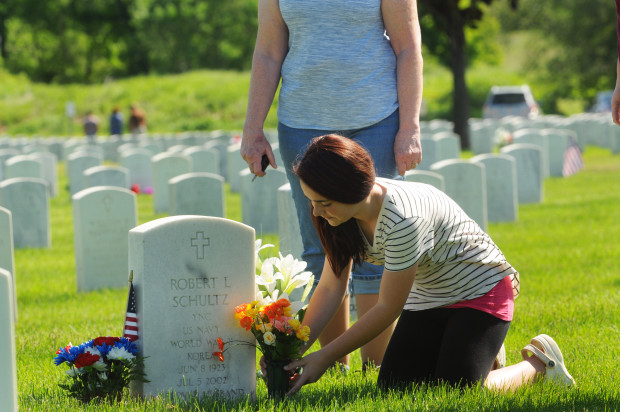
Memorial Day tradition at Ft. Snelling, Minnesota Source
Many Protestants have the custom of visiting the graves of their loved ones – spouses, children, parents, and relatives – on the anniversaries of their death or on special occasions like Christmas, Easter, or Memorial Day. It is a widely accepted practice to place flowers on the graves. Many will even talk with their loved ones voicing their regret, their loss, and sometimes the hope of being reunited in the future. What these Protestants are doing is quite similar to how Orthodox and ancient Christians remember the dead. I urge Protestant readers not to be hasty in judging how Orthodox Christians honor the dead but to consider the Orthodox point of view.
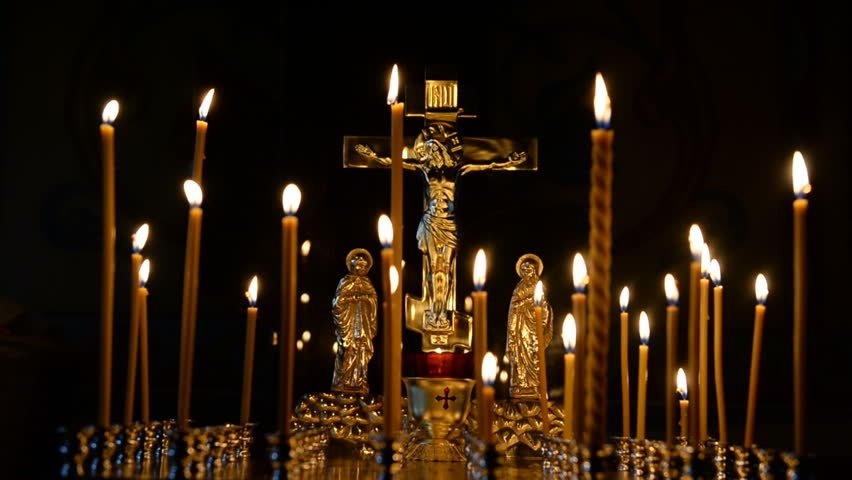
Memorial Service
From time to time, Orthodox parishes will hold memorial services for someone who has died. For this service a small table is placed before the icon of Christ. On the table is a plate with a small mound of boiled wheat and two candles on the right and left. The boiled wheat symbolizes Jesus’ remark about the grain of wheat that is buried (John 12:24). During the Memorial Service we lament our fallen state:
I am an image of Your indescribable glory, though I bear the scars of my sins. Master, take pity on the work of Your hands, and in Your loving-kindness cleanse me. Grant me the home land for which I yearn, making me once again a citizen of Paradise.
And we celebrate Christ’s victory over death:
God of spirits and of all humankind, as You trampled down death, overthrowing the Evil One and granting life to Your world, will You, Lord, grant rest to Your servant(s) (N.) now asleep in death, in a place of light, a place of renewed life, a joyous place, shunned alike by pain and sorrow and sighing.
During the Memorial Service we do more than remember our loved ones, we also pray for them. We ask God:
Every sin he (she, they) may have committed, in word or deed or thought, as our good and loving God forgive; for no one can live and not sin.
The Memorial Service culminates with the priest and the congregation singing several times: “May their memory be eternal.” [video] The website for St. John the Baptist Greek Orthodox Church in Portland, Oregon, gives this explanation for the Memorial Service:
The Orthodox Church teaches that through our prayers, those “who have fallen asleep in the faith and the hope of the Resurrection” continue to have opportunity to grow closer to God. Therefore, the Church prays constantly for her members who have died in Christ. We place our trust in the love of God and the power of mutual love and forgiveness. We pray that God will forgive the sins of the faithful departed, and that He will receive them into the company of Saints in the heavenly Kingdom. The Orthodox Church remembers the departed in the prayers of every Divine Liturgy, but also has a special Memorial Service, said on numerous occasions.
Whereas the Memorial Service takes place as the need arises, there are in the Orthodox calendar several days designated “Saturday of the Souls.” On these days we remember those departed and pray for them. This is so different from my former Protestant home church, where deceased church members are pretty much forgotten after their funeral.
There is in our modern culture a deep-seated fear of death. We don’t like to contemplate our mortality. We avoid talking about death and dying. Evangelical worship services, on the other hand, tend to focus on spiritual uplift or on how being a Christian can result in a happy, fulfilling life. In Orthodoxy there is a more frank acknowledgment of our mortality. In every Sunday Liturgy we pray for a good Christian death and a good defense before the dread judgment seat of Christ several times. Every year on the Sunday of the Final Judgment we are reminded that we will have to give a reckoning for how we lived our lives. All this is spiritually healthy. In the early Christian classic, The Ladder of Divine Ascent, one important step is “Step 6 – Remembrance of Death.” The Orthodox remembrance of death can lead to practices that Protestants may regard as weird, unseemly, or even grotesque. But it should be kept in mind that the cross which at one time was a means of inhumane punishment and an agonizing death was transformed into a symbol of hope and Good News by Christ’s resurrection. Each bedside death becomes a battle field where we come face-to-face with our final enemy Death and those who are faithful to the end become more than conquerors (1 Corinthians 15:28; Romans 8:37).
Orthodox Monasteries
Monasteries are very rare or non-existent in many Protestant denominations. Many Protestant inquirers are not sure what to make of monasteries. One very important thing to keep in mind is that monasteries are not places of normal Orthodoxy. Monasteries are places where certain people devote their entire lives to prayer and spiritual growth. [video] To visit a monastery is like visiting a training camp for professional athletes with high-tech equipment and strict training regimens. Not everyone is called to be a full-time athlete, but we are all called to live a healthy, active lifestyle.
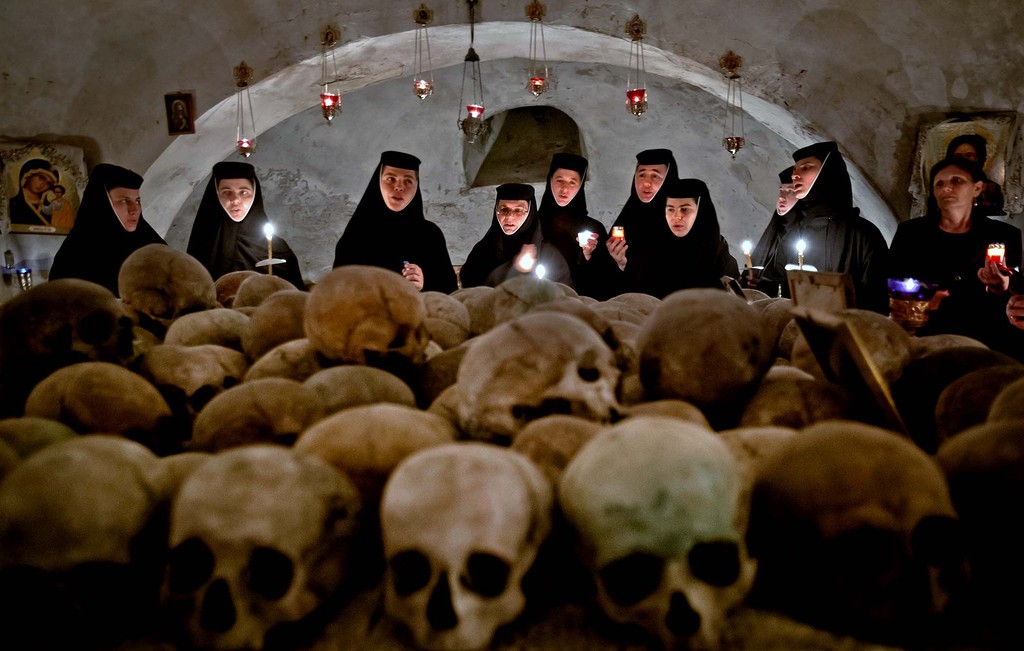
Orthodox nuns sing in the ossuary at the Pasarea monastery, Bucharest, Romania Source
Part of the monastic calling is preparing for death. In some monasteries monks will actually sleep in coffins in order to prepare themselves for death. In ancient monasteries monks will go into the ossuary, the place where the bones of earlier monks are kept, and rearrange the bones to make room for those who will die in due time. [video – see 34:27] To modern Americans fearful of death such practices are gruesome. However, the monastic discipline of preparing for the moment of death is an act of realism and courage. We are all going to die sooner or later. Many modern Americans have become obsessed with getting the most out of this life. They make bucket lists of all the fun and exciting things they want to do before they die, but they do so with little heed or preparation for the account they will have give to God after they die (Matthew 12:36; Luke 12:13-21).
Ordinary Orthodox laity will from time to time visit a monastery for spiritual renewal. They take part in the prayer routines of the monastery in order to deepen their prayer life. A Protestant visitor who lacks an empathetic understanding of Orthodoxy will often see monastic practices thru the lens of the original Reformers who reacted against medieval Roman Catholicism’s works righteousness. One should not be surprised if Protestants visiting an Orthodox monastery are offended, even shocked, by what they see there. Protestantism and Orthodoxy represent two different cultures. Visitors need to be respectful of these differences and not seek to judge the other by arbitrary standards. The best way to navigate the differences is through Scripture and church history. Late innovations should be regarded with suspicion while practices marked by antiquity and ubiquity can be considered worthy of respect by all Christians.
Venerating Relics
One common stumbling block for Protestants is the Orthodox veneration of icons. Often upon entering an Orthodox Church one will see people crossing themselves then kissing an icon of Christ, the Virgin Mary, or one of the saints. Another potential stumbling block is the Orthodox tradition of venerating the relics of saints. An inquirer might regard relics as something weird and out there, but there are relics in every Orthodox Church. Every altar contains bits of relics placed there during the consecration of the church. Canon 7 of the Council of Nicea II (787) mandates the placement of relics of saints, particularly martyrs, at the consecration of a church. This means relics are not something out there but right before us at every Eucharist! This practice follows Revelation 6:9, which tells of the martyrs under the altar. The Orthodox belief is that the martyrs are not far away, but interceding for us before the throne of God.
Making Church History Real
For many Protestants, church history has an abstract quality. Oftentimes, church history is viewed as a source of intellectual data, dates and remote historical figures, not as personal fellowship. In Orthodoxy, the saints are not far away, but very much with us, even if we cannot see them. Orthodoxy honors the saints through icons and feast days. It is one thing to admire the saints after reading about their lives, but it is something quite different to kiss their icons. Kissing an icon of a saint is an expression of Christian honor, respect and fellowship. In Hawaii there is the widespread custom of kissing people on the cheek when greeting them. Among Orthodox Christians it’s a common practice to kiss the hand of the priest as a sign of honor, respect and affection. In light of the American emphasis on egalitarianism, where one person is rarely if ever honored above another, and the stress on individualism, such Orthodox practices often seem not just weird, but offensive. Thankfully, the ancient Church was not so infected by the habits of modernity.
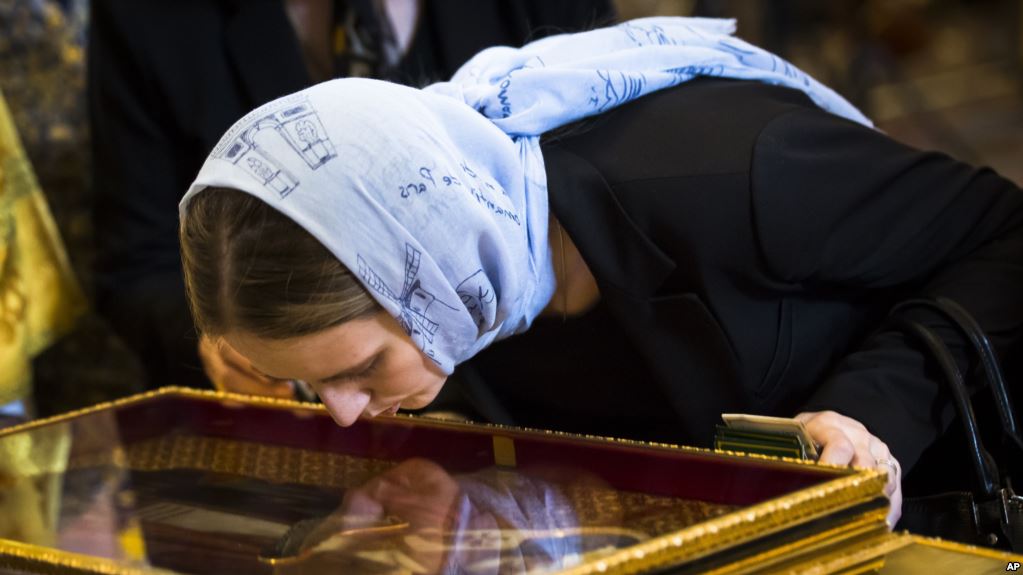
Venerating Saint Nichols’ relics in Moscow 2017 Source
Many Protestants think of Santa Claus as a mythical figure little knowing that there was a real historical Santa Claus – Saint Nicholas, bishop of Myra, who was present at the Council of Nicea (325). In June 2017, the relics of Saint Nicholas were brought to Russia and some 300,000 people showed up to venerate them. The Voice of America article quoted a young Russian economist who was among those who venerated the relics:
“It was tough, but you got a chance to think about your life, all the problems and the sins you have committed,” economist Svetlana Dzhuma, 24, said after exiting the cathedral in a state of elation.
Venerating the relics of saints represents one way of connecting with the ancient Church. It also represents a way of affirming that the final word for humanity is not death, but Jesus Christ who will resurrect our bodies at the Second Coming.
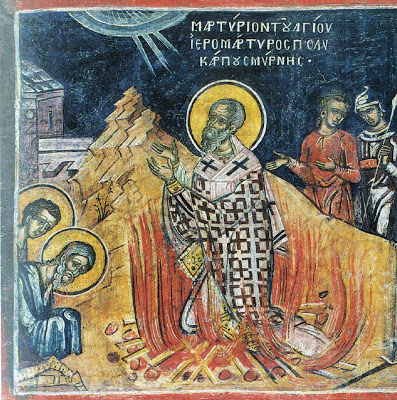
Icon – Martyrdom of Saint Polycarp
The Antiquity of Venerating Relics
The practice of venerating the relics of martyrs is an ancient one. It was mentioned in the early letter The Martyrdom of Polycarp, which has been dated to mid second century (c. 155 or 166). Here we see the early Christians drawing a distinction between the worship (προσκυνουμεν) given to Christ and the honor (αγαπωμεν αξιως) given to the saints.
For Him [Jesus Christ] indeed, as being the Son of God, we adore; but the martyrs, as disciples and followers of the Lord, we worthily love on account of their extraordinary affection towards their own King and Master, of whom may we also be made companions and fellow disciples! (Chapter 17)
In the following chapter we have one of the earliest accounts of the veneration of relics. Bishop Polycarp was sentenced to be burned at the stake by Roman authorities. Afterwards, the Christians gathered up his remains.
Accordingly, we afterwards took up his bones, as being more precious than the most exquisite jewels, and more purified than gold, and deposited them in a fitting place, whither, being gathered together, as opportunity is allowed us, with joy and rejoicing, the Lord shall grant us to celebrate the anniversary of his martyrdom, both in memory of those who have already finished their course, and for the exercising and preparation of those yet to walk in their steps. (Chapter 18)
From this passage we learn also of the early Christian practice of commemoration of the anniversary of a martyr’s death. What is significant about Polycarp’s martyrdom was how early it was. The veneration of Polycarp’s relics was not some later addition but part of early Christianity. The Martyrdom of Polycarp consisted of a letter by one church to another. This means it was not the personal opinion of one individual but reflects the collective thinking of the early Christians.
It is important to understand that the honoring of the saints and the venerating of their relics, while an integral part of Orthodox Tradition, do not comprise the core of Holy Tradition. They can be seen as out-workings of the core dogmas of the Christian Faith: the Incarnation, Christ’s saving death on the Cross, and his triumphal third day Resurrection. The Orthodox understanding is that, because the Son of God took on a human body, our fallen bodies can become redeemed vessels filled with divine life. Christ’s descent into Hades and his triumphal resurrection means that the faithful departed now stand before the throne of God. This belief in the unbroken fellowship between the Christians here on earth and those who have passed on is found in the Apostles’ Creed: “communion of the saints.” What may seem to be foolish superstition or arbitrary tradition to skeptical Protestants have their basis in the deep truths of the Gospel.
Calvin’s Argument Against Relics
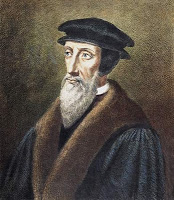
John Calvin
Calvin’s critique of relics is found, not in his Institutes, but in an essay: “On the Advantages of an Inventory of Relics.” This essay is a fifty-page rant filled with lurid examples. It is not the coherent theological argument one would expect from a well-respected theologian of his stature. There is no denying the rampant corruption, frauds, and abuses in medieval Roman Catholicism. But that still begs the important question about the theological basis for rejecting the veneration of relics. Calvin’s argument consists of unsupported assertions. He writes:
But the first abuse, and, as it were, beginning of the evil, was, that when Christ ought to have been sought in his Word, sacraments, and spiritual influences, the world, after its wont, clung to his garments, vests, and swaddling-clothes; and thus overlooking the principal matter, followed only its accessory. (p. 289)
He goes on to explain his rejection of venerating relics:
In short, a longing for relics is never free from superstition, nay, what is worse, it is the parent of idolatry, with which it is very generally conjoined. (p. 290)
A more theologically coherent argument against relics can be found in Peter Leithart’s article “Why Protestants Still Protest.” Leithart, echoing Calvin, argues that icons and relics have no basis in Scripture and that they comprise a veil that distracts people from an encounter with Christ. What we have here is a succinct summary of Calvin’s position, but what is still lacking is a sustained theological argument.
An Orthodox Response to Calvin
One important difference between Orthodoxy and Protestantism is Orthodoxy’s belief that physical matter is capable of conveying divine grace. We believe that in the Eucharist the bread and wine become the body and blood of Christ. We believe that in the water of baptism our sins are washed away and we are united to Christ’s death and resurrection. During the sacrament of baptism the priest blesses the water that will be used for the sacrament. What starts off as ordinary water becomes blessed and sacred means of grace. A painted image (icon) through prayer becomes a window allowing us to perceive the kingdom of God.
Underlying the Protestant rejection of relics is a metaphysical dualism that assumes a separation between physical matter and divine grace. The early Gnostic heretics viewed physical matter as inferior and corrupt in comparison to the spiritual. While not the same, there is within Protestantism a secular worldview that confines God’s grace to the interior world of thought (doctrine) or feeling (spiritual experience) while viewing external ritual as optional and physical matter as neutral or unspiritual. This secular approach to religion has resulted in a disembodied, intellectualized Christianity. The experience of personal conversion to Christ has been elevated as the core of Christianity while other elements like Church, the sacraments, the Creed, the Liturgy, and the ordained priesthood are relegated to the status of optional, non-essential aspects of Christianity. What for the early Christians was an integral package that comprised life in the Church have become in Protestantism broken fragments scattered all over the ground.
The early Christians, on the other hand, in light of the Incarnation and the Resurrection saw physical matter as capable of being sanctified and transformed into means of divine grace. This Christianized worldview would give rise to the sacraments of the Church, which took the stuff of creation and transformed them into entry ways into the kingdom of God. This sacramental worldview was the historic Christian worldview shared by all Christians until the Protestant Reformation.
There is within some modern Protestant circles an attempt to return to the sacramental worldview. Ted Olsen described how N.T. Wright, the widely-respected Anglican theologian, changed his thinking. In The Way of the Lord (1999) Wright wrote about:
… his slowly turning away from various forms of dualism, to which evangelicalism is particularly prone, and towards a recognition of the sacramental quality of God’s whole created world. … With the incarnation itself being the obvious and supreme example, and the gospel sacraments of baptism and eucharist not far behind, one can learn to discover the presence of God not only in the world, as though by a fortunate accident, but through the world: particularly through those things that speak of Jesus himself, as baptism and the eucharist so clearly do, and as the lives of holy men and women have done. (Emphasis added.)
Apparently, N.T. Wright still holds to the Protestant understanding of the sacraments in which God’s grace is conveyed principally through the sacraments of baptism and the Eucharist. However, his insight into the sacramental potential of creation provides a bridge to the Orthodox sacramental worldview in which icons, relics, and other physical stuff sanctified by the name of Christ can become channels of divine grace. This has biblical support. We read in the book of Acts how the Apostle Paul’s body became a vessel of divine efficacy.
God did extraordinary miracles through Paul, so that even handkerchiefs and aprons that had touched him were taken to the sick, and their illnesses were cured and the evil spirits left them (Acts 19:11-12).
The Apostle Peter’s body likewise demonstrated a similar sacramental grace.
As a result, people brought the sick into the streets and laid them on beds and mats so that at least Peter’s shadow might fall on some of them as he passed by. (Acts 5:15)
The notion of miraculous relics and icons might seem farfetched to Protestants, but there is ample support for these supernatural phenomena in Holy Scripture. There is the account of the woman with the issue of blood who was healed upon touching Jesus’ clothes (Mark 5:28-30). Her personal faith made her receptive to the divine grace emanating from Jesus’ person while the others who were jostling Jesus were left unaffected. That Jesus’ clothes conveyed some spiritual power can be seen in Mark’s writing: “At once Jesus realized that power had gone out from him.” (Mark 5:30) In the Old Testament, we read how Elijah’s cloak had the power to divide the Jordan River upon contact (2 Kings 2:8). In 2 Kings 13, we read about how Elisha’s bones had the power to bring a dead man back to life (2 Kings 13:21). Normally, the bones of a dead person are unclean, but under some circumstances they can become holy objects capable of effecting miracles. Modern Protestants might not be comfortable with such a world, but this is the world of the New Testament, as well as the world Christians inhabited before the Reformation.
A modern-day Protestant might find the notion of a dead person’s bones being holy and grace-filled ludicrous, but Scripture clearly supports it. Thus, what is puzzling is not the Orthodox veneration of the relics, but rather the Protestant aversion to this practice. Protestants who reject the Orthodox veneration of relics need to put forward a theologically-coherent and biblically-based argument. To sum up, where the Orthodox veneration of relics has biblical support and is consistent with the witness of church history, Calvin’s polemical essay comes across as an unhinged, emotional harangue that soon wears on the inquirer looking for solid theological reasoning. More recent Protestant objections have failed to do any better than Calvin.
The Orthodox practice of praying for the departed and venerating relics of the saints is grounded in the sacredness of our whole humanity (body, soul, and spirit), the power of Christ’s resurrection, and the sacramental understanding of creation, that is, material matter is capable of conveying divine grace. It reflects an ancient worldview that challenges the secular metaphysics of modernity. The discomfort felt by Protestants towards the veneration of relics is a sign of the cultural gap between Protestantism and the early Church. Ted Olsen, in his Christianity Today article “Wrestling With Relics,” wrote: “My own views would have been terribly out of step in the church’s earliest centuries.” This forces Protestants to choose between Protestantism’s modernity and Orthodoxy’s roots in ancient Christianity,
A Protestant Relic?
Probably the closest thing to a relic in Protestantism is the printed text of the Bible. There is something neat and soothing about the black ink on thin paper encased in black leather and embellished with gold leaf. Evangelicals are proud to carry their bibles under their arms into neat church buildings with four bare walls on Sunday mornings and listening to didactic lectures (sermons) about the biblical text. There is a certain Muggle-like neatness to this worldview. So it comes as no little surprise when a Protestant stumbles into the enchanted world of Orthodoxy with weird, wild stuff like icons, relics, incense, holy virgins and victorious martyrs they experience feelings of surprise, shock, discomfort, or the joy of having come home at last to the ancient Church.
Robert Arakaki
References and Recommendations
Robert Arakaki. “Early Evidence for the Veneration of the Saints.” OrthodoxBridge
Robert Arakaki. “Calvin Versus the Icon.” OrthodoxBridge
John Calvin. “On the Advantages of an Inventory of Relics” In Tracts and Treatises of John Calvin (vol. 1 of 3) pp. 289-341 and “Inventory of Relics” www.mongergism .com
Fr. Stephen Freeman. “Soul Saturday — And Forty Days Plus” Glory to God For All Things
Vincent Gabriel. “Early Christian Worship and the Bones of the Martyrs.” OrthodoChristian.com
Peter Gillquist. The Physical Side of Being Spiritual.
Peter Leithart. “Why Protestants Still Protest.” First Things (August 1995)
Ted Olsen. “Wrestling With Relics.” Christianity Today (February 2009)
Fr. John Whiteford. “What is the Basis for Venerating Saints’ Relics?” OrthoChristian
N.T. Wright. The Way of the Lord
Video: “A Thousand Years are as One Day.”


Recent Comments