Orthodox-Reformed Bridge

A Meeting Place for Evangelicals, Reformed, and Orthodox Christians

Wednesday-Friday Fast

Useful Signpost to the Ancient Church?

Looking for the Ancient Church?

One of the seemingly odd things Protestant inquirers learn in the catechumenate is that if you wish to become Orthodox, you will be expected to fast on Wednesdays and Fridays. For some this may come as a surprise, but for those who know their Bible this comes as no surprise. While the Bible does not explicitly teach the Wednesday-Friday fast, there is biblical support for this form of fasting. Many Protestants and Evangelicals are familiar with the passage in the Sermon on the Mount where Jesus spoke favorably about fasting:

16 “Moreover, when you fast, do not be like the hypocrites, with a sad countenance. For they disfigure their faces that they may appear to men to be fasting. Assuredly, I say to you, they have their reward. 17 But you, when you fast, anoint your head and wash your face, 18 so that you do not appear to men to be fasting, but to your Father who is in the secret place; and your Father who sees in secret will reward you openly. (Matthew 6:16-18; NKJV; emphasis added)

Protestants would agree that fasting is biblical, however, they struggle with how to put Jesus’ teaching into practice. Jesus taught “when you fast” but did not specify the timing of the fast. Another biblical support for the Wednesday-Friday fast can be found in the Parable of the Publican and the Pharisee (Luke 18:9-14). In the parable, the Pharisee boasts: “I fast twice a week.” Here Jesus was referring to the Pharisees’ practice of fasting on Mondays and Thursdays. This would become the basis for the early Christians’ fasting on Wednesdays and Fridays.


Fasting in the Early Church

The Wednesday-Friday fast was a universal practice in the early Church. The Apostolic Fathers wrote about fasting on the fourth and sixth days of the week. If Sunday is counted as the first day and Saturday as the seventh day, then Wednesday would be the fourth day and Friday the sixth day. In one of the earliest post-Apostolic writings, the Didache (early 100s), we read:

8 Your fasts must not be identical with those of the hypocrites. They fast on Mondays and Thursdays; but you should fast on Wednesdays and Fridays. (Emphasis added.)

It should be noted that “Wednesday” and “Friday” are dynamic equivalent translations of the original Greek, which reads “τετράδα” (literally, fourth) and “παρασκευήν” (literally, preparation). (Visit Greekdoc.com.) The names “Wednesday” and “Friday,” that we use, are ironically named after the pagan Norse deities: Woden and Frigg.
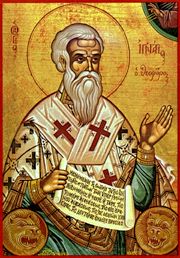
Icon – Ignatius of Antioch (d. 98/117)

Another ancient witness to the Wednesday-Friday fast is Ignatius of Antioch (d. 108), the third bishop of Antioch. In his Letter to the Philippians chapter 13, he urged them to keep the Wednesday-Friday fast.

After the week of the passion, do not neglect to fast on the fourth and sixth days, distributing at the same time of thine abundance to the poor. (Letter to the Philippians chapter 13; ANF Vol. 1 p. 119; emphasis added)

Antioch was not some obscure city. It was the Apostle Paul’s home church (See Acts 13:1-3). The historic Patriarchate of Antioch was one of the leading centers of early Christianity and has continued in this role to the present day. The current Patriarch of Antioch, John X, is the 169th successor to the Apostles Peter and Paul. Thus, the Patriarchate of Antioch is one of the strongest living historical links we have to the early Church and to the Apostles. Evidence for this can be found in how a typical parish in the Antiochian Orthodox Archdiocese in North America keeps the Wednesday-Friday fast. See St. Michael Antiochian Orthodox Church’s (Beaumont, TX) website. From Antioch in the first century to Texas in the twenty-first century, one sees a chain of unbroken Christian tradition spanning two millennia within the spiritual discipline of fasting.

Tertullian (c. 155-c. 220), the controversial third-century Latin writer, wrote a short treatise On Fasting in which he attacked the Wednesday-Friday fast. See chapter 2 (ANF Vol. 4 p. 103), chapter 10 (ANF Vol. 4 p. 109), and chapter 14 (ANF Vol. 4 p. 112). Tertullian wrote On Fasting around 208 after he had joined the Montanist sect. In it he attacks the Catholics for what he saw as their innovative approach to fasting and their indulging the flesh. While the Orthodox Church does not consider Tertullian a saint or a Church Father, he does provide insights into the early Church, especially before Constantine made Christianity a licit religion.

Clement of Alexandria (d. between 211 and 216) was a well-known third-century theologian who sought to synthesize Christianity with pagan Greek philosophy. In his Stromata Book 7 chapter 12, mention is made of the Wednesday-Friday fast among Christians. While his allegorical approach is questionable, he stands as an important witness to the Wednesday-Friday fast dating to the late second to the early third century.

Another important source is the Apostolic Constitution (c. 375-380), a manual or compendium of instructions for clergy that dates to the late fourth century. In it, we find why the two days were designated as days of fasting:

But He commanded us to fast on the fourth and sixth days of the week; the former on account of His being betrayed, and the latter on account of His passion. (Apostolic Constitution Book 5 §15; ANF Vol. 7 p. 445; emphasis added)

See also the Apostolic Constitution Book 7 §23, which contains the same instructions for fasting (ANF Vol. 7 p. 469). Although the authorship is unknown, it is believed to have orignated in Syria, perhaps Antioch.
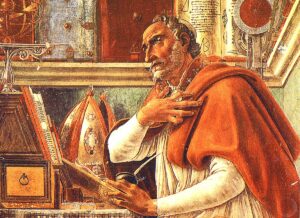
Augustine of Hippo

While the Apostolic Constitution gives insight into the spiritual practices of late fourth century Christianity in the East, Augustine of Hippo (354-430) gives us insight into the spirituality of late fourth century Christianity in the Latin West. In Letter 36, Augustine commended fasting on the fourth and sixth days (Wednesday and Friday) of the week but discouraged fasting on the seventh day.


The reason why the Church prefers to appoint the fourth and sixth days of the week for fasting, is found by considering the gospel narrative. There we find that on the fourth day of the week the Jews took counsel to put the Lord to death. One day having intervened — on the evening of which, at the close, namely, of the day which we call the fifth day of the week, the Lord ate the Passover with His disciples — He was thereafter betrayed on the night which belonged to the sixth day of the week, the day (as is everywhere known) of His passion. (Letter 36; NPNF Vol. 1 p. 267; emphasis added).

He explains that it was on the fourth day of the week (Wednesday) that the Jewish leadership decided to put Christ to death. And that it was on the sixth day of the week (Friday) that Christ was crucified. In present-day Orthodoxy, nearly the same rationale is given except it is taught that we fast on Wednesday in remembrance of Christ’s betrayal by Judas—which agrees with the Apostolic Constitution.

A century later, we find Pope Leo the Great (d. 461) urging his listeners to keep the Wednesday-Friday fast:

On Wednesday and Friday therefore let us fast: and on Saturday let us keep vigil with the most blessed Apostle Peter, who will deign to aid our supplications and fast and alms with his own prayers through our Lord Jesus Christ, who with the Father and the Holy Ghost lives and reigns for ever and ever. Amen. (Sermon 12; NPNF Vol. 12 p. 123; emphasis added)

Pope Leo urged his listeners on numerous other occasions to keep the Wednesday-Friday fast. See Sermon 16 (p. 125), Sermon 19 (p. 127, p. 128), Sermon 75 (p. 191), and Sermon 88 (p. 199). The repeated exhortations point to the importance of the fast to early Christian spirituality.

In Sermon 12, Leo sums up the reasons for fasting.

But there are three things which most belong to religious actions, namely prayer, fasting, and almsgiving, in the exercising of which while every time is accepted, yet that ought to be more zealously observed, which we have received as hallowed by tradition from the apostles: even as this tenth month brings round again to us the opportunity when according to the ancient practice we may give more diligent heed to those three things of which I have spoken. For by prayer we seek to propitiate God, by fasting we extinguish the lusts of the flesh, by alms we redeem our sins: and at the same time God’s image is throughout renewed in us, if we are always ready to praise Him, unfailingly intent on our purification and unceasingly active in cherishing our neighbor. This threefold round of duty, dearly beloved, brings all other virtues into action: it attains to God’s image and likeness and unites us inseparably with the Holy Spirit. (Sermon 12; NPNF Vol. 12 p. 123; emphasis added)
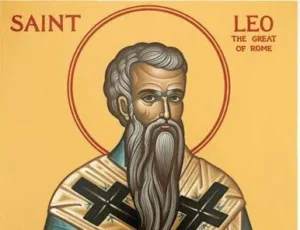
Pope Leo the Great

The rationale Leo presents very much agrees with Orthodoxy. First, Leo claimed that the Wednesday-Friday fast was part of Oral (Unwritten) Tradition going back to the Apostles. Where the Sermon on the Mount was not specific on when to fast, the early Church being guided by Oral Tradition knew on what days to fast. The specificity of the days for fasting based on Oral Tradition challenges Protestantism’s sola scriptura, which at best leaves the question wide open as to when Christians are obliged to fast. Second, Leo points out that fasting plays an important part in our spiritual growth. He lists three benefits: (1) curbing the lusts of the flesh, (2) drawing near to God, and (3) renewing the image of God within us. Third, Leo informs his listeners that fasting will facilitate their praying with Saint Peter. This indicates that the early Christians believed in praying to the saints and assured them that the saints were standing with them in prayer. This contrasts with Protestantism which frowns on praying to the saints. There is no hint in Leo’s explanation of our earning merit towards our salvation. This should allay any concerns Protestant inquirers may have about Orthodoxy espousing works righteousness. Lastly, Pope Leo’s triad of prayer, fasting, and almsgiving is frequently heard in present-day Orthodoxy. This resonance points to Orthodoxy’s living connection with the early Church.


How Protestants Approach Fasting

The Protestant Reformation stemmed from a schism with Roman Catholicism in the 1500s. As a result of this parting of ways, fasting became a forgotten spiritual discipline among Protestants. This neglect can be attributed to sola fide (justification by faith alone), which many Protestants took to mean that fasting is a form of works righteousness. Martin Luther, in reaction to the legalism of medieval Roman Catholicism, stressed that fasting was to be purely voluntary and optional. John Calvin viewed fasting as spiritually beneficial but this practice fell to the wayside in later generations.  (See “Fasting in the Bible and Reformed Tradition“) The English Puritans enthusiastically promoted fasting but did it as a form of protest against the Elizabethan church (see Leithart). Despite the near universal disappearance of fasting among Protestants, Protestant scholars knew of the Wednesday-Friday fast. Philip Schaff’s History of the Christian Church Vol. II, p. 379, makes a perfunctory observation that the early Christians observed the Wednesday-Friday fast. Gregory Dix in The Shape of the Liturgy discussed in detail the historical emergence of the Wednesday-Friday fast, the Montanist resistance, and the West’s eventual acceptance of the Wednesday-Friday fast (p. 342). Towards the end of the twentieth century, there emerged retrieval projects aimed at the recovery and reintegration of ancient Christianity with modern-day Protestantism. One such attempt was Robert Webber’s Common Roots (1978), chapter 13 “The Restoration of Historic Spirituality” (pp. 219-240), which called for the restoration of fasting. The Protestant retrieval project continues into the twenty-first century. In 2026, the popular YouTuber Austin Suggs of Gospel Simplicity, known for promoting dialogue between Evangelicals and other faith traditions,  uploaded a podcast about the spiritual discipline of fasting. At the 16:31 mark, he notes that the Wednesday-Friday was at one time a normal part of early Christianity then asks why this spiritual practice had all but disappeared. At the conclusion of the podcast, Suggs urges the recovery of fasting within the framework of Western Christianity, Protestantism and Roman Catholicism. It is curious that he says nothing about Eastern Orthodoxy’s history of keeping the Wednesday-Friday fast without break since the early Church.
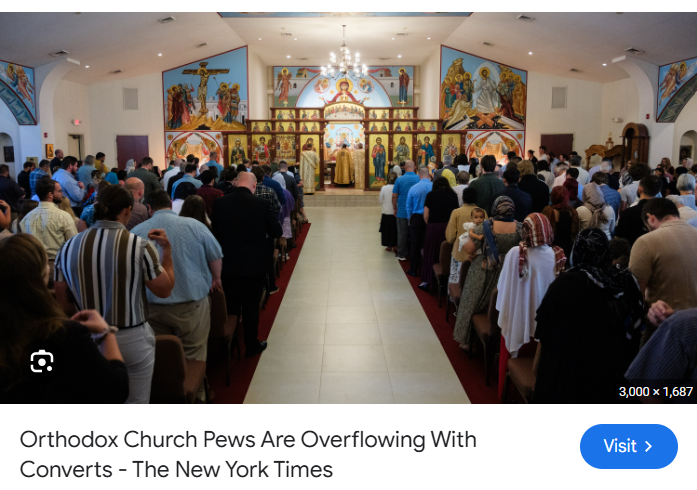
 

Signposts to the Ancient Church

Today growing numbers of the Gen Z cohort—and other generational cohorts—are converting to Orthodoxy. In response, Protestant apologists are urging these seekers to check out historic Protestantism, e.g., Anglicanism or Lutheranism, before choosing to become Orthodox. They point to Protestantism’s “historic” liturgies and tout their “deep” theology compared to the shallowness of low church Evangelicalism. This line of apologetics is problematic. Much of present-day Protestant worship hardly bears any resemblance to the worship practices of the sixteenth century Reformers. Moreover, very few pastors, Protestant and Evangelical, today are acquainted with the basic writings of the Reformation, let alone the Church Fathers. If one is looking for historic Christianity, Protestantism, at best, has a history that only goes back 500 years.

Protestantism and Evangelicalism suffer from a profound disconnect with the early Church. This disconnect can be seen in the areas of worship and doctrine. Unlike Orthodox churches today that use the ancient liturgies of Saint Basil and Saint John Chrysostom that date fourth and fifth centuries, none of today’s Protestant worship can even claim to date back to the Reformation. Likewise, where all Orthodox parishes recite the original Nicene Creed (381) on Sunday, the same cannot be said of Protestant worship. Much of Evangelicalism in their Sunday worship do not recite the Nicene Creed or any creed. Among the more traditional Protestant congregations or Anglican parishes, the form of the Nicene Creed used is a later version with the Filioque—a doctrinal and liturgical innovation that Orthodoxy finds objectionable. Protestantism’s historical disconnect can also be seen in its spirituality. In Protestantism, fasting is not taught as a normative spiritual discipline. (See Jones) Nowhere do Protestant pastors urge their members to keep the Wednesday-Friday fast as did the early Church Fathers. If spirituality is a fundamental component of Christianity, then Protestantism’s failure to observe the Wednesday-Friday fast signals a break from the early Church. Recently, there has been growing interest among Protestants and Evangelicals in recovering a connection with the early Church. While much of the retrieval has been in the areas of doctrine and worship, little attention has been given to spiritual disciplines, specifically the Wednesday-Friday fast.

The Wednesday-Friday fast can serve as a useful signpost for those searching for the ancient Church and who are wrestling with competing claims between Protestant and Orthodox apologists. During World War II, the Allies encountered the problem of German infiltrators whose flawless English enabled them to pass through their midst unchecked. It was not until American soldiers began questioning suspect individuals about American sports trivia that they were able to spot the phony Americans. Being American was more than a matter of speaking English but a way of life shared by Americans. Similarly, the Wednesday-Friday fast was known to the early Christians in the West and East and has been a normal part of Orthodoxy for the past two thousand years. The Wednesday-Friday fast may have been part of the history of Roman Catholicism, but it has undergone considerable modification. In present-day Roman Catholicism, only Ash Wednesday and Good Friday are deemed obligatory, with Fridays during Lent considered days of abstinence. While many Orthodox Christians struggle to keep the Wednesday-Friday fast, the fact that the Orthodox Church still teaches the Wednesday-Friday fast is evidence of its continuity with the Ancient Church.
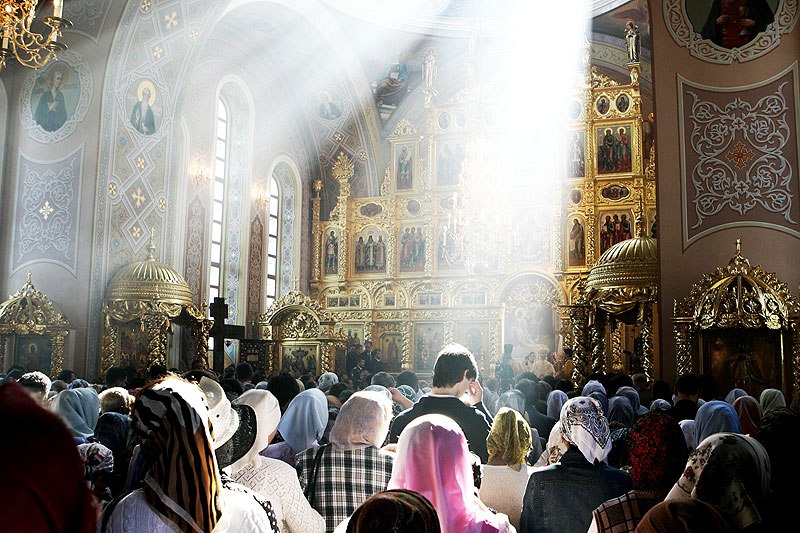
Ancient Worship – Orthodox Liturgy

In closing, while the Wednesday-Friday fast may at first seem to be an oddity, it can serve as a useful signpost for people yearning for the ancient Christian Faith. Much of the Protestant apologia for Protestantism’s antiquity is based on book research. It is one thing for a Protestant apologist to say they are in agreement with a particular doctrine based on their reading of early sources, but can they claim their Sunday services use the same liturgies as the ancient Church or that they fast as did the early Christians? So, while Protestant apologists and pastors can become fluent in the teachings of the early Church Fathers, their spiritual disciplines, especially fasting, will give the game away. Fasting, like a cultural practice, reveals the inner character of the faith tradition. The culture of ancient Christianity lives on in Eastern Orthodoxy. The Wednesday-Friday fast is proof of that. Come and see! Visit an Orthodox church on Sunday morning and witness the ancient Liturgy in action. Then after the Liturgy ask: Do you still keep the Wednesday-Friday fast?

Robert Arakaki


References

Apostolic Constitution Book 5. In Ante-Nicene Fathers Vol. 7.

Apostolic Constitution Book 7. In Ante-Nicene Fathers Vol. 7.

Augustine of Hippo. “Letter 36.” In Nicene and Post-Nicene Fathers Vol. 1 p. 267.

Peter A. Chamberas. 2015. “Not by Bread Alone: Fasting Today in the Orthodox Christian Way.” Greek Orthodox Archdiocese of America.

Clement of Alexandria. Stromata Book 7. In Ante-Nicene Fathers Vol. 2 p. 544.

Didache. Ante-Nicene Fathers Vol. 1.

Greekdoc.com “Didache of the Twelve Apostles.” Greekdoc.com

Gregory Dix. 1945. The Shape of the Liturgy. New York: Seabury Press.

Ignatius of Antioch. “Letter to the Philippians Chapter 13.” In Ante-Nicene Fathers Vol. 1 p. 119.

Ken Jones. 2019. “New Covenant Fasting.” Ligonier.org

Peter Leithart. 2012. “Puritan Fasts.” TheopolisInstitute.com

Leo the Great. In Nicene and Post-Nicene Fathers Vol 12.

St. Michael Antiochian Orthodox Church (Beaumont, TX). 2025. “What are the Wednesday and Friday fasts?

OrthodoxWiki. “List of Patriarchs of Antioch.”

Gavin Ortlund. 2025. “Why Young Men Are Becoming Eastern Orthodox.” TruthUnites.com

Presbyterian Church (USA). “Fasting in the Bible and Reformed Tradition.”

Philip Schaff. 1885. Ante-Nicene Christianity A.D. 100-325. History of the Christian Church Vol. II. Grand Rapids, Michigan: Wm. B. Eerdmans Publishing Company.

Austin Suggs. 2026. YouTube video: “Why Western Christians Stopped Fasting, and Why We Should Again.”  [27:22] Gospel Simplicity.

Tertullian. “On Fasting.” In Ante-Nicene Fathers Vol. 4 pp. 102-114.

Untold War Archives. 2025. YouTube video: “How One Baseball Question Exposed Germany’s Secret Infiltrators Dressed as Gis.” [45:47]

Robert E. Webber. 1978. Common Roots: A Call to Evangelical Maturity. Grand Rapids, Michigan: Zondervan Publishing House.



A Safe Place for Secret Inquirers


St. Nicodemus Society – a private FaceBook group

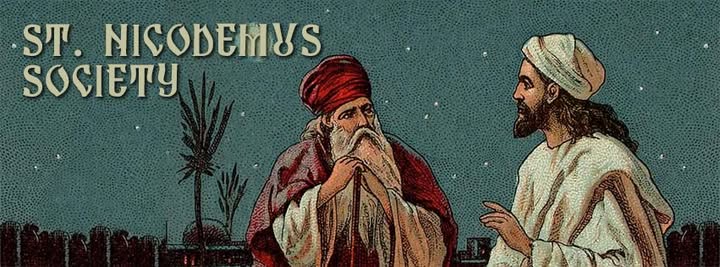
In John 3 we read about a prominent Jewish leader, Nicodemus, who met with Jesus under the cover of night. At the time, Jesus of Nazareth was a highly controversial figure. He had just thrown the Temple into turmoil by overturning the tables of the money changers and driving out the merchants who were selling animals for the Temple sacrifice. Then, to the consternation of the Jewish leaders Jesus made an ominous statement: “Destroy this temple and in three days I will raise it up.” (John 2:19, OSB) Yet, John the Baptist had earlier pointed out Jesus as “the Lamb of God who takes away the sins of the world.” (John 1:29) While many of the Jewish leaders viewed Jesus as a threat, the possibility remained that he may have been truly sent by God. This called for a sincere search for truth.

Nicodemus was a prominent religious leader. In John 7:50, we see him taking part in the judicial proceeding of the Sanhedrin, the ruling body of the nation of Israel.  When he spoke up in defense of Jesus, he met with “blind hatred” from his fellow rulers. (See the footnote comments in the Orthodox Study Bible.) Thus, for someone with Nicodemus’ high position, a public open-minded inquiry would be difficult to carry out given the social pressures on him. This explains why he met with Jesus in private away from the glare of public view in order to find out whether Jesus of Nazareth was the Christ.

Recently, there has been an upsurge of interest in Orthodoxy. The Internet offers a wide array of resources for Protestants and Evangelicals curious about Orthodoxy. Some will find to their surprise that their inquiry into Orthodoxy may lead them to renounce their Protestantism and convert to Orthodoxy. For some, converting to Orthodoxy is a matter of changing places of worship on Sunday morning. But for some church leaders inquiring into Orthodoxy may prove more disruptive and costly. This is especially true for pastors who may need to resign their pastorate and seek another occupation. Thus, the need for caution, due diligence, and much prayer. Converting to Orthodoxy is not something one rushes into.

Among the challenges for church leaders inquiring into Orthodoxy are the theological differences between the two traditions. Below are some of the theological issues:

  • Icons (religious images) in churches
  • Praying to the Virgin Mary and the Saints
  • The Eucharist (Lord’s Supper) as the body and blood of Christ
  • Liturgical worship versus contemporary worship
  • Sola Scriptura (Scripture Alone) versus Scripture and Holy Tradition
  • Apostolic succession through the office of the bishop
  • The Orthodox Church as the one true Church
  • Sola fide (faith alone) versus synergy (cooperating with God’s grace)
  • Salvation as theosis/deification

Besides theological issues, there are practical concerns such as:

  • How to investigate Orthodoxy discreetly
  • Whether to continue in church office or resign
  • Steps towards relinquishing one’s Protestant ordination
  • How to explain or disclose one’s interest in Orthodoxy
  • How to explain Orthodoxy in a peaceable manner
  • The manner and timing of resignation
  • The possibility of formal church discipline
  • How to deal with disrupted relationships and friendships
  • How to deal with loss of income
  • How to deal with reluctant spouses and children
  • How to deal with upset extended family members

Thus, it is clear that inquiring into Orthodoxy is likely to be a complicated process for the Protestant and Evangelical “Nicodemus.” That is why a private Facebook group “The St. Nicodemus Society” was formed for the purpose of assisting pastors and church leaders who need wise counsel given in confidence. It is a private group and by invitation only. The group is committed to maintaining confidentiality. It is also committed to inquiry free of peer pressure. Our goal is to support inquirers, not to browbeat them with arguments. Inquirers who have tough doctrinal questions will be treated with courtesy. However, this is not a forum for debate but rather a safe place for inquirers to ask hard questions and express their doubts. The key element here is trust and sincerity. Members of the St. Nicodemus Society come from a wide range of backgrounds. Some are former pastors or church elders from Reformed churches. A number have received seminary degrees, while others are self-taught. The St. Nicodemus Society is generally Reformed in background, but we welcome inquirers from other Protestant and Evangelical backgrounds.

If you are interested in joining the St. Nicodemus Society please go to Facebook and send a personal message to Jamey William Bennett about the St. Nicodemus Society. It would be a big help if you were to describe where you are in your journey to Orthodoxy—just curious, very serious, or serious but struggling certain aspects of Orthodoxy or Protestantism. It would also help if you could give us a sense of your level of responsibility: lay leader, church elder, assistant pastor, senior pastor, seminary faculty, seminarian, part of the denominational leadership.

Robert Arakaki


The Harvest is Ripe – Source

An Eastern Orthodox’s Encounter with Oriental Orthodoxy


Icon – Saint Mark Coptic Orthodox Church – Honolulu, Hawaii

[Note: I first met Genesis Sanchez at the Orthodox Christian Fellowship at UC Berkeley. At the time he was an inquirer, since then he has converted, graduated, and grown into a fine Orthodox Christian. In light of the increased attention given to Oriental Orthodoxy on the Internet, I thought that Genesis’ reflection on his interactions with Oriental Orthodoxy would be of interest to readers of the OrthodoxBridge blog. Robert Arakaki]


Family I didn’t know that I have, but family who I have not fully reconciled with yet by Genesis Sanchez

This is how I can summarize my experiences with the Oriental Orthodox tradition for over a decade. The following will be a reflection of my personal experiences as an Eastern Orthodox Christian (EO) with the Oriental Orthodox (OO)tradition. It will not be a treatise on our Christological distinctions as there are already many out there of greater quality.


First Impressions – Research

I am a Filipino American [Fil-Am] born and raised in the Bay Area (California). I grew up in the Pentecostal tradition and my parents raised me in the hopes that I would one day become a Pentecostal preacher.

My first impressions of the Oriental Orthodox were quite negative. I was just beginning to study ancient Christianity as a 17-year-old. I began by learning the ancients, from Socrates, Plato and Aristotle, under the guidance of a man would later become my Orthodox godfather, to gain foundational philosophical knowledge to personally work through the theological controversies which would be crucial in my decision for which ancient Christian community to join, whether Oriental Orthodox (OO), Eastern Orthodox (EO), or Roman Catholic. Under his guidance, I went from the Greek ancients to working through the writings of St. Cyprian, and afterward, Severus and St. John of Damascus. It is important to note that my godfather is Eastern Orthodox and, therefore, although I read through key Oriental and Eastern Orthodox Fathers, our theological discussions ultimately convinced me that the Eastern Orthodox position was the most tenable one, a position that I still hold today, especially when considering the question of Christ’s divine and human wills. In short, having made my decision to continue with Eastern Orthodox theology, I felt like I no longer needed to pay attention to the Oriental Orthodox. I was subsequently received into Holy Orthodoxy at a small Greek Orthodox parish in the Bay Area.


UC Berkeley

University Days – Unexpected Closeness

However, I then began my time at UC Berkeley where Oriental Orthodox students, primarily from Coptic and Ethiopian churches, regularly attended the Orthodox Christian Fellowship weekly liturgy and fellowship nights. It was here where I became very close with Oriental Orthodox Christians.  I found myself attending their own university gatherings and praying with them, although I still believed that EO theology was more complete, and not at all identical with theirs, and therefore I even considered them heterodox. However, I had no issues praying with them as I did not consider them heretics, and also could not help feeling a strange kinship with them. Now, I have to admit how inconsistent I was.

This inconsistency grew in complexity post-graduation as, by this time, I had gained even more close Coptic friends, many of whom I am still in contact to this day. I was deeply touched by how genuine, friendly, pious and fun they are. Even now, I consider many of these Coptic friends some of the best people I know. It was also around this time that I became aware of how many EO and OO priests in the Bay Area, and these were highly regarded and even saintly clergy, gave communion to each other’s laity, especially for mixed OO and EO couples. I honestly did not think much of this but by this point, all of the subconscious disregard I had for Oriental Orthodox still lingering in the recesses of my heart had vanished. Instead, for me the Oriental Orthodox did matter. Somehow, without articulating it, I did genuinely feel them to be family. However, I still believed there were issues in their theology.


Chengdu China – Source

From Berkeley to China

Two key moments transpired which revealed a tension I did not realize had become quite serious inside of me. The first was when a Coptic priest at their Hayward, California, parish told me that the Copts accept St. John of Damascus’ two natures formula. I was shocked and asked myself immediately, “So, what are we still arguing about?”

The second moment was when I had moved to China a few years later, and chanced upon the Agreed Statements from the Joint Commission of the Theological Dialogue Between the Orthodox Church and the Oriental Orthodox Churches. [See Resources below] In short, these are a series of dialogues between several EO and OO churches that have produced statements of agreements over each other’s Christologies. I was very excited by this and thought it was an official act of reunion between our two families, but little did I realize we are still far from it. One reason is that the agreed statements are not ecumenical on either side. That is, not all EO and OO patriarchates have agreed on this statement, although a good number on both sides have. However, the excitement I gained from this discovery stayed with me for many years.


Lady Margaret Hall, Oxford University

Oxford – Another Surprising Deeper Engagement

This excitement—this spark—didn’t actually lead to anything concrete for a few years. It wasn’t until I left China and began my master’s studies at Oxford University that things gained momentum. I was studying teacher education, which I like to jokingly describe as “learning how to give teachers homework.” I had enormous flexibility in choosing my dissertation topic, but I genuinely didn’t know what direction to take.

Holy Trinity Greek Orthodox community – Oxford University

Everything shifted upon my arrival in England. One evening, after attending a Vespers service at the Greek Orthodox parish of the Holy Trinity that the late, great Metropolitan Kallistos helped establish, I had a chance encounter with an Ethiopian Fulbright fellow. I don’t remember exactly how the conversation unfolded, but I ended up telling him that I was doing my master’s in education and that I was particularly interested in religious education. That’s when he introduced me to the Ethiopian Church’s remarkable educational tradition, particularly the Qene poetry system.

In the Qene poetry discipline, students learn to compose improvised hymns using Ge’ez—something he described in a way that made me think of it loosely as an “African Hebrew.” Under this tradition, children begin their training at a very young age and can continue developing their skills well into old age, eventually becoming master hymnographers capable of freestyling deeply theological poetry. I was stunned. I told myself, “I have to go to Ethiopia.”

Weekday training for Qene students

This desire eventually became my master’s project. Initially, I wanted to work with Eastern Orthodox communities in the Philippines and design educational programs for them. But strangely, I found the Eastern Orthodox churches there either difficult to approach or simply not focused on educational initiatives. It wasn’t until I discovered the Coptic Orthodox community in the Philippines, and reached out to them, that I found a group truly eager for collaboration. In light of their enthusiasm, I decided I would design religious education teacher-training programs for the Coptic Church.

When it came time to finalize my dissertation topic, the Ethiopian tradition resurfaced in my mind. I realized that if I wanted to explore how to train religious educators—not just technically but spiritually—I needed to learn from the traditions that cultivate deep theological insight through disciplined creative expression. So, during my second and final year at Oxford, I arranged to travel to Ethiopia to study this tradition firsthand.

But I didn’t stop there. As an Eastern Orthodox Christian, I wanted to draw from both the Eastern Orthodox and Oriental Orthodox worlds. For me, their educational traditions felt more similar than different, especially in spirit. So alongside Ethiopia, I set my sights on Mount Athos. There, I discovered that the Holy Mountain actually has a school for boys, where students receive their primary and secondary education right inside the monastic republic. Yes—there are literally boys who grow up going to school on Mount Athos! In 2017, I went on a pilgrimage to Simonopetra and Vatopedi. Then in 2022, I stayed at Simonopetra then the Skete of Saint Andrew.

In the end, my research journey led me to both Ethiopia and Mount Athos, allowing me to draw from two ancient, living traditions of formation. My aim was not only to understand how to teach religious education teachers, but to glimpse the deeper spiritual frameworks that shape how both Eastern Orthodox and Oriental Orthodox communities transmit faith across generations.  See Genesis Sanchez – MA Thesis.


Throne of the Qene Master in the classroom

Meeting “Four Eyes” Ezra

There is so much I could write about what I saw in both countries: Mount Athos and Ethiopia. To summarize it, I was blessed to meet with religious education teachers from both sides. But what left a particularly deep impression on me was meeting these Qene scholars face to face.

Lekaleqount Ezra and Genesis Sanchez

Especially significant was meeting an Ethiopian Orthodox religious scholar called Lekaleqount “Four Eyes” Ezra. He had memorized the entire Bible and several Patristic books, therefore gaining the “four eyes” of the Old Testament, New Testament, the Desert Fathers, and other Fathers such as St. Ephraim the Syrian. Lekaleqount Ezra is also known not just for his deep theological knowledge, but for his holiness as well. For me personally, I thought he was a very energetic, youthful, and even fun preacher despite being in his 70s.

Lekaleqount Ezra after back-to-back all-night vigil and a liturgy which started at 8 pm on Saturday and ended at 7 am on Sunday, followed by a 40 minute homely. [Picture on right]

As I came face to face with the depths of the Oriental Orthodox tradition, at one point I asked myself, “Why don’t I become Oriental Orthodox?” This came as a result of the profound interaction and connection with the scriptures and with tradition that I felt like I had not experienced. “Felt” would be the key term for these great moments. I think that I often overlook many parts of my own tradition whenever I find myself carried away by such experiences.


Communion Confusion

It was now time for me to go back to the Philippines to continue working with the Coptic community and helping with their religious education program, designing a program based on what I learned from Mount Athos and Ethiopia and even England, both the Greek Orthodox and Coptic Orthodox communities there. I designed a program to teach the Philippine Coptic communities in collaboration with one of their own religious education teachers who also was a science teacher in his secular career.

Although I had put my heart and soul into the religious education program, I ultimately did not become Coptic. I could write another whole other blog explaining why. However, I don’t think I’ll ever feel the need to be Coptic, especially now. If I could summarize my reasons however, I do think that my EO tradition is more truly Catholic and One that theirs, although my sense is that our Holiness and Apostolicity is as thorough as each other’s. But then again, I am a mere laymen inexperienced in the great mysteries of the spiritual life.

But more importantly, doing these activities, I fell in love with the Coptic people. Even before I launched this program, I already fell in love with them, but now my heart was at pains to reunite with them. Again, this is something that I felt even before I went to Athos and Ethiopia because my volunteer work with the Coptic community already made me feel such.

But at this time, I actually started taking Communion with them. They gave me communion, but when I had left for England, Ethiopia and Athos, I was told by a Coptic priest that I really cannot have Communion with them again, despite the volunteer work I had done for them. The decision was not made by the Coptic priest, who would have been happy, as he later told me, to continue to give me Communion. The decision was made by the Coptic bishop of the Philippines.

Yet upon coming back to the Philippines, I felt an even deeper attachment to the Coptic community, and my wife-to-be at that time also felt the same way. In fact, if the Coptic community still gave me Communion nowadays, I would have become a regular parishioner there. It is one of my favorite parishes in the Philippines.

And what’s even interesting is that after I came back from Ethiopia, I went to a Coptic liturgy after I had a conversation with their Tasuni, which is their term for sister or what they sometimes call a priest’s wife, essentially the equivalent of a presvitera (wife of a Greek Orthodox priest). And there I was hired by a Coptic American business lady to be an HR manager for her company. Sadly, my time with the Coptic company ended in just about a year. I was not a good fit for the company. And it was also at this time that I started having debates with one of my Coptic Orthodox missionary friends. And this has led me to my final and most current reflection and sentiment about the Coptic faith.


Saying Goodbye to Dear Coptic Family

My debates with my Coptic missionary friend were productive, but in a way that I did not expect. It was productive because it revealed to me the problems and difficulties that still remain between our two traditions. Yes, in many ways we are identical. I would say we are 98% in agreement, but how we work out not so much just Christ’s humanity and divinity and their unity, but more so the current state of his divine and human wills is an issue that needs to be resolved before we can have communion with them again. Although quite technical for people outside of our communities, I understand now that these are still important questions. The issue whether Christ has one will or two wills was so important that the Fifth and Sixth Ecumenical Councils met to resolve the controversy. Technically speaking, Eastern Orthodoxy is Dyothelite (Christ has two wills) and Oriental Orthodoxy is Monothelite (Christ has one will).

Saying Goodbye to Father Mina and Tasuni Phoebe

I see that we still have not fully worked out the question especially of an agreement between how we understand the will or wills of Christ. The Copts would still rather confess one will of Christ and we would articulate that he has two wills. Now, bridges and agreements can be made between these, but based on my very intense debates online, on Facebook, through chat, really not the most professional and I would have to say not the most representative of the Coptic tradition as well because I did not seek out to thoroughly dialogue with the greatest Coptic scholars that I could access, but was instead in a sense was the one that was quote-unquote sought out by my missionary friend who had lots of questions about Chalcedonian Christology.

For now, all I can be is a friend, a family, a brother to my fellow Oriental Orthodox, case in point. One of the saddest moments this year in my life here in the Philippines was when my wife and I found out that our dearly beloved friends, the Coptic priest and his wife of the Philippines, were leaving. All of a sudden, they texted us saying that they were leaving. This was one of the most heartbreaking moments in my year in the Philippines. They had become our best friends, family. They spoke during our wedding. And I look back at myself as a 17-year-old studying Oriental Orthodox theology and afterwards thinking no more about it, too, falling in love with the Abuna and his Tasuni, who were a family to us deeper than blood, who had given us communion, and I hope to receive Communion from again, someday, some other place. I would love to help out their church, visit them wherever they may be, because it was in that moment of oneness, of fellowship, that I believe our hearts became one. And if God wills, may this unity happen fully in my lifetime, which would bring me tears of great joy.

by Genesis Sanchez


Resources

First Agreed Statement [1989]

Second Agreed Statment [1990]

Bible Hub. “What is dyothelitism?

Genesis Sanchez – MA Thesis

Let’s Talk Religion. “The Ethiopian Orthodox Church Explained.” [34:46]

« Older posts