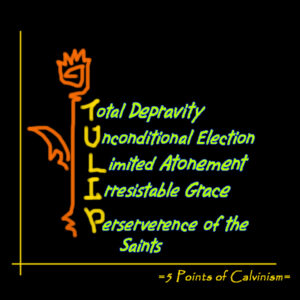
In an earlier posting I critiqued the individual components of TULIP, an acronym used by Calvinists to explain and defend double predestination: Total Depravity, Unconditional Election, Limited Atonement, Irresistible Grace, and the Preservation of the Saints. In this posting I will be critiquing TULIP as an overall theological system first by discussing how TULIP developed from Augustine’s theology. Then, I will discuss how TULIP’s denial of human free will is consequential for Christology and our understanding of the Trinity. I will also show how the Orthodox approach to the Trinity provides an understanding of salvation that allows for free will and genuine love.
Calvinism’s Western Roots
Calvin’s double predestination represents an outcome of the theological evolution in Western Christianity. Unlike Eastern Orthodoxy which draws on a wide range of Church Fathers, Western Christianity in both its Roman Catholic and Protestant forms depends heavily on Augustine of Hippo. Calvin was well aware that he was breaking with the patristic consensus and even then persisted in constructing his theology upon the Augustinian paradigm (Institutes 2.2.4, Calvin 1960:259). He cited Augustine more often than all the Greek and Latin Fathers combined (Schaff 1910:589).
While double predestination is closely associated with Calvin, it is not unique to him. It was also held by some medieval theologians. Gregory of Rimini (d. 1358) taught: “Just as God has predestinated from eternity those whom he willed to, not on account of any future merits, so also he has condemned from eternity those whom he will to, not on account of their future demerits” (in Pelikan 1984:31). Calvin stands out with respect to the clarity and rigor with which he described and applied the doctrine of double predestination (Pelikan 1984:222).
Likewise, the Calvinist vs. Arminian conflict that led to TULIP is not new. Similar tensions can be found in medieval theology. Medieval theologians like Thomas Bradwardine and Gregory of Rimini accepted the doctrine of absolute predestination, whereas Duns Scotus and William of Occam rejected it (Pelikan 1984:28-35; Oberman 1963:187; Barth 1922:52). What makes TULIP Protestant is the fact that it arises from the monergism underlying sola fide (justification by faith alone).
Monergism vs. Synergism
The driving force for Reformed theology is the passion to uphold God’s sovereignty. Reformed Christians glory in God’s sovereignty over all creation and especially with respect to our salvation. The Canons of Dort stresses that God “produces both the will to believe and the act of believing also” (Third and Fourth Head: Article 14; see also Article 10). They believe that any tempering of the divine sovereignty would detract from the glory of God. The German Reformed theologian, Philip Schaff notes:
Augustin and Calvin were intensely religious, controlled by a sense of absolute dependence on God, and wholly absorbed in the contemplation of his majesty and glory. To them God was everything; man a mere shadow (1910:539).
What we see here is what Robin Phillips calls a zero-sum theology. The term comes from game theory. In a zero-sum game there is a fixed amount of points which means that one player’s gain can only come from the other player’s loss. Similarly, in a zero-sum theology for any human to possess the capacity to freely love and have faith steals glory from God.
A zero-sum mentality towards grace assumes that God can only be properly honored at the expense of the creation, and where this orientation is operational it feels compelled to limit or deny altogether the important role of instrumental causation in the outworking of Providence. The zero-sum mentality is thus highly uncomfortable acknowledging that God’s decrees are outworked through secondary means, and prefers to emphasize the type of “immediate dependence” upon God that bypasses as much human instrumentality as possible.
This belief can be seen in the Canons of Dort’s rejection of errors in the Fifth Head Paragraph 2: “…which it would make men free, it make them robbers of God’s honor.” In this approach God’s grace occupies a preeminent role in our salvation and our response a negligible role. Man becomes more an instrument of an omnipotent deity than a free agent cooperating with divine grace. Free will exists, but only for mundane matters, not in relation to spiritual matters (Institutes 2.5.19).
This makes Reformed theology fundamentally monergistic in its soteriology. Monergism is the belief that there is only one (monos) efficient cause (ergos) in our salvation: God and God alone. The alternative approach is synergism, the belief that salvation is the result of human will cooperating or working with divine grace (syn = with, ergos = energy, effort, cause). Thus, where Orthodoxy’s synergism allows for human free will or choice in salvation, Calvinism’s monergism excludes it.
Synergism

Syngergy: God reaching out to us & our responding
In contrast to the either-or approach of Western monergism is the both-and approach of the Eastern doctrine of synergism. Synergism is based on our cooperation with God’s grace, that is, a response on our part to God’s initiative. The Apostle James wrote:
Was not our ancestor Abraham considered righteous for what he did when he offered his son Isaac on the altar? You see that his faith and his actions were working together, and his faith was made complete by what he did. (James 2:21-22, NIV; emphasis added)
An anonymous monk described aptly how the Orthodox understanding of synergism maintains the sovereignty of God.
The incorporation of humans into Christ and our union with God requires the co-operation of two unequal, but equally necessary forces: divine grace and human will (in Ware The Orthodox Church pp. 221-222).
Addressing the Western and especially the Calvinist concern that Orthodox synergism may attribute too much to human free will and too little to God, Ware wrote:
Yet in reality the Orthodox teaching is very straightforward. ‘Behold, I stand at the door and knock; if anyone hears my voice and opens the door I will come in’ (Revelation iii, 20). God knocks, but waits for us to open the door – He does not break it down. The grace of God invites all but compels none. (The Orthodox Church p. 222)
The Orthodox understanding upholds God’s sovereignty in our salvation. Not only does God take the initative in the salvation of Man and all Creation, He does the biggest and greatest part, the part man cannnot do. This critical and absolutely necessary action of God, however, in no way precludes man’s response. Note how far the Orthodox position on synergy is removed from the Pelagian heresy.
Robert Arakaki
Coming soon — the implications of TULIP for Christology and the doctrine of the Trinity.
Why is Calvinism becoming so popular among American Evangelicals? Even continuing Anglicans have fallen victim to the Calvinist movement. It certainly is not an appealing view of God, for it makes God a sadistic monster who creates someone and gives them no chance of salvation.
Fr. John W. Morris
Father,
I am now Orthodox, but I came out of Calvinism. Prior to that, I was an evangelical for twenty years. The collapse of evangelical theology and the dumbing down of everything including God, gives many evangelicals the impulse to search for a much loftier view of God. A God who is not just our buddy. Calvinism presents a lofty view of God in that He answers to no one and controls every molecule with power and authority which nothing can thwart. And the intellectual vacuum left in much of evangelicalism leaves them starving for something more. So they look back to their history and find the Reformers intricate theological systems. Lutheranism is often seen as too much like Rome while Calvinism is aggressively promoted by it’s adherents. Calvinists like MacArthur, Piper, Sproul and Horton have interacted widely with evangelicals and the Anglican J.I. Packer is ubiquitous in his promotion of Calvinism everywhere among Protestants.
Their high view of scripture is admirable, but apart from the Tradition of the church they have pushed the meaning of certain verses outside of the scope of orthodox theology and Christology.
Fr. John,
I want to say that Canadian gave a very good answer. You might want to read the excellent article “Young, Restless, and Reformed” by Collin Hansen. If you meet those who hold to Reformed theology please keep in mind that they are on a spiritual journey that is often motivated by a desire for truth and a high view of God. While there may be aspects of Reformed theology that you might repulsive, there are elements of Reformed Christianity that can be affirmed by Orthodoxy, e.g., their high view of Scripture, their desire for right doctrine, and their sober approach to worship. Let us look for common ground with them before we criticize their theology.
The popularity of Calvinism among Evangelicals can be viewed as an evangelistic opportunity for Orthodoxy. Let us pray for open doors that will bring many of these hungry Calvinists into the fullness of Orthodoxy!
Robert
Without getting into debate on this issue, and having seen a lot of this in college (I was there when the s0-called “restless reformed” thing got going):
In most American communities there are really only two options: Catholicism and Baptist. Calvinism, especially the paedo-variety, offers a rigorously systematic alternative to both (and as I keep telling Orthodox apologists, most of the time there is *NO* viable Orthodox witness in the community, or one that cares about “Western” folk).
The guys Canadian listed, especially Piper, are skilled communicators who appeal to youth.
It’s unfortunate that you engage in name-calling like “sadistic monster” (strange that Robert didn’t moderate that comment). I could return in kind, but I won’t. At the end of the day, I can’t read Romans 9:22 and say, “Well, it can’t mean *that*).
Perhaps the phrase is too much…or perhaps not. I’m not sure what else I might call a deity who gives one no choice of being born into a world were one is damned from the foundation of the world because the deity chooses it to be so arbitrarily and then says that we are somehow responsible for our actions within a context where we could never under our own power stop sinning or save ourselves (he certainly is not going to) so that we can suffer being tortured for eternity.
If that doesn’t qualify as a monster than what does?
Romans 9 is not about personal election to salvation and damnation at all. It is about the freedom of God to fulfill his purposes through whom and however he pleases while not violating Covenantal obligations. Look up the OT references that this chapter cites: Gen 25:23 “Two nations are in your womb and the older shall serve the younger.”
Exodus 4 “Israel is my firstborn” is a play on Jacob (Israel) and not Esau as God’s firstborn…..to fulfill God’s covenantal promises, not to speak about personal salvation.
Malachi 1: Jacob and Esau are nations.
Exodus 33 Moses pleads for God’s favor for Israel, God affirms it but adds “I will have mercy on whom I will have mercy.” God has the freedom to extend mercy to the gentiles.
God raises up hardened Pharoah not to the election of damnation, but as a vessel of wrath to push the Jewish vessels of mercy into the promised land. The Jews themselves will become vessels of wrath so the gentiles can become vessels of mercy. And in Romans 11 there is a grafting, breaking off and re-grafting of branches depending on their heart attitude and disposition, hence the attendant warning, and your Romans 9 election paradigm breaks down.
Romans 9 is not a discussion of God’s freedom in the election to salvation and damnation, but in fulfilling his purposes in Christ.
Canadian made a good point here which makes sense in light of Romans 1:16-17:
(see also Romans 2:9-10)
The entirety of Romans began to make sense to me when I read it as Paul’s response to the fact that many Jews were opposed to his preaching while many Gentiles were responding to his preaching. Romans 9 is Paul’s attempt to explain the Jews’ resistance to the Good News and what it meant for the Jews’ covenant standing than an attempt to explain God predestinating individuals.
As someone who has never liked Reformed or Calvinist theology, I think that many adopt such theology for two reasons: 1) it seems biblical and 2) its logic seems unimpeachable.
Robert,
Per your comments on syngergism: Reformed folk do not see the ordo terminating at regeneration.
Why is there no “printer freindly” version of plucking the tulip?
Roy,
I’m in the process of consolidating the Plucking the TULIP posting into one PDF file. I hope that will address your concerns.
Robert
This article fairly clears-up the Monergism Contra Synergism issue, also! http://www.examiner.com/article/synergism-an-eastern-church-and-western-church-comparison
Gabriel,
Thanks for the link!
Robert
P.S. Guard your eyes from the sinful ads on the right.
the orthodox as a whole is a shambles i use to be eastern orthodox and the things i saw for 20 years the ethinic culture club thinking and the us opposed to them ingrained in most of the minds of cradle orthodox or the outsider treatment you get at many orthodox churches by those who know you were not born of the orthodox faith or some parishes where the trustees and parish council members literaly call all the shots and the priest is subject to afraid to oposse them and thier decisions or a trustee who grabs you from under the arm and gives you the third degree as you are on the commuion line on sunday and ask you when the last time you partook of holy confession or a oca piest asking you not to come to his church too often because you did not pay the yearly assement and if you came around too much that they the parish would have to put it in for you after the fact they knew you were unemployed for over 4 years i am sorry by i reverted back to old catholicism with some leanings towards byzantine practices
these st not have statements in the above reply all happened to me plus many other events but in the limited time i was not able to mention oh
the russian church where the ladies wanted t teach me russian me a polish
czech and lithuanian learn a langauge of the people who held my people in communist bondage for over 60 years my died a ancestors would have been spining in thier graves or the priest who claimed to be polish and had icons of the romanov family and got mad when i said as a pole i would never venerate the royal family of a country who conqured and subjected my people for 124 years when litlle poland was swallowed up by austria , prussia and russia from 1794 to 1918 and the same priest invites you to his house for bible study pulls out a book of diffrent orthodox churches in poland and points to each picture telling you that the evil polish govermet destoyed this church i am sorry but if this is your faith you can keep it
Joseph,
Sorry to hear about your negative experiences with Orthodox parishes. I have seen both the good and the bad aspects of Orthodoxy. I have experienced both the narrow ethnocentrism and the welcoming evangelistic side of Orthodoxy. I am working to help Orthodoxy in America become more rooted in American culture. You might be interested in my article: “Why We Need An All English Liturgy.” But more than all English liturgies, we need Orthodox parishes filled with loving caring genuine Christians. I pray that you will encounter loving Christians to accompany you in your journey to Christ’s kingdom.
Robert
Just perusing the comments of John and was momentarily overcome by the smoke from all the strawmen he was busy burning. I’ve been reformed for decades, and have scores of books by a number of authors including all the ones mentioned in the above comments yet strangely have never learned that calvinists believe that God arbitrarily damns people. Who said God does anything arbitrarily? You need to learn what a theological system teaches before you further embarass yourself.
Dear Mac,
Welcome to the OrthodoxBridge!
It is unfortunate when some people set up straw men arguments. Let us be patient with others and seek to contribute to a more well informed and civil discussion on both sides. Thanks!
Robert
May I ask (for clarification), then, what is God’s election based on? If it is something outside of ourselves, having nothing to do with anything we do, say, believe, etc., what else can it be but arbitrary? At the very least, it must be arbitrary from a human perspective. While those authors may not use the word, it has been my understanding that no Reformed writers have said what election is based on. I have always heard it said in the negative, that is, it is based on nothing about us, or what we do.
If you could please suggest to me a place where a Reformed author does mention election and God’s decree to elect individuals, specifically, how it is not arbitrary, I would be more than happy to read it and be corrected. I am not as well versed in Reformed theology as you and many on this site. I am learning as much from reading comments by the Reformed here as by the Orthodox. Thank you.
JOhn
Robert,
Monergism has always struck me as untenable. Strict monergism of the Reformed variety almost necessarily requires a commitment to eternal security to be at all consistent. If theNT teaches eternal security, then I have misread the book of Hebrews all my life. We Baptists are said to believe in “once saved,always saved” but it is more disputed than outsiders might thank.
Good post.
Thanks! I’m glad you liked it.
Robert
Thanks, I’m working on the patience thing and will do better. John, I was uncivil and I sincerely apologize.
That said, it is statements like the ones made by John that are somewhat frustrating for those of us who adhere to a reformed theology. John, I would hope that in the future you refrain from referring to God as a sadistic monster. I do understand that from your POV you probably thought you were referring to a false version of God (the God of Calvinism) however, as a Christian, I find such language to be extremely disrespectful, not only to those of the reformed faith who worship the same God that you worship, but also to The Most High Himself. Such language tends to lower the level of dignity that should be afforded a conversation about genuine differences in our faith traditions.
Your assumption about the arbitrary nature of Divine Election is a legitimate concern and I wish I had the knowledge and authority to go beyond what the Scriptures teach but on this question I must defer to Rom. 9:
“If it is something outside of ourselves, having nothing to do with anything we do, say, believe, etc., what else can it be but arbitrary? At the very least, it must be arbitrary from a human perspective.”
It can be many things other than arbitrary from the Divine perspective. Even on a human level we can think of situations in which a leader makes a perplexing decision. A CEO hires an unlikely choice from a pool of otherwise highly qualified candidates, Why? The CEO knows why, but everyone else in the office is doubting his wisdom.
There can be many factors unknown to the tongue waggers but well considered by the CEO. What if the unqualified person chosen by the CEO has no redeeming traits? Is the CEO acting in an arbitrary manner, or is he carrying out a well thought out and approved plan by the company’s board, to hire a new employee based on nothing but grace and mercy? Why would a company decide to do such a seemingly unwise plan?
This is where we must recognize the mystery -in God’s plan.
Arminians appeal to mystery as do Calvinists, however, Arminians locate the mystery in man and even in satan. Why did sinless Adam commit sin? Why did satan fall? etc. Those are interesting speculative questions that cannot be answered this side of eternity, however asking why does God elect some and not others (or why not elect all for that matter) is no mere pointless speculation. That question is not one we need wrestle with for it was asked and answered by Paul in Romans chapter 9. There God refuses to play 20 questions and simply says, I’m the Potter, I have the right to do whatever I choose with the clay, and the rest is none of your business. Mystery located and we can move on to spreading the Gospel and clothing and feeding the hungry.
While those authors may not use the word, it has been my understanding that no Reformed writers have said what election is based on.
Neither does Paul, however the Apostle does explicitly state what election is not based on. It is not based on the one who runs or wills but on the will of God. So, we can rule out foreseen human righteousness other than that imputed and imparted by God according to His predestined provision.
“I have always heard it said in the negative, that is, it is based on nothing about us, or what we do.” -This is true according to the Scriptures, not just the Reformers.
“If you could please suggest to me a place where a Reformed author does mention election and God’s decree to elect individuals, specifically, how it is not arbitrary…”
Short answer, and this is just educated speculation (for what that’s worth) is that it seems that God chose the worst of the lot didnt He? Election is certainly no ego boost when you look at the sorry rag tag lot of sheep that He chose. It’s almost like God challenged satan and said you take the beautiful people, the winners, the wealthy and powerful, and you (maybe) can even have the majority. Ill take the failures, the dregs, and the down and out, and by the way, I’m going to defeat you.
We are told throughout scripture that God is perfect in wisdom knowledge and holiness. Why and how could a flawless Being with perfect foreknowledge commit an arbitrary act? The very thought is as self-contradictory as a round triangle or married bachelor. God’s omniscience (of future as well as past) and omnipresence along with His perfect wisdom make arbitrariness an impossibility and such was regularly assumed by the Reformers throughout their writings from Luther’s Bondage of the Will, to Calvin’s Institutes.
Mac,
Thank you for your thoughtful reply. I would like to say that I am not Fr. John Morris, who originally used the phrase, though I did piggy-back it in reply to Bayou Huguenot. I am a different John. I apologize for not approaching the subject with my question to you for clarification rather than running with that particular phraseology. I’m certain it would have led to a more thoughtful and fruitful discussion.
Given your interpretation of Romans 9, it seems I understood correctly that God’s election is unknowable from a Reformed perspective. I will agree that unknowable does not mean arbitrary, certainly, and that I do stand corrected. Thank you.
I must admit that I still recoil at the thought of a deity who saves some and not others, with no reference to any activity of their own, whatever the mystery of said election be. I cannot square your interpretation of Romans 9 with Romans 11 or the rest of the Scriptures or the history of Christ theology. Perhaps Robert could do a post, or a series of posts, on the history of interpretation of Romans, specifically paying attention to election and Romans 9, or other such post. I think the discussion that would result from that would be very interesting.
Thanks again for the correction.
John
Mac,
I left a brief comment about Romans 9 above, the 6th comment in the thread.
It should be noted, that in Romans 11 the ones that were hardened, fell, stumbled, cast away, broken off, blinded are the group that can be grafted in if they abide not in unbelief. Yet Calvinist’s affirm those are the ones described as elect to damnation in Romans 9.
Hi, I agree Calvinism is heresy. But Augustine was not a Calvinist. I just recently debated Calvinists who thought that Augustine taught Limited Atonement. It’s simply not true.
Nice to hear from you.
Let’s keep dialoguing with the Calvinists. We also need to read up on Augustine. He is a very foundational theologian for Western Christianity. Let’s help our Calvinist friends come to a greater appreciation of the rich spiritual treasures of the early church fathers.
Robert
Why are all there always gross caricature of each camp of belief? Why lump people into labels as extreme Calvinism or whatever view we are convicted to believe as the true view of God? When it boils down to it, it has to do with the gospel and the message of salvation.
Who are we to judge and say one camp of belief, be it synergism or monergism is false means of salvation as it changes the very heart and meaning of being saved itself?
Naturally one’s alliance to doctrine pertains to which Church they hold membership in and trust in their leaders based on the godly lives they display. You can debate this for centuries to come but the bottom line is to ask yourself if you find fruit in discussing thing, this is help you to bring glory to God more and to live your Christian life? In the end, I believe is not a matter of salvation but minds getting puffed up on which one has a “right/higher” view of God. For me personally, I am far more concerned with my own walk rather than engage in this anymore. It’s like we are judging one over another to be heresy and saying only our way of thinking is right, when its not an issue of salvation at all but on the extraneous details on salvation works that we would just confuse someone immensely when sharing the gospel with them and how would that be different from the way the other camps of thought do it? You wouldn’t. Therefore it is not a heart (heaven or hell issue)
Cecil,
Welcome to the OrthodoxBridge! You raised some good points. I believe that gross caricatures come from people either being intellectually lazy or caught up in the passions of the flesh. It takes a lot of humility and hard thinking not to fall into the trap of caricaturing another group.
As for your question “who are we to judge?,” I would say sooner or later we will have to choose which group we belong to or which teaching we will follow. Not to use our intellect is to disrespect God who commanded us to love him with our minds (Mark 12:30). Also, being Orthodox does not make one spiritually superior to the non-Orthodox or to non-Christians, it’s possible for one to be Orthodox and be prideful thereby risking a greater judgment from God. Every year at the beginning of Lent there is what we call the Sunday of the Final Judgment where the parable of the sheep and goats are read (Matthew 25). In it is the sobering reminder that we will be judged on our loving God and our neighbor. So you’re right that it’s not an issue that will determine whether one goes to heaven or hell. But neither is it an extraneous issue; behind this is the question which church do I belong to? We do not walk alone but with others. Evangelicalism’s ‘Jesus and me’ thinking has misled many, and Orthodoxy’s teaching that being a Christian means belonging to the Church provides a healing corrective. I may be wrong, but from I read in your comment I think your sentiments are closer to contemporary Evangelicalism than to historic Christianity. One cannot hold to Calvinist doctrines and be a member of the Orthodox Church. I wrote this article to help inquiring Calvinist to understand the position of the Orthodox Church. I want to help people make an intelligent and informed choice.
Robert
I know I am late to the game here but I thought I post anyway.
It seems to me that even with the overall congenial interaction that is taking place here, there is still some sense, in my mind, that perhaps both are parties are still talking past each other. It was mentioned briefly of the ordo salutis (Rom. 8:29-30) but other than that I have not seen it elsewhere. (I have yet to make it to parts 3 – 5 yet, though.) The ordo is crucial in understanding modern day American Reformed thought (esp. as evidenced in the Presbyterian Church in America – my home denomination for 22 years.)
Some of my Reformed and Orthodox brothers and sisters may disagree with, and perhaps with good reason, but it seems to me that both parties are really to close to agreement with this more than in disagreement. Whereas the Reformed have taken the Rom 8 passage in a literal temporal sense the Orthodox would not understand the passage in that manner, that is in a literal, temporal sense. As I understand it (and I acknowledge I am reading this through my Western/Reformed lenses) for the Orthodox it is all of it lived over the lifetime of faith while for the Reformed this is the order in which God acts and moves through individuals. They are inseparable but can be distinguished.
Orhtodox = Rom 8 occurs from Gods vantage point outside of time so relation of works to faith are synergistic because they are inseparable in the life of the believer thus leading to Theosis.
Reformed = Rom 8 is the temporal process that is affected upon us by God so as to lead to our eventual Glorification.
It seems to me that we are looking at the same sculpture but just from different places. I wonder if perhaps we Reformed are looking at a picture of a sculpture where our Orthodox brethren are seeing the actual sculpture in all of it’s dimensions simultaneously.
Sorry for the ramblings. Just trying to set this all out as I get to know Orthodoxy better.
Mark,
Welcome to the OrthodoxBridge! Glad to have you join the conversation.
Robert
Oops, I mispelled my own name.
I continue to appreciate the gracious attempts to “be ye kind to one another”
without tilting at extreme caricatures. It is refreshing. One thing to keep in
mind here for the Orthodox, is not so much a prideful fidelity to “our team
or camp”. After being raised So Baptists then 34+ yrs Reformed/PCA twice
Elder, I have found a great historic zeal in Orthodoxy to “pass on what has
been received and believed” from the Apostles. Given all the denominations
is should finally be obvious to all of us that “arguing from Scripture alone”
simply does not solve/resolve our differences. Indeed, it seems to multiply
them! 😉 That is why the Orthodox are so predisposed to defer or default
to the reasoning and legacy passed on by the Fathers. Some of them actually
knew the Apostles, Timothy and others…and what they taught. So there is
the assumption that the Holy Spirit (after a fairly resent Pentecost) did what
Christ promised he would…and taught the Apostles and their own Disciples
(Deacons, Presbyters, Bishops) rightly. No, they didn’t get is wrong. That’s
the thinking behind this short but excellent article here. Thanks again for
the kindness and willingness to hear and learn from each other.
“Marcion’s misinterpretation of Paul, nonetheless, forced the
Catholic Christians of the second century to reflect deeply and
critically about the problems of biblical interpretation and how
to resolve them. Largely in reaction to Marcion they insisted
that the writings of the Apostles were correctly understood, not
by latecomers claiming some special and rather private knowledge
of the apostolic mind, but according to the traditions of the local
churches the Apostles themselves had founded.”
“After all, Paul had conferred an inherited doctrinal authority on the
ministers ordained to succeed him in the pastoral ministry in the
local churches. Paul did not tell them, “in case of a doctrinal dispute,
just study my epistles very carefully, using grammars, dictionaries
and the latest exegetical theories, and that should clear up the difficulty.”
http://preachersinstitute.com/2015/03/28/paul-and-the-church-vs-every-marcion-since-then/
in His tender mercies,
david
Thank you, David.
Let us continue to learn from those who have gone before us, especially those who were taught by Christ.
Robert
St. Augustine lead me to the Orthodox Church. He lead me away from the Reformers and Rome. When I read St. Augustine, I heard the voices of St. Athanasius, the Cappadocians, St. Maximus the Confessor, and St. Gregory Palamas. After reading St. Augustine, I learned to distrust Aquinas, Luther–the Augustinian monk–and Calvin. His voice is silent in them.
Sadly, modern Orthodox assume that Aquinas, Luther, and Calvin quoted St. Augustine accurately. Modern Orthodox refuse to fight on behalf of our Orthodox Hierarch and to defend him against the Papist and Protestant thievery. In unorthodox fashion, modern Orthodox have thrown St. Augustine to the wolves.
Just as Rome and the Reformers misquote the Scriptures and proof-text their way to dogma, likewise they misquote St. Augustine and cherry-pick quotes out of context.
Instead of assuming that Aquinas, Luther, and Calvin quoted St. Augustine correctly, let’s assume they misquoted him. Let’s assume he is the Orthodox product of Sts. Ambrose and Cyprian. Let’s assume he is the great defender of the faith as Emperor St. Justinian did in his welcome letter to the Bishops of the 5th Ecumenical Council. Let’s assume he despises innovation; let’s assume he is sincere when he states that he only passes down the Holy Tradition of the one, holy, catholic, and apostolic Church.
Afterall, prior to the Great Schism, St. Augustine–from his little diocese in north Africa–wrote more about the Orthodox faith and defended the Orthodox faith against more heresies than any other Father of the Church.
St. Augustine was a synergist not a monergist or determinist.
St. Augustine supported the Nicene-Constantinople Creed (without the filioque).
St. Augustine was a humble, pious hierarch of the Orthodox Church.
In honor and celebration of St. Augustine’s Orthodox theological illumination, I chose his name at my Chrismation. I wish that I could defend him adequately.
Augustine of Dallas, TX
Sts. Barbara and John of Damascus, 2015
Terry,
Welcome to the OrthodoxBridge! And thank you for giving us a more positive assessment of Augustine of Hippo. Not all Orthodox Christians are opposed to him but I think the waters got muddied with post-1054 Western Christian theologians relying heavily on him for their ideas. We need more people like you in the Orthodox Church! The patristic consensus is broad and catholic, and should include people church fathers like Augustine of Hippo, Ambrose of Milan, Gregory the Great, and Leo of Rome.
Robert
Of course, also, you could ask whether Thomas has been interpreted rightly as Neo-Thomists have said, or if he represents a more Augustinian approach, one that was not scorned in the East during the days of Palamas.
And as for Luther or Calvin, there has been resourcement done on their behalf to varying effects. One can look at Luther through the Finnish-School or Calvin in terms of TF Torrance.
Unless undeniably so, it’s not worth throwing anyone under the bus.
Dear Mr. Arakaki,
I would like to inform you that I have decided to side with the Calvinists based on your thread. This decision is based on nothing you have written, but on the pictures of the two men at the top of the page. The Byzantine on the right seems stern and unapproachable, wearing strange garments. On the other hand, the Reformer on the left has an innocence about him. It’s the combination of the furry beard and the large-pupilled eyes which reminds me of a puppy-in-the-window. This line of reasoning also led me to conclude Benedict the XVI was evil, because there was a picture in which he looked like Emperor Palpatine. That said everything I needed to know.
I hope I haven’t offended anyone, or at least I offended everyone enough that I can make a hasty exit while the opponents are fighting for the opportunity to get their hands on me 🙂
But seriously, I enjoyed both articles of “Plucking the Tulip”, and I hope you get a chance to follow them up with your third piece.
One thing which came to my attention in while studying the subject of predestination and election with some friends is that “election” is interpreted by Reformed in a pre-Biblical narrative perspective, before God created anything. However, election to the Jew would have referred to his election within the people of God, marked out by circumcision. Paul the Apostle shares that view, and dialogues with it directly in Colossians 2:11-12, clarifying that baptism has taken the place of circumcision in the Christian covenant (the Law was fulfilled in Christ, bringing about the New Age). There is clear sacramentality/mystery here but there seems to be an ongoing barrier in many people’s minds (see this article for example: http://heidelblog.net/2012/09/baptism-and-circumcision-according-to-colossians-211-12/) in having God actually use the material world for His salvific purposes. For people like the author of the linked article, the material actions can’t “do” anything, it’s God who does the saving. There seems to be a straw-man that sacramental realities hold that water alone, or cutting off part of a boy’s penis alone, is sufficient to save someone (or graft them in). Maybe the star-man thinks God is forced to act because of these. Or maybe for the straw-man God has no part to play in it, and it’s the mark of narrow mindedness that anyone would think God needed to do anything for salvation to occur. Actually, there are people who think like that, and they aren’t just made of straw, so they should also be lovingly corrected. Returning to the point, though, God Incarnated as a material man for the salvation of humanity, he didn’t just save His creatures by remaining in Spirit form alone, so why would it be inconceivble that he gave His Church the same means to synergistically participate in His ongoing presence in the world?
On the other hand, my friends and I noticed there was a lack of Orthodox discussion of election and what it means in terms of circumcision for ancient Israel under the Old Covenant and baptism for the New Covenant. This perspective seems intrinsically linked to the view that God’s ultimate purpose is not simply “getting people to heaven”, but renewing His whole groaning creation, and the same race that made the mess in the first place is going to help put it back together (and I hope people’s eyes can see this without reading Pelagianism into it). Maybe I am mistaken and there are Orthodox sources that approach baptism and election from this perspective. If so, I would love to hear about them.
Peace,
Nicholas
Nicholas,
I found your reaction to the new banner look interesting. I hope Gabe Martini who designed it does not take offense.
Hopefully, there will be some one out there who can speak in more depth to your questions about election and predestination.
Robert
Nicholas,
You are likely correct in your observation that there hasn’t been much discussion among the Orthodox about election and how it pertains to circumcision. This is not all that surprising in light of the fact that the topic of election and predestination has received more attention in Western Christianity, especially the Reformed tradition. I suspect that the reason is that Orthodox theology has been more profoundly influenced by the mystery of the Incarnation, to quote Athanasius the Great: “The Word was made flesh so that we might be made gods.”
I enjoyed reading R. Scott Clark’s article on baptism and circumcision, although I thought his numerous interpolation of the word “alone” unnecessary. I am in agreement with your point about Christ through the Incarnation used material things like water to enable us to participate in his salvation. As I read the article I was reminded of the fact that in the Orthodox liturgical calendar the feast day of the Circumcision of Christ which falls on January 1 is followed by the feast day of Theophany which commemorates Christ’s baptism in the Jordan on January 6. The Incarnate Logos of God undergoes circumcision in fulfillment of the Law of Moses then undergoes baptism to fulfill all righteousness. In this way Christ in his Incarnation works to bring about the salvation of both Jews and non-Jews, and then through his death on the Cross and his third day Resurrection ultimately brings about the renewal of the cosmos.
Robert
I am a Calvinist for three reasons.
First, I see it throughout Scripture, from beginning to end. God’s providential activity is presented clearly over and over in exceptionally profound ways. When I first began reading the Bible, I often found it very difficult to resolve what I perceived as contradictions in many of these passages. The implications were confusing and tempted me to find ways to soften the impact of God’s sovereignty when it came to interpreting certain texts. I just left the question marks in my mind. When I was in Bible college I was exposed to the Calvinist/Arminian “debate” and quickly realized I was Reformed. Since I have been a believer (before ever hearing about any systematic theology), I have always believed these things unequivocally: (1) that God is good, and (2) nothing is impossible for God. Calvinism affirms these truths as foundational, without ambiguity or compromise. The Doctrines of Grace caused me to see that there is nothing confusing about the sovereignty of God; suddenly I was able to understand that Grace is the hermenuetical key to understanding the providential work of God throughout the Scriptures. I don’t think any honest person could say that there is a neat place for every single verse in the Bible and I’m certainly not saying that myself. However, Reformed theology leaves me with questions I am comfortable having unanswered, where others present very problematic Scriptural conundrums in my mind.
Second, Reformed theology is exceptionally practical in terms of spiritual growth and life purpose. In my exposure to various traditions I have seen that they tend to lean too far in one direction or another when it comes to salvation: “easy-believism” or legalism (of many varieties). Calvinism as a system avoids these extremes. Don’t come to me saying you prayed a prayer so it doesn’t matter how you live. I will warn you that you are in danger of eternal damnation. Likewise, no good work, ritual, or sacrifice is able to justify us before God; it is by faith alone that we are saved. This faith is the Gospel which is the purpose of our life and is unique in the all the world in all of history: That God forgives sinners. He is able to make us righteous by His great love for us, which comes to us in Jesus Christ our Lord. We share this Good News with the world in our lives, actions and words.
Third, each day of my life I believe more and more in the Doctrines of Grace. It is impossible for me to deny that everything I have comes from Him. I have nothing that was not given to me. And I know that it was given to me because He loves me, not because I deserve it. I know what I deserve. As I get older, I pray more and love more and worship more, but not because I’m getting good at being a Christian. It certainly isn’t because I’m a good man. It’s because I become more aware of the miracle of His forgiveness. It is unreasonable that He should have any concern for me. Yet He has given me life and poured out his love on me.
I find it very difficult to understand how anyone could say that I believe in a monstrous God. I do understand the difficult experience a person can have when they are exposed to an unusual tradition. That is how I found this website. I have a nice library of Reformed resources, but I am always on the lookout for good Jewish, Catholic and Orthodox resources. I find many attractive qualities in all these traditions; I greatly benefit from a different point of view. I’m eagerly awaiting my Orthodox Study Bible. We all know that coming from our respective “branches” of the faith, we all have “non-negotiable’s” and we say in our hearts, “these weirdos are not of the faith.” But, I am proud that I do not have that kind of zeal; I find it best to be patient, give lengthy and careful consideration to why people embrace certain beliefs, and pray. The first time I saw a dead dude in a glass case and people going up and praying to him, I nearly had a heart attack. Discussions about colors and pretty pictures and scholarly theological critiques of icons seem utterly meaningless to me. But I certainly intend to find out what the fuss is all about.
When it comes to understanding each other, I think it is important to remember that we all taste the same to lions. The right circumstances can make us aware of just how much we all have in common. I do not compromise any part of my faith for the sake of “getting along” or whatever. But I am humbled by the greatness of God, and I enjoy looking to see where He may be working. I’ve known some great Catholic folks, and I’m as far from Catholic theologically as a person can probably be within Christendom. I have always enjoyed the Church Fathers, particularly Augustine (cliche I know), and I appreciate great recognition for the history of the Church. I’m sure I will find many wonderful things in the Orthodox Church. But it’s going to take a lot of explaining to get me to understand the dead dude in the glass case and the people praying to him and stuff.
Joe,
Welcome to the OrthodoxBridge! One thing I appreciate about Calvin was his respect for the early Church Fathers. This gives much common ground between the Reformed and Orthodox traditions.
Robert
Joe,
“But it’s going to take a lot of explaining to get me to understand the dead dude in the glass case and the people praying to him and stuff.”
Take it from me…I understand what you mean. I’ve said it before, and I’ll say it again…in 1997 I lived in Bulgaria and walked into my first Orthodox Church. Raised as a rabid hyper Calvinist and hyper rationalist, I literally looked around, scoffed under my breathe “pfffft….pagans” and walked out.
Thankfully, you are in a far better position than I was at that point in my life.
How does one go from that to becoming Orthodox?
It’s not easy. It’s painful. It’s transformative. It is amazing.
And yet, your question stands. Ultimately no amount of “explaining” will make you ever “get it.” Not that understanding isn’t valuable…it is…but there are things at play here beyond what you (and I) are taught to react to.
Love is the only authority that will make such faith possible. Your openness (contra-mine) is a blessing. I became Orthodox kicking and screaming. Many do.
In respect to this particular “dead dude” – what are your questions?
In Love
Onesimus
Thanks Onesimus! Just recently, Rod Dreher wrote an interesting article about something happening here in the US, in Dallas TX.
Plus this one as well.
Robert