
Icon – Mary in Hagia Sophia
In recent years growing numbers of Evangelicals have become interested in Orthodoxy. Many want to convert to Orthodoxy but have difficulty with certain Orthodox teachings. Without question, one of the most difficult obstacles for any Protestant Evangelical interested in Orthodoxy is Mary.
A large part of the problem lies in a communications gap between Evangelicals and Orthodox. Unlike Eastern Orthodoxy which has ancient roots going back to the Early Church, Evangelicalism is very Western, very modern, and very American in its thinking. Part of the communications problem is due to the fact that Protestants and Orthodox operate from different theological paradigms. Paradigms are frameworks that scientists use to organize their data and formulate their theory. These differences have resulted in Protestants and Orthodox using similar words with quite different meanings.
This is further complicated by a cultural gap. Many Orthodox Christians born and raised Orthodox are not fully aware of the mindset that many Evangelicals bring with them. Evangelicalism is a subculture with its own values and its own vocabulary. Evangelicalism’s distinctive vocabulary includes: “being born again,” “being Spirit-filled,” “making a decision for Christ,” “assurance of salvation,” “eternal security,” having a “daily quiet time,” “prayer partners,” “witnessing for Christ,” “feeding on the word of God” etc. Thus, there is a need for bicultural Evangelical-Orthodox who can bridge the two worlds, that is, who can explain Orthodoxy using the familiar accents of the Evangelical lingo. As an Evangelical convert to Orthodoxy my goal in this paper is to explain the Orthodox understanding of Mary in terms familiar to Evangelicals.
Mary in the Bible
Because the Bible is the bottom line for what Evangelicals believe, we start here. One of the first things to note is that although biblical references to Mary are sparse, they are there and they are located in strategic places in the Bible. The first reference we find of Mary is in Genesis 3:15, after Adam and Eve ate the forbidden fruit. Speaking to the serpent, God said:
And I will put enmity
between you and the woman, and
between your offspring and hers;
he will crush your head, and
you will strike his heel. (NIV translation, unless noted otherwise)
In this short passage God provides a bare outline of the great plan of salvation that would be filled out later on in greater detail and colorful brush strokes in the rest of the Bible. What is so striking about Genesis 3:15 is the twofold enmity: (1) between Satan and the woman, and (2) between Satan’s offspring and the woman’s offspring. Many Evangelicals will acknowledge that the woman being referred to is not Eve, but Mary who gave birth to Jesus. The question that the Evangelical must ask is this: Why did God see fit to include a reference to the woman? Why couldn’t God just have made reference to the one who would crush Satan’s head? Why in this proto-evangelium did God pair the Savior with his mother?
This pairing of the woman and her child is a theme that occurs repeatedly in the Bible all the way up to the last book in the Bible, Revelation. The next biblical reference to this pairing is in Isaiah 7:14. In this passage Isaiah prophesied:
Therefore the Lord himself will give you a sign: The virgin will be with child and will give birth to a son, and will call him Immanuel.
According to Matthew’s Gospel, this prophecy was fulfilled in the birth of Jesus Christ.
But after he had considered this, an angel of the Lord appeared to him in a dream and said, “Joseph son of David, do not be afraid to take Mary home as your wife, because what is conceived in her is from the Holy Spirit. She will give birth to a son, and you are to give him the name Jesus, because he will save his people from their sins.
All this took place to fulfill what the Lord had said through the prophet: “The virgin will be with child and will give birth to a son, and they will call him Immanuel” — which means, “God with us.” (Matthew 1:20-23)
In his letter to the Galatians Paul writes that Christ’s being born of the Virgin Mary was not a chance occurrence but something that took place in the fullness of time, i.e., at the most strategic moment in human history.
But when the time had fully come, God sent his Son, born of a woman, born under law, to redeem those under law, that we might receive the full rights of sons (Galatians 4:4-5).
What is interesting about these verses is that they imply that the Incarnation was instrumental in our salvation. This challenges the Protestant paradigm which views our salvation almost exclusively in terms of Christ’s dying on the cross.
The next time this strategic pairing is found is in the book of Revelation (Note 1). The book of Revelation is quite popular among many Evangelicals for it teaches them about God’s plan of salvation for the entire world and how world history will culminate in the Second Coming of Christ. In Revelation 12 we come across a grand tableau depicting the cosmic war between Christ and Satan.
A great and wondrous sign appeared in heaven: a woman clothed with the sun, with the moon under her feet and a crown of twelve stars on her head. She was pregnant and cried out in pain as she was about to give birth. …. The dragon stood in front of the woman who was about to give birth, so that he might devour her child the moment it was born. She gave birth to a son, a male child, who will rule all the nations with an iron scepter. (Revelation 12:1-2, 4-5)
An Evangelical reading Revelation 12 is bound to become uncomfortable with the effusive language used to describe Mary. Mary is described in vivid symbolic language that refers to her being clothed with the divine glory (her being clothed with the sun), her preeminence in the order of creation (her standing over the moon), and her preeminence among God’s elect (the twelve stars representing either the twelve tribes of Israel in the Old Testament or the twelve apostles of the Church in the New Testament). This is a far cry from the humble virgin that gave birth to Christ in the manger and then quietly retires to the side lines in Protestant theology.
In summary, when we take into consideration the entire scope of the biblical witness from Genesis to Revelation we find a clear pattern bearing witness to the strategic role of the Virgin Mary in salvation history. According to the Bible Mary does not occupy a peripheral or marginal role but a strategic role in salvation history. The critical turning point of our salvation was when God entered history as a man.
During the month of August the Orthodox Church remembers the life and example of Mary. One of the assigned gospel readings is taken from Luke 11:27-28. In response to the woman who cried out, “Blessed is the mother who gave you birth and nursed you,” Jesus responded, “Blessed rather are those who hear the word of God and obey it.” At first I was surprised to hear this verse because many Evangelicals use this verse to put down Mary. But as I gave it further thought, I began to understand what it is that made Mary a model of faith. The woman thought that what made Mary great was her physical motherhood but what made Mary truly great was her willingness to do God’s will (Luke 1:38). In submitting to God’s will Mary did what the first Eve failed to do. In saying “Yes” to God, Mary became the Second Eve who reversed the Fall and opened the way for the Savior to enter into history. Mary’s giving birth to Christ is a unique experience, but her obedience to the word of God is something all Evangelicals can share in (Matthew 12:46-49, Mark 3:31-35, Luke 8:19-21).
Mary the Mother of All Evangelicals
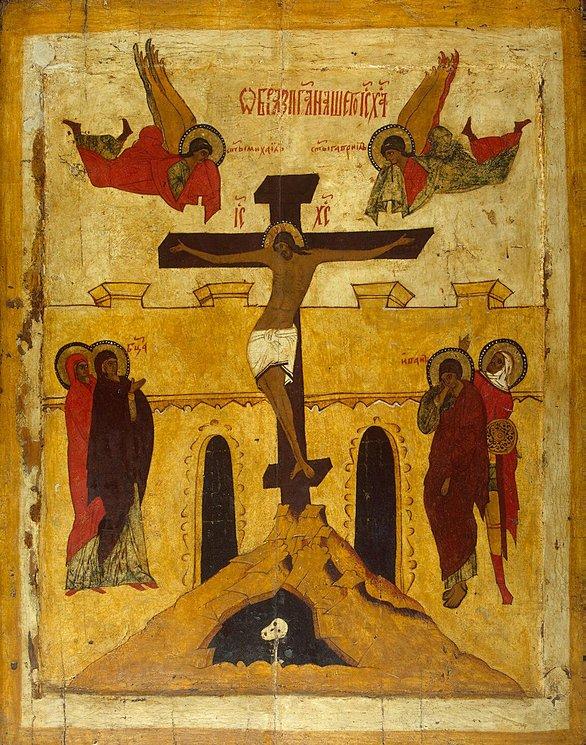
Crucifixion – Eastern style
One of Jesus’ last words as he hung on the cross were his words to Mary and to the apostle John. To Mary Jesus said, “Woman, here is your son,” and to John he said, “Here is your mother.” (John 19:26-27) This passage can be interpreted on two levels: literal/historical or allegorical/typological. Both approaches are valid. On the typological level it can be said that John represents the Christian and that in accepting Jesus’ death on the cross the Christian receives Mary as their mother. Mary was not only Jesus’ mother, she is our mother as well.
In Revelation 12:17 we read that all who obey God’s commandments and who hold to the testimony of Jesus are Mary’s children. What is striking about this verse is that it describes the two distinctive traits of Evangelicals: their zeal to be biblical and their zeal to be witnesses for Christ. If so, then in light of Revelation 12:17 Mary is the Mother of all Evangelicals. Protestant Evangelicals need to get over their hang-ups and in obedience to the Bible, accept Mary as their Mother.
The Bible teaches the concept of spiritual motherhood. This principle can be found with respect to Sarah, Abraham’s wife. Peter writes, “You are her daughters if you do what is right and do not give way to fear” (I Peter 3:6). Paul uses the Sarah/Hagar example in Galatians 4 and uses this contrast to make the point that the Church is our mother (Galatians 4:26).
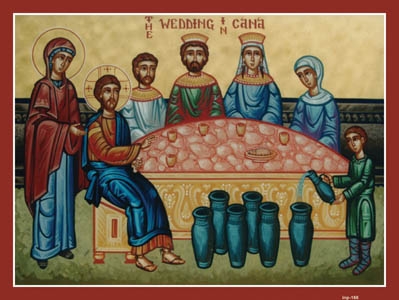
“Do whatever He tells you.”
Thus, to be Mary’s children means to be like her, following her example. Just as Mary was committed to doing God’s will, so we should be committed to doing God’s will. When she heard the astounding announcement from the angel Gabriel she responded, “I am the Lord’s servant. May it be done to me as you have said.” (Luke 1:38) Mary, likewise was devoted to bearing witness to Jesus. At the wedding at Cana she instructed the servants, “Do whatever he tells you.” (John 2:5) Doing whatever Jesus tells us to do means total acceptance of Christ’s lordship over our lives. Accepting Mary as our Mother does not weaken our commitment to Christ, rather it strengthens our commitment to Christ. Drawing closer to Mary leads us closer to our God and Savior Jesus Christ.
Mary in the Liturgy
For the Evangelical visiting the Sunday Liturgy is the best way to learn what the Orthodox Church really believe about Mary. (It is strongly recommended that the visiting Evangelical attend a parish where the Liturgy is in English. Going to an ethnic parish where the Liturgy is even in a mixture of English/Greek or English/Russian can be distracting and confusing.) For the Orthodox the Divine Liturgy is theology in action. The beginning part of the Liturgy consists of several litanies — set prayers — that close with a reference to Mary and then with reference to the Holy Trinity. When the priest reaches the end of a litany he will then say:
Remembering our most holy, pure, blessed and glorious Lady, the Theotokos and ever-virgin Mary, with all the saints, let us commend ourselves and one another, and our whole life to Christ our God.
At the end of our prayers we are reminded of Mary’s total commitment to Christ and that we are also remembering the example set by the other Christians who have gone before us. The call to commit our lives to Christ should warm the heart of any Evangelical. Years ago I made a personal commitment to Christ and now years later I’m renewing that commitment every Sunday in the Liturgy. Several times during the Liturgy I recommit my life to Christ and at the same time I commit the lives of my friends and family to God’s loving care.
As the Liturgy progresses we encounter Mary again in the Nicene Creed. The Nicene Creed is recited every Sunday and at every liturgical celebration. The Nicene Creed starts off with what the Church believes about God the Father, then what it believes about Christ’s divine nature and his human nature.
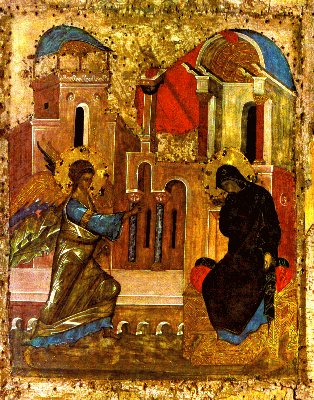
Icon – Annunciation
For us and for our salvation he came down from heaven
and became incarnate by the Holy Spirit and the Virgin Mary
and became man.
The first thing to note is that the Nicene Creed situates “our salvation” in relation to the Incarnation, not in relation to the Crucifixion as Evangelicals are wont to do. The next thing to note is that the Incarnation involved the Holy Spirit and the Virgin Mary. Mary played an integral part in the Incarnation; without her cooperation the Incarnation would not have happened.
Then, following the consecration of the bread and the wine the congregation sings:
It is truly fitting to call you blessed, O Theotokos; you are ever-blessed, utterly pure, and the Mother of our God. More honorable than the Cherubim, and far surpassing the glory of the Seraphim, remaining inviolate you gave birth to God the Logos. Truly the Theotokos, we magnify you.
Here an Evangelical might cringe at the effusive language praising Mary, wondering: Is all this exalted language biblical? A careful reading of the Bible show that it is.
Blessed — “Blessed are you among women, and blessed is the child you will bear!” (Luke 1:42)
Theotokos (God-bearer) — “Blessed are you among women, and blessed is the child you will bear!” (Luke 1:42; see also Isaiah 7:14, Matthew 1:21-25, Luke 2:6-7, Revelation 12:5)
Ever-blessed — “From now on all generations will call me blessed….” (Luke 1:48)
All-holy — “But just as he who called you is holy, so be holy in all you do; for it is written: ‘Be holy, because I am holy.'” (I Peter 1:15-16)
Utterly pure — “Blessed are the pure in heart for they will see God.” (Matthew 5:8). “Everyone who has this hope in him purifies himself, just as he is pure.” (I John 3:3)
Mother of God — “The virgin will be with child and will give birth to a son, and will call him Immanuel– which means, ‘God with us.'” (Matthew 1:23, cf. Isaiah 7:14)
More honorable than — “You made him a little lower than the heavenly beings the Cherubim and crowned him with glory and honor.” (Psalm 8:5) “And God raised us up with Christ and seated us with him in the heavenly realms in Christ.” (Ephesians 2:6)
Many Protestants are afraid that venerating Mary will eventually lead to worshiping her. Protestants’ confusion when Orthodoxy claims that it venerates Mary but does not worship her arises from differences in their understanding of worship. Where the sermon is central to Protestant worship, the center of Orthodox worship is the Eucharist. Kimberly Hahn, an Evangelical who converted to Roman Catholicism, makes this observation:
I could not figure out why it was that it seemed to be that Catholics worshiped Mary, even though I knew worship of Mary was clearly condemned by the Church. Then I got an insight: Protestants defined worship as songs, prayers and a sermon. So when Catholics sang songs to Mary, petitioned Mary in prayer and preached about her, Protestants concluded she was being worshiped. But Catholics defined worship as the sacrifice of the body and Blood of Jesus, and Catholics would never have offered a sacrifice of May nor to Mary on the altar (1993:145).
Thus, it is impossible for Orthodox Christians to worship Mary. This misunderstanding of the Orthodox veneration of Mary can be traced back to Protestantism’s departure from the historic Christian pattern of worship.
After repeated visits to Orthodox worship services, I saw that the focus of Orthodox worship is on the Holy Trinity and Mary plays a secondary role in Orthodox theology. Evangelicals are afraid of being misled by tradition run amok unchecked by Scripture. The important thing is to understand that Orthodox faith and practice is based on the teachings of the Apostles. The Sunday worship service uses the Liturgy of St. John Chrysostom which dates back to the fifth century and which has changed little in the centuries following. Because the Liturgy does not change, it protects our theology. The Liturgy functions like the two rails that keep the train on track and heading in the right direction. It should be reassuring for Evangelicals to know that the Liturgy guards us from excesses like putting Mary on the same level as Jesus or separating her from Jesus and that the Liturgy leads us to Christ. This is different from when I was a Protestant and was worried that some strange new doctrine might come down from the denominational headquarters.
The Ecumenical Councils
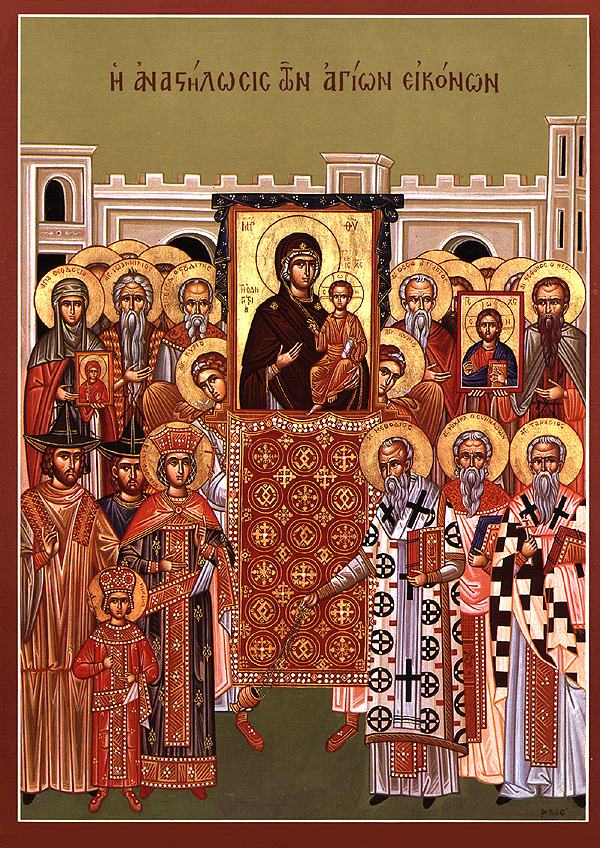
Icon – Seventh Ecumenical Council
Many of the titles for Mary used in the Liturgy come from the early theological debates. The debates were not so much about Mary but about Christ’s two natures, the Incarnation, and the Trinity. It was at these Ecumenical (Universal) Councils that the Early Church defined the essential elements of the Christian Faith. The Councils’ decisions to assign various titles to Mary: The Virgin Mary – Nicea I, A.D. 325, Theotokos – Ephesus, A.D. 431; Ever-Virgin – Constantinople A.D. 553, were all intended to safeguard the divinity of Christ.One would think that the Councils’ language would be effusive in their description of Mary. However, the language of the Councils was quite austere with respect to Mary. In order to understand what the Ecumenical Councils taught about Mary, it is important to understand how the titles ascribed to Mary served to protect a right understanding of who Christ is. Timothy Ware writing about the title “Theotokos” notes:
The appellation Theotokos is of particular importance, for it provides the key to the Orthodox cult of the Virgin. We honour Mary because she is the Mother of our God. We do not venerate her in isolation, but because of her relation to Christ. Thus the reverence shown to Mary, so far from eclipsing the worship of God, has exactly the opposite effect: the more we esteem Mary, the more vivid is our awareness of the majesty of her Son, for it is precisely on account of the Son, that we venerate the Mother (The Orthodox Church, p. 262).
Here we see the deep links between the Liturgy and the Ecumenical Councils. For Orthodoxy, church history is living history. Church history is not something found in the history books but something we relive every Sunday in the Liturgy.
Mary and the Icons
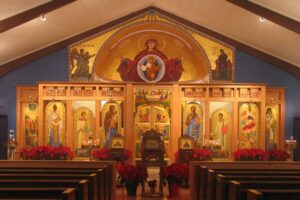 An Evangelical visitor will be struck by the visible prominence of Mary in the architecture of the Orthodox church. Looking towards the front of the church, one sees the icon of the Virgin Mary on the left of the royal door leading to the altar and the icon of Christ on the right side. Above the altar one may see the expansive icon of the Virgin Mary holding the Christ child. The icons are not just pretty pictures. They depict powerful truths about Christ and our salvation.
The huge, eye catching icon of Mary that catches the attention of so many Evangelicals needs to be viewed in its proper context. In Orthodox architecture if one looks up at the ceiling one will see the icon of Christ the Pantocrator — signifying Christ’s being in heaven as the All Ruling One. Then as one’s gaze moves further down one sees the icon of the Virgin with Child — signifying Christ’s coming down from heaven for our salvation. After that, if one looks directly at the altar one sees the cross — signifying Christ’s descending even further to the point of dying for our salvation. This is Paul’s famous hymn in Philippians 2:5-11 in visual form.
The icons by the royal door also teaches us about salvation history. The icon of the Virgin Mary holding the Christ child on the left represents the First Coming of Christ and the icon of Christ on the right represents the Second Coming of Christ. In the first coming Christ comes in humility to save us and in the second coming Christ comes in glory to judge humanity. It is significant that it is the practice of the Orthodox church for confession to be done before the icon of Christ on the right. On a symbolic level the icon of the Virgin Mary depicts the age of the Church in which the Church presents Christ to the world as a witness to God’s saving mercy. The altar area beyond the icon symbolizes the age to come.
Mary’s Virginity — The Biblical Evidence
One objection that Evangelicals have is the Orthodox belief of Mary being ever-virgin, i.e., her perpetual virginity. Every icon of Mary shows three stars or diamonds on her forehead and her two shoulders. These three stars or diamonds represent Mary being a virgin before, during, and after the birth of Christ. This is not some vague popular lore but defined as a fundamental dogma of the universal Church at the Fifth Ecumenical Council at Constantinople in A.D. 533.
The bottom line for Evangelicals is: What does the Bible teach? When one considers the biblical data for or against Mary’s perpetual virginity, the surprise is how ambiguous the biblical record is. It is quite easy for Evangelicals to marshal the requisite biblical proof texts to defend the Virgin Birth of Christ (Isaiah 7:14, Matthew 1:18-25, Luke 1:26-38). However, when Evangelicals claim that Mary had other children besides Jesus they are beginning to skate on thin ice. In making this assertion they point to Mark 6:2-3:
When the Sabbath came, he began to teach in the synagogue, and many who heard him were amazed. “Where did this man get these things?” they asked. “What’s this wisdom that has been given him, that he even does miracles! Isn’t this the carpenter? Isn’t this Mary’s son and the brother of James, Joseph, Judas, and Simon? Aren’t his sisters here with us?” And they took offense at him. (Mark 6:2-3)
What this passage teaches us is that Jesus is Mary’s son, but it does not teach that Mary had other sons and daughters beside Jesus. What Mary’s relationship is with these four men is not clear in the text. To say that Mary was their mother is one possible reading of the passage but not the only necessary reading of the passage. Another reading of the passage is that they were Joseph’s sons from a prior marriage before Joseph was betrothed to Mary. The historic Christian understanding has been that they were Joseph’s sons from a previous marriage. The Protestant understanding is a recent one.
Another interesting piece of biblical data is the fact that while the Bible does support the fact that Mary was betrothed to Joseph, it does not explicitly state that Mary and Joseph ever married. In first century Palestine the betrothal was a solemn ceremony in which the man and the woman were promised to each other. This was part of a two step process of a betrothal followed by a wedding. The fact that Matthew and Luke never mentioned that Joseph and Mary became married lends indirect support for the interpretation that they were betrothed but never took the second step of consummating their relationship through sexual union. It is telling that Matthew and Luke used the word μναομαι “to betroth” rather than the word γαμεω “to marry” to describe Mary’s relationship with Joseph (see Matthew 1:18 and Luke 2:5). In light of the biblical evidence Evangelicals must be open to the possibility that Mary was Joseph’s betrothed but not fully his wife.
Evangelicals point to Matthew 1:25 where it reads: “But he had no union with her until (‘εως) she gave birth to a son.” The way this verse reads to many Evangelicals is that Joseph refrained from having sexual intercourse with Mary until she gave birth to Jesus and then he had sexual intercourse with her. But there are other ways of reading this text. The Greek conjunction ‘εως does not necessarily denote a sharp temporal division of before and after. The semantic range for ‘εως allows for a continuity both before and after. For example, in the Great Commission passage (Matthew 28:19-20) Christ promised that he would be with us always even until the end of the age. No Evangelical would interpret this to mean that after the Second Coming Christ would no longer be with us.
What is even more problematic for the Evangelicals is the fact none of the Protestant Reformers, Martin Luther or John Calvin, interpreted the passage this way. Calvin criticizes those who deny Mary’s perpetual virginity and he points out that this interpretation does not fit the sense of the passage,

John Calvin
“Helvidius takes issue with this passage, and caused great disturbance at one time in the Church. He deduced from it that Mary was only a virgin up to her first birth, and thereafter bore other children by her husband. The perpetual virginity of Mary was keenly and copiously defended by Hieronymous. …. Joseph is said to have had no intercourse with her, until she brought forth, but this too only applies to that same period. What followed after, he does not tell.” (Calvin’s New Testament Commentaries Vol. 1 page 70; italics added).
In terms of the historic consensus we find Eastern Orthodox, Roman Catholics, and the original Reformers in agreement on Mary’s perpetual virginity! Evangelicals who deny Mary’s ever-virginity find themselves outside of the historic mainstream on the fringe.
Mary’s Perpetual Virginity — The Theological Angle
It is quite ironic that Evangelicals who played such a stalwart role in defending the Virgin Birth against the theological liberals in the early twentieth century would have such a hard time accepting Mary’s ever-virginity. They insist quite strongly that after giving birth to Christ, Mary had normal sexual relations with Joseph and that she had several more children after that. What is puzzling is why Protestants insist on making Mary’s having sex with Joseph into something akin to theological dogma. If anyone would have difficulty accepting Mary’s perpetual virginity it would be the theological Liberals who deny the Virgin Birth. But for Evangelicals interested in Orthodoxy, probably the biggest issue is their puzzlement as to why Orthodoxy treat it so seriously? To put it bluntly, “Why does Orthodoxy make such a big deal about Mary being ever-virgin? What’s the big deal about the whole thing?”
What does Mary’s ever-virginity have to do with our salvation? If we use the Protestant paradigm of salvation which focuses on the forgiveness of sins, it’s peripheral. But if we use the Orthodox paradigm of salvation which focuses not just on justification but on the totality of our salvation in Christ, it’s central. Mary’s ever-virginity is linked not to our justification but to our sanctification and glorification in Christ. Our salvation is linked to Mary’s salvation. This is because Jesus came to save not just individuals but the human race. Just as Mary was saved by Christ, so each one of us will be saved.
Mary is the prototype of our salvation. Take the analogy of the model home. In Hawaii we have numerous planned communities. Oftentimes when we drive around the island we see huge open tracts of land with nothing on it, just a sign announcing the developer’s plan to build homes on the land, and maybe a model home showing what the future homes will look like. The Developer is God, the future planned community full of homes and happy families is redeemed humanity in the age to come. Mary is the model home. Mary is living proof of Christ’s power to save us. Salvation is not just something far off in the future, in the life of the Theotokos we have concrete evidence of our ultimate salvation.
Sanctification forms an integral part of our salvation in Christ. One of the great miracles is that not only are our sins forgiven but that Christ takes profaned, defiled beings like us and makes us holy for service in his holy temple. I have found in Orthodoxy a tangible sense of holiness in worship. Experiencing the holiness of God in the Divine Liturgy has helped me grasp the significance of Mary’s carrying Christ in her womb for nine months. Being pregnant with Christ was a sanctifying experience for Mary in a very profound way.
Mary’s perpetual virginity shows that the Incarnation had real and lasting consequences. When Mary accepted Christ into her life she was transformed internally and physically. As the Theotokos (the God Bearer) Mary is the fulfillment of the Old Testament archetypes: the Ark of the Covenant, the Holy of Holies, the burning bush, the jar containing the manna, the sacred lamp in the Temple, the altar of incense, Aaron’s rod which mysteriously budded, the sealed East Gate in Ezekiel’s temple. In the Old Testament once something has been set aside and dedicated to sacred use, it is sacrilegious to reuse it for ordinary purposes. In Mary’s being pregnant with Christ we see something far surpassing any of the archetypes in the Old Testament. For her to be pregnant with another child after that would be like a priest pouring soda into the communion chalice! or the Israelites using the Holy of Holies as a storage room! For the Orthodox Christian the Protestant notion of Mary having other children or her having intercourse with Joseph shows a shocking lack of appreciation of holiness. An Evangelical may just shrug their shoulders with indifference, a sign of their inexperience with God’s holiness.
Mary’s perpetual virginity is also linked to our ultimate salvation in Christ. Her ever-virginity is a prophetic foreshadowing of the life to come. In his debate with the Sadducees Jesus noted:
When the dead rise, they will neither marry nor be given in marriage; they will be like the angels in heaven” (Mark 12:25).
Where marriage and sex is distinctive to the present age, virginity and celibacy points to the age to come. Mary being both Virgin and Mother spans the two ages: the present age and the future age. Mary is like the first Eve in Genesis who gave birth to children, and yet she is the Second Eve who foreshadows life in the hereafter. Thus, Mary spans the two ages. This is a good example of what the noted Evangelical theologian George Ladd referred to in his The Presence of the Future as: “present fulfillment and future eschatological consummation” (1974:133). Mary is the Second Eve who changed the course of human history with her “Yes” to God and her giving birth to the Savior of the world. But if one adopts the Protestant view that Mary had children like other mothers, then Mary is an ordinary woman who belongs squarely in the present fallen age; there is no decisive intervention that foreshadows the coming age. The Incarnation was not a nine month blip that disappeared into history but more like a “eucatatrosphe” — an event that took place in a brief moment in time with long-lasting and widespread consequences for the good of the human race.
Mary Our Prayer Partner
Another obstacle for Evangelicals is the Orthodox practice of praying to Mary. We ask Mary to pray with us, that is, we ask her to be our prayer partner. We do not ask Mary to give us what we need (only God can do that), but we ask her to join us in prayer. Orthodox Christians who are sharing their faith with Protestants need to be aware of the Protestants’ fear of any attempt to put anything between them and Christ. We need to emphasize to our Protestant friends that for Orthodox Christians there is only one Mediator between God and men, Jesus Christ (I Timothy 2:5).
The Orthodox Church’s understanding of Mary is grounded in Scripture. The Orthodox understanding of prayer is based upon the ancient doctrine of the “communion of saints.” Orthodox Christians are very conscious of the fact that we do not pray alone but that we are constantly surrounded by the great cloud of witnesses (Hebrews 12:1) and that we are participating in the ongoing heavenly worship (Revelation 5 and 7).
What helped me to accept Mary’s role as intercessor was a heartwarming anecdote I had heard from Tom Telford when I was missions chair of my former church.
Once I visited these three elderly saints who were all in senior citizen homes nearby. I went to see Gladys first. I knocked on the door and she could barely see. I said, “Gladys, do you know who this is?” She said, “Tommy!” and gave me a big hug. As we talked, I asked her what she did all day. She said, “Come here and I’ll show you.” She had an old yellow legal pad with fifty-two names of missionaries written down. “I spend my day praying for these people. See, Tommy, here’s your name.” (Tom Telford 1998:50-51)
What Gladys has been doing so faithfully day in and day out is exactly what Mary has been faithfully doing day in and day out in heaven. I would guess that after Gladys passes on and goes to be with the Lord, she’s not going to stop praying for Tom Telford. The Orthodox Church believes that Mary and the saints in heaven are fervently praying for those of us here on earth.
Protestantism’s Emotional Scars
The Protestant avoidance of Mary has its roots in the psychological trauma of the Protestant Reformation. The religious controversy between Roman Catholicism and the Protestant Reformation ripped apart the social, political and religious unity of Western Europe which left emotional scars on Western Christianity. Many times when someone undergoes a traumatic experience, they repress the memory of that experience. It is as if they completely forget that incident had ever occurred. However, psychologists know that that experience shapes the victims’ attitudes, perception and actions long after the incident happened. They may no longer remember the incident but its impact is still evident in their life. It controls them even if they are not aware of its influence. They usually need therapy to confront the incident and reconstruct their thinking so that it no longer controls their lives.
When Protestantism rejected Mother Church in the form of Roman Catholic Church it necessarily had to reject Mary. It rejected Mary by minimizing her role in God’s plan of salvation. It accepted her as one believer among many others but it refused to honor her for her part in salvation history. The loss devastated the soul of Protestantism. Protestantism is a lonely religion. We come to faith in Christ alone — on our own, as individuals. We gather on Sunday mornings as like-minded individuals. We read the Bible alone — we cannot rely on others to tell us what the Bible means. There is a certain emptiness in the Protestant systematic theologies despite their logical coherence. Not knowing Mary as Mother is a great loss and what is even more sad is that we do not know of our loss.
In all fairness it should be noted that the Protestant tendency to neglect Mary was not part of the original Reformation. It seemed to be a later development, most likely a subsequent development of the Puritan movement in the 1600s. While Reformers like Calvin strongly affirmed the Church as Mother, for some reason this understanding has been largely neglected by many Protestants. This is my personal guess as to why Mary is not given due honor in Protestantism. I’m sure there are other explanations as well.
Protestants have certain legitimate criticisms of Roman Catholicism. However, what Evangelicals should keep in mind is that despite the surface similarities there are significant differences between Orthodoxy and Roman Catholicism. Frederica Matthewes-Green in her popular book At the Corner of East and Now describes well the different temperaments in the East and the West:
In Orthodoxy, Mary is a strong figure, not a helpless or vapid one. She’s our Captain because she is first in the pack, the leader of all Christians, and it is her example we all follow, men as well as women. …. Western Christianity, I find, has a comparatively feminine flavor. The emphasis is on nurturing and comfort; reunion with God occurs as he heals our inner wounds. In the West, we want God to console us and reassure us; in the East, we want God to help us grow up and stop acting like jerks. (pages 89-90)
The differences between Roman Catholicism and Eastern Orthodoxy lie at a deeper level. Father Alexander Schmemann in For the Life of the World writes,
It is significant that whereas in the West Mary is primarily the Virgin, a being almost totally different from us in her absolute and celestial purity and freedom from all carnal pollution, in the East she is always referred to and glorified as Theotokos, the Mother of God, and virtually all icons depict her with the Child in her arms.
There is a tendency in Roman Catholicism to emphasize Mary’s exceptionalism to the neglect of her commonality with the human race. Pope John Paul II in his encyclical letter Dives in Misericordia (On the Mercy of God, page 30) notes: “Mary is also the one who obtained mercy in a particular and exceptional way, as no other person has.” This stress on Mary’s exceptionalism can put at risk our grasp of the Incarnation. Our salvation depends upon Christ being fully human, and Christ’s humanity depends upon Mary’s humanity. Orthodoxy with its stress on Mary as the Theotokos has maintained a healthier balance than in the West. Evangelicals journeying to Orthodoxy need to keep in mind that Eastern Orthodoxy is quite different from Roman Catholicism, and not let their anti-Catholic prejudice get in the way of hearing what the Orthodox Church has to say about Mary.
Moving Towards Orthodoxy
For the Protestant Evangelical, becoming Orthodox involves more than changing one’s theology. Unlike the Protestant understanding of faith as mental comprehension of doctrine, for Orthodoxy faith is lived out in worship. For a Protestant like me, the challenge of becoming Orthodox was not just in accepting what Orthodox Christians believed about Mary but also loving her as the Orthodox do. A good illustration of the difference between Protestantism and Orthodoxy can be found in a story of a theology professor from Holland making a trip to an Orthodox church.
One day he was in an Orthodox Church in Moscow standing in front of an icon of Mary and Christ when an old Russian woman approached him. She could see at a glance that Hannes was a foreigner. Few Russians could afford such clothing. And she could see he wasn’t Orthodox — he hadn’t crossed himself, he hadn’t kissed the icon. He was looking at it as one might look at a painting in a museum. “Where do you come from?” she asked. “Holland,” Hannes replied. “Oh, yes, Holland. And are there believers [as Russians refer to Christians] in Holland?” “Yes, most people in Holland belong to a church.” He could see the doubt in her face.
She began to cross-examine him. “And you also are a believer?” “Yes, in fact I teach theology at the university.” “And people in Holland, they go to church on Sunday?” “Yes, most people go to church. We have churches in every town and village.” “And they believe in the Father, Son, and Holy Spirit?” She crossed herself as she said the words. “Oh, yes,” Hannes assured her, but the doubt in her face increased — why had he not crossed himself? Then she looked at the icon and asked, “And do you love the Mother of God?” Now Hannes was at a loss and stood for a moment in silence. Good Calvinist that he was, he could hardly say yes. Then he said, “I have great respect for her.” “Such a pity,” she replied in pained voice, “but I will pray for you.” Immediately she crossed, kissed the icon, and stood before it in prayer.
“Do you know,” Hannes told me, “from that day I have loved the Mother of God.” (Jim Forest Praying With Icons p. 109)
This story summarizes the fundamental difference between Evangelicals and Orthodoxy. The Evangelical approach to Mary is one of distant respect, whereas the Orthodox approach is one of love and trust. For Protestants Mary is a distant historical figure but for Orthodox Christians she is with us in our worship on Sunday morning.
In my journey to Orthodoxy what I found most helpful was the principle of not forcing myself to do Orthodox things but to grow in my Orthodoxy. As I grew in my understanding of the Liturgy my approach to worship and prayer underwent a gradual change. I began making the sign of the cross and bowing towards the icon of Christ during worship. I took another step closer to Orthodox worship when I began bowing my head to the icon of the Theotokos. I bowed my head out of respect for her courageous commitment to Christ and her playing a key role in our human history. The next change came in my private devotions. Where before my quiet time consisted of bible readings and free form prayer, I began using the Orthodox Morning Prayers. I found my daily quiet time becoming more Trinitarian in focus. I also found myself no longer excluding Mary from my prayers but linking my personal prayers with the great heroes of faith like Mary and John the Baptist.
Sola Scriptura vs. Holy Tradition
An essential part of becoming Orthodox is renouncing the Protestant principle of sola scriptura (bible alone) and accepting Holy Tradition as it is handed down by the Church. This is why Mary is such a major problem for Protestants interested in Orthodoxy. Not everything in Orthodoxy can be found in the Bible. Evangelicals need to be assured that Holy Tradition will not contradict Scripture. This is because Scripture is an integral part of Holy Tradition and because the source of this Tradition is Christ.
The difference here is between the Protestant principle of sola scriptura (bible alone) and the Orthodox principle of Holy Tradition. Protestants claim to derive their theology from the Bible. They trust in the Bible as the Word of God but they are reluctant to trust the Church’s teaching authority. Protestants in rejecting the teaching authority of the Church are basically self-taught in their theology. Orthodoxy on the other hand believes there are no self-taught Christians, ultimately what we believe is handed down to us by means of Holy Tradition through a long line of transmission that goes back to the Apostles.
When I was a Protestant Evangelical I used the inductive bible study method. Then I supplemented the inductive bible study method with the early Church Fathers. I found myself moving closer to Orthodoxy but I was still operating as a Protestant in that I was still acting as a self-teaching Christian. I was like a student who enjoyed studying on his own, but who did not go to the classrooms.
However it was the collapse of my Protestant theology that forced me to take Orthodoxy seriously. This theological crisis was caused by two discoveries: (1) that much of what makes up modern Evangelicalism goes back only to the nineteenth century and (2) that the two cardinal dogmas of the Reformation — sola fide and sola scriptura — were never part of the Early Church. At the same time my studies in church history led me to the conclusion that Orthodoxy was right in its claim that it kept the teachings of the Early Church without change. At that point my thinking shifted from skepticism to that of deep respect to that of trust. I became convinced that the Orthodox Church could be trusted on the essentials of the Christian Faith. At that point I was ready to become Orthodox.
Much of what I’m writing here about Mary came after I became Orthodox, not before. When I joined the Orthodox Church I did not have all the answers to my questions about Mary, e.g., Mary’s perpetual virginity. My basic attitude was that if the Orthodox Church got things right on the important issues of Christ and the Trinity, she could be trusted to get things right on the Virgin Mary. When I joined the Orthodox Church it was like seeking admission to the university, enrolling for classes, and putting myself under the teaching authority of the professors (bishops). I stopped being a self-taught Protestant and began enjoying the benefit learning from great theologians of the past: Irenaeus of Lyons, Athanasius the Great, the Cappadocian Fathers et al.
Together We are Saved, Alone We are Lost
Do I need to believe in the Virgin Mary to be saved? If we mean by salvation Christ dying on the cross for our sins and our going to heaven — as Protestants understand salvation — the answer is: No. But if we mean by salvation Christ coming down from heaven to take on human nature, our being baptized into Christ’s death and resurrection, and our incorporation into the Church, the body of Christ — as Orthodoxy understands salvation — then the answer is: Yes.
The differences here are rooted in differences in theological paradigms. The Protestant understanding of salvation focuses on Jesus’ death on the cross and our sins being forgiven. For the Orthodox, Christ came to save us in the fullest sense of the word. The Orthodox theological paradigm focuses on Christ’s Incarnation: his life, death, resurrection, and ascension to heaven. Where Protestants take a minimalist approach to salvation, Orthodoxy emphasizes the fullness of our salvation in Christ. Accepting Mary is important for our salvation because eternal life consists of life in community. Christianity is a relational religion. When we enter into a personal relationship with Christ, we enter into a relationship with God the Father and we receive the Holy Spirit. Jesus came to bring us back home to God and to heaven where all the saints and angels dwell.
But you have come to Mount Zion, to the heavenly Jerusalem, the city of the living God. You have come to thousands upon thousands of angels in joyful assembly, to the church of the firstborn, whose names are written in heaven. (Hebrews 12:22-23)
Just as Jesus Christ is the Way to the Father, so Mary is the doorway to the Church. Honoring Mary opens the way to venerating the saints. Asking Mary to pray for us opens the way for us to ask the prayers of the saints. Accepting Mary into our lives is an integral part of accepting the “communion of saints” mentioned in the Apostles Creed.
In closing, I would like to note that in becoming Orthodox I did not stop being an Evangelical. Orthodoxy for me does not mean the abandonment of Evangelical principles but the fulfillment of Evangelicalism. Mary is the greatest Evangelist of all time, she opened the door for Christ the Savior to come to us (Isaiah 7:14, Revelation 12:5). Mary shows us the way of Christian discipleship. Mary’s words at the wedding at Cana, “Do whatever he tells you” (John 2:5) means that listening to her means accepting Jesus as Lord and Savior of our lives. Mary leads us to faith in Christ which is the very heart of Evangelicalism.
Robert Arakaki
Note 1 — The woman in this passage can be understood to refer to the nation of Israel or to Mary. Revelation is full of symbolic language which makes it quite difficult to interpret. Many Orthodox Christians prefer to interpret this passage allegorically (the woman = Israel), the reason being that according to Holy Tradition Mary gave birth to Christ without suffering birth pains. The Orthodox Study Bible is ambivalent about this passage.
Bibliography
Calvin, John. A Harmony of the Gospels: Matthew, Mark and Luke. Vol. I. Calvin’s Commentaries Series. A.W. Morrison, translator. David W. Torrance and Thomas F. Torrance, editors. Grand Rapids, Michigan: Wm. B. Eerdmans Publishing Company, 1972.
Forest, Jim. Praying With Icons. Maryknoll, New York: Orbis Books, 1997.
Hahn, Scott and Kimberly. Rome Sweet Home: Our Journey to Catholicism. San Francisco: Ignatius Press, 1993.
John Paul II. Dives in Misericordia (On the Mercy of God). Boston, Massachusetts: Daughters of St. Paul, 1980.
Ladd, George Eldon. The Presence of the Future: The Eschatology of Biblical Realism. Grand Rapids, Michigan: William B. Eerdmans Publishing Company, 1974.
Matthewes-Green, Frederica. At the Corner of East and Now: A Modern Life in Eastern Orthodoxy. New York: Jeremy P. Tarcher/Putnam, 1999.
Schmemann, Alexander. For the Life of the World: Sacraments and Orthodoxy. Crestwood, New York: St. Vladimir’s Seminary Press, 1988.
Telford, Tom with Louis Shaw. Missions in the 21st Century. Wheaton, Illinois: Harold Shaw Publishers, 1998.
Ware, Timothy. The Orthodox Church. Revised edition, 1997. New York: Penguin Books, 1963.
I graduated from arguably the leading evangelical seminary – Dallas Theological Seminary. I was taught that the reason for the rise of the importance of Mary as well as the rest of the saints was that the church rapidly became synchronistic in their worship after the rise of Constantine. The church needed a goddess figure and a pantheon to compete with the pagan gods, hence the rise of the importance of the saints and Mary. As the church moved into areas with female deities it became easier to incorporate the population into Christianity by simply substituting Mary for the goddesses. It would be interesting to document the veneration of Mary & the saints prior to Constantine.
This is a common Protestant viewpoint, but it is silly and completely untenable. Seek and ye shall find.
Jesus said ” No one comes to the father but by me” Mary can do nothing for us. Nowhere in the Bible does it say either she or the saints can intercede in prayer for us. Therefore praying to Mary is fruitless. I have read the entire Bible. Mary was actually only mentioned a very few times. She obviously was very special or God wouldn’t have chosen her to bear His son. She is to be respected, but not worshiped or prayed to. This is clearly not the role she was intended for. Jesus Christ and He alone can save our souls and have communion with th Father.
Velma,
Amen! Indeed, no one can come to the Father except through Jesus Christ. John 14:6 is one of my favorite bible verses. But I think it’s a little too strong to say Mary can do nothing for us. From reading the Bible about Mary I learn what it is to be a follower of Christ. One of my favorite bible passages about Mary is John 2:5 when she tells the servants: “Do whatever He tells you.” This teaches me about being completely submitted to Christ’s lordship. And as far as interceding in prayer is concerned we read in Genesis 18 that Abraham interceded for the cities of Sodom and Gomorrah, and in Matthew 20:20-23 we read about the mother of James and John asking a favor of Jesus (interceding).
Because Mary is mentioned in the Bible we should take seriously what the Bible teaches us about her. I readily admit that the Bible does not teach that Mary intercedes for us but then again the Bible does not teach the term “Trinity,” nor does it give us a listing of books that make up the Bible. These are the results of the Church being guided by the Holy Spirit (John 16:13).
Your reasoning is based on the doctrine of “Bible alone.” It was not part of early Christian and as a matter is a recent teaching. I encourage you to keep an open mind as you read the Bible, study church history, and learn more about Orthodox Christianity. I want to assure that Orthodox Christianity is very Christ centered. One cannot look at an icon of the Virgin Mary without seeing her pointing to her Son, Jesus Christ.
Robert
When we Christians ask each other to intercedefor us we are not question the efficacy of our Lord’s mediatorship..
In Christ we don’t know any dead. He is the God of the living, of Abraham, Isaac and Jacob. We can pray and ask each other to intercede for us. Asking someone for intercessions is not worshipping them
I was raised Catholic and attend an Orthodox Church. I have to agree with the criticisms of how Orthodoxy and some Catholics treat Mary. However, in all fairness I also have to be critical of how much focus some Protestants put on Jesus in their worship. While Jesus is divine, he came as a savior, not an object of worship; which already existed. He didn’t go around telling people to bow down and worship him. So if it wasn’t appropriate when he was here on earth, why would it be any different when after he died?
Ortho/Catholics believe God pays special attention to Mary’s prayers and so if they can get her to put in a good word for the, it might help their situation. This is of course ridiculous. You can always go directly to God with all prayers and requests.
When people begun to explore Orthodoxy there is a danger of thinking that just because something is traditional and has been done for a long time that it is the correct way. This isn’t true. Early Christians we’re quite capable of making mistakes, being corrupt, etc.
Eric,
Welcome to the OrthodoxBridge! I appreciate your frank questions. With respect to worshiping Jesus there are some instances where people worshiped him (Matthew 28:17). The Magis bowed down and worshiped Christ (Matthew 2:11). The disciples worshiped Christ at his Ascension to heaven (Luke 24:52). This teaching is continued in Paul’s writing about Christ being exalted to the right hand of God and every being kneeling in worship before Christ (Philippians 2:10-11). Then in Revelation we read that when the Apostle John fell at Jesus’ feet Jesus did not deny this act of worship but rather affirmed it by putting his right hand on John (1:17).
Your point that just because something is ‘traditional’ does not mean it must be followed. But the important issue here is the difference between small ‘t’ tradition which can be understood as human tradition and capital ‘T’ Tradition which is the body of teachings and practices that the Apostles received from Jesus Christ and which Holy Spirit revealed to the Church (2 Thessalonians 2:15). For example, the term “Trinity” is not in the Bible but it accurately reflects the teaching of Scripture. It was because of the Church being led by the Holy Spirit (John 16:13) that the Church was able to explain and defend what the Apostles taught. Similarly, when the Church gave the Virgin Mary the title “Theotokos” it was done as a way of defending the Church’s teaching that Jesus is divine and that which was in her womb is by nature divine as well as human.
As far as Mary being a mediator standing between us and God, I would encourage you to listen attentively to the prayers in the Divine Liturgy. You will find that the Orthodox Church does not view Mary as an go-between between us and God. The Orthodox Church believes that Mary prays for us and that she prays with us, but it does not teach that Mary is a go-between for us and God. I encourage you to bring up these questions with your local priest. Face to face conversation with an Orthodox priest usually conveys the teachings of the Church much better than a blog like this.
Robert
Christ,
I’m sure Dallas Theological Seminary has many fine professors on its faculty but I’m skeptical about the version of church history that you learned there. To put it bluntly, I think you are uncritically spouting the party line. May I suggest you contact your professors and get from them the title of a scholarly work that support your position. Much what I have written here is supported by Jaroslav Pelikan’s “Mary Through the Centuries.” Pelikan’s scholarship in the area of church history is regarded as among the best. Hopefully, we can get a fruitful dialogue going based upon the historical evidence.
BTW, I think you meant “syncretistic,” not “synchronistic.” Am I right on this?
Robert
Chris,
MG over at Energetic Procession already did a blog post on that very subject:
http://energeticprocession.wordpress.com/2011/07/29/prayers-to-saints-in-the-pre-nicene-era/
Hope it helps
Chris that is easy – just look a the sub tuum presidium (200s) for an example of the veneration of the Theotokos in the earliest Liturgies. Irenaeus of Lyon teaches she is the “new Eve” through whom salvation came into the world (100s). Ignatius of Antioch (ordained by Peter and a disciple of John) calls her perpetual virginity one of the three great mysteries of God in our salvation. What you were told is an ahistorical fabrication.
Thorough post and well done. I coincidentally wrote a short post on Mary today, especially as related to being the Second Eve.
Robert,
Thank you for a superb post. While you could have copy-pasted Jarolsav Pelikan’s work, your succinct summary (& collation from other sources) should be an extremely valuable resource to assist Protestants in their understanding of the all-holy Theotokos.
To address issues from Chris on “syncretism”: I think that I have an idea where Chris’s notion of syncretism came from. These are some of its representative contours (in no particular order):
1) In 313, Constantine and Licinius jointly announced an Edict of Toleration at Milan which also benefited the Church as a side-effect. Yet at the same time he was planning to abolish tolerance within Christianity. And tolerance of Judaism within the Empire. For the Church, his goal was E Pluribus Unum! Where Messianic Judaism and Celtic Christianity had no place. This unitary approach to religion was risky business for both Constantine and Licinius. Both were not in undisputed control of the Empire at the time – even in the West. Both were heavily dependent on the Imperial Roman Army where Mithraism was the primary preferred religion, although it was not as popular with the civilian population.
His decree regarding “rest” on die solis venerablis: “the venerable day of the sun” (Sunday) was primarily aimed at placating the supporters of Mithraism in the Army, although the Church was yet again a collateral side-effect beneficiary, as with the earlier Edict of Toleration. In 315, the inscription on Constantine’s victory-arch, which still stands near the Coliseum cites victory only “by the inspiration of the divinity”. Which “divinity”? Both Apollo and Christ are plausible! However his military sensitivities at the time make Apollo more plausible than Christ.
2) Constantine’s anti-Judaic & anti-Semitic rhetoric at the First Council in 325 in his support of the timing of the annual Pascha. [The end-result was correct, the rhetoric was radical heresy and a departure from the Apostolic Faith as far as the first-century “Jerusalem-Central” Church of St James the Just was concerned].
Constantine’s outburst against the Jews in his letter to the Nicene Council was aimed explicitly against the Desposnyi, although couched in general terms. His cynical use of Christ, to which all liberals in the Church acquiesced, meant a profound falsification of the Gospel and an injection of standards alien to it. From the moment of his “conversion”, a certain form of “Romanised” Catholicism flourished to the detriment of first-century, Apostolic Christianity
3) Following Constantine’s rhetoric from #1, the proven syncretism of the Imperial Church’s shifting of the celebration of the Feast of the Nativity from 15 Tishrei (1st of Sukkot) – September-ish (Jn 1:14), to (first) after Hanukkah on first 6 Jan, and (finally) to 25 Dec (the winter solstice – celebrated by a constellation of pagan religions both in and around the Empire).
This, of necessity “re-set” both the Jesus cycle and the Marian cycle of feasts which were fixed to the Nativity of Jesus. With the Annunciation falling on the pagan Equinox feast, etc.
4) The Church’s tightening of its post-Apostolic sacrament of Confession to address concerns over the ever-increasing nominalism in the post 325 Church where vast numbers “converted” for purely social and civil-service reasons, rather than true faith.
During this period, Constantine offered special concessions to his type of “Christian”: the rich were flocking into his Church for the sake of the tax-concessions, or to avoid wearisome service on city councils. Or Army Service. Privileges and exemptions granted to Constantine’s “christian” clergy precipitated a stampede into the priesthood. And most certainly not for any sort of genuinely spiritual reason.
Devout aristocratic ladies (who never abandoned their inward paganism) acquired followings of clerical groupies, and experimented with fashionable forms of devotion. True Christian moralists were apprehensive that “conversions” were occurring for the wrong reasons – to gain favour, to obtain a job, a promotion, and a pension. As far as the historian can tell, their anxieties do not seem to have been altogether misplaced.
5) On 11 May 330, Constantine dedicated his new capital, Constantinople in its newly-constructed Hippodrome. The high point in that ceremony was the arrival in its arena of a golden chariot carrying a gilded statue of the Emperor. That statue held a smaller figure – of the goddess Tyche from his recently-completed Temples to the goddesses Rhea and Tyche. Rhea was Byzantium’s most ancient “protecting” goddess – the “mother” of the Olympian gods. Tyche was the personification of good fortune – who was believed to be able to protect and bring prosperity to cities.
That ceremony, with that chariot and those statues was to be re-enacted in that Hippodrome for the next two hundred years! Equally, that ceremony with those goddesses placed where they were, was a declaration to all in sundry that his religious allegiances were still firmly pagan – no matter what he may say to the Church! Very much like the Muslim “Palestinian” rhetoric today – to the Western World in English, they proclaim feel-good universal salaam and goodwill; to their own “Palestinian” people in Arabic, they continue to urge jihad and fatwa against the Jewish and Western “infidels”.
6) Around 334, Constantine had constructed in Jerusalem the basilica Church of the Holy Sepulchre. This was constructed on the site of a Pagan Temple to Aphrodite (Venus) which itself had been constructed upon the site of the original Holy Sepulchre shortly after 135 when Jerusalem was renamed Aelia Capitolina. Constantine himself presided at the “dedication” of this basilica in 335. As far as can be ascertained, there was no formal “exorcism” of the “spirit of Aphrodite” from that site. Aphrodite’s influence there was never effectively banished until years later – well after the death of Constantine.
All this time, however, he was also erecting equally magnificent pagan temples in Constantinople. Such as to Rhea and Tyche. This was clearly understood as part of the first settlement of the ‘Roman Question’ – established during his reign.
In the circular forum, on one of the highest hills of the city, Constantine erected a great porphry column 25 metres high and arranged for it to be crowned by a gold statue of himself. Here the emperor was again associated with the sun, whose rays spread from the statue’s head.
7) At his interment, his sarcophagus in the centre of his newly-dedicated Church of the 12 Apostles (the only one both started and finished in his lifetime) was surrounded by 12 empty coffins, supposedly one for each of the apostles. With himself as the “chief apostle”(or was that “Chief of the Apostles”?) The usual pagan elevation of Emperors to the status of deity would certainly explain the latter. At the time of his son’s death, the bones of several apostles had been brought to this mausoleum – these coffins no longer had to be empty.
8) After Constantine’s death, clearly carrying out their father’s will, his sons issued a coin to commemorate their own consecratio. On one side it bore Constantine’s veiled head, and an inscription, ’The deified Constantine, father of the Augusti’. On the other side, Constantine is seen ascending to heaven in a chariot with a god’s hand reaching out to welcome him – in a portrayal similar to those of his pagan predecessors. In this coinage, without having to explicitly spell it out, they clearly proclaimed to all in sundry in the Empire that their father was never at any time in his life a Christian in any sense of the word!
9) The use of the pagan Greek methodologies of Allegory (from Alexandria) and Symbolism (from Antioch) – something documented by Pelikan, to produce Marian results, instead of the Jewish-mandated Remez and Derash (as in the PaRDeS schema).
Since Jewish literature was involved in the texts you so rightly quoted, ALL the “Fathers” were required to use the PaRDeS schema when interpreting Jewish Literature in order to avoid misunderstandings & traces of heresy.
[To reassure you, the use of this schema in its Remez & Derash form will produce essentially the same outcome as you have laid out, but since it uses a qualitatively different and non-Pagan route, it avoids the charge of Pagan syncretism.]
Both Allegory & Symbolism were invented in Greece (& thus were part of the Greek diaspora) to make something out of the all-Pagan, cryptic “cloud-gazing” jumble that came out of Mt Olympus, Mt Parnassus and Oracles such as at Delphi. Jewish Literature was never in the same class.
And it was the attempt by Antiochus IV (the “epiphanes”) to impose this on the Jewish Community which led to the more conservative and anti-syncretistic elements of Jewish society (such as Jesus & His Apostles) to reject even the use of the Greek language in proclaiming the Gospel. And thus reject the liberal & syncretistic LXX in favour of the conservative Hebrew/Aramaic Original.
# You asked Chris: “May I suggest you contact your professors and get from them the title of a scholarly work that support your position.”
Whilst this is a commendable request, the points listed above should suggest lines of enquiry that may well bypass such a request.
In closing, can I recommend
“The Life of the Virgin Mary, the Theotokos”, the Holy Apostles Convent, Buena Vista, Colorado, 1989.
Whilst not 100% accurate historically in some of its parts, it nevertheless provides much valuable material to support the Apostolic-era devotion to the Mother of God prior to her Dormition in 44CE.
Peace be with you.
Not nearly enough time to comment on all the loaded assertions in this long piece – the attempt to disentangle Hellenism from Christianity would require eviscerating the New Testament as well as rejecting (as you note) elements of what was originally received as Scripture. It is not a path a Christian should try to tread.
John,
The problem with a lengthy comment like yours is that it is inadequate in its treatment of a complex topic like this. That is why I asked Chris for a scholarly work in support of his claims. The key here is critical scholarship, not just the compilation of facts and data. Much of the information you listed above are intermixed with your interpretation and removed from the broader social context. The title you recommended: “The Life of the Virgin Mary, the Theotokos” is suitable for spiritual reading, but I don’t find it helpful for research purposes. For research I prefer something more along the lines of Jaroslav Pelikan. Can you give a title of a book that supports the Dallas Seminary reading of history using the standards of critical scholarship?
I have a hard time accepting your broad sweeping statements about the rejection of the Septuagint taking place around the time of Antiochus IV, two centuries before Christ. My understanding is that Paul and the other New Testament writers made heavy use of the Septuagint in their citation of the Old Testament and that the Jewish rejection of the Septuagint took place after the destruction of the Temple in AD 70. Are you sure you have your facts right? If you are confident of your position, could you give me the name of a recognized biblical scholar who takes this position? Furthermore, your characterization of the Septuagint as “liberal & syncretistic” strikes me as sweeping over generalization. Which recognized biblical scholar takes this position? The Masoretic text was composed from the 7th to the 11th century Common Era so how can it be superior to the Septuagint? Recent studies of the Dead Sea Scrolls have taught us that there was considerable more variation in the Old Testament texts than the precision of the Masoretic text. In short, I think you got the facts wrong on the Septuagint and the Masoretic text.
I appreciate your trying to provide all the facts on the subject, but what I want to promote on this blog is a concise and critically informed conversation. References to scholarly works are much preferred to broad sweeping generations.
Robert
Robert,
Thanks for this.
With this post, I support you all the way on Mary, and so on this thread I am one of your cheer-leaders.
FYI, I am not a supporter of the “Dallas position” on Mary – something that I believe will relieve and reassure you. Yet in my discussions with New Age people, they happily claim it as the basis of their acceptance of its results as legitimation of their use of Mary and the Saints for non-Christian purposes – seeing in Mary an archetype of the divine feminine. And seeing the saints as being a new incarnation of the gods and goddesses of old.
And yes, I agree with your thoughts re the book I recommended and re your use of Pelikan. I substantially rewrite its (not Pelikan’s) chronology, datings and its family trees, yet I am happy to use it for my personal edification.
Re you last thought:
“I appreciate your trying to provide all the facts on the subject, but what I want to promote on this blog is a concise and critically informed conversation.”
I try to respect this, but, please forgive me, sometimes being concise forces me to be unsatisfactorily elliptical.
Yet re “critical scholarship” and “peer-review” etc, I do have issues with the “Classical” position on a wide spectrum of matters. I have learned to suspect the “Classical” position on principle – it always leads to safer end-results.
Re the LXX etc. I do not want to take this thread too far beyond a discussion of/about Mary into an extended discussion on the formation of the Canon of Scripture, and thus be a distraction from Mary. If you were to do another thread on the LXX, I would be only too happy to expand therein thereon.
In this thread, I did not want to start a new discussion-thread. This is one reason why I tried to keep it short yet adequate re the issues on Constantine and will not be continuing commentary herein on Constantine.
For any true errors of fact, I offer my mea culpa.
May God richly bless you as you labour in His vineyard.
J.
John,
Thanks for your efforts…but post like yours rarely get read in full…worn out by the 30th line! Please be more succinct and to the point…not 40 point brother! 🙂
This is a massive generalization, but I believe that the emergence of the sacred feminine occurring on the fringes of evangelicalism came about because Protestants did not find a place for Mary in their theology. Mary is a tough subject for me personally. Im a seminary student working in an independent church and I have begun to seriously look into Orthodoxy. There is much in Orthodoxy that has been drawing me but “what to do with Mary” is something that I struggle with. Thanks for the article and the website.
Mike,
Welcome to the OrthodoxBridge! One advantage of being in seminary are the resources available for an in-depth examination of issues. It should also be a time when one can reflect on what one believes and explore the reasons for the beliefs. I remember a paper I did for Prof. Richard Lovelace on icons. The research I did for the paper was helpful in my journey to Orthodoxy. May God bless you as look further into Orthodoxy.
Robert
Robert,
Thanks. I’ve been visiting on and off for a bit now and thought I’d finally jump in, so to speak. What prompted me to investigate Orthodoxy deeper was a few things. At seminary we had a Christian Traditions class and had to read Bishop Kallistos Ware and attend a divine liturgy. I reacted negatively at first but due to attending a Florovsky conference, and becoming friends with a local Antiochian priest, I have began interacting with it beyond a reactionary level. I was content thinking I was set on my journey towards Geneva and never expected Constantinople to appear on the way.
Mike,
That’s an interesting connection/proposition. Perhaps the rise of a distorted “feminism” has arisen in Protestantism due to the lack of a developed theology of Mary? How does one prove or disprove it?
All said, I have far less difficulty venerating Mary as Theotokos & perpetual-virgin, as I do with a common Orthodox practice of holding virginity in higher esteem than marriage. Seems gnostic to me, while marriage far more earthy-human and “productive’ of the seed of Christ in history. Missing something here I guess. Why sex somehow “contaminates humanity” escapes me. Where do the Fathers teach this as part of Holy Tradition…or do they? And why doesn’t Orthodoxy still have married Bishops — as some Fathers who gave the Church Holy Tradition were sometimes married, no?
Mike,
Re your queries on virginity & the Church Fathers.
Can I recommend this book to you:
“Eunuchs for Heaven The Catholic Church & Sexuality”, Uta Ranke-Heinemann, (tr John Brownjohn), Andre Deutsch, London, 1990. ISBN: 0 233 98553 0
Whilst written for and about this issue in Roman Catholicism, at least 50% is directly translatable into an Eastern Orthodox setting. Whilst some of it is controversial, the scholarship for the undivided Church prior to 1054 is close to flawless.
Happy reading,
J
Ah, yes, the virgin birth was a metaphor and Mary was a carnal young lady with tons of kids. Flawless!
May I instead recommend Yannaras, perhaps his commentary on the Song of Songs for something that actually applies to Orthodoxy and erotic expression?
I actually second the question concerning married bishops, especially given St. Paul’s injunction that “bishops…shall be the husband of one wife” in 1 Timothy 3. I understand that that could apply to monastic abbots (the wife being the Church, the children being those in their charge) and a widower, but I’m not sure why currently married bishops aren’t allowed — it seems (and I’m more than willing to grant that I’m in an area I know little about) that here Tradition and Scripture aren’t speaking in one accord.
Russ
PS– My blogpost about Christ’s real presence and the Reformed Tradition is still coming! I promise!
The selection of Bishops from the ranks of the monastics was (and is) a disciplinary canon that was intended to safeguard against abuses. Of course, that didn’t always work.
While one could imagine Bishops with wives and childrens re-emerging, it is unlikely to solve any real problem and create a whole host of others.
to “Anon” – 2 Replies (assuming that you are the same “anon”):
A) to your post on May 23, 2012 at 12:48 am
This book is pure history – by the first woman ever to hold a chair in Catholic theology worldwide. She later held the chair of religious history at Essen University in Germany.
Please, you are chasing the wrong rabbit up the wrong rabbit hole.
B) to your post on May 23, 2012 at 12:51 am
The real and major reason for this selection of Bishops from the ranks of the Monastics was a major defect in Byzantine State Law (Novellas as Canons).
Nowhere in the entire corpus of this law did it properly distinguish between the Bishop’s personal family property and that property that he held in trust for the Church in his Diocese. Nor did it prohibit his selling or deeding this property held in trust – mostly to his family . This was the problem.
Rather than correct or defy faulty State Law, and maintain solely married Bishops, the Byzantine Church capitulated to the State, defied Pauline scripture (interestingly and sadly held in high esteem by them) and installed monastics as Bishops. Since monastics within the Empire were celibate, this sale-to-family rort was thus avoided.
The minor and interlocked reason was the doubtful purity and spirituality of State-appointed Bishops in the tradition of Sylvester of Rome. And of the greater holiness of the monastics.
Again, over many centuries, rather than defy the Emperor, repudiate his Erastian Episcopal appointments, and instal their own from their own Diocesan Synod without reference to outside the Diocese, the Byzantine Church again capitulated to the State, defied Pauline scripture, compromised, and recommended “suitable” monastics to work within this Erastian schema.
Most Orthodox Clergy that I have spoken to with any education on the topic recognize the problem, recognize that it is a purely administrative issue – and not a de fide issue, but sadly, no Bishop or Synod is game to be the first to break ranks and appoint a married priest to the Episcopate such that the new Bishop and his wife are at this consecration service.
I trust that this assists.
J
Paul did not mandate marriage for anyone (except those without self-control) let alone episcopal leadership, so to use the phrase “defied Pauline scripture” is silliness. See the verses from 1 Cor. 7 below.
Virginity is not held in higher esteem in Orthodoxy except in the same sense that it was held by Paul:
1 Cor 7:1 “It is GOOD for a man not to touch a woman.”
It is good, not weird, oppressive, or unnatural.
1 Cor 7:7-9 “For I wish that all men were even as I myself. But each one has his own gift from God, one in this manner and another in that. But I say to the unmarried and to the widows: It is good for them if they remain even as I am; but if they cannot exercise self-control, let them marry. For it is better to marry than to burn with passion.”
It is good to remain celibate unless they cannot exercise self control. Marriage is a blessed gift. Paul says celibacy is preferred and along with marriage is a gift of God.
1 Cor 7:32-33 “But I want you to be without care. He who is unmarried cares for the things of the Lord—how he may please the Lord. But he who is married cares about the things of the world—how he may please his wife.
I think I was pretty clear that this was not an issue of faith. Otherwise your statements about “defying” Scripture are absurdist and your understanding of the development and role of monastics in the episcopacy is radically oversimplified.
I am not opposed to married Bishops in principle but that would open up a world of problems that the Orthodox Church really doesn’t need – we have enough issues to struggle with already.
David,
A great question and one I have no actual research to back up. Sounds like a good research topic for school though. I know that among the emergent liberals there has been this move to try to “feminize” the Holy Spirit in some way by saying the Holy Spirit is the “motherly” part of God. I don’t think it would be a huge stretch to infer that because us Protestants don’t quite know what to do with Mary they have turned to the sacred feminine, at least in more liberal circles anyways.
As for sex contaminating humanity I think that comes from St. Augustine’s idea that original sin is transmitted through the act of sex itself.
Saying the Holy Spirit is the “motherly” part of God is hardly a new idea. Isn’t that what the Syriac Orthodox Church (including the early fathers, like Aphrahat) have always done? Granted, they use Aramaic and in that language the word for “Spirit” is feminine (as in Hebrew), so that could have something to do with it.
Let me clarify. I was stating what I was taught by my seminary professors. I no longer believe this since embracing Orthodoxy. Ironically, they have no documentation for this except veneration of the saints and Mary is not mentioned in the Bible.
Thanks for the clarification!
Robert
Heard you that way from the get-go Chris. Glad to have a DTS on the blog. Have you read Fr. Peter Gilquist’s book (he was at DTS) about the 2,000 fromer Campus Crusaders who converted to Orthodoxy (Antiochian) in 1987/8? It’s titled _Becoming Orthodox_ and an interesting read for an evangelical, though certainly not intended to answer all questions.
If you read the Bible with the ancient Church and Fathers the veneration of Mary and the saints is in fact frequently revealed in the Scriptures. Two simple examples:
Psalm 45, also quoted in the Magnificat:
The king’s daughter is all glorious within: her clothing is of wrought gold. 14 She shall be brought unto the king in raiment of needlework: the virgins her companions that follow her shall be brought unto thee. 15 With gladness and rejoicing shall they be brought: they shall enter into the king’s palace. 16 Instead of thy fathers shall be thy children, whom thou mayest make princes in all the earth. 17 I will make thy name to be remembered in all generations: therefore shall the people praise thee for ever and ever.
Also in Ezekiel 44: the Temple was seen as a type of the ever-Virgin before which the prophets falls to his face as it radiates with the uncreated energies of the Godhead.
I have mused a bit about the scriptural references to Jesus’ brothers. In one incident, recorded in the synoptics, Jesus’ mother and brothers try to get his attention when he is surrounded by the crowd. (Mark 12:46 et seq.) It certainly is inconclusive, but to me, it seems like this incident is more consistent with a family calling on a younger brother, than younger siblings trying to get the attention of their elder brother. Reading this incident this way supports the idea that the ‘brethren of the Lord’ were older children of Joseph by a previous marriage.
Interesting insight!
Dear Robert,
Thank you for this interesting and informative article. As a Reformed Christian I would consider myself Evangelical in the truest sense of the word in that I would hold fully to the Evangel – the gospel of our great God and Saviour, Jesus Christ. That said, ‘evangelical’ today has sadly come to lose its historic meaning and is ordinarily applied to all manner of folks whose doctrine and practice differ significantly. So I sympathise and appreciate that you are speaking to general terms.
Nevertheless in reading your article a number of points came to mind. Firstly, as a Reformed Evangelical I would question your following statement: ‘What is interesting about these verses is that they imply that the Incarnation was instrumental in our salvation. This challenges the Protestant paradigm which views our salvation almost exclusively in terms of Christ’s dying on the cross.’ This evidently is not a Reformed paradigm, although we like the apostle preach Christ and Him crucified. Clearly the Incarnation is instrumental in the sense that while the Son’s becoming Incarnate did not save us in and of itself nevertheless without the Incarnation there would have been no salvation. As a Protestant moreover I do not believe that Christ saves exclusively by His dying on the cross since His Person and active obedience were integral to His saving work and guaranteed the efficacy of His supreme sacrifice as the Lamb of God that takes away the sins of the world.
Moreover I’m not convinced that Revelation 12 is speaking of Mary rather than the church. Hence to quote one Reformed commentary: ‘The woman cannot mean, literally, the virgin mother of Jesus; for she did not flee into the wilderness and stay there for 1,260 days, while the dragon persecuted the remnant of her seed.’
I’m also slightly puzzled anent your statement on sanctification and Mary! Are you saying she is analogous to the church and thus our sanctification is worked out in the context of church? Christ IS our sanctification as well as our wisdom, righteousness and redemption. The Temple is Christ; and by extension His body, the church indwelt by the Spirit of Christ, rather than Mary.
I cannot help but think that the allegorical interpretation of our Lord’s words to John concerning Mary is His word to His church concerning our Mother is stretching things! It is surely telling that Mary is not mentioned in the Acts or the epistles in this manner! You mention her place in the Liturgy of Chrysostom still used in the Orthodox churches but Chrysostom lived 400 years after the events described in the gospel! What evidence is there that the successors of the apostolic church venerated Mary in this fashion? I understand they held her is great esteem and so do we but the distinction that the EO (and RCC) makes between veneration and worship pertaining to Mary is subtle and open to much confusion – even I suspect among those in their own respective communions.
On the subject of prayer, I must ask why would I go to Mary in prayer when I have direct access to the Father and the throne of grace through the Son in the Spirit? Why do you suppose there is no mention of such a practice in the NT Scriptures? You make reference to the great cloud of witnesses in Hebrews 12 but this has nothing to do with the subject matter in hand but rather to faith. They provide us with a great example of living and walking by faith in our present earthly pilgrimage; they do not live to intercede for us rather Christ does. We have no biblical mandate for praying to the Spirits of the saints departed this life!
I would question your view that the Reformed rejected the RCC dogma and practice pertaining to Mary due to some sort of psychological trauma born of the Reformation. Rather they did so because they found no warrant for such beliefs and practices in the Bible. I read a quote from an EO priest a couple of weeks back on FB who said ‘we interpret scripture through the light of tradition’. Well Protestants interpret tradition in light of sacred scripture.
Finally I would have to say that Reformed Christians are not lonely believers as you suggest but are catholic, confessional and commissional. This admittedly in not the case with many evangelicals but I have no liberty to preach and teach what is contrary to the teaching of the church and confession I belong to.
We, like you recognise the Virgin birth, that Mary is blessed among women. I think we would concur in her perpetual virginity but the focus of our worship, work and witness in not Mary but her Son, our Beloved Lord and Saviour; Immanuel – God with us, for us and in us the hope of glory.
Dear Rev. Pearce,
I very much appreciate your thoughtful comments on my article: “Why Evangelicals Need Mary.” Forgive me if I don’t address all your concerns! But I will do my best.
We are only scratching the surface in the discussion on the significance of the Incarnation for Christ’s work of salvation. I would venture that the difference between Reformed and the Orthodox paradigm of salvation is this: the Reformed paradigm is predominantly forensic while the Orthodox paradigm is ontological. I believe you are operating from the forensic paradigm when you wrote about Christ’s active obedience which implies legal merit. If I understand you right when one has faith in Christ then Christ’s meritorious standing is transferred to our account entitling us to certain benefits. In the Orthodox paradigm when we put our faith in Christ, we join ourselves to Christ. Because we are in Christ his life is in us. Eternal life then is the result in our partaking of the life shared by the Father and the Son. My understanding of Reformed theology is that eternal life is a benefit conferred on us through our entitlement via Christ’s merit.
The organic nature of the Orthodox paradigm integrates Christ’s life with his dying on the Cross. The Incarnation means that one cannot have eternal life part from being part of the Church, his Body, and our receiving the body and blood of Christ in the Eucharist. The unity of the Church is not just in an intellectual faith in Christ but also our sharing in Christ’s life through the Eucharist.
With respect to Revelation 12, let me say that Revelation is a very difficult book to interpret. My approach is to allow for multiple readings of Revelation and not to be locked into one particular reading. I used Revelation 12 to show that the Virgin Mary can be understood as mother, not literally but spiritually. Especially dangerous are attempts to force a literal interpretation on Revelation. So I need to ask you: Do you believe that a literal reading of Revelation is the best way to read it? And do you find yourself agreeing with the commentaries written by dispensationalists? Let me know where you stand and we can continue our discussion in subsequent comments.
You are right that Christ is our sanctification (I Corinthians 1:30). And you are right in your understanding that I see Mary as analogous to the church and that our sanctification is to be worked out in the context of the church. For Scriptural support I refer you to 2 Timothy 2:20-21, especially the phrase “in a large house.” Note that in 2 Timothy 2:21 Paul links our sanctification with good works. I view the Virgin Mary as the first disciple, that is, the first Christian. She put her faith in Christ and opened up herself to Christ so that he might be incarnate in her body. Mary then becomes a prototype or great example of Christian discipleship. That is why the early church recognized her as the Second Eve. We learn from her example what it is to be a Christian. Mary lived a life of faith, of prayer, and obedience to God. Many Reformed Protestants look to Paul as the exemplar of Christian discipleship but Orthodoxy given its oral tradition remembers Mary’s devotion to Christ. Our sanctification is linked to life in the church because it is in the church we learn to pray, that we learn to love one another, and we learn to live holy lives. Sanctification is not some abstract spirituality, but a rubber meets the road practical spirituality. It needs to be embodied or acted out in the context of corporate discipleship. Think of it this way, one could not really be a follower of Christ if one disliked the Apostle Paul could he? Just as Paul is an integral part of the New Testament canon, so likewise Mary is part of the church. I would be interested to hear your understanding of sanctification, especially how it relates to corporate discipleship.
You expressed skepticism about the early church venerating Mary in light of the absence in the book of Acts, the epistles, and the apostolic fathers. I’m not at all surprised by your skepticism but keep in mind your biases. One is sola scriptura. One result of sola scriptura is that in a way it closes the door on church history, especially early church history. For Orthodoxy there is a seamless transition from the New Testament into the early Christian writings but sola scriptura results in a sharp demarcation from the early church. The other is the static understanding of Tradition which assumes that Orthodoxy holds that the early Christians venerated Mary like the way Orthodox Christians do today. Orthodoxy holds to a dynamic understanding of Tradition. The hymn sung to the Virgin Mary in the Liturgy of St. John Chrysostom is the end product of several centuries of reflection on Scripture and Mary’s example. But my question to you is: Does your church honor the Virgin Mary in your Sunday worship? Is it an occasional mention of her or do you recognize her role in the Incarnation of the Word on a regular basis? And assuming that your particular confessional group accepts the first four Ecumenical Councils, does your church acknowledge Mary as the Theotokos in its services? Or is the title “Theotokos” just in the book?
You asked why one should pray to Mary while one can have direct access to the Father through Christ. First of all, we need to make clear that Jesus Christ alone is our mediator to the Father. We do not access Jesus or God the Father via the Virgin Mary. Having said that let me point out that corporate prayer is integral to being a Christian and very much part of our being gathered together on Sunday. I know where you are coming from with respect to Hebrews 12. I understand that a strict rigorous reading of Hebrews 12 does not lead one to the conclusion that praying to the saints is being enjoined on us. Your comment that there is no biblical mandate that we pray to the spirits of the departed saints is correct but rests on the assumption of sola Scriptura. The practice of asking the prayers of the departed saints arose during the great persecution and the rise of the cult of the martyrs. Your relationship with Christ is not dependent on whether or not you ask the prayers of the saints. Neither does your salvation rests on your praying to the saints! I hope this allays some of your concerns.
It’s okay for you to disagree with my conjecture about Protestantism’s psychological trauma; it is after all a conjecture. You wrote that Protestantism replaced Roman Catholic Mariology with a more biblical one. Then you asserted: “Well Protestants interpret tradition in light of sacred scripture.” That is all very nice, but what happens when Scripture is ambiguous and can be read in more ways than one? In 1527 there took place the Marburg Colloquy where Martin Luther confronted Ulrich Zwingli over the words of Christ: “This is my body.” Both Reformers held to Scripture as divinely inspired and authoritative but differed as to what it meant. Luther believed in the real presence in the Eucharist but Zwingli viewed the bread and wine as just symbolic. If you were there in that room, whom would you have affiliated with? And given that this was the first schism in Protestantism how would you bring about a united understanding of Scripture for the Lord’s Supper? For me the Marburg Colloquy revealed the fundamental flaw of sola Scriptura: a divinely inspired Scripture requires an oral tradition (implicit sense) that informs our reading of the text. Without Apostolic Tradition, Scripture becomes vulnerable to being misunderstood. Thus, inspired Scripture requires an equally inspired and authortative interpreter, that is, the Church founded by Christ. Orthodoxy because it relies on Apostolic Tradition in its understanding of the real presence does not suffer conflicting interpretations as the Protestants do with their sola Scriptura. Orthodoxy has been faithful to the Apostle Paul’s exhortation to the Christians in Thessalonica that they hold fast to the Apostolic Tradition whether written or oral (2 Thessalonians 2:15).
Thank you for your thoughtful interaction with my aricle. I look forward to hearing from you.
Robert
“I understand they held her is great esteem and so do we but the distinction that the EO (and RCC) makes between veneration and worship pertaining to Mary is subtle and open to much confusion – even I suspect among those in their own respective communions.”
Wayne, I’d like to deal with the concern you have in your quote that I have reposted above.
Regarding the above, it seems you are projecting your own confusion onto others. I know of no Orthodox Christian or Roman Catholic Christian who is confused about who Mary is (i.e. a creature) and who God is (i.e. Creator). The difference between veneration and worship for us isn’t a variation of degrees (such as a scale of 1 to 500) where moving too far on the scale moves from one thing (veneration) to the other (worship). Rather, it is like comparing mathematics to apples. They really are that far apart.
Additionally, we Orthodox Christians cannot possibly honor Mary any more than God already has. The idea of giving Mary too much honor, to us, sounds nonsensical because how can we bestow upon Mary more than what God has through sanctifying her and choosing her to bear Himself, God the Word.
Perhaps that doesn’t alleviate your concerns but please note that you might be imposing your confusion that you have onto those of us who are, in fact, not confused. Those Orthodox Christians who are closest to Mary are, by and large, closest to Christ. At least that is my experience.
John
Dear Robert, thank you for your thoughtful and helpful response. Its way after 2am here and I must get to bed. I also have a fairly busy schedule up to Lords Day but I will reply soon and look forward to further dialogue with you on the above subjects. For now, so that you have a little background information. I am a Scottish presbyterian minister and we take the Westminster Confession as our subordinate standard. I am not dipensational and hence do not read the Revelation in a literal fashion. Hope my first reply did not come across as combative for that is not my intention. Be in touch soon. Yours appreciatively in Christ, Wayne
Dear Wayne,
Not to worry. You came across as thoughtful in your reply.
Don’t worry about responding quickly. I prefer slow and thoughtful replies. And as I tell my commenters your real life is more important than the Internet. Give priority to your church work and family.
Robert
Dear Robert,
I found a little time to respond to your reply:
Yes, okay I agree the Reformed view is ‘predominantly’ forensic but not exclusively so. My paradigm would be covenantal in large part. Christ as the second Adam by His active obedience fulfilled the Law as a Covenant of Works and then ratified and sealed the Covenant of Grace by His precious blood. That is not to minimize the significance of His person and life, death and resurrection. However, salvation by grace through faith is much more than imputation for faith unites us to Christ. We are the recipients of the exceedingly great and precious promises in Him and through Him.
I would similarly argue that the Reformed paradigm offers a similarly integrated and organic conceptualization of Christ’s person and work. I similarly agree that there is no possibility of life outside the church which is the body of Christ but that church while visible through the manifestation of orthodoxy and orthopraxy transcends any communion/denomination. Evidently, I do not accept the EO claim to being the one, true, catholic and apostolic church, in the same way I do not accept the RCC’s claim – although it has been encouraging to read Pope Francis speaking of other Christians etc.
Moreover while the sacraments (of Baptism and Holy Communion) are signs and seals of the Covenant and given to nourish and strengthen us in the faith they are not the source of our faith and life. I do not recognize your claim to ‘intellectual’ faith as an accurate depiction of Reformed understanding. Faith includes credence (so there is an intellectual element or knowledge) but it also includes conviction and commitment. Faith moreover is not only routed to Christ but is rooted in Christ. Okay, I’m sure we will return to this elsewhere but I don’t want to get sidetracked from the main thesis of your article which is Why Evangelicals Need Mary.
Okay, we agree that the Book of Revelation is full of symbolism but I still think there are better alternatives to Mary as stated. I am not a dispensationalist and reject the wooden literalism that promotes pre-millennial and pre-rapture notions.
If you are merely saying that Mary is a great example to believers for faithfulness and fruitfulness then fine I agree. Yes, faith must manifest itself in good works. We are saved by grace through faith in Christ to do the good works that God has prepared for us (Eph.2:8-10). However, I detect a problem in your approach to sacred scripture. Rather than exegete the text you appear to be guilty of eisegesis. You are applying the same sort of paradigm to 2 Tim.2:20-21 as you did to Hebrews 12. There is no mention of Mary whatsoever in the text or epistle! Paul rather is reminding us that the visible church comprises wheat and tares, sheep and goats, all manner of fish taken in the net etc. He is urging true believers to demonstrate the genuineness of their faith by their faithfulness and fruitfulness (sanctification). They must show by their belief and behavior, confession and conduct, profession and practice that they are vessels fit for the Master’s use – honourable rather than dishourable. Our Lord says you shall know them by their fruits! Hence we are to supplement our faith with virtue, and virtue with knowledge, and knowledge with self-control, and self-control with steadfastness, and steadfastness with godliness, and godliness with brotherly affection, and brotherly affection with love. For if these qualities are yours and are increasing, they keep you from being ineffective or unfruitful in the knowledge of our Lord Jesus Christ (2Pt.1:5-8). Hence we grow in communion with God and the saints. Mary however is not essential to this process.
As for my skepticism, yes it is based upon the teaching of the infallible word of the living God. Thus I would simply reply ditto to your admonition – ‘keep in mind your biases.’ You are reading scripture through the eyes of Orthodox tradition rather than viewing tradition through the lens of sacred scripture. I’m. not opposed to tradition and hence the church, her creeds and confession have an important role to play. However their role must be a subordinate one. Men are fallible unlike God. One only needs to be a couple of degrees off course to find oneself lost and miles astray! So to answer your question no we don’t honour Mary weekly in `worship because we worship Holy Trinity alone and do not see the necessity of changing our position which we believe is biblical and confessional.
Given you agree that prayers to Mary or any of the other saints are not essential, nor biblically mandated (not by strict rigorous reading but by plain exegesis) then Evangelicals contrary to your article do not actually NEED Mary and hence the premise of this article is wrong or at least unproven. You explain that the practice has a long history and I accept that but that does not make it necessary which you concede. You suggested that Reformed profession and practice was born out of the trauma of the separation with Roman Catholicism but on the basis of your reply I could say that praying to the dead (and possibly other traditions) appears to have been born out of the psychological trauma of great persecution and martyrdoms in the early centuries of the NT church’s existence!
You ask who was right at the Marburg Colloquy? The answer is neither! Luther was probably nearer to the truth than Zwingli but I am Reformed and hence do not follow my own opinion but the teaching of our Reformed Confession. I believe in the real presence but that presence is not a corporeal presence in the elements of the bread and wine but rather a spiritual presence. We feast upon Christ and receive God’s grace in the sacrament of Holy Communion. My conviction is that the apostolic succession is doctrinal rather than personal. These issues however are not entirely pertinent to your thesis Why Evangelicals Need Mary. That said, I understand that you must move away from scripture in order to make your case. I look forward to hearing from you in due time. God bless, Wayne
Dear Wayne,
Thank you for your quick reply.
First, let me address the most pressing question between us: Do Evangelicals need Mary? Forgive me but I get the sense you misunderstand what I meant. Towards the end of my posting I wrote in the conclusion:
It seems to me that in your latest comment you are defining salvation in terms of justification, i.e., our legal standing before God, but that is not the Orthodox understanding of salvation. Until we recognize that we are using different understanding of salvation, we can’t really have a fruitful discussion on the matter. Let me know if what I just wrote is correct or incorrect, and we can take it from there.
There is a saying: You can’t get there from here. I would say that major sticking point between you and me is Scripture, especially sola Scriptura. If you are expecting me to convince you on the basis of sola Scriptura the Orthodox understanding of Mary, I would say it’s not going to happen. I will be upfront and say that certain Orthodox teachings on Mary cannot be derived directly from Scripture; but then Orthodoxy has never claimed to operate from sola Scriptura. At the same time Orthodoxy claims that what she teaches is compatible with Scripture. What you call eisegesis, I would call informed by the church fathers. Furthermore, I would say that the Orthodox understanding of Mary is faithful to the early Church’s understanding of her and that the Reformed understanding of Mary diverges signficantly from the thinking of the early Church.
I was dismayed by your answer about the Marburg Colloquy because your answer does nothing to heal the divisions among Protestants. The point behind my question was the divisive nature of sola Scriptura and your answer confirmed my concern that among Protestant there is no doctrinal unity. Or to put it another way: sola scriptura is unworkable. I wrote about sola scriptura being Protestantism’s fatal genetic flaw. It was Protestantism’s hermeneutical chaos that forced me to reconsider sola Scriptura. As I looked into the early Church I found that while they affirmed the authority of Scripture, none of the early church fathers advocated sola scriptura. This led me to conclude that sola Scriptura was a later addition. Also, to my surprise I found a doctrinal consensus that can be traced back to the Apostles. As you peruse my blog postings I hope you will notice that I take care to reference the early church fathers and give priority to the early church fathers and the early Ecumenical Councils over modern day Orthodox theologians and hierarchs. We all have our biases. My bias is that I read Scripture in light of the teachings of the patristic consensus. I hope you don’t find that problematic. The early Church shared a common faith and a common worship which are sadly missing among Protestants today. Let’s say you were to visit the USA where would you go to worship? Would you be comfortable with any Reformed congregation? Would a PCUSA church be okay for you? Or would you avoid it and go to the PCA, OPC, CREC, or NAPARC church?
I saved your first response for my last reponse here. You replied that your understanding of salvation is more covenantal than forensic. That’s good but let me ask you this: Do you understand being in a covenantal relationship with Christ primarily legal or ontological? Would you say that in baptism we are ontologically joined to Christ thereby becoming sharers in his death and resurrection? Would you say that the church is not just an assembly of people who hold to the same doctrine but a corporate entity infused by the divine life of Christ? I have no problems with your language of Baptism and Holy Communion as signs and seals of the Covenant but do you affirm that there is something happening on the ontological level in Holy Communion? Would you affirm that the bread and the wine in the Eucharist truly and in some mysterious way become the body and blood of Christ? And that in receiving Communion we are ontologically one with Christ? Or would you affirm that there is an ontological separation and that our feeding is by means of our faith in Christ? Or to put it in simpler terms: Is it real or mental?
Robert
Thanks Robert, no I didn’t misunderstand you, I was just making the point that ‘need’ was not proven and maybe another word might better articulate the thesis presented in your article. I do get what you are saying, just not altogether convinced by it. I agree with much of what you wrote but I am not convinced that we should invoke the name of Mary in prayer or give her such a prominent place in worship as EO and RCC do.
Again, no I am not defining salvation in terms of justification only, although justification is vital. God in Christ not only reconciles and redeems us but He also recreates, renews and reforms us. As I pointed out faith is not only rooted to Him but is routed IN Him. Salvation is in the here and now – For by grace you have been saved through faith. And this is not your own doing; it is the gift of God, not a result of works, so that no one may boast (Eph.2:8-9). However it also has an eschatological dimension to it.
Yes, I understand that your propositions cannot be proven on the basis of sacred scripture alone but rather you must turn to tradition. The problem here (for me) is that so often the early church fathers differed on given doctrines! If the EO position is that earliest is best then why not simply return to the prophets and apostles with Jesus Christ the chief corner stone?
I’m dismayed that you were dismayed by my answer to your question on the Marburg Colloquy. You write that my answer ‘does nothing to heal the divisions among Protestants.’ No, that’s true because I can’t re-write history and it is way beyond my ability and means to heal the divisions within Protestantism. Correct me if I’m wrong but you appear to view Protestantism as a single entity! Within a generation of Marburg within the Reformed churches and nations there was a very evident confessional consensus. Here in Scotland, by and large, there was simply the church reformed for a number of centuries.
I have no intention of trying to defend the chaos and confusion within Protestantism but the term, like Evangelical, is largely meaningless today. Many of the churches have departed from the Faith as foretold in the NT scriptures. Christ has removed His candlestick (I believe) in some so that they are little better than synagogues of Satan. Liberal unbelief, charismatic chaos, and American health and wealth individualistic propensities have wrought havoc among many who call themselves churches! The problem is not scripture but a very evident departure from its teaching. The church which scripture describes as the pillar and buttress of truth has lost its authority to individualism which mindset has in turn rejected catholicity and confessionalism. The problem is always men’s’ desire to add to or take away from special revelation. Does it grieve me that the churches are so divided and discordant? Yes, in fact the week I joined the Orthodox and Non-Orthodox group I posted a short exposition on Psalm 133 on church unity. Here’s what I wrote. You can delete it after reading it. I hope it explains where I am coming from.
Behold, how good and pleasant it is when brothers dwell in unity! It is like the precious oil on the head, running down on the beard, on the beard of Aaron, running down on the collar of his robes! It is like the dew of Hermon, which falls on the mountains of Zion! For there the LORD has commanded the blessing, life forevermore (Ps.133:1-3).
I want to share a few thoughts on the subject of church unity for I am greatly exercised over the state of the church in Scotland today. Christ after all only has one body and unity is a good gauge of the health and harmony of the body of Christ in a particular locality and throughout the nation. Understand that true church unity can only be promoted and practiced by the children of God – it is brothers who are to dwell together in unity! Who are these brothers but those who are saved by grace alone through faith alone in Jesus Christ alone (Jn.1:12-13). True church unity must therefore be in love AND truth – both are essential for our worship, work, witness and welfare. And hence it is my conviction that Christ’s church must be connectional and confessional. Both love and truth are necessary lest we produce a caricature of the church. Love without truth leads to license and promotes a false ecumenicity that is without substance. It does not glorify God but ultimately neglects and rejects His gospel and ways. Truth without love however makes the church cold, censorious, critical of others and uncaring. It creates people who are always finding fault with others and who are as warm and inviting as a block of ice! It creates hyper-separatists who think their little sect is the only true church! God’s word teaches us that knowledge puffs up but love builds up! Moreover it makes clear that love rejoices in the truth. Both are essential.
1. Church unity is highly desirable: Behold, how good and pleasant it is when brothers dwell in unity! Note firstly how we are to pay particular attention to this truth; hence the word ‘behold’. God is saying listen here; take notice; hear and heed this. The Lord wants us to understand that this is His word and will for His people. Church unity is for our good and for God’s glory. We are to note how good and pleasant it is when brothers dwell in unity! We live in a fallen world; a world full of danger, destruction, discord, division and disharmony. The church ought to be entirely different from the world in that respect. And yet the Evil One and the world are ever seeking to infiltrate the church with a view to dividing and destroying her – or at least with a view to weakening and ever worsening her witness. Let us be on our guard. Moreover while believers are saints we are sinners still in the flesh and hence too often the poisonous fruits of the flesh rather than the good and pleasant fruits of the Spirit are manifest among us (Gal.5:19-23). Let us therefore mortify the flesh and live in the Spirit. It is for our good and pleasure! While divisions, discord and disharmony occur in the church – they ought to be confronted and must not be perpetuated indefinitely.
Church unity is good and pleasant: and therefore it is highly desirable. It is good for our personal and collective spiritual and mental well-being. It cultivates an ethos and environment for mutual care, compassion and consideration and a true communion of saints. It gives true expression to our identity as the children of God, the family of faith, the household of God. Church unity is good for it conforms to the command of God. It is also essential for an effective witness to the world: By this all people will know that you are my disciples, if you have love for one another(Jn.13:35). Church unity is pleasant: it is pleasurable to belong to a community where concord rather than discord, harmony rather than disharmony, unity rather than constant dissension and divisions are the rule and norm; where love, joy and peace rather than acrimony, animosity and antagonism characterises the faith and fellowship.
Church unity is like the precious oil on the head, running down on the beard, on the beard of Aaron, running down on the collar of his robes! It is by God’s appointment and is a manifestation of His anointing and blessing. It ought moreover to impact the whole congregation and beyond. Aaron was a type of Christ our High Priest and Sovereign Head and thus the blessing originates and flows from our union with and in Him. It is refreshing, replenishing and gives cause for continual rejoicing: It is like the dew of Hermon, which falls on the mountains of Zion! Note brothers are to dwell in unity: it ought to be a way of life. This promotes stability and security. We are living stones bound together in the temple of God. Every kingdom divided against itself is laid waste, and no city or house divided against itself will stand (Mt.12:25). Rather we are to rest in Christ and dwell together in strength and unity.
2. Church unity is gospel unity: Behold, how good and pleasant it is when brothers dwell in unity! …For there the LORD has commanded the blessing, life forevermore. The qualification for church membership is faith in Jesus Christ. It is by faith in Him that we are made the children of God and become part of God’s family. We are brothers (and sisters) only in Christ. And together become heirs to the exceeding great and precious promises. There is no unity out of Christ or contrary to Christ (2Jn.9-11). Hence this good and pleasant unity is for those who are united by faith to and in Jesus.
Some Christians unquestionably but unconsciously hold to doctrinal error given the diversity of views expressed in such areas as eschatology and ecclesiology to name but two – even within the Reformed community. However our salvation is not dependent on these things. For loves sake we need to recognise a degree of diversity in doctrine and practice but seek to ensure that these are minimal. It might be that we cannot worship together in churches or denominations but let us nevertheless recognise and pray for and be willing to work with and support one another where and when we can as brothers and sisters in Christ. That said, we can never compromise or corrupt the truth of God and His gospel that salvation is by grace through faith in Christ alone (Gal.1:9). There can be no real and lasting unity contrary to the word in scripture and the Word Incarnate.
3. Church unity is commanded in the covenant: For there the LORD has commanded the blessing. This is the word and will of the covenant making and covenant keeping God. It is integral to the Covenant of Redemption made between the Father and the Son where the Son was given a people by the Father: Yours they were, and you gave them to me, and they have kept your word (Jn.17:6). Such are those who believe the gospel and are the beneficiaries and recipients of God’s Covenant of Grace which Jesus ratified and sealed by His life, death, resurrection and ascension. He therefore commands us to dwell together in unity. This is integral to the new commandment: A new commandment I give to you, that you love one another: just as I have loved you, you also are to love one another (Jn.13:34). It was Jesus’ prayer to His heavenly Father that His people might dwell together in unity: that they may all be one, just as you, Father, are in me, and I in you, that they also may be in us, so that the world may believe that you have sent me (Jn.17:21-22). Will we hear and heed the command of Christ?
4. Church unity in the here and now is a foretaste of the unity God’s people will enjoy for all eternity: For there the LORD has commanded the blessing, life forevermore. God’s blessing and beneficence are to be appropriated in the context of church – in communion with God, believers and their children. This is where the LORD has commanded the blessing. Biblical Christianity knows nothing of the isolationist and individualistic tendencies of some contemporary professing Christians! Moreover as ministers and members of the church militant we ought to do what it can to mirror the church triumphant where there are no divisions, dissensions or discord. In glory there are and will be no APC, FPC, FC, FCC, RPC, IPC or CoS. There are and will be no Presbyterians, Episcopalians or Congregationalists! There will be no Protestants, Catholics or Orthodox. Rather there are and will simply be God’s people united in perfect love, life and liberty for evermore. There is and will be no congregational or denominational apartheid or segregation in heaven or in the new heavens and the new earth – thank the LORD. Let us therefore seek to please the Lord in the here and now by dwelling together in congregational, denominational and trans-denominational unity and let us recognise and work for the true catholicity of the church and the communion of the saints in our communities, throughout our nation and to the ends of the earth. Church unity is to be commended, communicated and cultivated because it is commanded by our God.
Yes, I agree that the Bible does not specifically teach scripture alone (doesn’t use the word sacrament or Trinity either but clearly teaches them) but I don’t think it coincidental that the last book of Holy Scripture warns about adding to or taking from. That said, we Reformed Christians don’t leave it up to individuals to make up their minds what the Bible teaches but the church and confessions define the faith for believers within our communion. I hear what you are saying anent patristic consensus but that’s not as simple as might first appear unless you are referring to the councils and their creedal formulations. I have recently purchased Eusebius’ History, Athanasius’ On the Incarnation and Augustine’s Works for the Kindle on my Tablet so I am not opposed to reading and examining the claims of the fathers.
As to which church I would visit if in the USA on holiday I simply have no idea! I’ve heard of the OPC, PCA, RPs, ARPC but depending on where I was and who I was with I would not be opposed to visiting a non-liberal episcopal church or Independent church!
On your last point you might be expecting me to say primarily legal but I would say neither. I’m not sure how much my view is shared by Reformed brothers but it does not transgress the teaching of the Confession. Let me explain. We are not only saved by Christ but we are saved in Christ. Yes, I believe in the imputation of Christ’s perfect righteousness but we are also made partakers of the divine nature. The church is the Assembly of God’s people but they are a communion of saints – our communion is with the Father in and through the Son by the Spirit. We are united to Christ our Sovereign Head and one another in a fellowship of love.
In baptism we are incorporated into the Covenant community or visible church but only faith is that which unites us to Christ. So no I don’t believe in baptismal regeneration – that the sacraments work ex opera operato. In the Lord’s Supper we feast upon Christ by faith – the real Christ who is spiritually (sacramentally) present in the communion elements. But again faith is essential. We must be able to discern the body and blood of the Lord Jesus Christ and hence at Communion we fence the Table making clear that it is only for those whose profession and practice bear witness to their faith in Christ. God bless, Wayne
PS. Thanks David, Canadian and Karen for your comments. David, for the sake of your wife and children it might be wiser to stay within the Reformed church. It cannot be a good thing for a husband and wife and family to be divided in this fashion. I will pray for you brother that come what may that the family might be one in Christ.
Dear Wayne,
Thank you for your gracious and vigorous presentation of the Reformed viewpoint!
Robert
Wayne,
Good to have you here.
I will just add briefly to what has been said by the others.
First, there is no principled way to keep Sola Scriptura from reducing to Solo every time. Though the intention is to keep tradition in subordination to scripture, what is actually happening is that the individual will never submit to any authority/creed/confession until he first agrees with them from his own interpretation of scripture. This makes them no real authority at all. Submission is always contingent on prior personal agreement, and if a smarter exegete from another confession comes along, you can go up the street to a new subordinate “authority” because your personal interpretation has now changed. No one really can give you anything that is binding and normative, this is Solo in action and quite unlike the NT church.
Second, why does the judgement on unworthy partakers occur in the very act of eating and drinking, in 1 Cor 11? Why are they chastized for not discerning the body and blood of the Lord in the eucharist?
Hey Wayne,
As a 60-yr old twice Reformed (PCA) Elder (33+ yrs Reformed) we have much in common — though I am 2-mths an Orthodox Catechumen! I appreciate the grace of your comments and encourage you to stick around and read & “argue” with us. I did it for 3-yrs and profited greatly from it. One thing about Scripture that struct me as I read Robt’s articles interacting with Keith Mattisons’s book to keep in mind. We normally agree completely on what Scripture says. The rub come with what does it mean. Thus as you confess the the last para…you defer to the Reformed Tradition on the Real Presence of the Lord’s body and blood of Christ our Lord. Yes, on less clear passages…we all read and see the meaning within our own Tradition. The question is: “Who’s Tradition has the most primi facie credibility?” Given Christ’s promise to send the Holy Spirit to teach the Apostles (& help them remember) all things…and a continuing Pentecost (“never leave you”)…Orthodox Holy Tradition gradually became far more than something to consider in my options…or just another group of sincere men with an opinion. THEY certainly seemed to think so…per their exhortations to their disciples…who’d teach others also.
in His tender mercies,
david
David,
You made some very good points. It occurred to me that Protestants complain quite often about the Orthodox relying on “manmade” traditions. But the term “manmade” can also be applied to Scripture. While it is true that the Bible was written and composed by men, it is also true that they were inspired by the Holy Spirit and spoke/wrote with apostolic authority. That being the case why could not the oral teachings given by the Apostles’ to the early Christians also be considered Holy Spirit inspired and endowed with apostolic authority? If the New Testament writings point to and affirm oral tradition (see II Thessalonians 2:15), then why not the oral tradition/teaching committed by the Apostles to their successors? (see II Timothy 1:13-14, 2:2) Surely the Holy Spirit’s presence is not confined to the Bible alone but rather He is with the Church (John 16:13) and thus guides the Church into all truth. I would contend then that the Orthodox understanding of the Holy Spirit’s ministry is broader and more biblical than the Protestant understanding.
Robert
Robert writes: “Surely the Holy Spirit’s presence is not confined to the Bible alone but rather He is with the Church (John 16:13) and thus guides the Church into all truth. I would contend then that the Orthodox understanding of the Holy Spirit’s ministry is broader and more biblical than the Protestant understanding.”
I would add when this Orthodox Tradition given by the Holy Spirit is consistently and faithfully applied, it bears some pretty incredible fruit! Here’s one example, and there are several more in the book where this comes from:
http://everyday-saints.com/fatherjohn.htm
Hey David,
Congratulations on entering the catechumenate! No one can ever blame you for some knee-jerk conversion 🙂
Grace and peace.
Thanks Canadian…though I’ll admit to some past ‘knee-jerking’, I don’t think
my move to Orthodoxy was anything of the sort! 🙂 Indeed, most every Orthodox
friend, acquaintance or Priest cautioned me to go slow and take my time. There
was no rush atall in it as I wanted to grasp the theology, worship and praxis best
I could before making any commitments. I did love the Reformed Faith dearly.
Please do pray for me and my wife & kids…who remains in a CREC Reformed Church
where we’ve been for 22 yrs. Lord have mercy.
david
Just some thoughts that I hope will be taken in an irenic spirit. I was raised in a Southern Baptist church way before “evangelical” became such an all encompassing label. We viewed other Protestants with great suspicion, and Roman Catholics as lost. The only thing I knew about Orthodoxy was that you could buy the best pastries you would ever put in your mouth once a year at the local parish of the Greek Orthodox church’s Greekfest. Oh, and the local Greek community was full of truly outstanding public spirited citizens.
I am not looking to convert, nor dissuade anyone who is exploring Orthodoxy from so doing. I presently attend a Baptist church that is no longer affiliated with the SBC, and we have very respectful worship services with some”ancient-future” leaven from time to time. Thus, my interest in Orthodoxy is no more or less than it is in,say, Lutheranism, which is just as much foreign territory to me. I am greatly interested in Church history, however, and would probably agree with those who have said that the real tragedy in church history was the Great Schism, and not the Reformation. Oh, I don’t consider myself reformed except with a small “r
”
At the risk of perhaps not being all that relevant to your intended audience, my thoughts as prompted by your essay are:
(1) For a stranger, even with some forewarning, the Marian devotion at the two services I have attended is pretty high test. And I was told up front that the real worship was the Eucharist, and everything else was a warm up. If anything is so important in worship, couldn’t scripture have been at least a little clearer? Couldn’t Paul, a master of typology, have actually, like, just once, actually have constructed a typology using her by name?
(2) I was taught that the various church councils were inextricably intertwined with dynastic politics, and in over 40 years of reading history and seeking out non-confessional historians, I have concluded that that teaching stands up pretty well. The Constatinian turn is a real problem. That the earliest council’s got doctrines like the trinity mostly right is only proof that a nest of blind squirrels can find plenty of acorns in an oak forest. Whether for sincerely felt spiritual reasons or blatant political motivations, the increasing obscurantism of the later councils only weakened and divided the church. That I should give any deference to their Marian doctrine just doesn’t resonate. Maybe the real, barely remembered, tragedy in Church History was the loss of the Church of the East (Oriental Orthodox).
(3) Maybe this is obvious, but it seems like it would be an awfully Protestant thing to do to convert to Orthodoxy because of a convincing argument. What seems to happen a lot is someone has a strong commitment to systematic theology, a basis of that system is felt to be untenable, so one response is to look for a systematic solution. Sola scriptura a problem? Junk that and let a hierarchy tell you what tradition says to believe.
Finally, and off topic, I would point out two things: (1) where Orthodoxy is in the majority, they don’t hesitate to enlist the state to hamper Evangelicals at every turn. (2) Your hierarchy in the West is suspiciously committed to WCC style ecumenism.
Dan,
Welcome to the OrthodoxBridge!
I’ll respond to your comments point by point.
In point (1) you mentioned Marian devotion as a ‘high test.’ What do you mean by that? That Marian devotion predominated the Orthodox Sunday morning service? Could you give examples of this? It doesn’t sound at all like the services I’ve been to!
Paul referred to Christ as the last Adam in I Corinthians 15:45-49. The early church fathers took this insight and taught that Mary was the Second Eve. The idea of Mary as the Second Eve ties together a lot Scriptural passages. You complain why things couldn’t have been made clearer at the outset but that is the way God worked in biblical history. If you make that complaint then you might as well be complaining as to why the plan of salvation wasn’t made clearer in the Old Testament. See I Corinthians 1:7-8 which speaks of God’s secret wisdom.
In point (2) you mentioned your study of church history. Whom did you read? As regards the ‘Constantinian turn’ could you tell me whom you read? You might be interested in my article on Emperor Cosntantine and my review of Peter Leithart’s book “Defending Constantine.”
Your remark about blind squirrels is flip and adolescent in tone. It overlooks the grave threat that the Arian heresy posed to the early Church. It is thanks to the early Christians that the divinity of Christ became the Christian doctrine.
In point (3) you wrote about why people convert to Orthodoxy. From what I know about people becoming Orthodox very rarely do they convert because of a convincing argument. For many it is a slow and gradual process. It is one thing to call into question sola Scriptura, but it is another thing to embrace a different theology. Again, I think your characterization that Orthodox let the hierarchy do their thinking for them is flip. Do you know of Orthodox Christians who think like that? Can you give me examples of this kind of thinking?
You made a few more points after that. In societies where the Orthodox is the majority, there is a belief that the government is called to protect Christian values. In light of that it is not unreasonable to expect that the government protect the public welfare which includes spiritual and physical wellbeing. Also, keep in mind that the notion of religious freedom is a very modern notion and not a part of the Christian faith. If Evangelicals want to work in an Orthodox country my advice is that they work with local church leaders that way church unity and social peace will be promoted. If an Evangelical group wants to push their way into a society that already has the Gospel in order to push their sectarian viewpoint it is no surprise then that the authorities will be concerned.
With respect to Orthodox involvement with the World Council of Churches (WCC), I would say that some jurisdictions are quite involved but that others out of concern for the liberal theology in the WCC have severed their ties with the WCC. I hope this addresses your concern.
Robert
Robert,
I meant “high test” as in high octane gasoline. I did not say “a high test.” That the various visual and aural invocations of Mary in a typical service are very prominent is shown by your own opening sections in this essay.
That we don’t have clarity in Scripture on some things some would like is perhaps frustrating to some, but it really does seem odd to me that Paul, who wrote more extensively on salvation than anyone else, couldn’t have at least hinted that Marian devotion was kind of important. Look, as a lifelong Baptist, I can at least admit that there is at least some ambiguity that some have resolved in favor of infant baptism. (Principally the “household” references.) The direct scriptural support for Marian devotion seems to me to be even less.
As far as my knowledge of history of the period is concerned, I’ve read Norwich’s history of the Byzantine Empire in recent years, and way before that back in my college days I had to read a good bit of the standard texts back in the 60’s. the one name that sticks is Bury. I’ve read other odds and ends that come up from time to time. Jenkins has a good book on the Churc of the East, the title escapes me. The phrase Constantinian Turn comes from Yoder. Leithart’s book is simply an apologetic contra Yoder. They are both writing confessional history, but my reading of non -confessional historians comes down more on Yoder’s side
If Jesus was raised by God from the dead, and I firmly believe that he was, then I absolutely refuse to believe that his Church needed councils under the influence of the state to advance. That anything good came of them is accidental. Sorry if that sounds flip.
I don’t doubt that you and many others struggle with the decision to swim the Tiber, the Bosporous, walk the Wittenberg trail, whatever , but people struggle with the decision to walk down the aisle at a Baptist church, too. Both are decisionalal, but just about every high church convert blog I read denigrates that decision as emotional. If you are saying that your decision to join EO was not based on your evaluation of the various arguments pro and con at some important level, why do you write about them at such great length?
The point I really wanted to make, though, was that what I have noticed in reading around the blogosphere is that most evangelical converts to Rome, the EOC and to a lesser extent Lutheranism share a prior commitment to a systematic theology that has stopped working for them. Nothing wrong with taking theology seriously, people are wired differently. The only theology that has lasted for me is pretty much in line wit what that great, recently deceased, Baptist Will Campbell said: “We’re all bastards, but God loves us anyway ”
Yes, I clearly know that religious freedom is a modern innovation. I think we are better off for it. I would rather stand with Roger Williams than Vladimir Putin.
Dan,
Thanks for the comment. It sounds like you’re happy being Baptist.
Robert
I’m happy with my particular Baptist congregation. I wish you continued happiness in the EOC.
Hi Robert,
To Dan’s point that if God can raise Jesus from the dead, He wouldn’t need councils – it sounds as though he is saying God has to perform such miracles any time He wishes Dan to accept His will, because God cannot possibly “mean it” if he is causing His will to be done in less dramatic ways. Against this I would put my observation – God is everywhere present, and fills all things, and as Creator of all, can certainly use any manner He wishes to lead Christians into right thinking and to guide and protect His Church. He is not necessarily influenced by what Dan or any other creation of his thinks that God should do, although he is of course aware that that is happening, as He knows what He intends and why He intends it and we do not. God will do as He thinks best, not as we think He should think best.
I don’t believe God hopes His people will spend their lifetimes trying to define Him for ourselves and then search out others whose self-determined definitions of Him are congruent enough (no one will be exactly congruent as a result of this process) for community. I believe He wants us to recognize that He has caused that to happen for us, and that He has revealed himself to us in every way (not just in writing) and yet it is not our job to put boundaries around Him BEFORE feeling “comfortable” enough to worship Him. I believe someone who spends a lifetime on this process of definition and search cannot really experience what true worship and communion is because all the effort is gone into evaluation and rejection and building new constructs. It is a sort of “spiritual perfectionism” that prevents actual spiritual life.
God is saying, “Here I am. Come to Me everyone. I have shown you the way.” He is NOT saying “Search for clues among ruins, ashes and missed translations for glimmers of Me and try to find Me you who can read many languages and parse hidden meanings from words and woe to those who cannot.”
I think it’s difficult to have a conversation when one party is driven mostly by personal feelings of anti-authoritarianism, because then that is what the conversation will always boil down to. It may be helpful for those who are so driven to remember, even your freedom to think and will as you wish was given to you by God, you didn’t create that in yourself. Searching the past for evidence of authoritarianism in order to reject it causes the big picture and the main points to be overlooked. God has clearly used flawed and sinful people to do His work, and evidence that past figures in Christianity had flaws and were sinful is not evidence that the work they performed at God’s direction was flawed and sinful. And as God knows each of us intimately, he would naturally use us all in ways that He knows we can be used – hence the different roles people can play in common service to God, or (as some people like to call it) structure, establishment, authority or hierarchy. A bishop is not by definition a better person in God’s eyes than a child. He just has a different job to do.
Would anyone go to a hospital where, every single day, the staff is re-formed on the basis of random elements of imperfect understanding of what a hospital requires in service to the patients? Would you have faith that you would come out of that hospital alive if your doctor was self-appointed and self-educated, but also rejected the notion that others may know more, have more complete knowledge, or have any knowledge at all that might add to his? Where all the staff is moved to make decisions based on varying degrees of willingness to accept knowledge available outside of written word, and where the staff cannot agree on what the written knowledge actually says?
Paula,
If you haven’t read it, I would encourage you to read Yoder’s “The Politics of Jesus.”
The title of this thread is Why Evangelicals Need Mary. The only reason they might is that their systematic theology formed during and constrained by the magisterial reformation doesn’t really work so well.
Hey Dan,
Glad to see you interacting with Robert. I’ve done so for about 3-yrs and have (to my great surprise)
learned much! I suspect you are at least right in some cases — there are converts to Orthodoxy who
like their rational systematic argumentation(s) better than their former. But this seems to be the
exception to the rule…most Protestant apologists charge converts with emotional vulnerabilities,
and captured by the the sensory astetics of ‘smells & bells, pic’ (beauty) if not the desire for ancient
historic connectedness. Indeed, when you read and listen to the legion of “Journey Stories To Orthodoxy”
by the converts themselves…there are usually a host of “reasons” than simply don’t boil down to
mere rational and cognitive brain activity. Many, in fact even stoop to believing they were lead slowly
over time by the guidance of the Holy Spirit to the historic Apostolic Church…in all Her Fullness! 🙂
Suffice it to say, there usually a host of reasons people do what they do — and rational cognition is
rare if ever alone, if ever dominant! But do stick around, and continue to read. I think you’ll enjoy it
as a safe place to lurk, read and even learn some new stuff!
in His tender mercies,
david
David,
I guess my mileage varies. I’ve known 5 or 6 converts to either Rome or the EO, and while they have come to appreciate the smells and bells, each one of them was motivated to do something because of a perceived shortcoming in their theological systems, usually sola scriptura, maybe sola fide to a lesser extent. They have all seemed to long for some alternate source of authority. I personally have problems with sola scriptura, which I think is an open path to fundamentalist biblicism of the worst kind. But hey, believe whatever floats your boat, just don’t use the state to get an advantage for your version of the truth.
Dan,
I read Yoder’s “Politics of Jesus” a while back. It’s a good book but it didn’t make much of an impact on my thinking. Sorry! But I’m wondering as to why you’re so hostile to the state. Isn’t it part of God’s creation, albeit it a fallen, sin infected creation? Are you open to the possibility that God can use the government to achieve his ends? That is, to support the church, the body of Christ on earth? Or are you implying that the church is to be totally separate from the secular sphere? That being the case, are you apolitical? Just wondering.
I get the sense that you think the Orthodox Church is a creation of the Constantinian state, but that’s wrong. The Orthodox Church was in existence even before Constantine. The early Church had bishops who claimed apostolic succession, it had creeds, and it celebrated the Eucharist every Sunday. These were not added on by Emperor Constantine. I believe if you check out the early church documents you will find evidence of this. So, have you read Ignatius of Antioch’s letters? Have you read Irenaeus of Lyon’s “Against Heresies”? This is very different from your Baptist church! I would not say, “Whatever floats your boat” but “Enter into the Ark of Salvation, the Church of Christ.”
Robert
Robert,
Football calls, so this will be brief.
I cited Yoder in response to Paula who seemed to be under the impression that my comments were motivated by an individualistic anti-authoritarianism that I in fact do not hold. Stripped of its entanglement with the secular powers the church would still have legitimate authority claims. Several years ago my church decided not to change its requirement that all full voting members have experienced full immersion believer’s Baptism. (We allow anyone who claims to be a Christian to take communion). I was among the minority. So be it. Let the local church be the local church.
I am not as anti-government as you might have gathered. Sorry about that. Yoder probably undervalues the positive role government can play in some circumstances that might coincide with the interests of Christians. I am not apolitical, but the religious right and the religious left are equally suspect in my view. Entertwined with the state, the Church loses its witness.
Yes, I am aware that Christians celebrated the Eucharist, etc. before Constantine, but Orthodoxy as it has come to be known,in the main, formed its identity through the imperial councils. I have read some limited selections from the various Church fathers, but I’ve not found any of them to be life-changing. Athanasius’ On the Incarnation is pretty damn good, though.
Hi Robertar,
I appreciate your effort in this discussion but first I want to make it clear that my interest isn’t the discussion about the Evangelical and Orthodox. What we should be discussing is what really happened to the 1st century Christians/church. Our foundation must be the Lord JESUS CHRIST when it comes to Christianity. We can clearly see this by studying the 1st century Christians/church. The first church was born in Jerusalem somewhere around 30 A.D. when the Jews from different countries gathered in the city of Jerusalem to celebrate the Jewish festival which was around 60 days. On the last part of the celebration, Pentecost, the 120 believers together with the 3000 Jews experienced the outpouring of the Holy Spirit. The first church was born then in Jerusalem. I’ll be telling more about it later… First issue that I want to discuss with you is about Mary. It seems that the Mary you’re talking about is not the Mary of the Bible. In our discussion, we’ll start from 30 A.D. to 47 A.D. These are very important years because here we can really see how the true church of the Lord JESUS CHRIST started out, what they believed, practiced… It’s undeniable that they really got saved. Thus, we need to get familiar with it before we proceed to the later years of Christianity and do comparison with it to know if we’re in the truth. Hence, it will not be complicated at all. Again, the Lord JESUS CHRIST is the Truth, the Absolute Truth, John 14:6, not any man or any church fathers. All men are fallible.,, This is my first question, did the 1st century Christians/church really have this kind of discussion/doctrine/belief about Mary? Hope to hear from you…
JESUS loves you!!!
Welcome to the OrthodoxBridge!
To answer your question I would note that in Acts 1:14 it says that the Apostles were gathered in prayer with Mary. I imagine that they enjoyed being in fellowship with her and wanted to find out what she knew about Jesus. Much of what we know in Luke’s Gospel about Jesus’ conception and birth came from the witness of Mary. I can’t imagine they spent much time analyzing who she was. I mean, how much time did you spend analyzing the nature of your girlfriend or wife? Didn’t you rather want spend time enjoying her company.
As time went on the early Church had to grapple with who Jesus was. That is, was he like God or was he truly divine? This led to detailed theological discussions in the fourth century. From the discussion about Jesus divinity came a discussion a discussion about his humanity. And so in the fifth century Mary’s relationship with Christ became a critical issue for right doctrine.
I think you are making a mistake by wanting to stay only in the first century or so. The better approach is to believe that the Holy Spirit came upon the Church on the day of Pentecost as Christ promised (Acts 1:5) then to believe that Holy Spirit guided the Church (see Acts 15:28) throughout the Book of Acts and that the Holy Spirit continued to guide the Church in the years and centuries afterwards (John 14:26). The Orthodox Church IS the same Church as that gathered in Acts 2. It’s not like there’s the Church of the Book of Acts and then there’s the Orthodox Church. It’s like comparing a picture of you when you are a 5 year old and a picture of you today. The two individuals look quite different but there is a fundamental unity underlying the two pictures of you.
But rather than get into an abstract theological debate about Mary I would urge you to visit an Orthodox Sunday service and ask yourself two questions: (1) Do these people love Jesus? and (2) Do they love Jesus’ mom? If you can, try and visit an Orthodox church that has all English services (assuming that English is your mother tongue). Let me know what you think about the Orthodox worship and we can continue this discussion about Mary.
Peace,
Robert
Hi Robertar,
Thank you for the quick response. First and foremost, you’ve raised other issues which we can discuss later. I guess we need to get focused first on my question i.e. Did the 1st century Christians/church really have this kind of discussion/doctrine/belief about Mary? I’m not asking if Mary was there and if they enjoyed fellowshipping with Mary. Besides, you’re arguing from silence with such statements. You just don’t do that… Don’t get me wrong, I respect/honor Mary based on how the Word of GOD describes/introduces her. Now you might say, how about the other books that tell about Mary. These are great as long as they don’t go too far and contradict the Bible. By the way, I used to be a Roman Catholic and in fact I almost decided to become a priest. To continue, you’re putting too much emphasis on Mary which makes you contradict the Mary of the Bible. I understand as you’ve mentioned that the biblical references to Mary are sparse and that’s correct. This is the question, if the Mary that you’re talking about is the Mary of the Bible, the biblical references to her must not be sparse. Anyway, as I’ve mentioned we need to be focused on different issues one at a time. Please answer my question above.
Thank you.
JESUS loves you!!!
Hi Robert,
By the way, I already visited Orthodox churches and have attended also their Bible study several times.
Glad to hear that! And what did you think about the Orthodox Liturgy? And did you get to talk with an Orthodox priest about your questions about Mary? I think a personal one on one contact is much better than something over the computer.
Robert
Herman,
I can appreciate your interest in this subject considering your background. Did you note any differences in the Orthodox approach to honoring Mary and that of your Roman Catholic background? My background is Evangelical, so I am not familiar with Roman Catholic piety, but those who are and who later become Orthodox have said there is a difference in approach to honoring Mary. I do sense a different atmosphere in a Roman Catholic Church than in my Orthodox one. Orthodox worship is quite reverent and sober with an underlying current of joy in Christ’s Resurrection. It is more genuinely Christ-centered than any Evangelical worship I encountered (in my 40+ years as a Protestant).
For me, the proper recognition and honoring of Mary (and the Saints) is the “other shoe” dropping of the proper and whole expression of the worship of Jesus Christ and acknowledgement of all He does and came to do for the world. Jesus’ Incarnation means those who genuinely yield themselves to Him are truly made holy by His Presence and activity through the Holy Spirit in their lives. The Scripture teaches us, therefore, to show honor to those among us who deserve honor for their work, holiness and service to Christ.
Did you understand that Orthodox traditionally also bow to one another during the Liturgy and exchange the “kiss of peace” because we are honoring the image of God in one another? The first of the 10 commandments is to “Love the Lord your God with all your heart, soul, mind and strength.” Does that mean when we love and show respect for others we are robbing God of the love that is due Him? Clearly not. Rather we show the genuineness of our love for God by loving, honoring and respecting others, as well as ministering to those in need. One expression of showing our love for Christ (and our reverence for what He has done) is by gestures and words of honor and respect for Mary, the Saints, and sacred events (such as Christ’s Death and Resurrection) of salvation history. I find a proper Orthodox veneration of Mary is essential to the proper worship of Christ (which involves a full understanding of what has occurred in the Incarnation), and that the Protestant insistence on no such honor due to God’s people is based on a false dichotomy and a misunderstanding and misapplication of Scripture.
Hey Herman,
As a 34+yr Reformed Elder now Orthodox Catechumen you can imagine
how much I’ve had to work through. I found Dn. Michael Hyatt’s (also
a former Reformed Elder) SS lessons very helpful. He has a whole series
on Mary that is very good…here’s the last one you might find very arresting.
http://www.ancientfaith.com/podcasts/eastwest/most_holy_theotokos_save_us
in His tender mercies,
david
A question by means of clarification:
In justifying praying to Mary et al, are you all making a distinction between mediation of intercession and mediation of redemption?
Jacob,
1. Do you believe that man’s redemption, and salvation as union with God, was possible apart from God, the Son, becoming a human being?
2. Do you believe God, the Son, could have become incarnate and human in every way as we are except for sin, apart from being born of a woman?
Hi Robertar, Karen and David,
Thank you so much for your time to respond to my comment. But again, nobody has answered my question i.e. Did the 1st century Christians/church really have this kind of discussion/doctrine/belief about Mary? As I’ve stated earlier, we’ll discuss issues one at time otherwise we can’t come up with a solid conclusion. Hope to hear from you guys.
Thank you so much.
JESUS loves you all!!!
Herman,
I am interested in having a conversation with you, but I’m not interested in playing theological games according to your rules. You want to know what the first century Christians believe about Mary based on the Bible Alone. That’s the Protestant method of Sola Scriptura which I argued is not biblical. See my article: The Biblical Basis for Holy Tradition. Orthodoxy doesn’t do theology on the basis of Scripture Alone but on the basis of Apostolic Tradition in both the written and oral forms (2 Thessalonians 2:15). Furthermore, relying on Christ’s promise in John 14:26 we believe that the Holy Spirit guided the Church in the later centuries with respect to Mary and other doctrines. I don’t think it’s appropriate for you to insist that we Orthodox answer your questions using an un-Orthodox methodology. Since you are a Protestant you are of course welcome to present your views based on Sola Scriptura. Those of us who are Orthodox will respond as best we can from our tradition. That way we can have an open and fair discussion. This blog site is meant to be a place where people from different backgrounds can dialogue in a courteous and charitable manner.
Robert
Hi Robertar,
Thanks for your comment. What do you mean by your question below?
“And are you saying that this church can trace its succession back to the Book of Acts?”
JESUS loves you!!!
Herman,
Ahh, answering a question with a question! 🙂
How about you answering my first two questions: (1) What is the name of the church you belong to? and (2) What is the pastor’s name?
Robert
Hi Eric,
I’m waiting for your comment to my last comment. Then after that we can proceed to another topic. How about that?
JESUS cares!!!
The Lord JESUS CHRIST is my Pastor/Shepherd, John 10:11,14; Hebrews 13:20,21 and I belong to His church.
Can we proceed now to my previous comment? :-)…
What do you mean by your question below?
“And are you saying that this church can trace its succession back to the Book of Acts?”
JESUS loves you!!!
Herman,
What I wanted to know was which concrete Christian community you belonged to and who your pastor is. When I was a Protestant Evangelical my answer would have been: My church is Kalihi Union Church in Honolulu, HI and my pastor is Pastor John Boaz. My answer now as an Orthodox Christian is: My church is Saints Constantine and Helen Greek Orthodox Church in Honolulu, HI and my pastor is Father Alexander Leong who serves under Metropolitan Gerasimos of San Francisco. I’m sure many readers of the OrthodoxBridge, both Reformed and Orthodox, can give similar specific answers as to their church affiliation and pastoral accountability. To be a Christian is to belong a local church (Hebrews 10:25 and Hebrews 13:17-18). There is NO such thing as a Lone Ranger Christian; a Christian independent of any church is in spiritual peril. Your refusal to answer my two questions in a straightforward manner makes me question your sincerity in your comments on this blog. Your leading questions are designed more to stir up theological controversy on this blogthan to stimulate open dialogue among Christians from different traditions. You are hereby blocked from this site until further notice.
Goodbye,
Robert
Herman,
I think it is great that you consider the witness of the 1st Century Christians to be so important and you are not limited to Sola Scripture. Does that mean that you fast on Wednesdays and Fridays, as the 1st century Didache teaches? Do you also believe in the importance of Priests and their key role in celebrating the Eucharist, as the 1st century I Clement teaches?
Hi Eric,
I’m waiting for your comment to my last comment. Then after that we can proceed to another topic. How about that?
JESUS cares!!!
Herman,
I am still waiting for your explanation of your premise that orthodox doctrine must be based only on evidence that dates from the 1st century. To the Orthodox, this is as odd as saying Orthodox doctrine must be based only on evidence from left-handed authors or only those that begin with the letter “J”
Justify your premise and you will get a dialogue.
Eric,
I made the decision to block Herman from this site. I don’t think he’s sincere about dialoguing with people as he is with stirring up theological debate.
Robert
While I don’t know Herman from Adam, and I certainly can’t read his mind, I think I know what he was saying apropos your above comment:
***I am still waiting for your explanation of your premise that orthodox doctrine must be based only on evidence that dates from the 1st century.***
If one claims to be unchanged from the apostles in doctrine and practice, then shouldn’t one see evidence of said views in the first century?
I guess that is what he is asking.
“Unchanged from the 1st century”
Yes, but the question is in what manner we may expect the Church and faith to be unchanged if we understand, as the NT teaches, the nature of the Church correctly as a dynamic, living growing Divine-human organism? It’s logical there has to be a growing, maturing process not only in each believer, but also a development/deepening articulation in word and practices of the implications of her teachings in the ever-changing cultural landscape over the course of history. Herman’s line of thought smacks to me of naive, ahistorical, Fundamentalist Biblical literalism with all the typical blind spots of the one who does not see that the authority of the Scriptures is grounded in the authority of the Holy Spirit-indwelt Community in which they were given written expression and that they are not self-interpreting (as the Scriptures themselves explicitly teach). Herman’s presuppositions are perhaps quite well-intentioned–he means to exalt the pre-eminence of Christ and the assurance of salvation a genuine believer can have in Him–but his presuppositions are nonetheless based on a false understanding of the nature of the Church and the Scriptures.
The analogy about the nature of the Church’s development that has made a great deal of sense to me is that of the continuity of a person from infancy to adulthood. Can we look in the face of an adult and automatically identify him in his newborn photo? Maybe, but it can be quite difficult. On the other hand, if we took DNA samples at each stage, we would see the essential identity there. Many externals of the Orthodox Church do not perhaps resemble her 1st century self (in some significant ways, though, I would argue they do far more so than any form of American Protestantism!), but it is clear from what we do know of the proper context and meaning of her present practices and dogmas that their roots are deep in the Apostolic witness of the 1st century Church.
Hi Robertar, Karen and David,
FYI, it’s absolutely important to get very familiar with what happened during the first century. This is where we can find the solid evidence the some people undeniably got saved then, please read the Bible especially the book of Acts. All we have to do is to follow what they did and there’s no need to make any alteration. Yes, we can say that some of what we do in our times is just part of the development e.g. in the old days, there was no electric/electronic sound system in their gathering but now we have all kinds. Such are fine but to do something else which we sometimes are unconscious or probably we become religious fanatic in which we tend to become defensive and we just can’t see the truth anymore.
I’m still waiting for your response to my question i.e. Did the 1st century Christians/church really have this kind of discussion/doctrine/belief about Mary?
Lastly, I have something for all of us to ponder upon. As I’ve stated earlier, we can find the solid evidence that during the first century some people
undeniably got saved. GOD was pleased then with the way they worshipped/served Him. But after this era all kinds of doctrines/practices/beliefs and that definitely includes your belief/doctrine about Mary, came up. Can we find or show a solid evidence that people who worshipped/worship or practiced/practice differently from what the 1st century Christians/churches did really got saved or will be saved. Or is it just our own religious belief or in our mind/heart that they were or will be saved. Isn’t that dangerous/risky? Are you sure if Mary is right in front of us she’ll be pleased with the way you elevate her? Will she not say you’re going too far and that’s not the Mary of the Bible?
Thank you again and hope to hear from you.
JESUS saves!!!
Hi Robertar,
I’m not talking about Sola Scriptura, what I’m asking you is to show me any proof that the 1st century Christians/churches had that kind of kind of discussion/doctrine/belief about Mary? I believe the Orthodox church teaches that those 1st century Christians/churches were Orthodox and they wrote the Bible too. The issue is so simple, show any proof from the Bible or outside the Bible (but if it contradicts the Bible it must be something else) that the believers then did so. Your position about Mary is major one in the Orthodox church. Thus, if the first century Christians/church were Orthodox and they wrote the Bible we should easily find some proofs from the Bible. They should have included it in the Bible. But obviously, we can’t find one.
Also, we’re not doing any theological games. We’re dealing with the church history starting from around 30 A.D. We are talking about the facts/truth.
Also, you mentioned about the apostolic traditions which can be a vague term. First, we need to identify what exactly those traditions are. Are you sure your position about Mary is included in those apostolic traditions. We need another proof again which we can discuss later.
Seemingly, you can’t show any proof that 1st century Christians/churches had that of kind of discussion/doctrine/belief about Mary. Please confirm.
Thank you.
“Seemingly, you can’t show any proof that 1st century Christians/churches had that of kind of discussion/doctrine/belief about Mary”
This is an interesting challenge, but I wonder if it tells us anything. If your premise is that Christians after the 1st century fell into widespread error, than I wonder if you might first provide proof for that premise. Can you show proof from the 1st century of the modern New Testament canon? Can you provide evidence for a widespread apostasy in Christendom after the 1st century? If not, your cutoff would seem arbitrary.
Hi Eric,
Thanks for your interest to respond to my comment. You might also want to answer my question i.e. Did the 1st century Christians/church really have this kind of discussion/doctrine/belief about Mary? As you have mentioned, “If your premise is that Christians after the 1st century fell into widespread error, than I wonder if you might first provide proof for that premise”.
The issue is simple, if you can show proof that the 1st century Christians/churches really have this kind of discussion/doctrine/belief about Mary, it really makes sense that we have to do it too because the early true believers/Christians who undeniably got saved did it otherwise that would answer your questions, “I wonder if you might first provide proof for that premise. Can you show proof from the 1st century of the modern New Testament canon? Can you provide evidence for a widespread apostasy in Christendom after the 1st century?”.
An absolutely important advice for you Eric who’s just like myself seeking the truth. We don’t defend something because this is where we belong. A truth seeker must be willing to let go of something if it’s not in accordance with the truth though many times it hurts and it challenges us to get out of our comfort zone. At the end of the day it’s all about the Lord JESUS CHRIST, the Way, the Truth and the Life… John 14:6. I pray that we’ll have the HOLY SPIRIT in our search for the Truth, the Absolute Truth who is non other than the Lord JESUS Himself, John 14:26; 15:26.
Thank you so much and hope to hear from you.
JESUS loves you!!!
Herman,
I’m confused by your insistence that there is no evidence of Orthodox teaching about Mary in the 1st century. Robert has provided many verses from the Scriptures from which the Church derives its understanding of Mary. This is the first century evidence you say we are not providing, but, indeed Robert has provided ample evidence from the Scriptures in this post, including Mary’s prophecy that “all generations will call me blessed.” The real question for you it seems to me would be “Where do we find any New Testament teaching that refutes this understanding of Mary?”
Hi Karen,
Thank you so much for your reply. I don’t want to assume when you say that Robert has provided many verses from Scriptures from which the Church derives its understanding of Mary. Please let me know of all those verses that Robert has provided including the ones that you know that would answer the question i.e. Did the 1st century Christians/church really have this kind of discussion/doctrine/belief about Mary?
Thank you so much.
JESUS loves you!!!
Herman,
Obviously, you hold the position that there is no proof that 1st Century Christians venerated Mary, and as such no Christian should do so. Further, it would seem that you believe that any Christian that practices or believes what 1st Century Christians did not faces damnation and is not saved. Is this incorrect? I may be wrong as your syntax is often incorrect and confusing, but please advise.
You also claim not to be using “Sola Scriptura,” yet in your argument you say that since Orthodoxy claims to be the true church and wrote the bible, then they should have placed this proof text somewhere in there. And since it’s not there, then Orthodoxy is one big lie. But what about Holy Tradition, which Robert explains in the above post and its relation to the veneration of Mary? Are you also claiming that there is no Holy Tradition? If there is Holy Tradition, and Orthodoxy has it wrong, then where does it exist in truth?
Going from that, if Orthodoxy is in error when it comes to the Tradition it claims, and that Orthodoxy also holds that scripture came from Tradition, do you then believe the NT canon to be incorrect or incomplete?
Robert cited scriptural references for his article, to which you have not issued any critique in support of your own position. You said you’d reveal more about the first century Church “later.” When is “later,” and why the delay? Are you planning some sort of combox initiation into the Truth for those of us in the darkness? You’ve also teased at further proof of your contrary position. If it’s simple and easy, let’s hear it.
What are your contentions with the scriptural references Robert provided in support of the veneration of Mary? Do you doubt the NT canon itself?
In what regard do you hold Mary? How are you tying your belief to the 1st Century Church?
What do you think the position of Mary should be in the Church?
Do you think there is even a physical Church existant today, or a Church that existed through the centuries since the 1st? If so, and it’s not the Orthodox Church, then which Church is it?
Hi Jason,
Thank you so much for your interest to hear my side. You’ve posted a lot of questions and I’ll try to answer them all as much as I can. FYI, I’ll copy and paste your statements that will be given consideration to make it easier and faster.
“Obviously, you hold the position that there is no proof that 1st Century Christians venerated Mary, and as such no Christian should do so. Further, it would seem that you believe that any Christian that practices or believes what 1st Century Christians did not faces damnation and is not saved. Is this incorrect? I may be wrong as your syntax is often incorrect and confusing, but please advise.”
Let me start from the bottom of this paragraph. You mentioned that my syntax is often incorrect and confusing. My question, what are those which are incorrect and confusing?
It doesn’t necessarily mean that if somebody does something which the 1st century Christians did not faces damnation and is not saved. For example, some of the ways I preach the Gospel probably are not exactly the same with the ways the early Christians did it. It doesn’t put me in trouble with GOD as long as I preach the pure and true Gospel. What can put you in trouble with GOD is when you change the Gospel, that’s an abomination to the Lord. When we say we change the Gospel I don’t think it would be hard to know if the Gospel has been altered. GOD didn’t make it complicated to understand. That’s one reason even ordinary person got saved then otherwise who can be saved if it’s complicated.
“You also claim not to be using “Sola Scriptura,” yet in your argument you say that since Orthodoxy claims to be the true church and wrote the bible, then they should have placed this proof text somewhere in there. And since it’s not there, then Orthodoxy is one big lie. But what about Holy Tradition, which Robert explains in the above post and its relation to the veneration of Mary? Are you also claiming that there is no Holy Tradition? If there is Holy Tradition, and Orthodoxy has it wrong, then where does it exist in truth?”
It just makes sense that if the Orthodox really wrote the Bible they should have included the teaching/doctrines about Mary. It’s not minor one in the Orthodox church but it’s a Major one. How come it’s not there. Did they really write the Bible? Look at any law of the land, the very important ones are never omitted/forgotten. Every citizen has to see them so he’ll know how to become law-abiding citizen.
Speaking of tradition or Holy tradition. First, what’s your basis of tradition or when is it considered holy? Furthermore, I believe in the tradition as long as they don’t contradict the GOD approved tradition i.e. holy. Thus, any tradition which contradicts the Word of GOD is not acceptable. In fact a lot of the traditions of other churches have pagan origin.
When it comes to Robert’s Bible verses, please show all these so we can have a great discussion about them. In fact, I’m still waiting for his response but I don’t know if he’ll still get into it.
Also, when it comes to telling more about the 1st century Christians/church(es), sure next time around we’ll be discussing more about it.
“Going from that, if Orthodoxy is in error when it comes to the Tradition it claims, and that Orthodoxy also holds that scripture came from Tradition, do you then believe the NT canon to be incorrect or incomplete?”
Not at all, the NT canon itself is correct and complete. This is the issue now, if the Orthodox church really wrote the Bible, it seems they forgot to include their heavy doctrines about Mary. So probably the NT canon in incorrect or incomplete that’s why they have to go to other sources e.g. tradition, even if many of those are contradictory or in violation of the 1st century church history or the Gospel. What do you think?
“In what regard do you hold Mary? How are you tying your belief to the 1st Century Church?”
What do you think the position of Mary should be in the Church?
Very good question, if you’ll read the book of Acts which tells about the history of the true Christian church (es), you will not really see what the Orthodox church teaches about her. You can see here how the people got saved which is very clear and not complicated at all, how the church started spreading out, etc. You know Eric, we just can’t go beyond what really happened in early Christians then. A lot of your beliefs about Mary must be questioned. You need to find out when they started doing a lot of those practices/doctrines about her. It’s really sad to say, many of your doctrines about her contradict the Bible. The Bible itself is awesome but the issue is the way you interpret it when it comes to Mary. I understand you have some references about Mary, these are fine as long as they don’t contradict the beliefs/doctrines/practices of the 1st century Christians/churches.
“Do you think there is even a physical Church existant today, or a Church that existed through the centuries since the 1st? If so, and it’s not the Orthodox Church, then which Church is it?”
Another great question. You know if you believe that the Lord JESUS CHRIST is alive and you know how the Trinity works the church will continually exist as we wait for the second coming of the Lord JESUS CHRIST. Now the question, what church is it or what is the true church. We need to go back again how the Christian started out in the city of Jerusalem. Around 30 A.D. the Jews from different countries gathered in the city of Jerusalem not really to form a church but to attend the huge Jewish event which lasts for around 60 days. On the other hand the 120 followers of JESUS were also there to look for a place where they’ll be praying and fasting. Our Lord JESUS CHRIST told His disciples the work they were to do. The apostles met together at Jerusalem and HE instructed them to stay there and wait for the promise of His Father, the outpouring out of the Holy Spirit which was the baptism by the Holy Ghost, giving them power to work miracles, and enlightening and sanctifying their souls. It confirms the Divine promise, and encourages us to depend on it, that we have heard it from the Lord JESUS CHRIST, for in Him all the promises of God are yea and amen. On the last part of this huge Jewish event, the Pentecost, the prayer meeting was absolutely awesome, powerful… the outpouring of the HOLY GHOST took place and they started speaking in tounges. Out of those Jews (not the 120 early followers) who gathered in Jerusalem for this big event, 3000 got saved and became converts (Please read the book of Acts to know how the first church (Jerusalem) was born and started spreading out. Out of the Jerusalem church they started other churches in other places, they trained other believers… Using the term Apostolic succession comes with Gospel succession otherwise we need to watch out. This is just a brief history of the early churches i.e. 1st century, thus anyone/any congregation that would be adhering to the same doctrines/belief/practices with these 1st century churches will be considered the true church. As I’ve said using the word Apostolic succession comes with Gospel succession, this is a very important fact to always remember. I’m telling you Eric it’s not complicated at all otherwise these 1st century churches should not have existed this way. Just get very familiar with the book of Acts you’ll not get lost.
More later and thanks for reading…
JESUS saves!!!
Herman,
What is the name of the church you belong to? And what is the pastor’s name? If you don’t mind me asking.
And are you saying that this church can trace its succession back to the Book of Acts?
Robert
Herman,
Thanks for taking the time to answer those questions. I apologize for the tone of my post. I bear you no ill-will, and the hostility apparent in some of my statements above is inexcusable.
I understand your drive to verify the source of the Faith, and it is something I share, in addition to the fact that I think Orthodoxy’s holistic approach to these matters is essential. May God bless you on your quest for the truth.
“The issue is simple, if you can show proof that the 1st century Christians/churches really have this kind of discussion/doctrine/belief about Mary, it really makes sense that we have to do it too because the early true believers/Christians who undeniably got saved did it otherwise that would answer your questions, “I wonder if you might first provide proof for that premise. Can you show proof from the 1st century of the modern New Testament canon? Can you provide evidence for a widespread apostasy in Christendom after the 1st century?”.
Herman, just repeating your question ad infinitum does nothing to advance the debate. If you are unable to justify your premise-that evidently only the First Century Christian evidence is admissible to define orthodoxy–then you cannot expect others to answer your question more than they already have.
I would also like to know what evidence you have from the First Century for a closed New Testament canon.
Hi Eric,
Let me make it simple so you can understand what I’m trying to point out. Do you believe that the people who got converted in Jerusalem really got saved? And from that time on the church(es) started to spread out and more people even got saved. During this period Eric, please show a proof that they did to Mary what the Orthodox church has been doing ever since. What I notice you’l even use some Bible verses to support your belief about Mary. Another fact, the 1st century Christians/church(es) undeniably got saved. GOD showed us the Way to salvation, the Lord JESUS CHRIST, Jn. 14:6. They were getting saved by believing in the Lord JESUS CHRIST. The word belief here isn’t just head knowledge but it has a very deep definition i.e. commit, dedicate, surrender… to the subject and object of our faith who is non other than the Lord JESUS CHRIST.
Now, this is what I can tell you to ponder upon. After the 1st century or so in which a lot of doctrines came out. Some are even mixed with pagan practices. Can you show me a strong evidence that the people who claim to be followers of Christ but their practices are not identical anymore with the way the 1st century Christians/church(es) worshipped/served GOD really got saved?
Herman,
If you are truly interested in having a reasonable discussion about this, I think it would be a good idea for you be a little more specific. Give us an example of an Orthodox “discussion/doctrine/belief” that you keep referring to that you believe are in contradiction to the way 1st Century Christians practiced their faith? Is there something in particular from Robert’s post that you believe is contrary to some specific part of the Scriptures?
Hi Tom,
Thanks for your comment. It all started with the article written by Robertar i.e. Evangelicals need Mary. As you’ve read my question I’m using the word “that” discussion/doctrine… There are several issues within that article, probably we can talk first about praying to Mary or something related to it.
Thank you.
JESUS loves you!!!
Herman,
This discusion is getting rather splintered, and maybe it would be best to let others dialog with you, but forgive me for ‘piling on’.
Maybe I can clarify your objection by asking a question. You claim (without proof) “After the 1st century or so in which a lot of doctrines came out. Some are even mixed with pagan practices.” Do you consider that calling the Virgin Mary “Theotokos”, or “Mother of God” is an example of a pagan practice? We admittedly do not have documentation of this term being used for the Virgin Mary in the 1st century which you are fixated on.
This is somewhat a trick question, because it was a key issue for the Third Ecumenical Council. Do you beleive that teh Virgin Mary is the Birthgiver of God (Theotokos)? If not, why not?
Hi George,
Thanks for the time reading my comment. Anyway, I appreciate you for saying “We admittedly do not have documentation of this term being used for the Virgin Mary in the 1st century which you are fixated on.”
With regards to the word “fixated”, I’m just wondering if you’re against it. Please let me know what’s your position about it.
Also, concerning your questions about Mary, I guess what if you’ll be the one to tell something about those issues. I’m not really sure if you believe those and if you do I’d be more that happy to listen to your side.
Hope to hear from you.
JESUS loves you!!!
Hi George,
Thanks for the time reading my comment. Anyway, I appreciate you for saying “We admittedly do not have documentation of this term being used for the Virgin Mary in the 1st century which you are fixated on.”
With regards to the word “fixated”, I’m just wondering if you’re against it. Please let me know what’s your position about it.
Also, concerning your questions about Mary, I guess what if you’ll be the one to tell something about those issues. I’m not really sure if you believe those and if you do I’d be more that happy to listen to your side.
Hope to hear from you.
JESUS cares!!!
Luke 1:28 ” . . . the angel said to her [Mary], “Rejoice, highly favored one, the Lord is with you; blessed are you among women!”
Herman, the Lord Himself through his angel calls Mary “highly favored,” says “the Lord is with you” and “blessed are you among women!” Ought we to do less? Are you suggesting the NT Christian community would have done less? Why?
“From now on all generations will call me blessed”.Luke 1:48
This prophecy regarding Mary has been consistently fulfilled in the Orthodox liturgies for centuries.
Hi Karen,
Your response is highly appreciated. There’s nothing wrong with the verse but the issue is how it’s interpreted. The 1st century Christians/church(es) just did what it right. If we’ll read the NT nowhere we can find that in order to get to the God the Father and God the Son, JESUS CHRIST, they had to call on Mary first, etc. Your belief about Mary just went too far which contradicts the 1st century Christians practices/beliefs and history plus you get into a lot of troubles reconciling with what the what the Bible says. They were the people who undeniable got saved. Let me ask this Karen, as I’ve mentioned, it’s a fact that these early Christians undeniably got saved. All we have to do is to follow what they did which is not complicated at all. Now after this era, can we show any proof that the people who claim to be followers of CHRIST but they modified/changed the way they worshipped/served GOD got saved too?
Herman, the Orthodox Church does not teach that “in order to get to God, you have to go through Mary first.” This claim makes me suspicious that you have superimposed your own prejudices/beliefs (perhaps from what you were taught as a Roman Catholic?) on what Robert has written and are making him out to say something he is not trying to say in the post above. (See also my comment here: https://blogs.ancientfaith.com/orthodoxbridge/why-evangelicals-need-mary/#comment-51708)
There is no question from an Orthodox Christian perspective that those who are actively placing their hope and trust in Jesus Christ in this life are being saved/sanctified. At the same time, we are also given statements in the NT that there were those among those who received the apostolic witness and who were perhaps even full formal members of the Christian communities that received apostolic epistles who might not continue to run the race of faith to the very end and could end up disqualifying themselves through falling away into unbelief and wickedness (e.g., Philippians 3:11-16, 1 Corinthians 9:27, Hebrews 2:1, 3:12-13, 4:1, 11, 12:14-16, 2 Peter 3:17-18,). We also have statements to the effect that there could be those “in the Church” but not “of her,” (i.e., whose lacked saving faith and the fruits of the Spirit accompanying it, and so eventually separated themselves from Christ’s Church and from apostolic teaching, 1 John 2:19). Therefore, though (a persevering living) faith in Christ is sure to be rewarded because Christ is faithful to His promises and His work cannot fail to be effective for those who lay hold of it by faith, this does not mean that all who begin seeking Christ (even sincerely), who initially find His word agreeable or convicting, even those who are baptized and become formal participants in the life of a Christian church (even the Orthodox Church) necessarily will pursue that faith to the very end. Consider Christ’s Parable of the Seeds sown in four different types of soil–only that sown in the good soil ends up producing fruit. Consider also our Lord’s sobering warning that not all those who call Him “Lord, Lord” and “even cast out demons in [His] Name” will enter the Kingdom of heaven, but only those who do the will of His heavenly Father. All that is to say from an Orthodox perspective, NT “faith” is ultimately a growing and dynamic process where, by God’s grace, we are inwardly being transformed and begin to produce the fruit of the Holy Spirit in Christ-like hearts, actions and lives, or it is not true NT living saving faith at all. Orthodox Christian faith is very much the same faith as that of the NT believers.
I assure you, Herman, I am very much depending on the reality that the Lord Jesus loves me (not only me, but you and the whole world as well). There are many days I’m sure I would never get out of bed if I didn’t believe that this is the Truth that sustains the universe. But this also makes me very grateful that the Lord Jesus demonstrates His love for me, not only through His historic acts of redemption in His Incarnation, Death and Resurrection, etc., but also in continuing to act on my behalf and on behalf of all His people by sending His Holy Spirit to the Church to guide her, by nurturing us with His very own precious life-sustaining Body and Blood in the Eucharist, by charging His holy angels with our care, by surrounding us with a “cloud of witnesses” (Hebrews 11, 12:1) who are cheering us on from heaven and praying for us in this race of faith, and by sending us the gifts of apostles, prophets, evangelists, pastors, and teachers in His Church to nurture and encourage our faith in Him. Why shouldn’t I also live and speak as if these are people and realities worth honoring and celebrating as well? Is it wrong to love, honor, and thank those, who out of love for God/Christ, are Christ’s co-workers and laborers with Him for our salvation (2 Corinthians 6:1, Romans 16:3, 1 Corinthians 3:9, 2 Corinthians 1:24)?
No one disputes that Mary is highly favored. Rather, the dispute is along the lines of whether she is a mediator of intercession and/or redemption. Methinks there is a certain jumping of inference from Luke 1:28 to Mary’s Mediation.
Let me comment the SS lesson I reference above from Deacon Michael Hyatt. In it
he addresses this very subject of “Mediation” of grace to each other. Bottom line is
that while Christ is the only ground for our salvation…we ALL potentially “mediate
grace” to one another. The Apostle says he saved many…and that women are saved
in child birth…”. Not all references to saving grace are to the same sort of “saving”.
A grandmother’s prayers, or a Saints (or Mary’s prayers) might be the secondary
instrumental means of “saving” in one sense. Nor does this language of holy scripture
rob God of His primary role as the only savior of mankind. Listen to Dn. Hyatts lesson
carefully. It is very good and deals with these things. It’s why I linked to it.
All said, however, I suspect the overwhelming majority of prayers to Mary are simply for
her intercession. The logic is that IF “the fervent prayer of a righteous man availeth much”
…then so likely is the prayer of Christ’s own “ever-blessed” and “highly exalted” Mother. In
other words, IF we can’t bid Mary to pray for us…then don’t ask your own mother or friends
to pray for you either. 🙂 Read carefully IF you really want to graciously understand the
Orthodox view…Robert deals with both of these above.
*** In it he addresses this very subject of “Mediation” of grace to each other. Bottom line is that while Christ is the only ground for our salvation…we ALL potentially “mediate grace” to one another.***
Okay. That distinction can hold (for now). I’ll make my use of of “mediation” a bit more specific. I can accept that we all “mediate” one to another. However, I do not *mediate* the redemptive work of Christ. I do not stand before god and man.
***All said, however, I suspect the overwhelming majority of prayers to Mary are simply for
her intercession. ***
That was my supposition, too.
The NT witness is that humans can be “ambassadors for Christ,” and that God advances His plan all the time through those of His servants He chooses (i.e., through their witness to and demonstration of the truth of the gospel). Mary’s role in this plan of salvation is obviously unique and pivotal. That is why I asked the two questions of Jacob above. It is a given that human participation in God’s plan of salvation is impossible apart from the grace of the Holy Spirit at work in the lives of faithful people.
Nevertheless, there is a sense in which we all have a role to play, through the Holy Spirit’s work in our lives, in the redemption and salvation of others. The Orthodox claim is that everything the Church has to say about Mary is ultimately true of the entire Church. She is just the first and pre-eminent example. This doesn’t just involve merely intercession, though that is a huge part of this, but also obedient action and a yielding to the Holy Spirit.
None of this is to detract from the absolutely foundational work of Christ, Who not only effects our salvation by His primary Mediation as our Great High Priest and Sacrifice, but Who in an even more foundational sense IS our salvation. None of us could be participants in one anothers’ salvation apart from His grace at work within us, and no one is claiming that about Mary either. It is also a false dichotomy to understand such intercession and mediation/ambassadorship on the part of Christ’s people (glorified or not) as something that “stands between” us and God. There is no sense that we are unable also to come directly to Christ ourselves on our own behalf as well. In fact, by far the majority of the Church’s prayers in the Liturgy and elsewhere are addressed directly to God.
” The Orthodox claim is that everything the Church has to say about Mary is ultimately true of the entire Church”.
I have found this to be true in practice on numerous occasions. The Orthodox claim that Mary is an “icon of us” and the “great example, not the great exception” (as with Roman Catholicism). Just when the Orthodox seem to be preaching about Mary, as Father Hopko often does, they end up preaching about us. By contrast, I have found that Roman Catholics, when they set out to preach about us, often end up preaching about Mary.
Karen,
***Yes, but the question is in what manner we may expect the Church and faith to be unchanged if we understand, as the NT teaches, the nature of the Church correctly as a dynamic, living growing Divine-human organism?***
And this sounds exactly like John Henry Cardinal Newman’s Development of Doctrine theory. Given what you have just said, you can prove anything. If the Reformed is asked why he can’t find double imputation in the post-Apostolic fathers, he can easily say, “That’s fine. We have to understand that the tradition/faith/deposit/what have you is a dynamic, living-growing Divine human organism.”
It seems special pleading to say on the one hand, “We hold to the faith unchanged” and then on the other hand, when pressed to demonstrate evidence of said faith in the NT, you reply, “Tradition is dynamic.”
That the deposit of apostolic Christian faith is fixed, but its expression can, and sometimes must, change seems to be something all Christians believe in principle. One of the favorite slogans of my Evangelical alma mater was Augustine’s famous, “In essentials unity, in non-essentials liberty, in all things charity.” The problem occurs when we can’t agree on what are essentials, right? Obviously, what is also under discussion is discerning what changes are consistent with the deposit of faith and which aren’t.
I don’t get the impression from your comments, Jacob, you are anywhere near as simplistic in your approach to the NT and Christian history as Herman seems to be, and even he seems aware theoretically that the expression of faith can change in some ways in differing circumstances. Perhaps it would help move the discussion along if you could describe for me how you would justify as faithful to the apostolic deposit your own variant interpretation/application of Scripture in faith and practice in areas where you might differ from someone in, say, the “Campbellite” Churches of Christ, for example, who insists his church alone follows the true essential NT faith and practices?
***I don’t get the impression from your comments, Jacob, you are anywhere near as simplistic in your approach to the NT and Christian history as Herman seems to be***
Thank you.
,*** and even he seems aware theoretically that the expression of faith can change in some ways in differing circumstances. Perhaps it would help move the discussion along if you could describe for me how you would justify as faithful to the apostolic deposit****
Sure, I have my own ideas. I even think I have good reasons for them. I cannot give a perfect 1:1 correspondence between what I think Scripture says as oral tradition and what you say, for precisely the same reason (Scripture doesn’t define the oral tradition, but it does tell us not to go beyond what is written).
My own answer to the question is simply, and most NT scholars, liberal or conservative, give roughly the same answer, to examine Paul’s use of “hymnic” material: Christ has died according to the Scripture, Christ has risen, Christ will come again.
“If one claims to be unchanged from the apostles in doctrine and practice, then shouldn’t one see evidence of said views in the first century?”
This does not follow as a necessary condition. Why the first century? The historical method does value evidence nearer to the time of an event. So the more first century evidence, the more convincing, especially those doctrines that are purely historical facts, like the ever virginity of Mary (for which I think our earliest evidence dates from the second century). But lack of first century evidence doesn’t imply that those historical events didn’t happen. That is a weak argument from silence.
The Early Church relied heavily on the oral tradition, especially given the persecution of the Church. Many early documents have been lost; the Didache, one of the most important first century documents, was not available to the Reformers, having been rediscovered in 1873.
Moreover, the Church often positioned itself clearly on doctrine only when challenged by error or heresy–e.g. the Council of Jerusalem in Acts 15. So it is not surprising that the title “Theotokos”, for example, would not appear until the Church needed that title to counter heresy. So expecting a first century written catechism is unreasonable, since it wasn’t needed.
In addition, why demand that evidence be available from the first century per se? Why not the first 50 years? Or the first 150 years? Unless you can show some external rationale for a first century cutoff, such as a Great Apostasy in the second century, your cutoff seems arbitrary. Many of the Early Church Fathers were martyrs for the orthodoxy of the faith. Why are those holy fathers from the second or third centuries disregarded as witnesses to apostolic doctrine and practice? Perhaps Herman makes that cutoff because he generally disagrees with the Fathers, even ante Nicene ones, so he just doesn’t want to discuss them, which is of course tautological if the Fathers are witnesses to orthodoxy.
Also, if the first century evidence is the only evidence admissible for Orthodoxy, then it would seem you and Herman have a bigger problem with defining what is the New Testament. What evidence for the modern New Testament canon can you provide from the first century? If you have no evidence for a closed NT canon from the first century, then, according to your own premise, you have no external support that the existing canon is orthodox and thus no basis for judgments of whether Orthodox claims about Mary are unchanged from the apostles in doctrine and practice.
Very well said Eric…and germane to Jacob’s charge also:
“It seems special pleading to say on the one hand, “We hold to the faith unchanged” and then on the other hand, when pressed to demonstrate evidence of said faith in the NT, you reply, “Tradition is dynamic.”
The Orthodox look to the oral Tradition of the early centuries for credible evidence.
This is partly true since Scripture itself says Christ told them many other things that
did NOT get written down…AND the Apostles exhortations to “keep/hold/guard” that
Tradition. So, via the Holy Spirit’s guidance in the Church, the disciples and grandchildren
of the Apostles kept the Faith and guarded that Tradition…and answered the heretics
in the Councils from that Tradition.
What seem far more “special pleading” is (as Eric noted) for Protestant to dogmatically
appeal to this very Tradition to validate their NT Cannon of Scripture…but then with the
next breath rule that same Tradition unreliable when it comes to the OT, Mary, Church
Government, Sacraments. As Eric said:
“What evidence for the modern New Testament canon can you [Protestants]
provide from the first century? If you have no evidence for a closed NT canon
from the first century, then, according to your own premise, you have no external
support that the existing canon is orthodox and thus no basis for judgments of
whether Orthodox claims about Mary are unchanged from the apostles in doctrine
and practice.”
david
***This is partly true since Scripture itself says Christ told them many other things that
did NOT get written down***
And my contention is you cannot make a clear, empirical connection between the *content* of Scripture’s so-called “oral tradition” references and the content of modern Orthodox praxis (ala the intricate theories behind the procession, iconostasis, etc).
I can even theoretically grant you are correct in the long run. My point is that you simply cannot make a 1:1 connection.
OK…seems to depend on just how strict one’s, as you say, “clear, empirical connection”
must be. I suppose there must NOT be a 1:1 “clear, empirical connection” between what
Scripture says about the resurrection…and what the Church believes today? It’s back to
your Protestant practice of loving and submitting to Oral Tradition when you like what it
(NT Cannon of Scripture) teaches…then denigrating it when you don’t like what it teaches.
As Robert pointed out with “Calvin Dissing the Fathers” this is the selective historic Protestant
practice.
***It’s back to your Protestant practice of loving and submitting to Oral Tradition when you like what it (NT Cannon of Scripture) teaches…then denigrating it when you don’t like what it teaches.***
Apropos of what I just said, you technically can’t prove the canon falls under the rubrics of oral tradition. Technically, it doesn’t since it is written (and hence, not oral). I have no problem looking to the church fathers for guidance on this matter (though many of them give different lists of canons). But just because they can offer guidance doesn’t mean I have to accept everything they say. I know that sounds brazen, but at the end of the day everyone will default to some variant of that position (since there are a lot of things the fathers say y’all don’t accept, and they are not minutia either, but big topics by prominent bishops).
One quick addendum, since I know this will be asked:
I have no problem saying that I look to the church for guidance on the canon. However, I see the church’s decision to “canonize” (such as it is) is quite fallible. From this follows the inevitable inference: my own knowledge of the canon is quite fallible. That’s fine with me. If Jesus according to his human nature did not have omniscient knowledge (pace the theologia unionis), then how can I expect man to have such knowledge on the canon?
“I have no problem saying that I look to the church for guidance on the canon. However, I see the church’s decision to “canonize” (such as it is) is quite fallible.”
If the canon is fallible, then how can it be normative? Could the American Constitution be binding on Americans if we were not sure which amendments it included?
Why can’t fallible sources be normative? My pastor has authority over me, but he is fallible. Anyway, I didn’t say the Bible was fallible. I said my understanding (and by implication, the Church’s) of the canonization process is fallible. And really all I mean is that the canon is still–theoretically–open. It has to be, logically.
To be fair, my answer will be different from most Reformed because I have a slightly “Barthian” tinge to my theology.
Can you clarify, Jacob, what you mean by the canon is still theoretically “open?” Do you mean: a) some of the books/letters that have been received may not be, in fact, inspired/apostolic? Or, b) There may be bodies of work that should have been included as canonical, but have not (yet) been recognized as such? Or, c) Both?
Technically, Orthodoxy has not (officially) closed the canon of what are deemed to be “the Scriptures” as have the Roman Catholic and Protestant Churches (meaning, as I think you understand, there are one or two books that are “Scripture” for some Orthodox and not for others, not that any of the books all Christians consider Scripture are in dispute). I have no problem; however, submitting myself to the authority of the Orthodox Church in the manner David outlines below, because I don’t see any truly viable alternative (given the big picture that presently exists). I don’t do so blindly by any means, but I do so recognizing, that my understanding of Orthodoxy is fallible. So far, that doesn’t seem to have presented the kind of hindrance to my ability to progress spiritually the way that I found was true as a Protestant. In fact, therein has been plenty of fodder for prodding all my insecurities and sins and issues of trust with God to the surface, so that I have to deal with them.
But how can you know the Bible is infallible, if you cannot know the canon is infallible?
You cannot know the Bible is infallible if you cannot know what books are found therein.
Is the authority of the Bible for you analogous to the authority of your pastor?
I didn’t say the canon was fallible/infallible. I said my *knowing* (and yours, given the theologia unionis) of the canonization process is fallible. Further, I make a distinction between “the canon” and the Word of God.
“I didn’t say the canon was fallible/infallible. I said my *knowing* (and yours, given the theologia unionis) of the canonization process is fallible”.
You have said the canon is fallible.”However, I see the church’s decision to “canonize” (such as it is) is quite fallible.”” If the Church’s decision regarding the canon is fallible, I do not see how you could claim with any certainty that the canon is infallible.
But even if you modify your position to say now you cannot know whether the Church’s decision is fallible, that does not help you. If you cannot know if the process is infallible, then you cannot know if the cannon is fallible. If you distrust the way the Church selected the canon, how can you trust what was ultimately selected? If the canon is fallible, then you leave open the possibility that Scripture is fallible. There may be books included in the canon that shouldn’t be there, or some left out. If so, then Scripture cannot be supremely normative for you, for you will always have a doubt about whether a particular book is really Scripture, or if an existing book could be modified by the inclusion of another book.
You have posited that infallibility is not necessary for authority. Of course, we all submit to infallible authorities, so in a sense I agree. Christ commanded us to “render unto Cesar that which is Cesar’s”. If we read self help books, we may follow their advice. But not all authorities are analogous or of equal importance. I asked you if the authority of your pastor was analogous to that of Scripture. You didn’t answer but I believe it is not. Scripture is our supreme material authority; Council decisions based on the material authority of Scripture cannot supersede such authority. By contrast, your pastor is a formal authority for you. Your pastor interprets Scripture; Scripture does not interpret your pastor. So the nature of their authority is not analogous. (This has been discussed previously in the series here on Sola Scriptura by Perry Robinson and others).
You have tried to defend the idea, expressed above by Herman, that Marian theology and practices must be rooted in first century evidence. I have pointed out that one (but not the only) problem with that position is that the modern canon of the New Testament cannot be defended by first century evidence, since the modern Protestant canon was formulated definitively much later (4th century).
You have responded that the New Testament canon is open. Whilst I see this is probably the best you can do, based on the premise that evidence from the first century is necessary for defending orthodox doctrine and practice, I hardly think this strengthens your ability to judge whether Orthodox ideas about Mary are orthodox. If the canon is open, then there is no final word as to the formal canon of scripture and what constitutes Scripture. This implies that each one of us may in principle then create our own canon. So you diminish significantly the supremely and universally normative authority of Scripture. Your canon is true for you, but not necessarily for me.
Moreover, if the canon is open, then you leave open the possibility that another first century document will be discovered that should be included in the New Testament, which buttresses Orthodox theology and practice concerning Mary. So, your open canon idea ultimate defeats your ability to determine with confidence the apostolic origin of anything. The best you can say is, “based on what I know today, this doctrine x is not Scriptural”.
Which of course begs the question of how you even get to your canon of the New Testament, if evidence from after the first century is inadmisible. Here is a list of first century Christian documents, according to http://www.earlychristianwritings.com
30-60 Passion Narrative
40-80 Lost Sayings Gospel Q
50-60 1 Thessalonians
50-60 Philippians
50-60 Galatians
50-60 1 Corinthians
50-60 2 Corinthians
50-60 Romans
50-60 Philemon
50-80 Colossians
50-90 Signs Gospel
50-95 Book of Hebrews
50-120 Didache
50-140 Gospel of Thomas
50-140 Oxyrhynchus 1224 Gospel
50-150 Apocalypse of Adam
50-150 Eugnostos the Blessed
50-200 Sophia of Jesus Christ
65-80 Gospel of Mark
70-100 Epistle of James
70-120 Egerton Gospel
70-160 Gospel of Peter
70-160 Secret Mark
70-200 Fayyum Fragment
70-200 Testaments of the Twelve Patriarchs
73-200 Mara Bar Serapion
80-100 2 Thessalonians
80-100 Ephesians
80-100 Gospel of Matthew
80-110 1 Peter
80-120 Epistle of Barnabas
80-130 Gospel of Luke
80-130 Acts of the Apostles
80-140 1 Clement
80-150 Gospel of the Egyptians
80-150 Gospel of the Hebrews
80-250 Christian Sibyllines
90-95 Apocalypse of John
90-120 Gospel of John
90-120 1 John
90-120 2 John
90-120 3 John
90-120 Epistle of Jude
93 Flavius Josephus
100-150 1 Timothy
100-150 2 Timothy
100-150 Titus
100-150 Apocalypse of Peter
100-150 Secret Book of James
100-150 Preaching of Peter
100-160 Gospel of the Ebionites
100-160 Gospel of the Nazoreans
100-160 Shepherd of Hermas
100-160 2 Peter
100-200 Odes of Solomon
100-200 Gospel of Eve
100-230 Thunder, Perfect Mind
101-220 Book of Elchasai
105-115 Ignatius of Antioch
110-140 Polycarp to the Philippians
Please explain how you get from this list to the modern New Testament canon without relying on post first century tradition. If you accept the modern Protestant canon, which I assume you accept even if you say that it is open, than it would be truly miraculous that you arrived at that very canon based on purely first century evidence.
Since I suspect you accept the modern NT canon as a given, you are implicitly trusting the evidence from the Church at least up to the forth century. So if you trust the post first century Church’s judgement regarding books that define the canon, why do you reject that Church’s judgement regarding Marian doctrine? It is the same Church.
Forgive me if my eyes glazed over during reading that. I will try to answer some of your concerns, but I doubt I can answer all of your many questions in one post.
***If you distrust the way the Church selected the canon, how can you trust what was ultimately selected?***
You moved from my position that the process was fallible to the claim that I “distrust” the church, but the two do not follow. I am simply saying, as any textbook on the canon notes, that the process was quite messy and prolonged. Ironically, both the evangelical and the EO agree on this point: they think the canon just magically appeared when that’s now how it happened.
***Which of course begs the question of how you even get to your canon of the New Testament, if evidence from after the first century is inadmisible.***
I never said it was inadmissible. I am simply pointing out that the 1) church is wise and should be listened on the canon, yet 2) they are not infallible and to say so is borderline idolatrous, since you are assigning to man what belongs to God, and 3) by anyone’s criterion of canonicity, the canon can conceivably still be open.
*** If the canon is fallible, then you leave open the possibility that Scripture is fallible.***
May I make a distinction between Scripture, revelation, and the Word of God? I fear if that distinction is not understood, we will be talking in circles. Or someone could take the time to get familiar with the most influential theologian of the 20th century, Karl Barth.
***You have tried to defend the idea, expressed above by Herman, that Marian theology and practices must be rooted in first century evidence.***
I was simply saying if you claim that your faith and liturgy remain unchanged, then it stands to reason that you would see such praxis in the first century.
***Moreover, if the canon is open, then you leave open the possibility that another first century document will be discovered that should be included in the New Testament, which buttresses Orthodox theology and practice concerning Mary.***
The first part of your clause is true, and that does not bother me; the second *could* follow, but while we are entertaining hypotheticals anything is possible.
***You have tried to defend the idea, expressed above by Herman, that Marian theology and practices must be rooted in first century evidence.***
I was simply saying if you claim that your faith and liturgy remain unchanged, then it stands to reason that you would see such praxis in the first century.
I still don’t really understand why the NT putting the words of blessing of Mary and ascription to her as “the mother of my Lord” into the mouths of an angel of the Lord and another righteous person (Elizabeth) can be seen as saying anything substantially different about Mary than the subsequent developments of this doctrine in the ante-Nicene and Nicene Church. We also know from the Scriptures that the relics and memory of prophets, patriarchs, and honored members of the Israelite and early Christian communities as well as significant events in salvation history were treated with special respect, their accomplishments not infrequently lauded in poetry and song, and their testimonies recorded for posterity as encouragement for future generations. In fact, this latter aspect forms a major segment of the Scriptures themselves. This is a biblical pattern that subsequent generations treated as normative. The belief that subsequent expressions of this in reference to Mary, the Apostles, and other Saints throughout Church history are something other than a continuation of this biblical pattern formalized into the Church’s life and Liturgy seems to be an unfortunate result of the Protestant propaganda that erupted much later in the wake of the Reformation reaction to abuses in the 16th century Roman Catholic Church.
The Orthodox hymns I have seen in honor of Mary (and it should be said, implicitly, if not always explicitly, also in honor of God for Mary) and the couple of Roman Catholic ones I have read are all taken from Scripture–a lot of of it virtually verbatim. All the images for Mary are Scriptural ones ascribed also at various times to Israel and to the Church, as well as on a whole different level, of course, to the Messiah in His Incarnation as well.
As a related aside: as someone who has lived overseas and interacted with folks from several different cultures (western and non-western), I have found virtually only American culture has this aversion to bowing and kissing in a formal way as a means of expressing respect and greeting to others. In the OT, there are recorded instances of OT prophets and patriarchs bowing before a human dignitary. The OT also seems to take for granted that it was customary for subjects also to kiss the hand of a king in sign of deference when coming into his presence. Nevertheless, these biblical cultural norms for expressing honor and respect before a natural social superior are not censured in the Scriptures as instances of “idol worship” because they are given to another human being, rather than to God alone. (A servile obedience to a wicked ruler is another issue altogether that certainly would be an instance of idolatry.)
“I am simply saying, as any textbook on the canon notes, that the process was quite messy and prolonged.Ironically, both the evangelical and the EO agree on this point: they think the canon just magically appeared when that’s now how it happened.”
You seem to be fighting a few straw men in this and other posts. Which Orthodox think the canon magically appeared? Who said it was not messy? Surely the emergence of councils, starting in Jerusalem, in the face of destroying heresies suggests that the refinement of Christian doctrine and praxis was messy. Indeed, the conciliar episcopacy is by its nature messy.
“I am simply pointing out that the 1) church is wise and should be listened on the canon, yet 2) they are not infallible and to say so is borderline idolatrous, since you are assigning to man what belongs to God, and 3) by anyone’s criterion of canonicity, the canon can conceivably still be open.”
I am glad you concede that the Church is wise regarding the New Testament canon, which enables you to escape from having to justify your a priori rationale for including, from the “eye-glazing” list of first century documents I posted, those books that appear in the NT canon. However, it is rather ad hoc to suggest the post Nicene Church is wise and should be listened to with respect to the NT canon, yet not with respect to its view of Mary. Your approach seems to lead ineluctably to subjectivism: the Church is wise when it agrees with you.
You again revert to fighting the straw man of “infallibility”. Whilst the Church may arguably be infallible when pronouncing at Ecumenical Councils that which is believed “everywhere, always, by everyone”, it does not generally use this vocabulary, as others here have mentioned. In fact, the word “infallible” appears at only one council I am aware of, the Synod of Jerusalem (1672) and only in certain translations (for example, evidently not in the Russian). We can debate what is or is not infallible (Scripture?, the canon?, councils?), but this is not how the Councils or Church Fathers speak of the Church. So why are you obsessed with proving that the Church is fallible, when it does not claim to be so?
Whilst the canon can conceivably be considered open, one wonders why you would conceive it as such; this is your view but not that of the Church. Since you evidently consider the Church wise in its selection of the canon, it is highly curious that you would consider it erroneous it that which it did not select. Moreover, as I have argued, your position on the open canon debases the supremely normative nature of Scripture, for you leave open the possibility that new additions to the canon modify its previous teaching.
But how can you know the Bible is infallible, if you cannot know the canon is infallible?
You cannot know the Bible is infallible if you cannot know what books are found therein.
Is the authority of the Bible for you analogous to the authority of your pastor? Does the Church’s canonisation process require your infallible understanding of it in order to be infallible?
And also, I reject what I call the “divine database model” of revelation, which basically assumes the Bible = platonic realm of ultimate truth. If I accepted that model, then all of y’all’s criticisms pace the canon, tradition, etc. would have some force. Granted, that distances me somewhat from most evangelicals, but I think this approach is more faithful to the narrative of Israel’s God and his work in Jesus of Nazareth.
Hark, the autonomy and independent judgement of the Protestant mind
at work. Here Jacob shows where the refusal to submit to a real and viable
Pentecost (ie…presence of the Holy Spirit teaching/leading the Church to
Truth) ends up. Not only are all Fathers, exegetes, Councils, Creeds subject
to his own rejection and/or selective judgements — the Scriptures themselves
become a matter of his own private judgement…ie the Bible according to
Jacob! Granted, there are other Protestant “scholars” who do much the same
though perhaps not as openly about their own autonomy and independence…
that is forever changing with their own independent whims.
In contrast Orthodoxy holds the Fathers in a balanced holy reverence and
regard (venerating them openly as intercessors) as the early if not first Bishops
guided by the Holy Spirit after Christs’ Pentecosts promise was delivered in
time/history. Even higher regard is given the collective wisdom of these Bishops
in holy convocation (Ecc Council) over the centuries. Is it a perfect system
that always yields infallible Truth? No, dogmatism is highly reserved…without
bleeding the Cannons of the Councils of their rightly authority…including the
selection of what writings from Holy Tradition are recognized as Scripture.
Given such a “choice” of options…whose Liturgy, Prayer rule, Fasting rules,
Government, Doctrine (Christology, Trinity & Creed) Bible do I wholeheartedly
submit myself and family too?
***Here Jacob shows where the refusal to submit to a real and viable Pentecost (ie…presence of the Holy Spirit teaching/leading the Church to Truth) ends up.***
I have no problem listening to the church. I just don’t think Jesus’s promise to be with the Church = infallibility and authority in everything they say. Not even Rome believes that. Not even you guys believe that (especially when I pull up Eastern fathers who said the Spirit proceeds from the substance of the Son).
What I see in this discussion and in the above comment is not interacting with my arguments, but pointing out how autonomous I am and how wonderful Orthodoxy is.
***Is it a perfect system that always yields infallible Truth? No, dogmatism is highly reserved…without bleeding the Cannons of the Councils of their rightly authority…including the selection of what writings from Holy Tradition are recognized as Scripture. ***
Therein lies the problem. You realize that you can’t claim infallibility in everything, but you don’t give any definite criteria for when you are and aren’t speaking infallibly. At least Rome can, even if it is extremely circular.
Karen,
With this comment I will bow out.
***I still don’t really understand why the NT putting the words of blessing of Mary and ascription to her as “the mother of my Lord” into the mouths of an angel of the Lord and another righteous person (Elizabeth) can be seen as saying anything substantially different about Mary than the subsequent developments of this doctrine in the ante-Nicene and ***
Because there is nothing in that text about theotokos (which I don’t have a problem with), queen of heaven, save us, etc. or being prayed to. All of those are read into the passage.
Thanks, Jacob. It would be wrong to do anything (no matter how right it is in and of itself) if your conscience convicts you otherwise.
Of course, as I’m sure you will realize I find all the things to which you object to be implicit also in the texts of the Scriptures and their teachings. Robert has amply covered all of this in several of his posts, but if you are not convinced, you are not convinced.
Hi Karen,
I find your comments on this and other blogs to be so well written and informative that I wanted to thank you.
Thanks for your kind words, Paula. I learn so much from what others have written (who are most often much more learned than I) of which Robert is one example. I find writing my thoughts and interacting with others helps me to understand and articulate my faith better and am glad to know others find it helpful as well.
Dear Robert,
I am a Protestant enquirer into Orthodoxy and have found your writings immensely helpful in understanding the Orthodox mindset. Thank you so much. I have been attending a Greek Orthodox Church for the last 10 months and enjoying the journey!
Every now and then I get tripped up on some aspect of Orthodoxy, whether it is on the Theotokos, or icons, or Faith and Works. And I was wondering if I could get your help with 2 questions I have:-
1) In reading this article of yours, I am greatly helped in understanding the Theotokos more, but I am confused about how Psalm 8:5 and Eph 2:6 make the Theotokos “more honourable than the Cherubim”. Firstly, there is no mention of her in these two passages and secondly, Psalm 8:5 says we are lower than the Cherubim. So how does this figure?
2) I wonder if you would be as kind as to indulge me by watching what is said by the holy man and hermit from 54:20 min onwards in this documentary:
http://www.youtube.com/watch?v=R1TzgKZQB-s
When my wife and I watched this documentary, she asked me why he says “May the Mother of God forgive you”. My wife is protestant and nowhere near as keen on Orthodoxy as I am.
I immediately assumed that the holy man meant the Mother of God forgiving the pilgrim’s sins and so, my unlearned and unschooled reply to my wife went something like: ” The Theotokos is held in very high regard in Orthodoxy and there is plenty of extravagant language used to venerate her in Divine Liturgy, Matins, etc, all of which I have learned to accept and understand. However, this is one instance where I disagree. I think this holy man went theologically off with that prayer, because only God can forgive sins”. Is my thinking wrong here?
I fully recognise that my Protestant sensibilities are still very strong and as such it is very likely that my misgivings have to do with my lens/ paradigm etc, so please forgive me, but I would greatly appreciate your viewpoints.
Thank you in advance for helping me along in my journey.
Jo
Jo,
You asked some good questions. I’m also glad to hear that you have been attending services at an Orthodox Church. This provides a necessary context for understanding my articles.
You are right that Psalm 8:5 and Ephesians 2:6 do not specifically mention Mary the Theotokos. What Psalm 8 teaches is that God made humanity – including us, Adam and Eve, and the Theotokos — lower than the angels but crowned us with glory and honor. Ephesians 2:6 teaches that we – Christians and the Theotokos – are raised up with Christ and seated with Christ. In addition, Hebrews 2:5-9 contains an exposition of how Christ fulfilled Psalm 8. Then, Hebrews 2:10 talks about God “bringing many sons to glory.” What these verses teach us is our eventual exalation and glorification with Jesus Christ. This is part of our salvation in Christ. All this is a consequence of our being united with Christ. Mary is the first of many Christians; she does not stand alone or apart from other Christians. If we are faithful disciples of Christ like Mary was we should not be surprised to find ourselves being praised by others. What happened to the Virgin Mary is an anticipation of our future glorification. What I have done is read these verses broadly then inserted Mary the Theotokos into these categories. So when we read or sing certain parts of the Liturgy that refer to the Theotokos we can also anticipate that one day God will act graciously to us as well.
Thank you for the link to the beautiful video documentary about the young man’s pilgrimage to Romania. Like you I was also taken aback by what he said. The first question that came to mind was: Was this an accurate translation? Assuming that this was in fact an accurate translation I would say that this is the first time I ever heard about the Theotokos forgiving sins. Now we can forgive those who have sinned against us but that’s the limit of our power to forgive. But what the elderly gentleman said in the video documentary sounded quite extreme. I checked my prayer books and I could not find anything like what was said in the video. So the elderly gentleman may either have mispoke or said more than he should have. That’s my personal opinion here. I would be very surprised that there are other Orthodox Christians who hold to similar views. My recommendation is that you ask the local Orthodox priest. There’s an acronym AYP (Ask Your Priest) that is very useful for people wanting to inquire into Orthodoxy. The Internet is a good place to learn about Orthodoxy but eventually one will need to come into contact with the local priest who is an official spokesperson for the Church. God bless you and your wife in your journey to Orthodoxy!
Robert
Jo & Robert,
Thanks for your kindness and humility in asking excellent questions. I to0,
as a very recent protestant-become Orthodox (Holy Sat Chrismation!) I
have had problems with Orthodox overstating and using careless language
when referring to our Blessed Virgin and Theotokos. (Of course, I’m also
reminded how easy it is to find silly comments by protestants that are also
unguarded about a printed bible, sermon…) Yet I’ve been told that state-
ments in the services and Services only seem over the top due to translations
…and our forgetting they are said with an unstated assumption Mary “does”
these things thru her prayers for us via the power of her Son…not her own
innate powers. Think of the very real miracles we see effected in scripture
through the prayers of men. Indeed, we see Paul and others referred to as
“saving” others. This is expanded language from what we might call “secon-
dary means” that God uses to effect real change…like the prayers of your
grandmother, pastor, saint, uncle being answered and leading to your salva-
tion. Careless, and perhaps unguarded language notwithstanding, there is a
real element of truth in the fact that the prayers of the blessed Theotokos
“availeth much”! Hope this helps.
david
Robert, David,
Thank you so much for your kind and thought-through responses – they are most helpful.
Robert, I will ask the priest in the parish that I am visiting when I have a chance. He is Greek, so before or after I speak with him, I may ask some Romanian orthodox in the parish to help verify the translation of the phrase in question.
Jo
Good to hear from you! Please let us know what you learn.
Robert
Will do that, Robert.
Jo
I appreciate you very lengthy article; I will reread it a few times.
However, I think most Catholics, especially, the “Roman” ones get the feeling that whenever an EO writes about his church that Catholicism always gets thrown under the bus; all problems of religion and faith and worship start and end with “Rome”.
Allow me to make this very clear: Catholicism and Eastern Orthodoxy are like first cousins; EO and Calvinism are like cousins so many times removed it is hard to count them. The Protestants had zero use for the Fathers, Greek, Latin, or Syrian, the Councils, the Papacy, the sacraments, the saints, the Blessed Virgin Mary–and the list goes on.
Welcome to the OrthodoxBridge!
It is unfortunate that some Orthodox Christians have taken a harsh tone in their criticism of Roman Catholicism. But it is an exaggeration to say that Orthodoxy believes that all problems originated with Rome. I know from personal experience that when I talk with Coptic Christians and the Nestorians Rome is not a big factor.
Also, when I was a Calvinist I was inspired by Calvin’s frequent citations of the early Church Fathers. So the distance between Reformed Protestantism and Orthodoxy may not be a big as you think it is. As a matter of fact I would say that reading Calvin has helped prepare me to become Orthodox!
Robert
I can see how evangelicals under value Mary. It seems that God would not so honor her for a single moment in time. I can understand how perpetual virginity would be consistent with her being chosen by God to be the instrument of the birth of Christ and I can understand that her sinlessness would be a necessity for logical consistency. By that same logic wouldn’t the apostles also have been sinless? As vessels used to advance the Gospel it seems they were as important in God’s plan as was Mary.
Thomas,
I think one important difference is that where the Apostles were used by God to advance the Gospel, Mary is an integral part of the Gospel message; her ‘yes’ made it possible for the Divine Word to become human, to share in our humanity, to die on the Cross, and to rise on the third day. I think Mary’s specialness is due to Holy Tradition and not just extrapolation of certain bible passages.
As for the sinlessness of the Apostles, we know that Peter backed down to the Judaizers and needed to be corrected by the Apostle Paul (Galations 2:11-21). The life of the Apostle Peter is one of a very human person with weaknesses and foible yet was transformed by the Holy Spirit on Pentecost. I think this experience with the grace of the Holy Spirit was what motivated him to write about becoming sharers in the divine nature in 2 Peter 1:4. Sinlessness is not just an ideal but part of theosis.
Robert
Thomas / Robert,
I wasn’t aware of an Orthodox dogma for the sinlessness of Mary? In fact, my understanding is that immaculate conception is a Roman Catholic innovation.
My understanding has always been that Mary “cooperated” in synergy with the Holy Spirit in a special way, and that indeed she was a very Holy Saint. As for sinlessness, I know of no such teaching or conjecture in regards to her life. Perhaps you can correct or lead me to further info.
AJ
Aaron,
You’re right that the doctrine of immaculate conception is a Roman Catholic dogma, and you’re right that Orthodoxy does not hold to this teaching. The Orthodox Church believes that Mary inherited from Adam and Eve a fallen human nature but that God preserved her from actual sin. This is compatible with the doctrine of synergy.
As for Mary’s holy life the early Christians who knew her would likely have passed on to future generations what they remembered about her. This became part of the oral Tradition that complements the written Tradition of Scripture. One important difference between Orthodoxy and Protestantism is that Protestants tend to be either skeptical or hostile towards oral Tradition, and for that reason put great stock in the Bible. Orthodoxy on the other relies on both oral Tradition and written Tradition. This is one reason why the early Church is so important to the Orthodox. It is part of the great line or chain of Tradition that extends back to the original Apostles to the Church of today.
Robert
As Thomas F. Torrance has written, the liturgical worship in the Eastern Orthodox Church is surely the most Biblical in all of Christendom. Certainly, the Protestants have much to re-think concerning the Mother of God and her example of submission to the Grace of God.
However, the veneration (I know it is not worship) of the Theotokos expressed in beseeching her as Mediatress is simply a Traditional bridge too far for many Christians, me included. Yes, I understand and respect that “Theotokos save us” simply means intercede to your Son for us, and this is founded, not on dogma, but on the Holy Tradition of the Orthodox Church; yet it seems superfluous since we may pray directly to the Father through Jesus Christ within the Communion of the Holy Spirit. (Friends on earth whom we ask to pray for us are not a significant part of the liturgy as Mary is, so any comparison to their intercession is lost on me.)
Therefore, the practice somewhat obscures – from my viewpoint – the sole mediation of Christ to the Father for us. Alas, perhaps St. Basil and Lossky, et al., would just say that this is a liturgical mystery accessible to “those who are within” and that I am not called to understand, or something like that. If this be the case, so be it. Nevertheless, as one who is “outside,” my study of the Orthodox veneration of the Theotokos, has certainly been edifying and pleasant.
If anyone out there knows of an Orthodox church whose liturgy omits the veneration of Mary, I would be interested to hear about such a church.
Thanks for the website.
Thank you Bill. Welcome to the conversation!
Robert
Bill,
Welcome to the OrthodoxBridge! I’m pretty sure you won’t find an Orthodox church whose liturgy omits the veneration of Mary. The Orthodox Liturgy is pretty much the same no matter where you go. The Orthodox priest has no wherewithal to make the kind of changes you suggested. Also, the laity like the bishop are guardians of Orthodox Tradition.
One key principle I learned as a Reformed Christian is the importance of being Christ centered. The Divine Liturgy is both Trinitarian and Christ-centered. I find that these two principles help me avoid the concerns you raised. The saints surround us but they are not the focus of our worship.
Robert
Thank you, Robert,
As a Protestant, grounded in an incarnational Trinitarian theology, I accept the Virgin Mary as the Theotokos, the God-Bearer, and yes, the Mother of God, Immanuel.
Imagine a Protestant communion (fellowship) that embraces a “theological paradigm [that] focuses on Christ’s Incarnation: his life, death, resurrection, and ascension to heaven” emphasizing “the fullness of our salvation in Christ,” (to borrow from your words above in reference to the Orthodox Way); yet – with respect – sees requests for intercession and prayers to the Virgin Mary in the liturgy as somewhat of a distraction from the Person and Triune Work of Jesus Christ.
Do you understand what I am trying to say? Without meaning any disrespect to the Holy Tradition of the Orthodox church which you have adopted, I am wondering if you might agree that it is entirely possible to experience “the fullness of our salvation in Christ,” without the mediation of Mary? Asked another way, is the mediation of the Theotokos essential to our salvation?
I cannot look at a beautiful icon of Mary and the Christ Child without seeing the Incarnation and thinking of the Magnificent Exchange – He became poor, so that we might become rich!
Grace & Peace,
Bill
Bill,
I have been richly blessed by the Protestant tradition so I hesitate to pass judgment on the Protestant tradition. However, I have to say that having made the paradigm shift to the ancient Christian understanding of Mary and the communion of saints I have been blessed in ways that went beyond what I experienced as a Protestant.
I rejoice that you as a Protestant honor Mary as the Theotokos and that you appreciate the spiritual truths in icons. Either you belong to a very unusual Reformed church or more likely you are a Lutheran. Am I right in my guess?
Robert
Robert,
No, I am not a Lutheran. I am a member in Grace Communion International , whose incarnational Trinitarian theology is significantly influenced by the theology of Thomas F. Torrance. For many of us, Torrance’s theology, as he follows Christ, leads one to doxology, and a way of thinking that is a Way of Life. Torrance is one Protestant theologian who felt that the Reformed tradition has failed miserably in its understanding of the Theotokos.
Robert, I appreciate what you wrote about TFT in your February 26, 2014 post: “It is thanks to him that we can benefit from the superb scholarship of Andrew Louth and John Zizioulas.”
Anyway, now that I have provided an answer to your question, may I again refer you to my question above: basically, is the mediation of the Theotokos essential for salvation? In answer, you very graciously stated, “I hesitate to pass judgment on the Protestant tradition.”
Then you go on to say that, since seeking the mediation of Mary and the communion of saints, you have “been blessed in ways” that go beyond your experience as a Protestant. Therefore, I take it that you do not believe that the mediation of Mary is essential for salvation, but, in the Orthodox Way, seeking her mediation does provide some richer experience in blessings, such as, I assume, answered prayer which is above and beyond what one would expect to receive looking to Jesus Christ as sole mediator and intercessor to the Father in communion with the Holy Spirit?
If I have misunderstood you, please let me know. This is about faith seeking understanding.
Thank you much, Robert.
Bill
Bill,
Thank you for bringing to my attention Grace Communion International. I was happy to see your group uses the Nicene Creed in the unaltered 381 version. And I’m delighted to know that you read my article about TF Torrance, a great Protestant theologian but not as well known as he deserves to be.
I noticed that twice you phrased your question about whether Mary’s mediation is “essential for salvation.” My answer is Mary’s mediation is not essential to our reconciliation with God the Father. Jesus Christ is the Way to the Father (John 14:6) and He is the “Mediator between God and men” (1 Timothy 2:5). Years ago I came to faith in Jesus Christ through reading the Bible. This was long before I was Orthodox and before I joined any church. And this was long before I knew much about Mary the Theotokos. I would not say that I was reconciled to God when I accepted Mary as the Theotokos!; that happened when I put my faith in Jesus Christ the Savior who died on the Cross for my sins. I am happy to acknowledge Protestant as fellow believers in Jesus Christ.
Your question about what is “essential for salvation” frames the question around the minimum requirements for salvation and eternal life, but Orthodoxy takes a maximalist approach asking: What do we need to do be a Christian and best live out our love for God? In light of this approach Mary is not essential to being saved in the sense of the forgiveness of sins and getting into heaven BUT she is essential to being a Christian in the fullest sense of the word. Accepting Christ as Lord and Savior is deeply relational. Accepting Christ as Savior results in our reconciliation with the Father and our being baptized in the Holy Spirit. Accepting Christ as Savior leads us to the Eucharist where we partake of His Body and Blood. The mystery of Pentecost leads us into the communion of saints, foremost among them, the Theotokos.
Taking this line of thought further, honoring Mary as Theotokos in the Sunday worship and asking her intercession links one to the ancient Apostolic Church. Protestants’ reluctance to pray to Mary unfortunately interposes a distance between them and the ancient Church. And I would venture it interposes a division between the Church Militant and the Church Triumphant. Accepting Mary’s intercession opens the way for accepting the communion of saints; this opens the way for united prayer between the Church Militant on earth and the Church Triumphant in heaven. I may be mistaken but I don’t think Protestantism has this understanding of church prayer. Part of what I am seeking to do is help inquiring Protestants unite with their roots in the ancient Faith.
In closing, I would say this understanding of Mary while not necessary to salvation in the narrow sense of the word is essential to the fullness of the Christian Faith. I encourage you and Grace Community International to continue to learn about the ancient Christian Faith.
Robert
Thank you for answering my question, Robert.
You make quite an interesting distinction regarding the essentialness of Mary’s mediation within the context of Salvation: is her mediation essential for Salvation in a “narrow sense”? No, you say. Is her mediation essential for “being a Christian in the fullest sense of the word”? yes, you wrote.
Perhaps you will rejoice to hear that the incarnational Trinitarian theology of some few Protestants makes no such distinctions regarding Salvation, because the focus is not on the penal substitution that is embraced by most Protestants, rather the Atonement is viewed as ontological, and intensely relational within the Incarnation by the Holy Spirit of the eternally begotten divine Son of God in the human womb of the Theotokos. By the Person and Work of the Son of Man our humanity is redeemed and sanctified. In other words, we have no “narrow sense” of Salvation.
Believers can participate in his recreated divine humanity, here and now by the Holy Spirit. The Eucharist teaches us this. Thus, due to the ontological nature of the Atonement, no distinction can be seen between Salvation and the abundant “fullness” of the Christian way of life.
Yes, of course, the Theotokos is “needed”! We look to her as the Mother of God; however, with sincere respect to the Holy Tradition of the Orthodox Way, we simply do not seek her as Mediatress.
In his book, “Incarnation: the Person and Life of Christ”, Thomas F. Torrance offers an excellent chapter explaining the role of the Virgin Mary. The chapter is subtitled, “Christ’s Birth Into Our Humanity.” In this book, and his sequel, “Atonement”, Torrance continually takes us back “to our roots in the ancient Faith,” (to borrow your phrase). If you decide to take a look at his book, let me know what you think.
Also, perhaps, you could offer a title of the definitive Orthodox work that speaks to what you wrote just above regarding the distinctiveness of Salvation in the context of the mediation of the Theotokos?
Thank you, Robert, for the encouragement you offered to me and the Grace Communion to “learn about the ancient Christian Faith.” By the grace of the Triune God, we continually seek to heed the words of the Apostle Peter to “grow in his grace and in the knowledge of our Lord and Savior Jesus Christ,” who is the Ancient of Days.
Offered in the spirit of faith seeking understanding,
Bill
Bill,
I don’t know of any definitive Orthodox work on the distinctiveness of Salvation in the context of the mediation of the Theotokos. There may be such a book or article but I’m not aware of it. Actually, the idea of a “definitive book” is a very Protestant one. 🙂 The essential versus non-essential distinction and different understandings of salvation I used came out of my inquiry into Orthodoxy. The question you raised about Mary’s intercession being “essential for salvation” is a Protestant question. I had asked a similar question in the past and was perplexed as to how it could be reconciled with Orthodoxy. Once I realized that the question I was asking reflected the Protestant approach to doing theology and that it differed from the patristic, conciliar, and liturgical approach used by Orthodoxy I was able to make headway in resolving Mary’s role in our salvation. There is much in the Protestant way of thinking that we take for granted and when we learn of the ancient Orthodox Faith we all too often superimpose our Protestant presuppositions. That’s why it’s best too approach Orthodoxy slowly and reflectively.
In my journey to Orthodoxy the question I had had to do with Mary’s perpetual virginity. Once I was able to make explicit the differences in the way Protestants and Orthodox understood “salvation” (justification versus life in Christ) I asked my priest if the distinction I made between the two theological approaches was valid and he affirmed the distinctions I made. My advice to you is don’t take my word for it; ask other Orthodox priests, seminary professors, and bishops the same question. If I’m on the right track, you will hear a more or less consistent answer about the Theotokos and our salvation in Christ.
I encourage you and Grace Communion International to keep learning about Orthodoxy. I was greatly encouraged by the article in your blog “Remembering our future — return to apostolic tradition.” Perhaps the leaders of Grace Communion International might want to initiate a conversation with Bishop Basil of Wichita, Kansas (Antiochian Archdiocese) or Metropolitan Kallistos Ware.
Robert
Robert,
The Surprising God blog post you referenced, “Remembering our future – return to apostolic tradition” actually assigns the veneration of Mary to a tertiary level of importance in the apostolic tradition, or “rule of faith.” So, I am somewhat surprised that you are “encouraged” by it. Perhaps you just happened upon the title, without reading the article? It is part of a book review series on “Deep Church Rising.” Some few Protestants look for a more Incarnational Trinitarian framed worship service with Christ as the sole human bridge to the Triune God, apart from the pastor or priest, or tradition. I am one of them!
I thought of the “bridge” theme of your webpage as I read this in the Princeton Theological Review:
“in the East, the agency of the human priest in conducting the liturgy came to the forefront. In the absence of Christ’s human bridge laid down for us, there arose the demand [tradition] for other mediatorial ‘functionaries,’ such as the cult of Mary and the saints all gathered momentum.”*
*“Apollinarianism in Worship Revisited: Torrance’s Contribution to the Renewal of Reformed Worship” by Roger J. Newell, PTR, Volume XIV, No. 2, Fall 2008, Issue 39 (p.51).
Note: the phrase “Christ’s human bridge.” Any other bridge is a “bridge too far,” in my humble opinion.
Therefore, as regards your very kind suggestion that we approach either of the two distinguished Orthodox theologians you mentioned (I have been edified by Ware’s writing); well, while I do not speak for the leadership of Grace Communion International, it is my opinion that ultimately such a dialogue will only come to the same conclusion expressed by Georges Florovsky in a letter to his good friend Tom Torrance:
“ I am terribly disturbed that, being brethren and friends in the sacred name of Jesus, we cannot meet at His table (the middle of the your bridge?). But the tragedy is that we cannot, simply and purely. Let us pray together and for each other, and do what we can do together, trusting in the mercy of the Lord.”
Florovsky, as did many Orthodox theologians, considered Thomas Torrance to be a brother and friend in “the sacred name of Jesus”; for example, Torrance dedicated his book, “Divine Meaning” to George Dragas and his wife! (You may have touched on some of this in your February 26, 2014, post about Torrance.) They agreed in many areas of the Faith; however, due to their deeper disagreements, they could not share the Eucharist together. Pity. However, I wonder whether this may have quietly happened somewhere, sometime? We can only hope.
I guess we Christians will all have to wait until the Great Wedding Supper to do that, after the Lord graciously points out the miserable failings of us all in our blind self-righteousness and human pride, and yet brings us together in his mercy, in the love of the Father, and in communion with the Holy Spirit.
Offered in the spirit of Faith seeking understanding.
Your brother and friend in the sacred name of Jesus,
Bill Ford
Bill,
No, I did read the article carefully. I was encouraged by Walker and Parry’s critique of Evangelicalism’s historical amnesia and their call for a return to the early Church. I wasn’t bothered by their listing the Feast of the Theotokos as “speculative or popular beliefs.” I had in mind the Evangelical Orthodox, a group of Evangelicals seeking to be part of original Church. They didn’t have everything right early on but they were moving in the right direction; that’s how I view your church group. In 1987 the Evangelical Orthodox were received into the Orthodox Church through Metropolitan Philip of the Antiochian Archdiocese. As I read up on Grace Communion International I noticed that the name change was fairly recent (2009). This suggests to me that the leadership may be open to further changes with respect to the historic Christian Faith. If you haven’t, I recommend you read Peter Gillquist’s “Becoming Orthodox.”
I understand that you don’t speak for Grace Communion International but I am hoping you will speak to them about entering into a discussion with the hierarchs of the Orthodox Church. All this of course depends on whether your group is willing to embrace the fullness of Holy Tradition. In my page “Welcome!” I explained that the bridge metaphor has several meanings. One is that it can be a meeting place where the two sides can meet and hold a conversation. That’s what you and I are doing right now. Another is that the bridge can assist people in crossing over to the other side. In my opinion the Great Wedding Supper is already taking place in the Divine Liturgy every Sunday. There is no need to wait! Come on over. Many individuals and groups have done so in recent years.
Robert
Robert,
No doubt, if we were to ever approach any of the Orthodox for dialogue, the purpose would be the same as Thomas Torrance, i.e., for (inter)communion in a ecumenical spirit, but most certainly not to “cross-over.” My previous posts speak to one of reasons why the idea of “cross-over” is simply a non-starter for us. Seeking to understand one another in a spirit of Christian love, yes; cross-over, no thank you.
By the way, at the bottom of your February 26, 2014, article about Thomas Torrance and his dialogue with the Orthodox, you posted a link to a podcast (video) of the Reverend Father Protopresbyter George Dion Dragas, a close friend and former student of Torrance. That video was produced by Grace Communion International, along with the Thomas F. Torrance Theological Society and Fr. George. I note this just to give you a bit more info about who we are at Grace Community International.
Best Wishes in Christian Love,
Bill
Well. Bill, thank you for your interactions here with Robert. I will certainly take the time to look into Torrance’s works after this discussion.
I am quite sure that your notions of Christian love are being nurtured to some degree in your faith walk. As an Orthodox convert at an evangelical seminary I am constantly in conversations with my colleagues about the nature of Christian love. I ask everyone to define Love for me. What I often get is what Christos Yannaras calls “vague ideological notions of love.” These quite define most Christian thought in modernity.
You have a very interesting notion of what “Christian Love” is. Based on your statements above, it seems quite different that the Apostolic – Patristic – and Orthodox understanding of Christian Love.
I really liked the interaction you and Robert were having. But there is a true divide I think in your version of Love and an Orthodox one. A “no thank you” to an invitation to explore the possibilities of embracing the fullness of Orthodox tradition – or at least coming to some kind of understandings as to how inter-communion could be achieved – is not Love – but something quite different from my vantage point. It is a limiting of what Love is – and is quite heartbreaking to hear.
Ignatius of Antioch’s seven letters before martyrdom help us understand that Love is unity…not simply understanding…or “agree to disagree” in an ecumenical spirit of understanding. These are vague ideological notions of Love Ignatius’s ideas give us clear witness to the meaning of Agape love throughout the scriptures and epistles. It is visible, tangible and keeps the ecumenia united. Paul, John, Peter et al. continuously speak of being of “one mind” (psuche) – which is more like being of one soul. Love as unity is paramount in Christian life. Paul indicates that of these three things – Faith, Hope and Love – LOVE trumps even faith. John gives us an understanding of what Love looks like in Christ – who was willing to give up all prerogatives in order to be reconciled to mankind. True Love will do anything to be at one with the other and to be mutually submissive, just as the Trinity is always at One – and in perfect agreement on all things – and therefore IS Love…so must our Love be made manifest.
Ignatius of Antioch – to the Ephesians – “It is therefore befitting that you should in every way glorify Jesus Christ, who hath glorified you, that by a unanimous obedience “ye may be perfectly joined together in the same mind, and in the same judgement, and may all speak the same thing concerning the same thing… Wherefore it is fitting that ye should run together in accordance with the will of your bishop, which thing ye do. For your justly renowned presbytery, worthy of God, is fitted as exactly to the bishop as the strings are to the harp. Therefore in your concord and harmonious love, Jesus Christ is sung. And do ye, man by man, become a choir, that being harmonious in love, and taking up the song of God in unison, ye may with one voice sing to the Father through Jesus Christ, so that He may both hear you, and perceive by your works that ye are indeed the members of His Son. It is profitable, therefore, that you should live in an unblameable unity, that thus ye may always enjoy communion with God.” I reckon you happy who are so joined to him as the Church is to Jesus Christ, and as Jesus Christ is to the Father, that so all things may agree in unity! Let no man deceive himself: if anyone be not within the altar, he is deprived of the bread of God. He therefore that does not assemble with the Church, has even by this manifested his pride and condemned himself…live according to the truth…no sect has any dwelling place among you. ”
Ignatius to the Philadelphians
“Flee from divisions and wicked doctrines…For there are many wolves that appear worthy of credit, who, by means of a pernicious pleasure, carry captive those that are running towards God; but in your unity they shall have no place. Keep yourselves from those evil plants which Jesus Christ does not tend, because they are not planting of the Father. Not that I have found any division among you, but exceeding purity. For as many as are of God an of Jesus Christ are also with the bishop. And as many as shall, in the exercise of repentance, return into the unity of the Church, these, too, shall belong to God, that they may live according to Jesus Christ. Do not err, my brethren. If any man follows him that makes schism in the Church, he shall not inherit the kingdom of God. If anyone walks according to a strange opinion, he agrees not with the passion of Christ. Take ye heed, then, to have but one Eucharist. For there is one flesh of our Lord Jesus Chrsit, and on cup to show forth the unity of His blood; one altar; and there is one bishop, along with the presbytery and deacons, my fellow servants: that so, whatever ye do, ye may do it according to the will of God.
Flee therefore the wicked devices and snares of the prince of this world, lest at any time being conqured by his artifices, ye grow weak in your love. But be ye all joined together with an undivided heart….
I therefore did what belonged to me, as a man devoted to unity. For where there is division and wrath, God doth not dwell. To all them that repent, the Lord grants forgivenesss, if they turn in penitence to the unity of God, and to communion with the bishop….
All these have for their object the attaining to the unity of God. All these things are good together, if ye believe in love.”
I was quite perplexed to then to see you speak of Love, while closing the door on it with a wink and nod. It hurts us as Orthodox to have the Body torn…and indeed, we believe it cannot be torn. But we know many seek Christ with true hearts outside of our walls…yet without diminishing our own “distinctives” and for the unity of the whole, we have no Love. Faith must be lived in Love, by which it is activated (energio.)
Having looked at your blog and your emphasis on Trinitarian theology – I would simply ask that you apply your Trinitarian theology and discover its connection to the nature of Love. This is the Love that is to be manifested as Faith in the ecclesia – the same Love (unity) as the Trinity. Being as Communion by John Zizoulas, as well as The Freedom of Morality by Christos Yannaras both help a modern person understand the connections between the person (hypostatsis) and the body (ousia) and how the one can only find Love in the other…and without destroying its distinctiveness. Apply this then to history and tradition….and I’m not sure one has a leg to stand on for not keeping the door open to explorations of “crossing-over.” Your response seemed so final and dismissive and closed the door to the unity of Love in Faith that has always characterized Orthodoxy. This is a no thank you to Love. There can be no more devastating blow to the Body of Christ. I would beg you to keep the door open and not close it so quickly. Please keep engaging with Robert and other Orthodox Christians with a mind towards true Love and unity.
Aaron,
Robert’s gracious invitation to “cross-over” was predicated “on whether [our] group is willing to embrace the fullness of Holy Tradition.” As you know, Orthodox Holy Tradition includes the Theotokos as Mediatress. Robert’s title for this thread is “Why Evangelicals Need Mary.” Yes, we say, in the sense of honoring her as the Mother of God, the Theotokos, but no, as Mediatress. I have stated the reason why in my replies to Robert above.
In my first post, I rather naively asked if there might exist an Orthodox Church that omits the request for the Mediation of Mary from the Divine Liturgy. Key word here is “naively, I suppose.” This is what started the enlightening conversation (to me) between Robert and I. He has been very helpful and patient.
I like what you write on your webpage, Aaron: “It is neither my intent nor desire to be polemical, hostile or disrespectful to Protestants or Calvinists.” Likewise, it is not my desire to offend the Orthodox, most especially the converted.
So, I most sincerely apologize if/since my comments have offended you, Aaron, or caused you consternation, or heartbreak, as you put it. It was not in my heart to do so.
“My daily life as a married man has taught me that communication, no matter how lovingly intended, does not always come across faithful to that intent.” So you wrote at your blog, and so I say a hearty Amen (!), as I too am a student of this teaching, who has had to learn the hard way. (If I knew how to insert a smiley face emoticon here, I would.)
Speaking to one purpose of this blog, Robert wrote above: “One is that it can be a meeting place where the two sides can meet and hold a conversation. That’s what you and I are doing right now.” And, that is what I am more than happy to continue to do.
Best wishes to you in Seminary and thank you for your military service to our country,
Bill
Bill,
Thank you for your wonderful response. After posting last night I watched an interesting Youtube video entitled “T.F. Torrance a Theologian For Our Times: an Eastern Orthodox Assessment” with Father George Dragas who was an Orthodox student of Torrance’s in Edinburgh. It was enlightening and the mutual admiration between Father Dragas and “T.F.T” was clear.
I will be seeking at some point (hopefully soon) to read at least two of his works; Theology in Reconciliation and Space, Time & Incarnation. In the meantime, I would like to let you know that I personally understand where you are coming from and did experience the same issues you have in regards to Mary / Saints / Icons. I had difficulties even after accepting the Orthodox faith, and literally stepped forward with complete trust (pistis) in God that these things would be made clear. They have been…and the depth and width and breadth and length of salvation within Orthodox faith in far beyond anything I could ever have imagined – and it is understanding this soteriology first – before anything – that must be the basis for understanding the place of the communion of Saints & the Theotokos. By trying to understand it from a Western perspective of soteriology, one cannot understand the communion of Saints. My questions and the obstacles to fully participating in worship as an Orthodox Christian were not made clear through anyone’s theological analysis and discussion, nor by any pressure by an Orthodox (there was never any) but by prayer, worship and a true experience of how classical, Apostolic Christian faith has always approached salvation and love – as opposed to the caricatures I (we?) created as Reformers based on our own tradition’s taboos formulated by our own experiences and analysis of the Roman Catholic Church. I even see in some of your responses a projection onto Orthodox faith of a mediatory role that is not practiced by us, and is indeed a caricature – a misapprehension – an application of Western soteriology in its truncated form onto the all encompassing nature of Christ’s power to deify human nature and defy all time & space. I hope this summer to write an essay regarding my experience in overcoming my own issues with my caricatures of the communion of Saints, and the deep associations and implications it has to soteriology for the Orthodox. Perhaps it may create some space for further understanding for Reformed Christians for you.
In the meantime, thank you for your warm heart and for engaging with Orthodoxy. That alone is a “bridge too far” for many. You are loved and I appreciate your response and openness to try to understand…and I pray you can keep that desire to understand truly open, so that practical – true and effective Love and unity are fostered and built. Anywhere where Christians are truly and faithfully working towards this end with a clear conscience, they are in my opinion – as Saint Gregory Nanzianzus once said of his own father’s sectarian past; of us, before being with us.
“Before he was of our fold, he was ours. His character made him one of us. For, as many of our own are not with us, whose life alienates them from the common body, so, many of those without are on our side, whose character anticipates their faith, and need only the name of that which indeed they possess. My father was one of these, an alien shoot, but inclined by his life towards us.”
I hope to be bold enough to say the same of many of my Evangelical brethren; like T.F. Torrance – and you I must believe- who truly seek to bring us all back into one fold, one mind, one faith, many “hypostases” – one “ousia” – the image and likeness of God recapitulated in the Church through union to Christ. There is no greater calling in Christ than this – and it is the true nature of salvation.
You will be in my prayers by name daily.
Yours in Christ ~AJ
Bill and Aaron,
I very much appreciate the serious and devout nature of your interactions. It is a delight when people who come from different theological perspectives take each other seriously and engage each other in the spirit of charity and humility.
Robert
Aaron,
You wrote: “I even see in some of your responses a projection onto Orthodox faith of a mediatory role that is not practiced by us”.
What, specifically, do you mean when you say, “a mediatory role that is not practiced by us”?
Thank you for your prayers,
Bill
Bill,
I hope to have time to respond to you by tomorrow, and will have my response posted to my own blog.
Blessings in Christ,
AJ
Rev. John Shearouse,
Please don’t feel intimidated by some of the questions raised by some of the commenters. Give it your best shot. This is meant to be a courteous conversation among people seeking after God’s truth. If you don’t know, it just mean you don’t have the answer right now.
God bless,
Robert
Aaron,
Why post to your blog? I would rather the conversation stay here so that we might have Robert’s input, as well as any others on this site.
Please remember, I am simply asking you to clarify your own statement, as quoted above, in regard to what you see as a misunderstanding on my part of the mediatorial role of Mary in the Orthodox faith. I pose the question in the spirit of faith seeking understanding.
Thanks,
Bill
Bill,
My reply is not short…and will not likely be approved for length. I’m also juggling a 7 month old, finals and PTSD. But I’ll approach Robert with it and see if he’ll post it.
The reason for the length is that – while for you it seems simple – cut and dry – the saints and the Saints, the Theotokos, the Prophets, the Apostles and the Patriarches can be parsed out from salvation. It’s not quite as easy in Orthodoxy because our understanding of salvation is Trinitarian Love IN and AMONG us- union of all with Christ and Love recapitulated in the Church through Christ. We will not abandon the Theotokos in this…not because she is meadatress ( in the way you understand it) but because salvation is accomplished IN Christ, but is realized in and through humanity and in and through synergia with the Holy Spirit….in kenosis – which is theosis. To deny the sanctifying power of Christ in the Theotokos is to misapprehend much, and I’m not willing to leave you without a robust understanding of how these interrelate. Unpacking salvation as Love means looking at the Trinity, the nature of sin, the understanding of true communion, the true nature of worship…if you found a string to pull to understand the very interwoven nature of what salvation is for an Orthodox Christian…this would be…well one of many. 🙂
As a starting place…and only a starting place…let us begin with this.
No need to recreate the wheel. This below video is extremely valuable as a starting off point and as a clear expression of the Orthodox understanding of the Theotokos and Saints from which we can then springboard into deeper understandings.
I think you will find this surprising – perhaps even quite agreeable. I believe this exposition would provide clarifying information for you to consider whether or not you have applied a misapprehension and/or possible muddling of Roman Catholic and Orthodox belief in regards to the Theotokos into your view – which is then superimposed onto Orthodoxy – which I would suggest is true.
Takeaways from the Video
1) The Centrality of Christ as the source of all sanctifying power in the Theotokos and Saints.
2) The Theotokos’s and Saints are only understood in relationship to Christ working in and through them.
3) What is important about the Theotokos and the Saints is the power of God revealed in their lives. Everything about the Saints and the Theotokos is about God.
4) The Church is Indivisible – even Death does not divide what is united IN Christ. (HUGE!)
5) Is Prayer Worship? (Open Question which I will address in my response.)
Love,
AJ
Video link
https://www.youtube.com/watch?v=-VM0_bcL7qA
Aaron,
By all means attend to your priorities, and put me at the bottom of your list. Keep in mind that I am only interested in knowing more about the Orthodox veneration of the Theotokos by way of conversation (it adds to what I read), but with no intent to “cross-over.” So, no rush on my end.
Thanks for the video. I will take a listen. Although, I think you have answered my question in that you believe I have muddled RCC Mariology with my attempt to understand the Orthodox Theotokos. However, the five points you listed concurs with my own understanding of the Orthodox view.
It might be helpful if you could point out – no rush, just when you can – what specifically I said to make you think I have confused the two? Quote it, please. Perhaps I used a term, or phrase that was misleading? Or perhaps a quote from Torrance that I included?
Just FYI: my dentist is Greek Orthodox with an MDiv. from Holy Cross. His Patristics professor was Fr. George Dragas, who was a dear friend of Thomas F. Torrance, before Torrance’s death. I actually look forward to visiting my dentist!
Thanks,
Bill
Hi Bill,
Click my link above for my reply. It is too long for Robert to accept here…but I hope it conveys some better understanding of the issues I see at play and of the Orthodox “inner life.”
In Love,
AJ
Aaron,
You wrote: “Bill, I guess what I’d say is this; as long as you keep beating the drum of “mediatrix, mediatrix, mediatrix” with your own concepts in mind….”
No where have I used the word “mediatrix” in relation to the Theotokos, nor do I think of here as such. That is an RCC teaching.
Bill
Whatever word you use Bill…even if you use the word “pumpernickel” – the concepts you have conveyed or relayed as being “Orthodox” do not relate to our praxis our understanding and praxis in the Commuion of Love with the Theotokos and the Saints.
I hope that I somehow provided you some other insights other than that. I’m going to withdraw from this conversation here on Reformed Bridge….but am always open to hearing from you if I can help clear up misconceptions you have about the Orthodox faith.
In Love.
AJ
Aaron,
I think that once you begin to read, reread, ponder and reponder the incarnational Trinitarian theology of Thomas F. Torrance, and his brother James, you will understand what close affinity there exists with Orthodox Trinitarian theology. It is centered in the onto-relations within the Godhead reveled by Jesus Christ. I would recommend you start with the “Mediation of Christ,” after you read Robert’s February 26, 2014 post about Torrance.
In any case, all the best to you with your time at Fuller.
“Jesus loves us, this I know; for the Bible tells us so”!
Bill
In the midst of your discussion, I hope you have not overlooked the fact that this blog post on Why Evangelicals Need Mary is a very fine, comprehensive overview of the issue.
I have nothing to add to it, beyond perhaps a couple of the many examples of the very specific Greek grammatical construction used in Mathew 1:25, “until….(and not then after),” i.e., “and he knew her not until she had brought forth her first-born son (and not then after).” It is used elsewhere in the NT and also in the Septuagint, i.e., Gen 8:7, “the raven didn’t return until the waters had dried up (and not then after),” 2 Sam 6:23 “and Michal had no children until the day of her death (and not then after).” There are many others.
The biggest problem with an Orthodox-Evangelical dialog about Mary is that Evangelicals have largely abandoned the idea of sacred space, sacred time, and sacred things. I think it is largely this lack of understanding of the sacred is what the discussions always seem to butt up against. Protestants are often ontological flatlanders and it is difficult sometimes to get them to see the mountains.
Christ by his Incarnation sanctified the material world. Mary is the first disciple, because she said “yes,” she is not some kind of goddess. The icons of Mary are also icons of Christ. All icons are lit by the light of Christ, all icons point to Christ, all icons are an assertion that Christ came in the flesh. The Incarnation is a watershed event in the history of redemption that will ultimately roll back the effects of the Fall.
In some ways, the Reformed understanding of federal headship might be applied. Christ is the last Adam, and Mary is a type of Eve, the mother of all living. Mary, the mother of Christ, is the mother of Christians as well. That is why we ask for her prayers, not as a mediatrix, but because the Church Militant and the Church Triumphant is not really divided in the Orthodox understanding. We are all one, and we meet together in the Divine Liturgy, the meeting of Heaven and of earth. Take that, ye flatlanders!
There is no such thing as the mother of God. God does not have a mother, and there is ZERO biblical evidence that Mary is our prayer partner. These issues, among others, are glaring problems with your article.
Fredrick,
The term “mother of God” is a confession that the one Mary gave birth to was the God-Man Jesus. Otherwise, we would be insinuating that Jesus wasn’t really God which opens the door to heresy. This issue was settled at the third and fourth Ecumenical Councils. I would urge you to study the history of early Christianity and the heresies they had to combat. This is no frivolous matter.
Mary as our prayer partner comes from an inference based on Revelation 6:9-11 and 8:3-5. These two passages teach us that the saints in heaven are offering prayers before the throne of God. What may look like glaring problems take on a different light when viewed from the standpoint of historic Christianity.
Robert
I’m an evangelical considering EO. I’m wrestling with ideas and I can even accept that requests to the dead could be a not-impossible folk superstition (evangelicalism has its own superstitions). But I don’t get how Mary can out rank all the patriarchs of the faith just because she was a vessel.
I don’t see how the verses you cited refer to Mary at all:
“All-holy — “But just as he who called you is holy, so be holy in all you do; for it is written: ‘Be holy, because I am holy.’” (I Peter 1:15-16)
Utterly pure — “Blessed are the pure in heart for they will see God.” (Matthew 5:8). “Everyone who has this hope in him purifies himself, just as he is pure.” (I John 3:3)
More honorable than — “You made him a little lower than the heavenly beings the Cherubim and crowned him with glory and honor.” (Psalm 8:5) “And God raised us up with Christ and seated us with him in the heavenly realms in Christ.” (Ephesians 2:6)”
Being “mother of God” doesn’t seem that important in itself, as you say Jesus himself downplays his mother’s physical tie to him. So the argument you made is that Mary submitting to the Lord shows she is more righteous then anyone else in history?
Isn’t that assuming no other women in history would have said yes to an angel of the lord? I don’t see how it would require any special women, God has used tons of people in history without requiring special character on their part. Moses said yes to a lot more commands from God and still messed up in places. Was Mary even historically bodily ascended to heaven like Enoch or not, wouldn’t that show Enoch was more righteous?
Humble servants have their place in history that God knew before creation, without taking anything away from free will. That doesn’t require inhuman levels of righteousness. Once the levels of righteousness are more equalized between finite humans as opposed to super saints vs normal Christians there doesn’t seem to be much point in making requests to the dead as opposed to local Church members.
Mary saw herself as a “humble servant”. Would a humble servant even ever want an icon made of them?
Thank you for your questions! When I first heard a liturgical hymn to the Virgin Mary “It is truly meet . . . .” I thought it was inappropriate to use language that applied to God. The purpose of the verses I cited was that it is possible to use extravagant phrases like “ever blessed,” “most pure,” “more honorable than the cherubim,” to a human being like Mary.
The sense I get from reading your comment is that you are concerned with the idea that that Mary was and is more intrinsically righteous than all other humans. This seems to be the sense I get from your phrase “inhuman levels of righteousness.” The language here is ontological, pertaining to physical existence, rather than relational. Keep in mind that the word “righteousness” means “to be in a right relationship.”
What makes Mary unique and special is the role she played in salvation history. Where Moses brought down the Tablets of the Law, Mary’s “yes” opened the way to the Incarnation of the Son of God. The Incarnation marked the turning point in human history — the infinite God enters into history as finite man, the invisible God takes on tangible, visible human flesh. The Incarnation as a historic turning point hearkens back to the First Eve whose disobedience resulted in the ruination of the human race. In contrast, the Second Eve’s obedience resulted in the salvation of the human race. I would encourage you to reflect on the significance of God taking on physical human flesh for our salvation and how this is just as important as Christ’s physical death on the Cross, and how these two events culminate in Christ’s bodily resurrection. Mary’s physical involvement in the Incarnation of the Word is radically unlike all the other acts of righteousness by other saints. Mary’s role in the Incarnation is unique and incomparable.
With respect to your last question about Mary being a “humble servant,” Mary may not have wanted a picture to be made of herself, but I believe that out of humility and respect she allowed pictures to be made of her. The reverse of this would be a mother, who in a fit of extreme humility, decided to take down and remove all pictures of herself from her home and that of her children. Can you imagine the sense of loss her children would feel? The purpose of pictures is to bring to mind important events; so it is with icons. Orthodox icons of Mary all have important spiritual lessons. I would encourage you find a knowledgable Orthodox Christian who can explain to you the meaning of the icons and how they relate to our salvation in Christ.
I suspect that your unease stems from Mary’s prominence in the Orthodox churches in comparison to Protestant sanctuaries. Keep in mind that Orthodoxy and Protestantism have two quite different histories. So it would not be appropriate to impose Protestant expectations on Orthodoxy. The main point to keep in mind is that Orthodox worship is Christ-centered. The icon of Jesus Christ is placed in the most prominent location in the sanctuary. Attentive “reading” of the icons of Mary shows her directing our attention to Jesus Christ.
Robert