Revised 3 March 2014
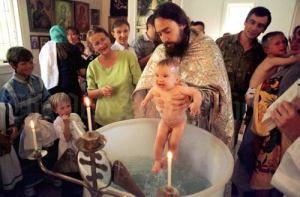
Orthodox Baptism
Martin wrote:
I have a question. Baptists and Pentecostals say infant baptism is not biblical. Do we find infant baptisms in the Bible? I heard someone say that this practice started around year 200. Where can I find the earliest teachings about infant baptism? When is the first time the early Fathers mentioned it? What does the Orthodox Church teach about this? How can a baby be “born again” with no personal faith before he/she has heard the Gospel being preached? Or what is the point of infant baptism? What difference is there between Catholic, Lutheran and Orthodox infant baptism?
My Response
You asked some very good questions about the rationale for infant baptism. I will attempt to answer each of your questions below but before I do so I need to discuss the role of Scripture in the various Christian traditions. But feel free to jump to Question 1.
For Protestants the Bible is the preeminent source of theology. This arises from the doctrine of sola scriptura (Scripture alone). But what does one do when Scripture is silent or the biblical text is not clear? Protestants respond to this ambiguity in several ways: (1) some will argue that this makes the practice unbiblical and thus prohibited; (2) some will argue that this is a matter of liberty subject to personal opinion or conscience, and (3) some will attempt to rely on historical precedents to guide them. This accounts for the wide array, even contradictory, positions Protestants hold on baptism, including infant baptism.
Orthodoxy base its doctrines and practice on Tradition (with a capital ‘T’), a combination of oral tradition and written tradition (II Thessalonians 2:15). Orthodoxy also relies on Christ’s promise that the Holy Spirit would guide the Church into all truth (John 16:13). Thus, with respect to the Orthodox approach to infant baptism we find an ancient practice widely accepted that in time was formally acknowledged by the Ecumenical Councils.
In contrast to Orthodoxy’s conciliar approach to church authority, Roman Catholicism holds to a monarchical understanding of church authority. It views the Pope as having ultimate authority in matters of faith and practice. Thus, on matters where Scripture is silent the Pope speaks. This view stems from the understanding that the Pope is the successor to the Apostle Peter and thus has the ultimate authority to interpret Scripture and define Tradition. This monarchical understanding of the Bishop of Rome arose in the Middle Ages. Orthodoxy rejects this as a departure from the conciliar approach of the early Church. While it has roots in the early Church, the Great Schism of 1054 resulted in the Church of Rome going its own way. It began to adopt innovative teachings and practices that many found objectionable. This resulted in the Protestant Reformation. In order to counter the authority of the Pope, Luther and the other Reformers invoked the authority of Scripture. This led to sola scriptura as a foundational principle for Protestantism.
With this new theological method of sola scriptura, Tradition — oral tradition, the church fathers, and Ecumenical Councils — took on a subordinate position to Scripture. Orthodoxy rejects the Protestant subordination of Tradition to Scripture because it views written and oral tradition as two sides of the same coin, integral and inseparable to the other (II Thessalonians 2:15). Understanding these differences will help you understand how I put together my answer to your questions. In answering your questions I seek to show how Orthodoxy is at its core biblical in its doctrine and practice while also consistent with the early Church founded by the Apostles.
1. Do we find infant baptisms in the Bible?
A lot depends on the question we ask. If you ask a question the wrong way, you are quite likely to get an incorrect answer. If we take your question about infants as a starting point, we can extend it to adults, teenagers and elderly as well. Just as there is no teaching in the Bible in support of infant baptism so likewise there is no teaching in the Bible in support of teenagers or of senior citizens being baptized.
A better way to frame the question is to ask: What does the Bible teach about covenant initiation? We find throughout the Bible God establishing covenants (contracts) and people entering into a covenant relationship by means of a certain ritual act. In Genesis 17 God invites Abram to enter into a covenant via circumcision. What is the age span of those circumcised in Genesis 17? Anywhere from a new born male child eight days old (Genesis 17:12), a teenage boy (Ishmael was 13 years old at the time; see Genesis 16:16), to a male senior citizen (Abraham was 99 years old at the time; see Genesis 17:1).
When we look at Peter’s Pentecost Sermon we find some interesting teaching about covenant initiation. At the climax of the sermon Peter exhorts:
Repent and be baptized, every one of you, in the name of Jesus Christ for the forgiveness of your sins. And you will receive the gift of the Holy Spirit. The promise is for you and your children and for all who are far off—for all whom the Lord our God will call. (Acts 2:38-39: NIV, emphasis added)
The phrase “you and your children” implies both the adult listeners and their offspring. The Greek word for “offspring” (τεκνος, teknos) can include young children as well as those grownup. If we look at the opening quotation from Joel in Acts 2:17 Peter is describing those receiving the Holy Spirit broadly, not restrictively. Notice the language used: sons versus daughters, young men versus old men. In Peter’s Pentecost sermon water baptism is closely linked to Spirit baptism. The Orthodox Church maintains this linkage by administering Chrismation immediately following baptism.
Another element we need to take into consideration is the fact that the Bible teaches the salvation of families. Luke in his account of the conversion of the Philippian jailer wrote:
At that hour of the night the jailer took them and washed their wounds; then immediately he and all his family were baptized. The jailer brought them into his house and set a meal before them; he was filled with joy because he had come to believe in God—he and his whole family. (Acts 16:33-34; NIV, emphasis added)
The phrase “his whole family” can be read to include little children and infants. This emphasis on the family unit parallels the first Passover when the Israelites gathered in a home to celebrate a Passover meal (Exodus 12). The blood of the sacrificed lamb was smeared over the door of the house, not on individuals. This contrasts with the modern mindset that elevates the individual over the family, and which emphasizes individualized faith over believing together with others.
Baptism is the new circumcision. Just as circumcision was the rite of initiation into the old covenant, so likewise baptism is the rite of initiation into the new covenant founded by Christ on the Cross.
In him you were also circumcised, in the putting off of the sinful nature, not with a circumcision done by the hands of men but with the circumcision done by Christ, having been buried with him in baptism and raised with him through your faith in the power of God, who raised him from the dead. (Colossians 2:11-12; NIV)
Orthodoxy does not view the sacrament of baptism as magic. Rather, it understands baptism as making one part of God’s family. It is the responsibility of the parents and godparents to make sure the baptized child learn about Christ and the Christian way of life. In II Timothy 3:15 we learn that Timothy was exposed to the Old Testament at a very early age, from infancy. As the child grows up he or she will begin to make their own decisions and develop a lively personal faith in Christ. If there is “magic,” it is the powerful influence a loving and faith-filled environment at home and church will have on a child. One of the biggest threats to this model of Orthodox discipleship is a mindless nominalism in which people do church things because it is part of their ethnic heritage and are not able to give a reasoned response to youths asking questions about the doctrines and practices of the Church.
2. Where can I find the earliest teachings about infant baptism?
The thing to keep in mind is that the early church allowed for infant baptism, it did not mandate the baptizing of infants. It was a common practice among Christians and there was very little protests against it. Infant baptism became the standard practice with the conversion of entire people groups. When a ruler converted, he would be followed by his supporters and their entire families. It is also important to keep in mind that given the high mortality rates at the time many parents would seek to baptize their child especially if death was imminent.
An overview of the early church’s attitude towards infant baptism can be found in Jaroslav Pelikan’s The Emergence of the Christian Tradition (100-600), (pp. 290-292). The earliest mention of infant baptism was by Tertullian (c. 160-220) who voiced skepticism about the practice of baptizing infants. The renowned Alexandrian theologian, Origen (185-254), admitted infant baptism to be part of the church tradition going back to the Apostles even as he struggled to articulate a clear rationale for the practice. With the church father Cyprian (c. 200-258) we find infant baptism defended on the basis of original sin. Of the three sources mentioned here only Cyprian is regarded as a church father. J.N.D. Kelly in Early Christian Doctrines noted while the sacraments of baptism, chrismation, and the Eucharist were universally practiced in the early Church there was very little evidence of a systematic sacramental theology at the time of the fourth and fifth centuries (p. 422 ff.). This points to the sacraments and Liturgy preceding theology in the early Church.
Dating infant baptism to AD 200 is based on a restrictive reading of the evidence. The evidence is clear that the first mention of infant baptism took place circa 200 which means that its origin can be placed earlier than 200. Given Origen’s testimony that infant baptism has apostolic roots and the absence of contrary evidence, we can assume that infant baptism dates back to the early days of the church, even the Apostles. Given Christianity’s Jewish roots and the established practice of infant circumcision among Jews, it should be no big leap to infant baptism among Christians.
3. What does the Orthodox Church teach about this?
Orthodoxy accepts infant baptism as an ancient practice. For Orthodoxy the Ecumenical Councils comprise an important authority for faith and practice. We find in Canon 84 of the Quinisext Council (692) instructions on how to handle those who claimed to have been baptized as infants but unable to provide witnesses to support that claim—baptize them provisionally. Van Espen in his commentary on Canon 13 of the Council of Nicea (325) noted “that after baptism and confirmation, the Eucharist was given even to infants.” The implicit acceptance of infant baptism by the major church councils points to infant baptism being a widely accepted practice among Christians.
From the standpoint of church history infant baptism was an ancient practice accepted by the Eastern Orthodox, Roman Catholic, and Oriental Orthodox churches. It was even accepted by the mainstream Protestant churches: Lutheran, Reformed, and Anglican. But it was rejected by the radical Anabaptists then by the Baptists. In time it became popular among many Protestants, especially Evangelicals and Pentecostals. Thus, the strict credobaptist position which rejects paedobaptism is a doctrinal novelty that originated in the 1500s and marks a major departure from the historic Christian faith.
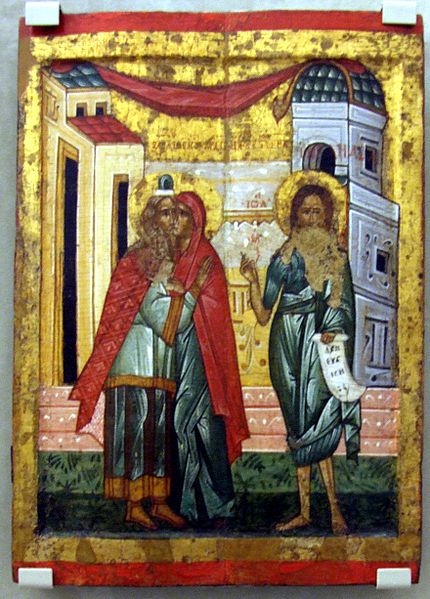
The Visitation Icon
4. How can a baby be “born again” with no personal faith before he/she has heard the Gospel being preached? Or what is the point of infant baptism?
This question defines faith in Christ narrowly in terms of an intellectual acceptance of certain precepts on who God is (God is loving and just), what human nature is like (sinful and fallen), what Christ has done for us (died on the Cross for our sins), and the expected response (saying the “sinners prayer” to receive Christ into your heart). This intellectual understanding of faith has resulted in certain branches of Protestants debating among themselves about the “age of accountability.”
Evangelicals have projected their subjective emotionalism into the phrase “born again.” Being “born again” is not an emotional experience as it is a new life in Christ. Once we were living life apart from Christ, but now we put our faith in Christ and come under his authority through baptism. In Genesis 17 when Abram entered into a covenant with Yahweh via circumcision, he took on a new name “Abraham” signifying his new life as a follower of Yahweh. Genesis 17 is about a change in relationship with God, it was not about Abram having an emotional “born again” experience.

“The baby leaped in her womb” (Luke 1:41)
If we look at what the Bible has to say about the spiritual capacity of young children the answer might surprise us. Luke reports that when the Virgin Mary entered into Elizabeth’s home and greeted her that the baby inside Elizabeth’s womb “leaped for joy.” (Luke 1:41, 44) John the Baptist’s pre-natal response to the presence of the Incarnate Logos points to our desire for God in the primordial core of our being. An infant may not have a fully developed intellect, but it possesses the ability to respond to love. This is because the ability to love and respond in love is foundational to our humanity. Faith as the ability to trust someone is critical to our being able to love another person. That is why the betrayal of trust is so damaging to our being able to love another. This relational approach to faith can be seen in Orthodoxy’s Holy Week services which mourn Judas’ betrayal of Christ. This is something I did not learn as a Protestant.
But what is Jesus’ attitude about the spiritual capacity of children? The incident of Jesus blessing the little children appears in all three synoptic Gospels. Where Matthew and Mark used the general term for children παιδιον (paidion), Luke used the more precise term βρεφος (brephos) which can mean infant and new born, and even unborn children.
But Jesus called the children to him and said, “Let the little children come to me, and do not hinder them, for the kingdom of God belongs to such as these. I tell you the truth, anyone who will not receive the kingdom of God like a little child will never enter it.” (Luke 18:16; NIV)
This incident contains a powerful lesson about the accessibility of the kingdom of God. It is for those who have an open heart like little children. It does not teach that the children should wait until they are old enough to understand before they can enter the kingdom of God. The phrase “enter the kingdom of God” is a synonym for entering into a covenant relationship with Christ. This phrase crops up in Jesus’ night conversation with Nicodemus (see John 3:5). Read in the larger context of the entire chapter Nicodemus’ conversation with Jesus in the first half of John 3 dovetails with the second half which describes how Jesus’ baptism was superseding that of John the Baptist. The message behind the need to be “born again” was not about an emotional spiritual experience but about a new life in Christ through the sacrament of baptism.
Our understanding of the spiritual capacity of children will be consequential for our understanding of their place in church. Because the sermon is the focal point of many Protestant worship services, many infants are sent off to the child care ministry. They are not expected to be in main worship service. It is by and large assumed that the main worship service is for adult members.
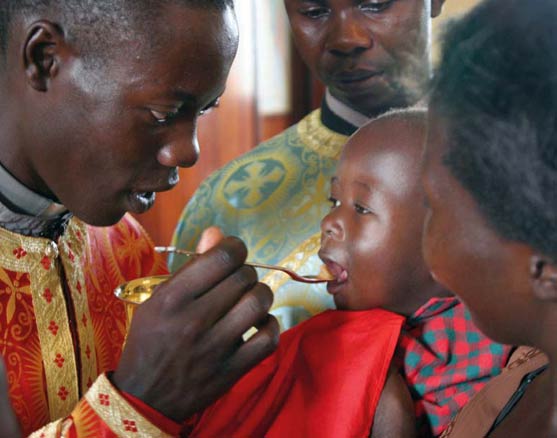
Baby receiving Holy Communion
In Orthodoxy the general understanding is that children, even young infants, belong in the Liturgy. They may not fully comprehend what is going on but they are in the presence of God. Orthodoxy believes this exposure is important for their spiritual growth. Furthermore, as a sign of their inclusion in the kingdom of God, children are given Holy Communion. The practice in many Orthodox parishes is to let the children go up first to receive Communion followed by the grownups. For me this stands in stark contrast to my Protestant experience where I would see parents go up to receive Communion while their children remained behind because they have not yet made a profession of faith.
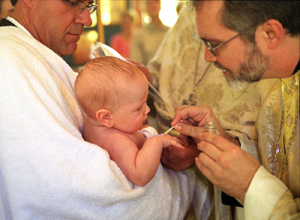
Sacrament of Chrismation (receiving the Holy Spirit)
5. What difference is there between Catholic, Lutheran and Orthodox infant baptism?
All three traditions baptize infants but the Roman Catholic and Lutheran churches tend to defer Confirmation and Communion until the child reaches a certain age. The practice in Orthodoxy is to baptize infants about a month after they are born, and to give them the sacraments of Chrismation and Holy Communion in the same service as baptism. This makes them full members of the Church.
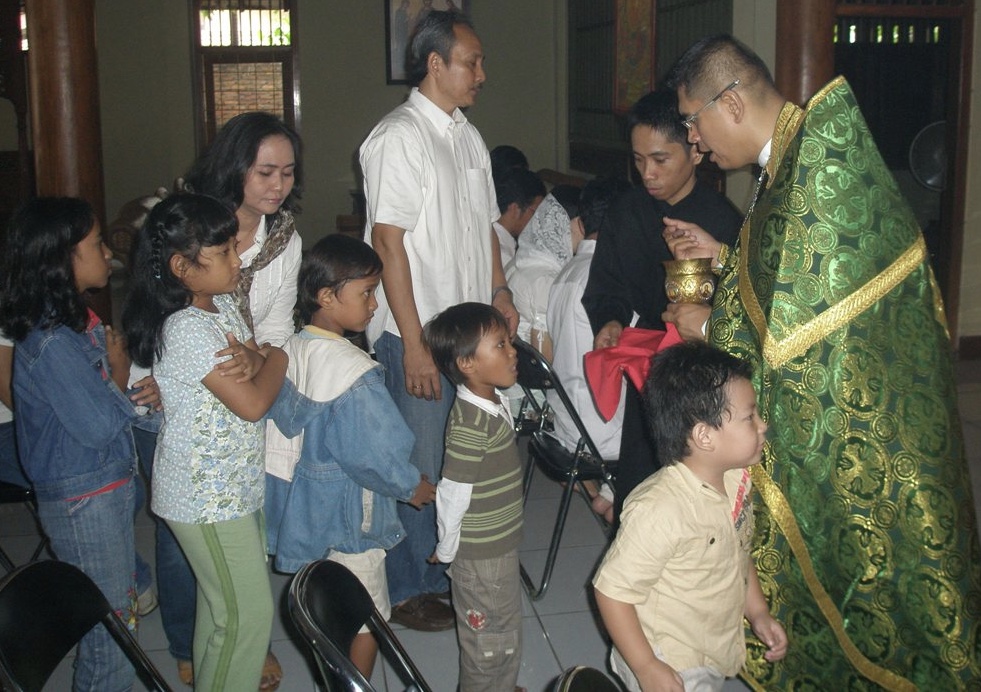
Children Receiving Communion in Indonesia
It is a touching sight to see parents carrying babies up for Communion, followed by a line of toddlers and teenagers, then adults and seniors. The demographics of a line for Orthodox Communion is something you won’t find in either Roman Catholic or Lutheran parishes Orthodoxy is for people of all ages!
Robert Arakaki
Robert,
Am i right that Catholics and Lutherans would also view the baptism of infants as having different theological effects than Orthodox? (i’m thinking here mainly of belief in Original sin–that infants are, in a sense, ‘barred’ from a relationship of God due to inherited guilt or blameworthiness, and baptism is needed to ‘fix’ this.)
And also, neither Catholics or Lutherans immerse infants, do they? –strictly sprinkling, yeah? Whereas Orthodox immerse, right?
–guy
Guy,
Great questions!
I’m quite familiar with the Orthodox, Reformed, and Evangelical theological traditions. But I’m less familiar with the finer points of the Roman Catholic and Lutheran traditions.
I would say that you hit the nail on the head with respect to the Western understanding of Original Sin and how it affects the Catholic and Lutheran understanding of baptism. With respect to how Catholics or Lutherans baptize infants I invite others from these traditions to share what they know. But you are right that the normal Orthodox practice is to immerse converts, whether infants or adult.
Robert
Broadly speaking, I would say that the “western” view is that infants should be baptized in order to remove Original Sin, whereas the Orthodox Church baptizes infants in order to unite them fully to Christ and make them a full member of His Body, the Church — they are sinless as babies, only inheriting “corruption” (i.e., mortality) from Adam.
The Oriental Orthodox Churches, like Coptic and Syriac orthodox Churches, believe that the baptism for infants is for both forgiving the first sin and being members in the body of Christ, i.e, the Church of our Lord.
The Text of praying of baptism in Coptic church announce that fact.
++ Pelagius heresy denied the original sin at all, and after him some people took intermediate situation by saying that we did not took the original sin itself, but only a certain bad nature.
++ Romans 5: 12, in its right translation from Greek and Latin and Coptic languages, say that all men sinned in him (Adam), and also Psalm 50: 5 (Or 51: 5 in Protestant versions) says that we are sinners since we started in The womb of our mothers.
+ The only man who did not inherit the original sin is our Lord because he came through a miracle not through the nature law, and that was the reason of that miracle, to be completely pure from any kind of sin, in order to give himself as a pure holy sacrifice to die instead of the hole world.
Makram,
Thank you for sharing with us your Oriental Orthodox tradition!
Robert
My Reformed church(CREC), which is paedobaptist, baptizes infants to bring them into the Covenant. I’ve not heard it referred to as ‘washing away original sin’. Actually, they way I’ve always heard it (growing up Anglican, now Reformed), it sounds more like the Orthodox understanding! Great article, btw!
PG,
One thing I appreciate about the Reformed tradition are the surprising similarities with Orthodoxy. Glad you liked the article.
Robert
The CREC is far from a bastion of “traditional” Reformed teaching, but nonetheless, there are numerous Reformed teachers that would intimate, following Augustine of Hippo (for example) that the Grace of Baptism washes away original sin.
Without the shedding of blood there is no remission for sin. Sola Scripture…what scripture claims the baptism washes away sin?
The reason for infant baptism in the Roman church was for collecting taxes!
Cheri,
You asked: “What Scripture claims the baptism washes away sin?” Please consider the following Scripture passages which I highlighted:
“Repent and be baptized, every one of you, in the name of Jesus Christ for the forgiveness of your sins.” (Acts 2:38; NIV)
“Repent, then, and turn to God, so that your sins may be wiped out. . . .” (Acts 3:19; NIV)
Through baptism we put our faith in Jesus Christ who died on the Cross for our sins.
You wrote that infant baptism was instituted for collecting taxes but gave no evidence for that claim. I would be interested to hear the evidence in support of your claim.
Robert
That is correct. Orthodox Baptize infants by triple immersion. The actual meaning of the word Baptize in Greek means to dip or immerse. As a matter of economy, we will receive a person Baptized by pouring or sprinkling by Chrismation, but by definition economy is a departure from the norm.
It seems that Tertullian rejected the established practice of infant baptism for different reasons than Baptists and Pentecostals. He was very rigorous about sins committed after baptism and even ended up leaving the Church because it was too lax for him. He suggested for baptism to be delayed at every age due to his rigorism. (See Tertullian’s On Baptism 18)
Good call on Tertullian. I wondered if any would mention him. I think both sides could appeal to Tertullian on this point. The Baptist/Pentecostals (since T. was in all effect a Pentecostal) have here a very early witness advocating a form of credobaptism. On the other hand, Tertullian was rejecting what he saw–infant baptism, which implies a very early date for infant baptism.
The mindset behind Tertullian, as you correctly noted, is the problem of post-baptismal sins. We even see this in Constantine and Augustine, though muted in the latter. I suppose one could examine the ontology and worldview behind such a presupposition.
One fine point on the Reformed view of Scripture relating to infant baptism: Reformed view the *inferences* drawn from Scripture as authoritative. Baptists, the smarter ones anyway, emphatically reject that point. Therefore, the Reformed can say they see infant baptism in the Bible because it is an inference.
The Anabaptists who were the first to reject infant Baptism, Baptists and Pentecostals do not believe in the Sacramental nature of Baptism. To them Baptism is only a kind of public profession of Faith and is not a means of grace. That is why they reject infant Baptism.
One must be very careful with Tertullian because he left the Church and embraced the heresy of Montanism.
Hi there! I have a question for you that’s somewhat unrelated to the post at hand (which is excellent) on infant baptism. You mention the heresy of Montanism. I thought the Montanists believed that the spirit of prophecy and other miracles continued in the Church, whereas the rest of the church wanted to say they ended with the apostles, a third century pentecostal vs cessationist debate. But surely this can’t be heresy, then. Can you explain Montanism? I’m an Anglican, for example, but I believe in prophecy in the church, and “eagerly desire the spiritual gifts, especially that you may prophecy” as Paul wrote, and I have experienced other supernatural gifts. Would that have made me a Montanist? Or were they saying something more that made them heretics? Thank you!
Dandler,
Welcome to the OrthodoxBridge! I hope Father John Morris will give you his response to your question.
One of the reasons why Montanism was considered heretical was because they believed that their prophetic utterances were superior to that of the bishops. Keep in mind that in the early days of the Church before there came to be the New Testament the Christians had to rely on the witness of the bishops who could pass on the teachings of the Apostles. In today’s terms it would be like a Pentecostal minister claiming that his prophetic utterances by “the Spirit” was equal to or superior to the Bible.
Orthodoxy is not cessationist. We believe that the Holy Spirit continues to work in the Church. Instances of what Pentecostals call prophecy or words of knowledge can be found in the lives of the saints. However, the presence of the Holy Spirit may not be as dramatic as some would expect. From my time in the charismatic renewal I would sense God’s presence in a special way and I experience the moving of the Holy Spirit today when I am at the Divine Liturgy on Sunday mornings.
Robert
{ I thought the Montanists believed that the spirit of prophecy and other miracles continued in the Church}
Who denies the continue of the acts of the Holy Spirit forever!!!
Our Lord said that the miracles will continue with the believers forever.
But the problem is that some persons made false miracles and say false prophecies.
It is alike what happened in OT, as Sadakia, the false prophet, who Hit the prophet Micah on his mouth 2Kings 18: 23.
Also our Lord warned us from false prophets, and also false teachers.
about refusing giving that grace to the children, fearing that some of them may not maintain it after growing up, is un logic and also against the plane of God.
1- it is un logic, because if we follow that rule in every thing concerning children, we will prevent them from getting any good chance, because they may not keep it, we shall prevent good food because they may become ill or weak, we shall prevent education because they may fall in it, we shall prevent even love because they may replay it later in bad way! So it is un logic to prevent so important thing because they may not keep it, especially if we really love them. I think that Tertullian was not having any love or mercy towards children, because it is not the way of thinking of any father towards his own children.
2- And it is against the plane and the will of our very kind God, because he said: let children come to me and do not prevent them!!! so how that man wanted to prevent children from their God who loves them and wants them to come to Him!!! and how they can come to Him if that man wants them to be away from Him, that man who wants to put a big gap between them and the Lord!!! Is that man really loves our Lord who wants children to come to Him and not prevented!!! I think that man did not love neither children nor the Lord.
And He -in OT- ordered to give the fleshy stamp of his people to the babies, what ever they maintain that gift or not, so how we prevent the holly soul stamp?
And He gave His gifts, and made His miracles, to all people, whatever they shall maintain it or not. He gave the food (bread and fish) to 5000 men, regardless they shall continue believing in Him or not, He made miracles to all people who ask Him, regardless they shall continue following Him or not, and He sent His disciples to teach all the people and baptism them, and they did it, giving baptism to all the family that their father believed, it is written that they gave baptism to all the family, not only for the grownup men and women.
+++ So, that man was not following the Lord, nor even the natural loving feelings towards our children, and all children.
The below is another good article the should be read after reading this great one of Robert’s we are commenting on:
http://thesobornost.org/2012/12/common-evangelical-objections-to-orthodoxy/
A Happy New Year 2013 to everybody, but, most important, a year with blessings from God, especially health!
When converting to Catholicism I was taught that removing the “stain” of original sin is the immediate effect of baptism at any age. If one has attained an age at which individual sin is possible, all past sins are forgiven without need for confession or any act of penance. After baptism, one must confess ones sins to and receive absolution from a priest if at all possible. In extraordinary circumstances (sudden death, e.g.) God forgives all who are truly penitent. I have no idea what Lutherans think or even if there is a uniform doctrine concerning baptism among them.
Sid Dhartha,
Thanks for sharing!
Robert
May I make a suggestion? There was a big controversy over infant Baptism among German Protestant scholars in the late 1950s/early 1960s, whether it was “biblical,” and, in any case, whether it should be continued today. The three principal works in this controversy, all of them rather short, have been translated into English, and are well worth perusing. They are:
*Infant Baptism in the First Four Centuries* by Joachim Jeremias; London, 1960: SCM Press Ltd. (112 pages)
*Did the Early Church Baptize Infants?* by Kurt Aland; London, 1962: SCM Press Ltd. (119 pages)
*The Origins of Infant Baptism: A further study in reply to Kurt Aland* by Joachim Jeremias; London, 1963: SCM Press Ltd. (91 pages)
Jeremias defends infant Baptism, and asserts that it is both primitive and apostolic; Aland that it was a later development, and ought to be discontinued by contemporary Protestants. Both men were German Lutheran pastors and theologians.
William,
Thank you for your suggestions! These are well respected Protestant scholars.
Robert
Whenever I hear Protestants criticize any non-Protestant understanding of baptism, I often hear them say that communions like RC/EO (and sometimes Lutherans) beleive in “baptismal regeneration” whereas they (and, they assert, the Bible) do not. By this I think they mean to avoid any sort of magical belief in baptism that divorces it from personal faith, as in “I’m baptized, now I’m a-goin’ to heaven”). I know the sacramental understanding of baptism is that is actually effectual for the removal and purification of sins…but even there, the EO understands that differently than the RC (with original sin, inherited guilt and the like). Does “baptismal regeneration” have meaning in Orthodoxy?
After all that babbling, I guess my question actually is “Do the Orthodox believe in baptismal regeneration, and if so, what exactly do they mean by it?”
I’ve been Orthodox for about 18 months but haven’t really studied baptism in great detail. I’m still much more familiar with the covenantal model of Presbyterians.
The short answer is yes, inasmuch as Orthodox baptism is a grace-filled sacrament (mystery) that really and truly connects the one baptized to Christ and His Church, Orthodox understand baptism as regeneration. However, we do not believe this is conveyed magically or mechanically, or that the mystery of baptism can be divorced from the whole mystery of Christ in His Church with all that this entails. Accordingly, Orthodoxy also teaches that ultimate salvation requires the ongoing exercise of faith on the part of the one baptized (at whatever level he or she may be capable of that). Christ’s teaching that one must become like a little child and to such “belongs the Kingdom of heaven” means that the personal trust of which an infant or young child is capable is the kind of faith that saves us. I believe also the Orthodox understanding of regeneration is different that that of Protestants. In one of his recent homilies, my Priest said that in holy baptism we are born again and each time we repent after we sin again, we are born again, again! In other words, regeneration in Orthodoxy is pretty much a synonym for being saved, which we understand as a process, “from glory to glory” if you will. Another synonym for being saved and regenerated is being “illumined.”
Bill,
You asked a very important question. I agree with Karen’s short answer, but I think your question merits a longer and more in-depth response. One could answer in the affirmative, but given the fact that Protestants understand salvation and the sacraments quite differently from the Orthodox the short answer could end up muddying the waters. I think it best if one first defines the terms before answering ‘yes’ or ‘no.’ I want to give an answer that will advance communication and understanding between Protestants and Orthodox Christians. I’m hoping to upload a posting based on your question shortly.
Robert
As Robert has wisely stated, this is a complicated question, given that various Protestants and the Orthodox Church can use the same terms, but mean very different things by them.
But the short answer is “Yes.” Even in the Baptismal service itself, the passage in Titus is referenced (“the washing of regeneration”).
Yes indeed, it is written that -in baptism- we die with Christ to rise up with him. So it is a new beginning for a new life, as it written also: the all became neu>
In oriental orthodox churches, we believe deeply in 7 sacraments, one of them is baptism. The word “sacrament “, does not mean those things which known from some people and hidden from others, but means the works of God in the Church, which are higher upon the mind of all people, they are similar to the sacrament of creating the world or creating a new living and seeing eyes to the man who was born blind.
The word: creating is also not as the unbelievers ancient Greek philosophies were saying, that the creating is only from nothing , and made by the 1st grade God, and the maker made from that material all the things, it is a false idea they made it to give reason for their belief of multi Gods. It is false because giving the life to the dead material is the real creation more than creating the dead material, because the life is greater than the dead things. So the lord created new living eyes from mud to the born blind -as I said before- and not just made new eyes from the mud. The later expression could be said if he made just the shape of eyes without life, like that of Statues!
Great Post! Thank you. What has impressed itself upon me more and more (having grown up in a more Baptist mindset) is Jesus’ words, “Let the little children come.” What started it for me is thinking about the Eucharist in terms of it being access to Jesus. What right do I have to keep my children from going to Jesus? And if Baptism precedes the Eucharist, then what right do I have to keep them from baptism? It reminds me of something Peter said in Acts 10-11 when the Holy Spirit came upon the gentiles for the first time – can anyone withhold the water of baptism from these people?
Prometheus,
I’m glad you liked the post! I’m currently working on another post dealing with the issue of baptismal regeneration.
Robert
I look forward to that one.
Great article.. However, I would have to ask: what is your evidence that the idea of the primacy of the Bishop of Rome (seat of Peter) was an innovation following the schism of 1054?
Both Eusebius and Augustine list the popes long before the 11th century.
In addition, Catholicism accepts the conciliar decisions. There is no incompatibility between the conciliar authority and the final (might I suggest “tie breaking”) authority of the pope.
Dan,
Welcome to the OrthodoxBridge! I do not deny the primacy of honor due to the Bishop of Rome. This was acknowledged by the First Ecumenical Council (Nicea 325) in Canon VI and the Second Ecumenical Council (Constantinople 381) Canon III. What Orthodoxy disputes is the Pope’s claim to supremacy. It is this claim to papal supremacy that we regard as an innovation.
With respect to your claim that Roman Catholicism is conciliar, I would have to respectfully disagree. Rome’s papal supremacy can be seen in its unilateral insertion of the filioque clause “an the Son” into the Nicene Creed. By doing so apart from an ecumenical council the Pope effectively claimed an authority equal to or superior to an ecumenical council. If the Pope were to admit that the filioque clause lacks conciliar authority and if he were to restore the original version of the Niceno-Constantinopolitan Creed to the Sunday Mass, a major impeditment to reunion would be removed.
Robert
A man (I assume he is reformed) made the following comments in a discussion we are having with regards to Justin and the Didache on baptism. I to have similar questions. I think the foundational question is how we view authority.
“why does the Didache and Justin seem to totally exclude baptism of infants by referring to prayer and fasting of candidates prior to it and to it being by immersion?
Justins comments suggest he knew nothing of infant baptism in the Christian community whom he is writing about in defense. His comments concerning children of choice contradict any current practice of infant baptism.
Origen claimed a lot of things was it a case of “weak point – shout” as in a famous quote of a speech in the house of commons?”
My comment to him was as follows,
“I agree, Justin is far more authoritative than Origen.
Justin appears to be talking to those who can entreat God and those who can fast, however, arguing from silence doesnt make infant baptism either true or false.
The councils are under inspiration of the Spirit and are representative of the Tradition passed down by the apostles, so, in 325AD we have a clear approval of infant baptism, “that after baptism and confirmation, the Eucharist was given even to infants.”
The issue isnt, why Justin didnt explain infant baptism or why Turtullian was opposed to it but why the Council upheld it and made it doctrine for the church.”
Immersion clearly does not exclude infant baptism since Orthodox baptize by immersion (or rather triple immersion), yet they baptize infants. Arguing against the practice based on Justin Martyr’s writings is pretty weak, when it’s clear the practice existed around that time (i.e. Tertullian). So yes, I would agree with your conclusion, credobaptists need to explain why
1. Nobody clearly teaches a credobaptist position in the early church. (Justin Martyr doesn’t mention infant baptism at all, so it’s a stretch to use him as support and Tertullian doesn’t take a creadobaptist position in his opposition to pedobaptism).
2. There is wide acceptance of the practice in the early Church, so much so that the Counsel upheld the practice.
I do not poses the knowledge to speak to this but thought you might, if you want to reply,
http://heidelblog.net/2013/10/the-didache-on-the-baptism-of-converts/?replytocom=200956#respond
“Travis, my first reply to you is awaiting moderation, but I must add that I don’t see the logic behind your second paragraph. I said that I suspected the Didache to be a Montanist document, and the Montanists were around well before 325 AD.
Also, regarding your reference to Origen in your later post, can you give evidence (Quotation of source and defining context will suffice – I don’t at the moment have access to even a translation of what Origen actually wrote, let alone the original Greek) that it was specifically infants to which he was referring, rather than minors in general (In Greek that would be the difference between brephos and pais, but I suspect that all that has survived may be Latin translation(s))?
What I’m going to write now isn’t going to support a case against infant baptism, but I must not suppress it for that reason: If the Didache were a Montanist document and its authors did not practice infant baptism, this and Tertullian’s skepticism about the practice might be related, since Tertullian was, at least for a time, allied to the Montanists.”
Some important sum up of Infant Baptism
Infant baptism has been the normal practice of Christians throughout the entirety of the Christian era, from the early church up to the present time. It is still the practice today among Eastern Orthodox, Roman Catholics, and most Protestant denominations. It was never a controversial or debated issue until about 1525, when those in the “Anabaptist” movement rejected infant baptism and began re-baptizing each other, viewing their infant baptisms as invalid.
(It is interesting to note that there is a political twist to the story: infant baptism was used by the secular government for tax registration, so this may have been a tax protest in disguise! If Christians had not allowed Caesar to meddle in the affairs of the church, perhaps we would not have the controversy over infant baptism today.)
One of the arguments used against infant baptism is that it is not referred to in Scripture — that is true. But there is also no mention in Scripture of the practice of Christian parents waiting to baptize their children until they are older.
Although infant baptism is not mentioned explicitly in Scripture, there are hints of it in several passages that record the baptism of a whole “household,” which may have included children and infants:
“… she [Lydia] and the members of her household were baptized…”
(Acts 16:15)
“… immediately he [the jailer] and all his family were baptized.”
(Acts 16:33)
“… I [the apostle Paul] also baptized the household of Stephanas…”
(I Corinthians 1:16)
Peter replied, “Repent and be baptized, every one of you, in the name of Jesus Christ for the forgiveness of your sins. And you will receive the gift of the Holy Spirit. The promise is for you and your children…” (Acts 2:38-39)
The earliest explicit reference to child or infant baptism is in the Apostolic Tradition of Hippolytus, about 215 A.D.:
“Baptize first the children, and if they can speak for themselves let them do so. Otherwise, let their parents or other relatives speak for them.” (Hippolytus, Apostolic Tradition 21:15, c. 215 A.D.)
Martin Luther and John Calvin, the two primary founders of the Protestant Reformation, both believed in infant baptism:
Of the baptism of children we hold that children ought to be baptized. For they belong to the promised redemption made through Christ, and the Church should administer it to them. (Martin Luther, The Smalcald Articles, Article V: Of Baptism, 1537)
“If, by baptism, Christ intends to attest the ablution by which he cleanses his Church, it would seem not equitable to deny this attestation to infants, who are justly deemed part of the Church, seeing they are called heirs of the heavenly kingdom.” (John Calvin, Institutes of the Christian Religion, 1559)
http://www.ephesus.com/Orthodox/InfantBaptism.html
Welcome to the OrthodoxBridge! Thanks for sharing this.
Robert
Thank you. This is important stuff. It actually provokes an emotional response in me. I’m a Christian who currently belongs to the Anglican tradition; have spent time in the Pentecostal tradition; and have had our 8 children infant baptised, given communion all their life and have refused to send them to Sunday School. They are aged 27-7 and all still continue as Christians. God’s grace has been huge to us. But I see many other Christians whose children leave the faith, so I’m always asking what’s Biblical. Obviously I needed to know the Orthodox tradition better so that I didn’t feel so alone.
Diane,
Thank you for visiting the OrthodoxBridge! Please continue to learn about Orthodoxy. If you can please visit an Orthodox Sunday service.
We wish God’s blessings as you continue to teach your children to walk in the way of the Lord. To God be the glory!
Robert
Dear Robert,
Amen!
Perhaps the best papers I have ever read on this interesting question. Concise, complete and easy to understand!
I myself was baptized at birth, as were my kids, so you can imagine how my view on this subject are 🙂
Thanks so much and Blessings in Christ to you and all of yours,
Angus
Angus,
Thank you for visiting the OrthodoxBridge! Please continue to learn about the Orthodox Church and what it teaches.
Wishing you a blessed Advent!
Robert