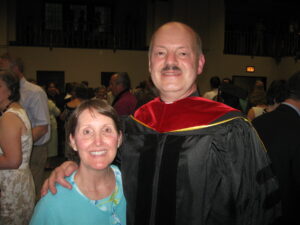
Fr. Isaiah and Beth Gillette
Folks, I invited Fr. Isaiah to write this blog posting for couples. I met Fr. Isaiah when he was stationed at Schofield Army Barracks in Hawaii. He is currently stationed at Ft. Riley, Kansas. He serves under Bishop Basil, Diocese of Wichita and Mid-America, Antiochian Orthodox Christian Archdiocese. Robert
I wish to write briefly about the importance of husbands, on the way to Orthodoxy, to be patient with reluctant wives, to love them unconditionally, pray fervently, and demonstrate the positive and life-changing influence of the Orthodox faith in their lives. I would now also like to say something about helping wives understand something about the reason for seeking such a change. The acceptance of the Orthodox Church can be seen as the fulfillment of the road we are already on.
My wife and I converted to the Orthodox faith in 1991, after several years of searching. We were both raised in the evangelical wing of the United Methodist Church, and met at Asbury College. After attending Asbury Theological Seminary, I went on to serve as a pastor in United Methodist churches for 11 years. During that time, we proudly identified ourselves as evangelicals; it was our commitment to an evangelical view of Scripture and the historic teachings of the Church that eventually led us to search for a home in historic Orthodoxy.
It was shortly after we left the United Methodist Church, during our first few weeks as Orthodox catechumens, that a conversation took place after the Liturgy. One of our new Orthodox friends was asking us some questions about our life, back “…when you used to be evangelicals.” In the car on the way home, my wife asked me, “When did we stop being evangelicals?” We talked through the idea that terms mean different things in different contexts. To us, “evangelical” had always meant the opposite of “liberal,” with reference to our conservative theological commitments. Thus, our movement to Orthodoxy was the fulfillment of our evangelicalism. But to our Orthodox friend, “evangelical” meant “Protestant,” as it does in Europe, where you can be “evangelische” and still be as liberal as the day is long. Thus, to someone with a more European outlook, our coming to Orthodoxy was a leaving behind of evangelicalism.
This was an important conversation for my wife and me. It served to emphasize that, even though we were entering a new world, our entry to Orthodoxy did not represent the abandoning of everything we had believed in. Rather, we were following our hearts, and God’s call, to live our evangelical faith to its logical fulfillment. There is a balance, in the Gospel, between continuity and discontinuity. Christ, who said, “Behold, I make all things new,” also told His disciples that He did not come to destroy the Law, but to fulfill it.
For all of those considering the Orthodox Church, there is something about their spiritual quest, for which Orthodoxy is the fulfillment. For many modern Roman Catholics, for example, the Roman church is not Catholic enough. Coming to Orthodoxy, for them, is a returning to the ancient Catholic faith, to a Church more like the one their grandparents knew. It is the fulfillment of their Catholicism, not its negation. Much the same could be said of those coming from the Anglican tradition. To be sure, there are great differences which need to be dealt with, doctrines and practices which need to be brought into line with Orthodox theology and ecclesiology.
For those like my wife and me, coming from Protestantism, the continuity and fulfillment experienced in the move to Orthodoxy have more to do with finding an unchanging Church, faithful to Scripture and the teaching of the Apostles, after being set adrift by ever-changing social policies and make-it-up-as-you-go doctrine. We were delighted to find so many direct links between the Church of the New Testament and the Orthodox Church; not just Apostolic Succession, but the apostolic faith and practice, here and now.
As I work with new converts, both enthusiastic and reluctant, I find it most useful to find out where they are coming from, on this spiritual quest, and build on the strengths already there. Enthusiastic husbands with hesitant wives should first appreciate their wives’ hesitation. Reluctance to jump ship is a good thing! Gently and patiently help her to see that this move is in the direction of truth (the Truth), faithfulness, authentic worship, deeper spirituality, and life-long transformation in the likeness of Christ. In other words, what she is longing for. Tell her what it is that excites you about Orthodoxy. Most of all, this move must be a movement toward something, not just away from something.

Couple on Bridge – New York
I hope in another installment to give some more practical advice, about when and how to adopt Orthodox practices into the home.
For that, it would be good to have some input from guys who have made this journey with their families. How did you handle the sign of the cross, a prayer corner, prayers at meals, attendance at Orthodox worship services, etc., while you were still on the way?
The blessing of the Lord and His mercy!
Fr. Isaiah Gillette
See also:
Father Isaiah Gillette “Family Concerns and Converting to Orthodoxy”
Frederica Mathewes-Green “In the Passenger Seat”
Great post, thanks! I would love to see a post addressing convert wives with husbands, who have remained Evangelical. Here, it seems to me, are some unique challenges.
I’m glad you liked Fr. Isaiah’s post! I asked him to write this because I have been in conversation with several Protestant men who have a desire to become Orthodox but whose wives are been reluctant to make the change. I don’t know of any convert wives whose husbands have remained Evangelical. But I would like to hear from them also.
Folks, feel free to share your experience about your journey to Orthodoxy and your spouse’s reaction. I’m interested in hearing of your struggles and challenges, and what you found helpful and practical. Fr. Isaiah has considerable pastoral and counseling experience so he can offer wise counsel on this. This is your chance to ask him for advice on this important topic.
Robert
Thanks, Robert. Well, I’m one of those wives. I converted (with my husband’s assent) without the rest of my family. My husband is quite happy in his (our former) Evangelical church where we met. (Our situation is further complicated by the fact that my husband, as a result of some extremely bad experiences from earlier in his life, is averse to doctrinal debate and discussion.) I suspect my case is a bit of an exception to the rule, though. It’s probably more common that Orthodox-raised women sometimes marry Christians from other confessions and end up in a mixed situation that way. At least, I know that’s true of some of the women in my parish–some of whose husbands also attend with them (as does my family–we alternate churches every other Sunday) and some whose husbands do not. In either case, we need some counsel, too (though some of this post does generalize).
If you or your friends have a question for Fr. Isaiah this is your chance to ask. Just write a comment with a question for Fr. Isaiah and he would be happy to answer.
Robert
I’m a little late to the party, but I’m in the same boat as ofgrace — a wife drawn to Orthodoxy with a husband who isn’t (yet). It’s a little…overwhelming?…to make this journey alone, but I choose to see it as my just being a few steps ahead of him for now.
Dear Bonnie,
Welcome to the OrthodoxBridge! May God give you wisdom, patience, and charity as you wait for your husband.
Robert
I am also one of those wives. My husband loves our ICoC family (as do I) that we have been a part of for over 20 years. We met and married there, our children know nothing else, and our teen son just got baptized. Additionally, it looks like the church family of about 600 is finally going to purchase a building after 25 years of renting various spaces, and it’s 15 minutes closer to our home (we’ve traveled 45 minutes each way the entire time in order to attend, sometimes longer). Our teen kids love our church family — missing a youth activity is practically unthinkable for them. To further complicate matters, my husband greatly admires the humble, servant-leader we currently have in our new lead evangelist (this after enduring several evangelists over the years, who, shall we say, seemed to crave the veneration and spotlight associated with their positions). This lead couple has carefully listened to and inspired the whole body, one person at a time, and I think they may be the finest leaders we’ve ever had, and I’ve personally been dreaming of a home church kitchen for years! (I’m such a girl, I know.) But… For five or so years, I’ve grown more and more restless. I see our worship as shallow. We venerate men who preach more than Christ, I think. I’ve had it with the self-help styled women’s “devotionals”more focused on relief than true healing, and I cannot bear another rock star stage performance on Sunday morning that allows the performer “to use their gifts for God.” I am just an audience member on Sundays rather than a participant. I crave true worship. I crave depth. Studying the ancient church, church history, the ecumenical councils, and finally attending a Divine Liturgy loosened my grip on Protestantism. Letting go of sola scriptura (painful process, that) was the final untethering. After that point, I was undone. My timing is the absolute pits. I have to go, but I will be praying that my wonderful husband and children will join me. My husband is very sad about this, but he has given me his permission to see where this all leads, and has agreed to read Bishop Ware’s The Way (that is huge — my husband has a powerful bias against Catholicisn, and so by default, Orthodoxy as well). I thank you for sharing your blog articles. They have been a blessing.
Dear Navicula,
Thank you for sharing your story with us. For many of us the transition to Orthodoxy has not been an easy one but we feel truly blest to have found the ancient Faith that Christ taught the Apostles. I’ll be praying for you and your family. A word of advice take it slowly. Get to know the Orthodox approach to worship and the Orthodox way of life. Get to know the local parish priest and to the degree you feel comfortable let the priest become your spiritual guide.
Robert
Hey Navicula,
My heart goes out to you as I’m in a similar situation with
a devout Reformed family…wonderful HS sweetheart wife
with our eight children. They’re all grown and still love the
Reformed faith we raise them in…5 of eight still at the
home local church here…3 moved away. I was chrismated
& received into the Orthodox Church (after about 3.8 yrs reading/attending) this past Holy Saturday…much to the
unhappiness of my wife and kids. I will pray for your family
as I do mine…please do remember mine in your prayers
for yours. [Robert is right advising you to take things slow.
The Orthodox Church is the true Church, founded by Christ
and the Apostles via the Holy Spirit. It is a multi-facited glorious place for healing and maturity. However…it is full
of sinners (like us) and is often a mess and anything but
perfect. Lord have mercy.
Thanks for the great encouragement. Being the one who has a habit of chasing squirrels sometimes it is good that my wife is a bit more reticent. I am glad to hear that we are not alone in our wrestling with truth.
Brendan,
Welcome to the OrthodoxBridge! And thanks for sharing your experience with us.
Robert
The problem that often arises is with respect to children. For many that understand that “protestant evangelicalism” differs from Christianity at least as much as Jehovahs Witnesses or Mormonism (in the former case the differences are probably moot; in the latter they seem to be matters of degree), it may indeed be one to allow the spouse to find God on whatever terms He allows. St Paul forbids separation on the grounds of a foreign religion. However parents have a responsibility for their children – dare I say an accountability – Father what advice do you have for a Christian father whose spouse is adamant on steering the children away from Christ’s Holy Church?
Dear Anon,
Good question. I will pass on your question to Fr. Isaiah.
Robert
Fr. Isaiah,
I have a friend who described Orthodoxy as the elephant in the room for him and his wife. He’s strongly leaning towards Orthodoxy but his wife doesn’t want to talk about it. What advice do you have for them?
Robert
Chaplain Gillette, Ran into you tonight, so to speak, while reading on the blogs. Hope you are well. Fond memories of your service at Camp Casey.
v/r
David Acuff
Robert, I found this post because I was searching for topics on Orthodox men with Protesrant wives. I am currently Protestant as is my wife. I’m a born again believer as of 2004 and a member of a local Baptist church. Several years ago I started attending (part-time) a Seminary in my community because I felt I needed something more in my Christian walk. I felt as though something was missing and that perhaps this formal education was the answer. After three years, I had more questions than answers, which wasn’t necessarily a bad thing. I still felt an emptiness is my Christian life but couldn’t identify why. My wife suggested that my prayer life was lacking. Probably some truth there. However, I really couldn’t identify where the emptiness was coming from.
One Saturday afternoon, the wife an I decided to attend the local Greek festival put on my the Greek Orthodox Church. We took a tour of the nave and had a one on one with the priest. The icons, Mary theotokos, the apolostic succession, all those things were very interesting to me, especially the Eucharist .
Over the next several years, I met with the priest, attended some services and have read many books on Orhodoxy and Orthodox theology. The first several services I attended felt very foreign to me. I didn’t like it, but at the same time there was this mystery that I felt I had to explore further. I remember driving home from work one day asking myself why, what is it about this church? One word popped into my head, HOME. I don’t know why because everything seemed so foreign to me, but, it felt like home.
I can’t talk about it to my wife or any of my Protestant brothers because they won’t understand. I would love to convert to Orthodoxy so that I can experience the fullness of the faith but my wife is not on board. In fact, she really won’t listen at all. She’s been baptist her whole life and holds to the teaching familiar to the Protestant evangelical. I try, very carefully, to talk about things comparing and contrasting Protestantism and Orthodoxy. I talk about the Eucharist. She told the priest one time that she believed the bread and wine to be the body and blood of The Lord. I thought to myself , why are you Protestant? She has problems with icons, Mary, Mary’s ever virginity and see things happening in the church as ritual. I understand, I see the big picture but she doesn’t seem willing to discover truth. She’s content where she is at. For me, it is very difficult because I feel like I’m just going through the motions in my baptist church. I can’t take communion anymore because I long for the Eucharist. I bite my tongue when the pastor talks about Jesus’ brothers, siblings.
Any suggestions would be much welcomed and appreciated .
Larry,
Welcome to the OrthodoxBridge! I appreciate your heartfelt account of your situation. The main thing is to love God and love your wife. In your prayers commit your situation to God’s mercy and wisdom. This time of trial can result in greater patience and spiritual maturity.
One way to look at the situation is to assess how it is affecting you and your wife (and I’m guessing your family) spiritual wellbeing. Waiting can result in a couple entering Orthodoxy together. But then there may be situations where one spouse moves ahead into Orthodoxy while the other spouse remains where they are. This is not ideal but could be a possibility if the other spouse supports this. These are more suggestions than advice. In any case please listen to the local Orthodox priest. Even if you are not Orthodox perhaps you can come under his spiritual direction?
You are not alone in this. I’m thinking that perhaps someone should start up a Facebook group for people like you where they can share their experience and learn from each other. Anyone out there willing to do this?
Robert
I have been drawn to Orthodoxy over the last couple of years and have increased my reading of the subject and watched numerous videos. I feel as though I already have crossed the line in my heart even though I have only attended 3 services -one of which happened to be for the Archangel Michael (my name also). As Larry Champion said in a previous post it is exactly like coming home. It has touched me so deeply that I already am thinking of myself in terms of being Orthodox, which may seem peculiar as I am barely started.
I truly see that something is amiss in my experience of the non-demoninational church I have been attending with my wife and son. I am delicately negotiating the bridge as my wife does not yet grasp my love for Orthodoxy. Meanwhile, I grapple with the doctrinal irregularities and aversion to Tradition that are routinely expressed within the reformed ‘tradition’. I pray to one day make the transition fully with my wife. It could be a long story but I write initially to show my appreciation for the post and to thank the contributors for their encouragement.
Dear Michael,
Thank you for writing! Keep talking with us and with other Orthodox Christians. May the day come soon when you and your wife come home together!
Robert
Was there ever the follow up article to this? I too am on the journey with a wife and kids who are not even remotely interested. I want to be an example of following Christ to them and leading us to the fullness of the faith but don’t quite know how. Yes, I pray and am patient (at least trying) as we attend a Baptist church (I’m even trying to say positive things about the services with out being too snarky 😜). I’d love to see how others have traversed these waters with regards to prayer corners, family/meal prayers etc.
Mark,
I think that’s a good idea. I will ask around and see if I can find someone to write a follow up article. You might find Frederica Mathewes-Green’s article: “In the Passenger Seat” helpful.
Robert
I realize this is an older article – I first wanted to let you know your link to Father Isaiah Gillette “Family Concerns and Converting to Orthodoxy” is broken, but I did search and find it.
I’m casually looking for information as well. I’m in my third year in the Orthodox Church, and my husband is staunchly holding onto a quasi-Reformed-Baptist background, though dabbling a bit in conservative Pentecostalism. He is also very anti-Catholic, and sees the Orthodox Church through the same lens. And often gets agitated if I speak of spiritual matters. It is an absolute no-no for me to discuss anything distinctly Orthodox.
Slowly, though, there are tiny windows that open. I won’t say we are making “progress” – I am not really sure of the overall effect of the occasional softening + re-hardening that goes on. But he does notice when I am able to actively love him in a way I did nit manage to do before. He was surprised (as was I!) that I managed to keep the fast of a Great Lent, with little fuss or fanfare or outward difficulty, even in spite of him sometimes teasing me and deliberately tempting me. He notices that I relate differently to him, with a higher and more mature level of honesty and compassion, which in a way demands his relations with me change a bit at the same time. I’ve also recently received a serious medical diagnosis, and he is impressed with how I am handling that. I only wish I could correct all of the ways I fall short, but it don’t think I have the physical energy.
I don’t know what the outcome will be. I pray for him, and for my daughter, who I raised in my former traditions as well. And I don’t cross myself in front of him, or venerate icons, though I have a couple in the living room. The rest are in my daughter’s old room, and if I go in there to pray, I close the door. There are still difficulties, but overall we relate much better to one another than we once did. I have found patience and prayer to be the only way to handle things, and I hope the changes in myself will eventually mean something to him.
I can still use help and guidance myself, if any were available. But I am trying day by day to work on myself. That and prayer seem to be the only things that make any difference in my case.
Thank you for the article. 🙂
Anastasia,
Thank you for sharing with us. May God’s kindness and mercy be with you and your family!
BTW, I fixed the broken link.
Robert